The OSI Model vs. Reality
Why is this Networking meme funny?
Level 1: All Zero, Not Each Other
Imagine you have an empty box, a card with “0” written on it, and a blank slip of paper that only has a little whitespace on it. Each of these is a different thing, but in their own way they all represent “nothing” or zero. If you ask each one “Do you mean zero?” they’d all say yes: the empty box has 0 items in it, the card literally says 0, and the blank slip can be taken as “nothing here” (which we interpret as zero). But now if you compare the items to each other, it gets silly. The empty box is clearly not the same as the card with "0" on it, and that card isn’t the same as the blank paper either. So even though each one individually can mean zero, none of them matches each other directly. That’s exactly what’s going on in the joke: in JavaScript, an empty array, the string "0", and a tab character all count as zero when you check them that way, but they’re not the same as one another. It’s a funny, mind-bending quirk — kind of like a little riddle where everything equals zero but doesn’t equal everything else!
Level 2: The == vs === Saga
For those newer to JavaScript, let’s break down what’s happening in this meme. JavaScript has two ways to compare for equality: loose equality (the double equals operator ==) and strict equality (the triple equals operator ===). The difference is all about type coercion. Type coercion means JavaScript will automatically convert one value’s type to match the other’s type when using ==. It tries to be helpful (or “loose”) by saying, “If these two things aren’t the same type, I’ll coerce one to the other’s type and then compare.” In contrast, === (strict equality) does no conversion at all – the two things must already be the same type and value to be considered equal.
Now, the meme gives a comical example of where == leads to weird results. We have three very different-looking values:
[]– an empty array. In JavaScript an array is actually a kind of object."0"– a string containing the character 0."\t"– a string containing just a tab whitespace character (like pressing the Tab key).
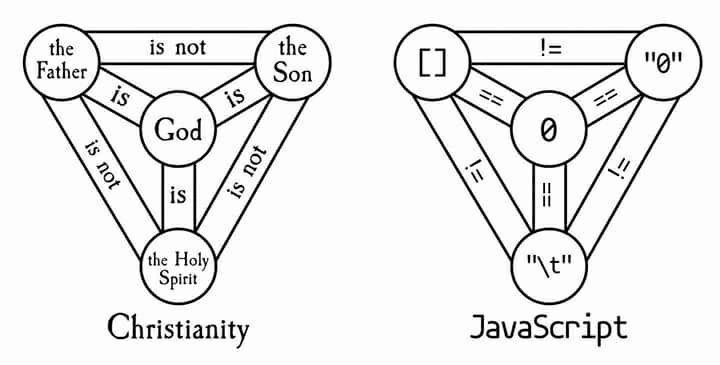
The diagram says under JavaScript’s rules, each of these is equal (==) to the number 0, but none of them is equal to each other. How is that possible?
Here’s how loose equality works in each case:
- When you do
[] == 0, JavaScript sees an object on one side and a number on the other. For==, it will convert the object to a primitive value. An empty array[]turns into an empty string""when converted (because when you try to represent an array as text, you get the list of its elements – here there are none, so it’s just""). Next, it compares""to0. One is a string, one is a number, so it converts the string""to a number.Number("")becomes 0 (empty string is treated as 0). Now we have0 == 0, which is true. So indeed,[] == 0is true. "0" == 0is a simpler case: one side is a string, the other a number. JavaScript will convert the string"0"to a number. The numeric value of the string "0" is 0. Then it compares 0 to 0, which is true. So"0" == 0is true as well."\t" == 0again has a string on one side and number on the other."\t"is a string that just has a tab in it. When converting that string to a number, JavaScript first ignores any whitespace at the start or end. A tab is whitespace, and in this string there’s nothing else. So effectively it becomes an empty string""after trimming, which then becomes 0 as a number. So we get 0 == 0, true again! Thus,"\t" == 0is true.
So individually, each of those comparisons returns true. Each of [], "0", and "\t" independently acts like zero when compared loosely. But what if we compare these weird values to each other with ==? This is where things flip:
- Compare
[]and"0"with==. As before,[]becomes"". Now we’re comparing"" == "0"(two strings). JavaScript sees two strings and just compares them directly, character by character. An empty string is not the same sequence of characters as"0". So"" == "0"is false, meaning[] == "0"ends up false. In the diagram, that’s why the link between[]and"0"is labeled!=(not equal). "0" == "\t": Now both sides are strings from the start. One is the string "0", the other is a string with a tab. JavaScript doesn’t need to convert types because both are already strings. It just checks if the two strings are identical. They’re not (one has the character '0', the other has a tab character), so this is false as well. Thus"0" != "\t".[] == "\t": On one side an object (array) and the other a string. The array[]becomes""again. So we have"" == "\t". Both are strings now. One is empty, the other is a tab. They’re not the same characters, so it’s false. So[] != "\t".
We’ve confirmed what the meme diagram shows: in loose equality terms, each of the three is equal to 0, but none is equal to each other. It’s like a little triangle of strange relationships, exactly paralleling the Trinity chart structure. This is a famous quirk in JavaScript’s equality logic — something that often surprises beginners. In everyday thinking (and in most programming languages), if A equals B and B equals C, we expect A equals C. But JavaScript’s == breaks that expectation because of how it converts types differently depending on what you’re comparing.
Many JavaScript learners run into these odd results and get confused. This is one big reason why mentors and style guides will tell you: “Always use === (strict equality) unless you really know what you’re doing with ==.” With strict equality, no type conversion happens. The comparisons above under === would all simply be false, which is a lot more straightforward. For example, [] === 0 is false because an array and a number are different types, period. So if you stick with ===, you avoid this whole coercion circus.
The humor here comes from equating these wonky JavaScript rules to something as complex and famously non-intuitive as theology. It’s poking fun at how esoteric JavaScript’s design can be. The “== vs === wars” mentioned are the debates in the developer community over using loose equality at all. Seasoned devs often share tables of bizarre == results (commonly called “JavaScript WTF” examples) – this meme specifically pulls out one of the most head-scratching patterns and gives it a holy parody. If you’ve ever been baffled by why "" == 0 or [] == false is true, this meme is a light-hearted way of saying “Yeah, it’s crazy – you practically need a PhD (or a sermon) to justify it!” It’s both a jest and a lesson: JavaScript’s type coercion can lead to 'religiously' weird results, so be careful with ==.
console.log([] == 0); // true -> empty array becomes "" then 0
console.log("0" == 0); // true -> "0" as number is 0
console.log("\t" == 0); // true -> "\t" trimmed to "" becomes 0
console.log([] == "0"); // false -> [] becomes "", "" is not "0"
console.log("0" == "\t"); // false -> "0" vs "\t", different strings
console.log([] == "\t"); // false -> [] becomes "", "" is not "\t"
Above is a quick demonstration in actual code. It prints out the result of each comparison we discussed, matching exactly what the Trinity parody shows. Crazy, right? The key terms here are loose equality (==), which allows type coercion, versus strict equality (===), which doesn’t. This meme is a playful warning about how loose equality in JavaScript can produce logically puzzling situations – we have to remember that behind the scenes the language is doing all these conversions. When you know that, the pattern isn’t magic; it’s just JavaScript’s rules… but seeing it drawn as a shield diagram makes us laugh at how convoluted it feels!
Level 3: The Unholy Trinity of ==
At the highest level, this meme is a brilliant satire of JavaScript’s loose equality rules, comparing them to the notoriously mind-bending doctrine of the Trinity. The left diagram is the classic Shield of the Trinity from Christian theology: each outer node (the Father, Son, Holy Spirit) “is” God (center), yet each “is not” the others. The right diagram swaps in JavaScript values and operators: an empty array [], a string "0", and a tab character "\t" sit in place of the Trinity, all loosely equal (==) to the central 0, but each not equal (!=) to one another. This isn't just a random joke — it highlights a very real quirk of JavaScript: non-transitive equality. In math and logic, equality is supposed to be transitive (if A equals B and B equals C, then A should equal C). JavaScript’s == breaks this expectation in spectacular fashion, much like a paradoxical theology for coders.
Under the hood, the ECMAScript spec’s abstract equality algorithm performs a chain of type coercion steps that can yield surprising results. Let’s follow the “faith” of each comparison:
[] == 0: The empty array is an object, so JavaScript tries to convert it to a primitive.[]becomes an empty string""(because an array’stoString()joins elements — here there are none). Then""is coerced to the number 0. So0 == 0yields true. The array is “equal to” 0."0" == 0: The string"0"is directly converted to the number 0. It’s a straightforward numeric coercion:"0"becomes 0, so again0 == 0is true. The string"0"is also “equal to” 0."\t" == 0: The string containing just a tab is all whitespace. When coerced to number, JavaScript first trims whitespace, turning"\t"into an empty string"", which then becomes 0. Thus"\t"loosely equals 0 as well (another true comparison).
Now comes the funny part: if each of these is equal to 0, you’d think [], "0", and "\t" should be equal to each other, right? Nope! When you compare any two directly, the coercion rules follow a different path and those values refuse to match. For example, [] == "0" runs the object-to-primitive on [] (producing ""), but now it’s comparing "" to "0" as two strings – no numeric conversion this time – and "" is not "0", so that yields false. Each pair of distinct outer values similarly fails to align once you apply the rules. In other words, [] != "0", "0" != "\t", and [] != "\t". All three outer nodes cry “is not” about each other, just like the Trinity chart’s outer links.
Developers who’ve been around the block will chuckle (or groan) at this type-coercion theology. It encapsulates the WAT?! of JavaScript’s equality table – a hallmark of LanguageQuirks that has sparked endless debates known as the “== vs ===” holy wars. Seasoned JavaScript devs have long learned (often the hard way) that == can lead to these bizarre equivalences. Many projects and linters ban loose equality altogether, preaching the gospel of strict equality (===) to avoid such confusion. With ===, there’s no coercion: [] === 0, "0" === 0, and "\t" === 0 would all be false, as common sense would expect, and the triangular absurdity collapses. But where’s the fun in that? The meme humorously elevates this == behavior to a kind of arcane doctrine – a JavaScript Trinity – implying you need almost religious devotion (or decades of experience) to accept and understand it. It’s a nod to countless “WTF JavaScript” moments: the language’s design decisions (some made in a hurry back in the 90s) still haunt us like ancient scriptures. In short, the meme resonates because it nails that shared experience: discovering that in JavaScript, truth can be stranger than fiction – so strange it might as well be taken on faith.
Description
A humorous, simplified diagram explaining the 7 layers of the OSI model from a pragmatic programmer's perspective. The standard layers (Physical, Data Link, Network, Transport, Session, Presentation, Application) are listed, but with funny, cynical descriptions. For example, the Application layer might be described as 'Where the magic happens' and the Physical layer as 'Is the cable plugged in?'. The meme resonates with developers because it contrasts the complex, theoretical model taught in computer science courses with the practical, often messy reality of debugging network issues. It's a classic example of theory vs. practice, highlighting that most network problems are solved by checking the most basic things first
Comments
7Comment deleted
I've solved 90% of my 'complex' networking issues by debugging layer 1: yanking the cable out and plugging it back in again. The other 10% were DNS
The spec calls it ‘Abstract Equality Comparison,’ but after twenty years it still feels more like faith-based computing than formal semantics
Both systems involve accepting that three things can simultaneously be one thing while remaining distinct, and both require years of theological study to understand why '[] == 0' is true but '[] === 0' is heresy
Just like the Trinity, JavaScript's type coercion is a mystery that three equals signs can't fully explain - though unlike theology, we actually have a spec document, we just choose to ignore it and use triple equals everywhere instead
ECMA‑262’s Abstract Equality is basically theology: three distinct values all equal to 0, and salvation arrives only when the linter preaches ===
JS Trinity: united by == coercion, but === exposes the schism - much like refactoring that 2010 jQuery monolith
JavaScript's holy trinity: [] == 0, "0" == 0, "\t" == 0; none of them are equal to each other - proof that '==' is a religion and '===' is the separation of church and state