Skip to content
DevMeme
5907 of 7435
Merry Code Freeze: ornament-decked IDE marks the annual release lockdown
Deadlines Post #6467, on Dec 19, 2024 in TG

Merry Code Freeze: ornament-decked IDE marks the annual release lockdown

Why is this Deadlines meme funny?

Level 1: No Last-Minute Surprises

Imagine you’re building a huge sandcastle at the beach, and tomorrow there’s going to be a big contest to show it off. You’ve been working on it for days. The night before the contest, your parents say, “Okay, time to stop now. We’re not adding anything else to the sandcastle.” Why would they say that when you might want to make it even better? Because if you try to change it last-minute, you might accidentally knock part of it down and ruin the whole thing, and there’d be no time to fix it before the contest. So you leave it as-is, even if one of the towers is a little crooked, and you just decorate around it carefully and then step away.

This meme is showing the same idea, but with computer code and Christmas. Right before a big holiday, the people who make an app or website decide not to change anything in the app for a little while. They do this so that users (and the developers themselves) don’t get any bad surprises, like the app breaking, when everyone is supposed to be relaxing and having fun. It’s like saying, “The code is good enough for now, don’t touch it!” They even call it a “code freeze,” which sounds like putting the code in a freezer so it stays exactly the same. In the picture, the code is sitting in a snowy scene next to a Christmas tree, which is a funny way to show that the code is frozen for the holidays. The big words “Happy Code Freeze Day!” make it look like a holiday card. It’s humor because normally we say “Happy Holidays” for Christmas or New Year’s, but here we’re saying happy holidays for the code itself. The joke is basically: when the holidays come, we freeze (stop changing) the code, so nothing goes wrong and everyone can enjoy their New Year without unexpected problems. In simple terms, no last-minute surprises!

Level 2: No Deploy December

Let’s break this down in simpler terms. Code freeze means a period of time when developers stop deploying new code to any important system, usually to avoid causing problems when people are out on vacation. In this meme, the code freeze is tied to the winter holidays (hence “Freeze Day” with snow and a Christmas tree). Essentially, the tech team says: “Alright everyone, from now until after New Year’s, no more new code goes live.” This is often called a holiday release moratorium – a fancy way of saying “a temporary stop on releases during the holidays.” The idea is that if we don’t change anything, we won’t accidentally break anything at a critical time. It’s like hitting the pause button on the software delivery pipeline.

Why December? Because late December has major holidays like Christmas and New Year’s. Many staff take time off, and many online services are under heavy use (imagine an e-commerce site during Christmas sales). It’s the worst possible time for a new bug or outage. So, companies institute a “No Deploy December” – essentially no deployments in the last couple of weeks of the year. This falls under ReleaseManagement in software projects: carefully controlling when changes go out. A deployment (or “deploy”) is when new code or features are released from the development environment into production (the live environment users interact with). In a code freeze, deployments to production are halted, except maybe emergency fixes. The meme’s tagline jokes about deploying on New Year’s Eve – that’s usually a big no-no unless it’s absolutely unavoidable. If someone asked “you’re not going to deploy on New Year’s Eve, are you?” the expected answer is an emphatic “No!” because doing so is considered very risky (imagine your new code breaking at midnight and you having to fix it instead of celebrating).

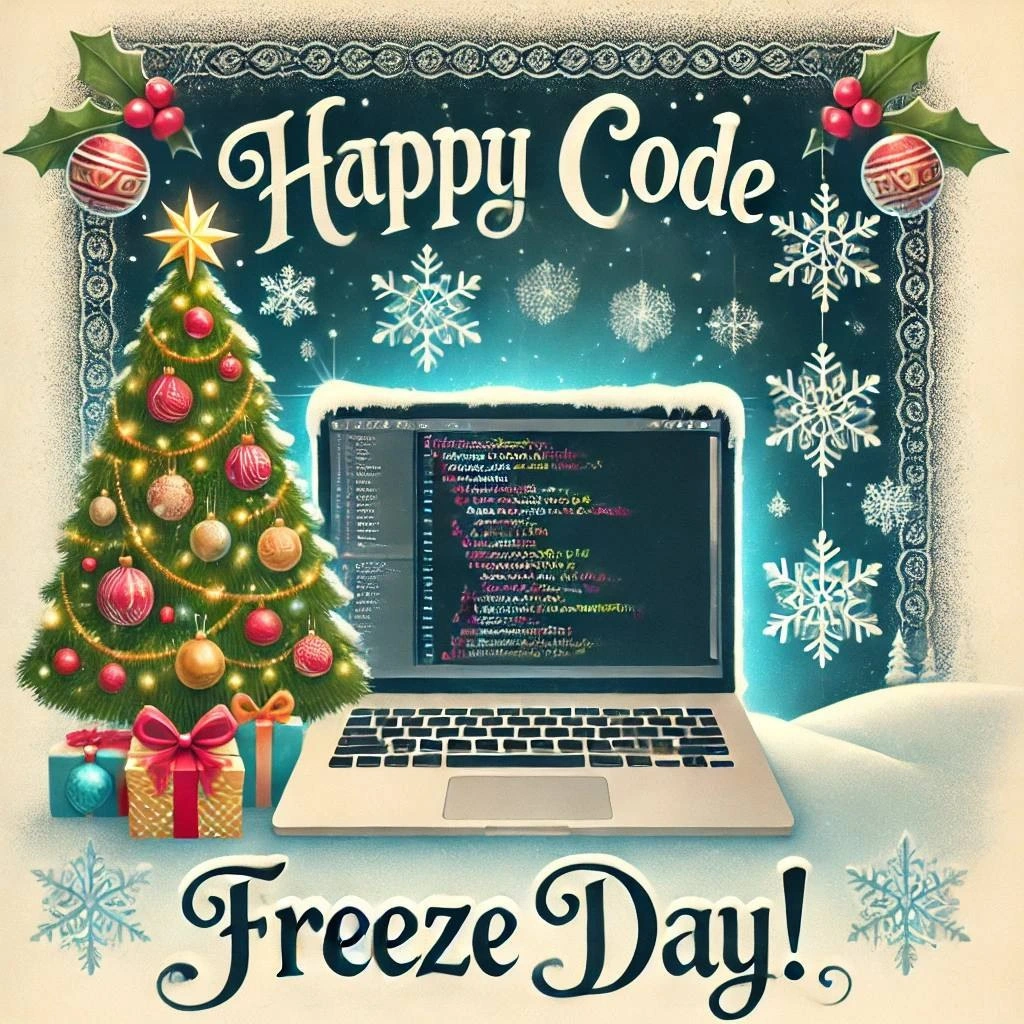
The laptop in the image shows a code editor open with a React JSX component. JSX is a syntax used in React (a popular JavaScript library for building UIs) that lets you write HTML-like tags in your JavaScript. The code on screen is highlighted in multiple colors – typical of an IDE or text editor with a dark theme. It’s showing something like:

<div className="holiday-card">
  <Header title="Happy Code Freeze Day!" />
  {/* ... possibly more JSX code ... */}
</div>

This colorful code represents the kind of work developers do. Putting it on the screen of a laptop surrounded by snow implies that the programmer’s world is now in a deep freeze. The whole scene has holly, snowflakes, and a Christmas tree with ornaments. These are symbols of the season, coexisting with the symbols of programming (the code, the laptop). It’s visually saying “Holiday time for humans, freeze time for code.” The phrase “Happy Code Freeze Day!” written in big fancy letters is a humorous way to wish someone a good holiday break without any coding. It parallels typical holiday greetings like “Happy Holidays” or “Merry Christmas,” but it’s personalized for developers.

For a junior developer or someone new to release cycles, here’s what’s being referenced:

  • Code Freeze: A scheduled period (often end of year or before big events) when no new code can be merged or deployed. Think of it as a lockdown for the codebase to keep it stable.
  • CI/CD Pipeline: This stands for Continuous Integration/Continuous Deployment pipeline. It’s the automated system that builds, tests, and deploys code. During a freeze, this pipeline might be literally turned off or set to reject any new changes. It’s like a factory assembly line that’s temporarily shut down for maintenance.
  • Production (Prod): The live environment where real users use the software. If something breaks in prod, it’s a big deal. During the holidays, breaking production is especially bad because the on-call engineers might be sipping eggnog or away with family, and users (or customers) might be very active. So we lock things down.
  • Backlog Bug: The meme mentions a bug lurking in the backlog. The backlog is a list of tasks and bugs that need to be addressed. A bug in the backlog means it’s a known problem that hasn’t been fixed yet. During code freeze, that bug might have to wait because only the most critical fixes are allowed (and even those are handled carefully). Engineers know it’s there, and it kind of annoys them, but unless it’s truly urgent, it stays put until after the freeze.

The categories “Deadlines” and “SDLC” (Software Development Life Cycle) hint that this meme is about a specific phase in a project timeline. The code freeze often comes right after a deadline – for example, “all features must be completed by Dec 15, then we freeze the code.” It’s part of the release cycle: you plan it into the SDLC so that after a certain date, you do not allow any changes. In practice, teams might have a calendar event marking the start of the freeze. They might send out an email or Slack message company-wide: “Code Freeze starts today: please refrain from merging to main until Jan 2 unless approved.” Some companies even throw a little party or at least breathe a collective sigh of relief on code freeze day, because it marks the end of crunch time and the start of a calmer period.

The post’s message, “You either need it now or will need it soon,” is advice to those who haven’t experienced a code freeze yet. It suggests that if your team doesn’t do code freezes, you might eventually run into a situation that convinces you why they are useful. This usually means someone had a bad experience (like a deployment causing a major outage at a terrible time) and learned the lesson the hard way. So, a junior dev reading that learns: code freeze isn’t just an arbitrary rule, it was born from real-world lessons and scars in the industry.

In summary, this meme is a piece of Developer Humor that plays on the intersection of tech work and holiday traditions. It’s relatable if you’ve ever had to stop coding for a bit because the calendar says “no more changes.” Even if you are new, you can imagine why a team would say “let’s not touch anything until the big holiday season is over.” The laptop in snow with pretty decorations basically tells the story: the code is staying right there, untouched and frozen, while everyone enjoys the holidays. You might even picture an office with a Christmas tree where a sign reads “Code Freeze in effect - do NOT deploy 🎅.” It’s both funny and an actual practice in tech companies around the world. After all, nobody wants to be deploying a hotfix while the New Year’s Eve countdown is on.

Level 3: CI/CD in Cold Storage

At the highest level, this meme is poking fun at the annual year-end code freeze – a ritual as familiar to seasoned developers as stale fruitcake at the office holiday party. The image presents a whimsical holiday postcard scene: a fully decorated Christmas tree, wrapped gifts, and an IDE open on a laptop nestled in snow. In lavish vintage script it wishes us “Happy Code Freeze Day!” as if code freeze were a festive holiday in itself. The humor hits senior engineers immediately: mixing warm holiday cheer with the cold reality of a release freeze. It’s a tongue-in-cheek celebration of that time of year when merging to the main branch is strictly off-limits, all to avoid becoming the Grinch who broke production at 11:59 PM on Christmas Eve.

Why is this funny to an experienced dev? Because we’ve all lived the tension between end-of-year joy and the dread of a last-minute deployment gone wrong. The meme nails a shared industry practice: locking down the CI/CD pipeline during the holidays. All new code changes are put on ice (sometimes literally, as in this snowy scene) until the New Year. The retro greeting card aesthetic – snowflakes, holly, and an IDE adorned like a Christmas tree – exaggerates how ingrained this practice is. It’s practically a season of its own on the software calendar. Release management has its own “holiday”: the code freeze. For veteran developers, that’s equal parts comforting and ironic. Comforting, because finally no one will deploy something on Friday at 5 PM for a couple of weeks. Ironic, because the codebase is frozen precisely when it’s most critical to keep things stable during peak usage and minimal staffing. We decorate the office and simultaneously “decorate” our repos with a big red “Do Not Merge” ribbon.

This image’s laptop screen displays a colorful React JSX snippet (complete with <div> tags and curly braces), highlighting a live code editor even as everything else is frozen. It’s a playful contradiction: the code looks active and festive (multi-colored like Christmas lights), but we all know it’s not going anywhere near production — not until the freeze thaws. Senior devs chuckle because they’ve done this dance: merging frantic last fixes right up to the freeze deadline, then closing the gate with a sigh of relief (and maybe a glass of eggnog). The backlog still has that one annoying bug (the meme mentions “that one bug still lurking”), but touching it now risks an outage when half the team is on vacation. So it stays lurking, like the ghost of deployments past, haunting our holiday thoughts. 🎄👻

The Deadlines category is at play here: “code freeze day” is the ultimate year-end deadline. Miss it, and your feature or fix gets the cold shoulder until next year. This practice is embedded in the SDLC (Software Development Life Cycle) at many companies — a final hardening phase where only critical fixes are allowed. It’s the waterfall-era idea of a “hardening sprint” resurfacing in agile shops as “no merge December.” In continuous deployment culture (the BuildSystems_CICD angle), it feels counterintuitive to halt the conveyor belt. But most teams concede a brief truce in the velocity war, because the risks of a bad deploy during the holidays are just too chilling. Even DevOps automation can’t fully guarantee that “one last deploy” won’t spark a fire that summons a 3 AM on-call nightmare. As the meme’s post message quips, “I hope you not gonna deploy to prod on New Year’s Eve dear, wouldn’t you?” – that line drips with the seasoned sarcasm of someone who’s been paged during the New Year’s countdown before. It’s basically a senior engineer’s way of saying “Been there, done that, please don’t be that hero who pushes a Christmas miracle code change and instead delivers a Festivus fiasco.” In other words: You either institute a code freeze now or learn the hard way why you should have.

At a deeper level, this tradition speaks to release anxiety and organizational memory. After enough holiday outages or frantic rollback calls, companies develop almost superstitious caution around late December. The meme resonates with that collective PTSD in a humorous way. We see the happy tree and gifts – symbols of peace and family – right next to an IDE showing code that won’t be shipped today. It’s like the developer’s version of a “Closed for the Holidays” sign. And right beneath, in the same cheerful font: “Freeze Day!” The wording mimics holiday greetings (“Happy Holidays” / “Season’s Greetings”) but replaces it with a very tech-specific term. This contrast between celebratory language and rigid policy is funny because it highlights the absurdity: in what other profession do you literally stop work around the holidays to prevent disaster? A cynical veteran might chuckle that if only not touching things guaranteed nothing breaks — unfortunately, Murphy’s Law still applies. But at least if something does break now, we’ll know we didn’t cause it this week. As one battle-scarred sysadmin famously put it, “No change, no problem.”

The meme’s caption “You either need it now or will need it soon” underscores a mentor’s hard-earned wisdom. It implies that younger companies or engineers who scoff at code freezes (“we deploy whenever, we’re agile!”) eventually encounter that one catastrophic holiday deploy that changes their mind. It’s both a warning and a welcome to the club. The DeveloperHumor and ReleaseCycles tags flag that this is an inside joke: developers love to joke about our own processes. We cope with deadline pressure and release management nightmares by turning them into seasonal jokes. In this case, treating the code freeze as a festive event is a form of humorous catharsis. We can imagine seniors sharing this e-card with a smirk, reminding everyone to step away from the keyboard and enjoy some fruitcake instead of deploying.

Finally, let’s acknowledge the visual pun: “code freeze” in a snowy scene with literal ice and snowflakes is TechHumor 101. The snowflake_ui_theme context tag hints that even the editor might be skinned with a holiday theme (some IDEs do have fun plugins for snowfall or Santa hats on cursors). It’s a goofy yet charming parallel: just as water freezes in winter, code freezes in December. And just as you’d bundle up to avoid a cold, developers bundle up their code and don’t let it out into the wild for a while. To sum up the senior perspective: this meme hilariously captures that unwritten truce in the tech world – the one that lets engineers actually relax with family by freezing the codebase, even if it means nervously joking about the one bug quietly stowed under the tree. Because nothing says “Happy Holidays” like not deploying to production and thereby actually having a holiday.

# Example: A veteran engineer's terminal on Dec 31 at 4:00 PM
$ git push origin main
🚫 ERROR: Year-End Code Freeze Active (Dec 18 - Jan 2)
👉 Tip from IT: Don't be the Grinch. Deploy next year, go enjoy the New Year’s party!

Description

Vintage holiday-card style graphic with ornate snow-flake border, holly sprigs, and a fully decorated Christmas tree beside a ribbon-wrapped stack of presents. Center stage sits an open laptop resting in a snowy drift; its dark-themed editor shows multi-colored syntax highlighted code (a React-style JSX component with curly-brace props and closing </div> tags). Large retro script across the top reads “Happy Code”, while matching lettering beneath the laptop proclaims “Freeze Day!”. The festive composition humorously parallels the software practice of instituting a code-freeze before year-end holidays, when no new commits are allowed into the main branch to protect production stability. Senior engineers will instantly recognize the tension between holiday cheer, locked CI/CD pipelines, and that one bug still lurking in the backlog

Comments

26
Anonymous ★ Top Pick Code freeze: the magical season where ‘merge permissions disabled’ is the only thing keeping that last-minute feature from sneaking down the production chimney
  1. Anonymous ★ Top Pick

    Code freeze: the magical season where ‘merge permissions disabled’ is the only thing keeping that last-minute feature from sneaking down the production chimney

  2. Anonymous

    The only time of year when 'freezing production' is actually celebrated rather than causing panic - though both involve praying nothing breaks while everyone's away and nobody wants to be on-call

  3. Anonymous

    Ah yes, the most wonderful time of the year - when we collectively agree that deploying to production between December 20th and January 2nd is a war crime. Nothing says 'Happy Holidays' quite like a P0 incident at 2 AM on Christmas Eve because someone thought their 'quick hotfix' was worth risking everyone's eggnog-fueled peace. Code freeze isn't just a policy; it's an act of mercy for the on-call rotation and a testament to our hard-won wisdom that no feature is urgent enough to debug while your family asks why you're typing furiously during dinner

  4. Anonymous

    Code freeze: the one holiday where your git repo gets read-only R&R, and QA finally unwraps the real gifts

  5. Anonymous

    Annual code freeze: we disable deploys, then ship three “harmless” hotfixes via feature flags - because production code with a toggle is still production code

  6. Anonymous

    Happy Code Freeze Day: the only reliability strategy with a 100% success rate - until marketing requests a “copy-only change” via a feature flag and we remember YAML is code

  7. @TERASKULL 1y

    that code is as illegible as mine, there's no way AI will replace me

  8. @newroman1 1y

    My eyes are so tired from looking at ai generated content

    1. @TERASKULL 1y

      something about the gradient diffusion in the images makes me irrationally angry. sure, ai images for the meme are funny, but when you're trying to unironically use this slop in ads and banners it gets annoying fast

      1. Deleted Account 1y

        Yes bro ai never matches the perfection made by human Ai always do silly mistakes

        1. @TERASKULL 1y

          it's not even mistakes or 6 fingers or whatever. it's the unrealistic coloring, looks like a corporate design that was run through a bunch of smoothing filters until it has this "uncanny valley" look

    2. @Wintercoresystem 1y

      Me too, despite me being pretty interested in this stuff. Like drawing cool stuff without learning to draw? Cool, now I can visualize stuff from my dreams and show it. But humans spoiled it. As always.

  9. @chirpbirb 1y

    slop for the slop god

  10. Deleted Account 1y

    Nice texture mapping bro

  11. @ArielXBT 1y

    Still using sublime text

    1. Deleted Account 1y

      What is sublime 😳

      1. @undefined_af 1y

        Oh my God, u don't know sublime

        1. @RiedleroD 1y

          for some reason sublime is really popular with russians (and maybe surrounding countries?) but generally pretty unknown outside that

          1. @undefined_af 1y

            One time I tried sublime, but I immediately uninstalled it after opening it Switching back to my friend vscode 😊

  12. @ArielXBT 1y

    an editor

    1. Deleted Account 1y

      Ohh I know only vs code 😆

  13. @Bjastkuliar 1y

    I quit my job on the 27th, so risk avoided 🙈

  14. @dsmagikswsa 1y

    why happy code when freeze code?

    1. dev_meme 1y

      Because it's "Code Freeze Day" 🌚

  15. @Hernohi 1y

    A mix of stock webp photos would have been a better meme than this AI slop

  16. @Le_o_R 1y

    Freeze day? We have freeze 3 weeks!

Use J and K for navigation