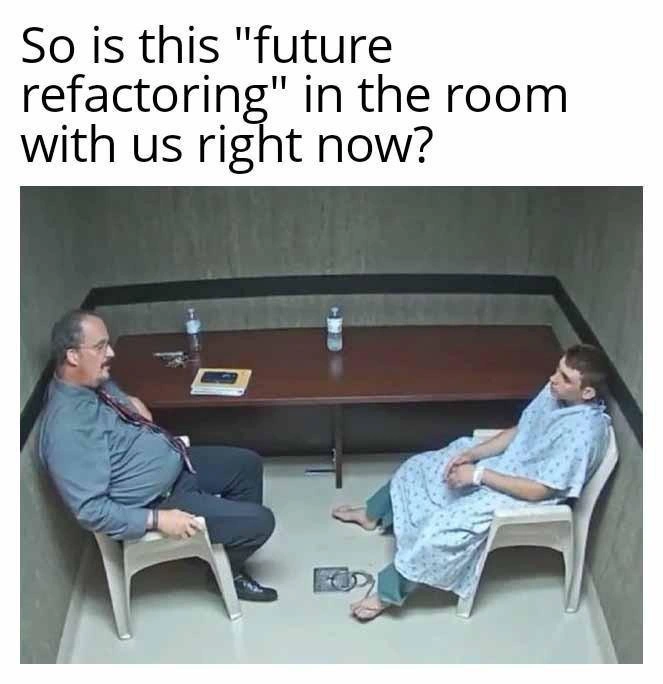
Interrogation room meme exposes the myth of "future refactoring" promises
Why is this TechDebt meme funny?
Level 1: Imaginary Friend
Imagine a child with a very messy room. Every day, the parent says, “You need to clean this up,” and the child replies, “I will, I promise – I’ll do it later.” But later never comes. Clothes and toys just keep piling up. Eventually, the fed-up parent sits the child down in the cluttered room, looks around seriously and asks, “So, is this ‘Later’ person you keep talking about here in the room with us right now?” The parent is poking fun at the child’s excuse – of course there’s no actual person named “Later” who’s going to do the cleaning. Both of them know the child was just procrastinating. The question is funny because it makes the child’s excuse sound like an imaginary friend or ghost that doesn’t really exist. In the same way, this meme jokes that the team’s promised “future refactoring” is like that imaginary friend – it was never real. Everyone keeps talking about it as if some magical clean-up crew will arrive eventually, but deep down we all know it’s just an excuse to avoid doing the hard work now. The humor hits home because we’ve all been that kid (making a promise for later) and we’ve all known that parent or friend who finally calls us out, with a smile, saying essentially, “We both know ‘later’ isn’t here, and it isn’t going to clean up this mess.”
Level 2: Debt vs Deadlines
Let’s break down the joke in simpler terms. In software development, technical debt refers to the extra work we create for ourselves in the future by taking shortcuts or writing quick, messy code now. Think of it like cutting corners: you save time today, but you’ll have to pay back that time (with interest) later when you inevitably need to fix or improve the code. Refactoring is the process of going back into that code and cleaning it up. When a developer refactors code, they reorganize, simplify, or rewrite parts of it without changing what the code actually does for the user. It’s like tidying up a messy room — you’re not adding new furniture, just putting things in order so it’s easier to navigate next time.
In a perfect world, teams would regularly schedule time to refactor and reduce this technical debt. But in real-world companies, deadlines often win over code cleanup. This is where corporate culture comes in: if a company’s culture and priorities focus heavily on releasing new features or hitting quarterly targets, developers get the message that they should deliver features fast. Quality improvements or cleanup tasks get labeled as “nice-to-have.” Managers might genuinely intend to allow refactoring later, but there’s always another pressing feature or bug fix that steals the spotlight. So people start saying things like, “We’ll fix this in the future when we have more time.” It’s a common manager excuse to keep projects moving quickly. Developers, especially those new to the industry, might initially believe these plans. You think, “Okay, we’ll come back and make this better later.”
However, “later” has a way of never arriving. For example, you might encounter code full of comments like this:
// Quick hack to meet the deadline
function launchFeatureQuickly() {
implementFeatureFast(); // done: works, but it's a kludge
// TODO: Refactor this when we have time (spoiler: we never do)
return true;
}
In the snippet above, someone added a // TODO: Refactor this comment. That’s basically a developer’s way of acknowledging, “I know this code isn’t great, and I intend to improve it later.” Early in your career, you’ll stumble on plenty of these TODO comments or hacky sections of code labeled with “fix me later.” It’s a sign that the team planned to pay off the technical debt... but often the plan fell by the wayside. The joke in the meme is that this “fix later” promise is treated like an actual person or entity that we pretend is going to swoop in and solve everything.
Why is that funny? Because every developer eventually realizes that unless you make refactoring a real task with time assigned, it simply won’t happen by magic. It’s a bit like telling your teacher, “I’ll do my homework eventually,” without setting a date – you’re fooling yourself more than anyone else. Teams constantly juggle debt vs. deadlines: should we take extra time now to tidy the code (pay off debt), or do we rush the feature out to meet the deadline? Most of the time, the deadline wins out. The unfinished cleanup is pushed into an imagined future. Over time, those postponed clean-ups pile up, and the codebase becomes harder to work with – what developers call legacy code (old code that’s gotten crusty and difficult to change). New developers joining the project might ask, “Why is this part of the system so convoluted?” and the answer will be, “Oh, we meant to refactor that ages ago, but we never got around to it.” It’s said with a shrug, because by now everyone knows that “meant to” doesn’t count.
The meme text “So is this ‘future refactoring’ in the room with us right now?” directly pokes fun at that empty promise. It’s like catching someone in a fib. In everyday terms, it’s as if the team has been talking about a mysterious helper who will clean up all the mess “later,” and now someone is bluntly asking: Where is that helper, exactly? Of course, there is no helper – there’s just us and the messy code. The humor comes with a bit of a sting: it forces folks to admit that the long-awaited cleanup isn’t happening unless we make it happen. For a junior developer, it’s a valuable (if amusing) lesson: always take promises of “refactoring later” with a grain of salt. It’s better to assume that if code needs improvement, you might have to champion it yourself, because the mythical “later” often keeps getting postponed indefinitely.
Level 3: The Mythical Refactor
To any senior developer, this scenario is achingly familiar. It’s an industry in-joke that “we’ll refactor later” is about as credible as a unicorn sighting. The meme’s caption nails that collective skepticism: So is this "future refactoring" in the room with us right now? — basically asking, does this magical fix-it plan even exist? We’ve all heard (or given) some flavor of this promise during crunch time, only to watch it evaporate once the deadline passes. It’s the mythical refactor that’s always one sprint away, perpetually postponed by the next feature or emergency.
Developers share a knowing grin at lines like:
- “We know the code is ugly, but let’s ship now and clean it up in the next sprint.”
- “It’s just a temporary workaround for this quarter. We’ll refactor in Phase 2.”
- “Leave a TODO comment — we’ll address this technical debt when we have time.”
We nod along in meetings when we hear these, but inside we’re rolling our eyes. Why? Because experience has taught us that temporary fixes often become permanent. There’s a cynical maxim in software: Nothing lasts longer than a “temporary” solution. That hardcoded tweak or kludgy module you introduced “just for now” can end up underpinning the whole system years later. The result is LegacyCode: old, brittle code that everyone is afraid to touch because it’s never been refactored as promised. The meme’s humor is essentially pointing at the elephant in the room (or rather, the phantom in the room): every engineer knows that the fabled future refactor session is probably never going to happen, yet we all ritualistically invoke it to justify quick-and-dirty decisions. This is classic DeveloperIrony – we’re laughing at our own common habit of making promises we don’t keep.
The interrogation room meme format amplifies this irony by staging a confrontation. It’s as if the tech lead or an exasperated team member has put the abstract idea of “refactoring later” under a spotlight for questioning. The suited interrogator might as well be asking a developer or a manager, “Where were you on the night of the last release, and why didn’t that refactoring you swore by ever occur?” Meanwhile, the hapless shackled “suspect” symbolizes that elusive refactor plan – weak, neglected, and treated as a bit of a lunatic idea at this point. It’s a tongue-in-cheek dramatization of our software process: future_refactoring has become a running gag, an imaginary scapegoat we drag out when convenient. Everyone talks about it, but no one has actually seen it happen.
Why does this hit such a nerve in corporate development? Largely because of how CorporateCulture and incentives work. Companies reward delivering features and hitting deadlines; there’s rarely a celebration for refactoring a module to reduce technical debt. Product managers often treat maintenance as a second-class citizen – something to do “someday” when there’s free time (which, of course, there never is). These are the classic manager excuses: “Just get it done now, we’ll polish it later,” or “We’ll allocate a full sprint to refactoring next quarter”. Next quarter arrives, but along with it comes new sales demos to prepare, critical customer requests, and another round of “just one more feature.” The dedicated refactoring time keeps slipping. In many enterprise environments, the idea of a grand cleanup is essentially a mirage on the horizon. The technical debt thus becomes institutionalized – part of the normal. New hires are told, “Yeah, we know Module X is a mess. We intend to refactor it… eventually.” It’s practically a hazing ritual for developers to discover that those Jira tickets labeled RefactoringNeeded or TechDebt have been sitting there for eons.
Let’s be real: what engineers say versus what actually happens often looks like this:
| What we promise | What actually happens |
|---|---|
| “We’ll clean up this code next sprint.” | Next sprint comes, new features take priority, and the clean-up is forgotten. |
| “Let’s leave a TODO and fix it later.” | Later never comes; that // TODO remains in the code running in production. |
| “We’re planning a refactoring phase soon.” | “Soon” keeps getting postponed each quarter, and the phase never materializes. |
Every seasoned dev reading that table is probably smirking (or groaning) in recognition. The technical debt keeps piling up like a credit card balance, but no one is making payments. Meanwhile, devs cope by joking about it: “Oh, the future refactor? Sure, it’s scheduled right after we land the Mars colony project.” This gallows humor is a way to bond over the absurdity. The meme shines a floodlight on this shared delusion. The interrogator’s question could just as well be a senior engineer or QA lead exclaiming in a meeting, “So where is that big refactor you all keep mentioning? Is it here with us now, or have we been chasing an imaginary friend?” It forces everyone to admit the truth: the promise was empty.
In sum, the meme is funny (and painful) to us because it exposes the gap between best practice and actual practice. Best practice says you should continuously refactor and address tech debt. Actual practice? You slap on another layer of code and insist you’ll mop it up later. The humor comes from that wink-wink knowledge that “later” is a mythical land. It’s a comedic call-out, a way of collectively sighing and laughing at the fact that, in the real world of software, later often means never.
Level 4: The Ghost of Ward Cunningham
In the pantheon of software folklore, future refactoring is akin to a phantom promise – the ghost everyone swears they’ll confront eventually, yet it never materializes. This meme drags that specter into an interrogation room, essentially asking point-blank: “So is this promised cleanup actually here with us or just in our heads?” Behind the dark humor lies the concept of Technical Debt, a term famously coined by Ward Cunningham in 1992. Cunningham likened quick-and-dirty coding to taking on a financial loan: you gain a short-term benefit (shipping code faster) at the cost of long-term interest (the extra effort needed later to fix, maintain, or refactor that code). Just as unpaid loans accrue interest, unpaid technical debt silently accrues complexity. Each time you defer refactoring, the “interest” compounds: future changes become more cumbersome, bugs sprout in the neglected corners of the code, and the cost of cleaning up keeps rising.
Refactoring – the process of improving internal code structure without changing its external behavior – is supposed to be how we “pay down” that debt. Martin Fowler’s seminal 1999 book Refactoring laid out formal techniques to restructure code (e.g. eliminating duplication, improving naming, organizing logic) in order to reduce entropy in the codebase. And indeed, software entropy is a real thing: one of Lehman’s Laws of Software Evolution observes that systems degenerate over time unless actively maintained. In physics, entropy means everything tends toward disorder unless energy is invested to keep it organized. In software, refactoring is that energy. If it’s never applied, the code’s structure degrades. Functions grow into monstrous 500-line spaghetti, modules become intertwined by tentacles global state, and what started as a clever hack turns into a permanent landmine. Ward Cunningham’s metaphor still haunts modern projects – teams accumulate dozens of // TODO: refactor later comments, each one a little IOU that future generations of developers inherit. Like broken windows in a building, each unchecked hack signals that more decay is acceptable.
Over time, a codebase laden with deferred clean-ups begins to resist change. You’ll see higher bug rates and slowed velocity, as if the system itself is saying, “I can’t take any more without a makeover.” Seasoned engineers recognize this as the software equivalent of compounded interest: the longer you wait, the more “interest” you pay in the form of development drag and production issues (the classic 3 AM outages caused by that one fragile module nobody ever rewrote). In extreme cases, the only way out of massive debt is a complete rewrite or restructuring – essentially declaring bankruptcy on the old system. But even that is risky and costly, which is why the mythical full refactor is often endlessly postponed.
The interrogation-room setting in the meme brilliantly underscores this situation’s absurdity. It’s a stark, fluorescent-lit confrontation scene, as if the CorporateCulture itself has dragged in this elusive “refactoring plan” for questioning. The heavy-set man in the suit could represent a hard-nosed project manager or architect, demanding the truth, while the shackled guy in the hospital gown embodies the sorry state of that long-promised refactoring. He’s slumped, restrained, and blurred-out – basically the institutionalized form of all those code fixes that have been locked away in planning documents and never released. The question “So is this ‘future refactoring’ in the room with us right now?” is both literal and metaphorical. Literally, it echoes how a therapist or investigator might challenge someone claiming to see an imaginary figure (“Is that imaginary friend here with us now?”). Metaphorically, it calls out the hallucination we maintain in enterprise engineering: we speak of future refactoring as if it’s a real forthcoming event, but it’s as invisible and elusive as a ghost. The meme is poking at a fundamental truth of large codebases: if you keep deferring maintenance, you’re essentially chasing an apparition. In high-level terms, this darkly funny image highlights a core software engineering reality: continuously postponing refactors turns your code improvement plan into a fictitious character – one that everyone references, but nobody ever actually meets in reality.
Description
Image has a top caption in bold black text: "So is this 'future refactoring' in the room with us right now?" Below, a CCTV-style overhead view shows a small, bleak interrogation room. On the left, a suited, heavy-set man sits in a cheap plastic chair; on the right, a barefoot person in a hospital-style gown and ankle shackles slumps in another chair. A plain wooden table with two water bottles, a notebook, and a key ring separates them. Both faces are blurred for anonymity. The meme humorously equates the perpetually postponed refactor - often invoked to justify cutting corners - to an imaginary suspect under questioning, highlighting how technical debt becomes institutionalized in enterprise culture and eventually feels like a hallucination everyone references but no one actually sees
Comments
9Comment deleted
Future refactoring is the quantum ghost of the roadmap - observable only when the CFO approves budget, which collapses its waveform back into "next quarter."
After 15 years in the industry, I've learned that 'future refactoring' exists in the same quantum state as 'temporary workarounds' - simultaneously everywhere and nowhere, until observed by an auditor, at which point it collapses into a critical P0 incident
After 15 years in the industry, I've learned that 'future refactoring' exists in the same quantum superposition as 'we'll add tests later' and 'temporary solution' - simultaneously planned and never executed until the heat death of the codebase. It's Schrödinger's technical debt: both acknowledged and ignored until a production incident forces us to open the box
Future refactoring is Schrödinger’s epic - both “on the roadmap” and permanently deprioritized until the waveform collapses during a Sev1 postmortem
Future refactoring isn't in the room - it's the hatch under the table, where all those 'temporary' hacks finally break free in prod
Future refactoring is Schrödinger’s epic - simultaneously on the roadmap and never scheduled; it materializes only after someone assigns a budget line, which is how you know it won’t
moved to the basement a long time ago Comment deleted
err, wrong person Comment deleted
Ofc not, but it will be Comment deleted