Skip to content
DevMeme
699 of 7435
Grand Theft Data: Zuckerberg Edition
DataPrivacy Post #792, on Nov 8, 2019 in TG

Grand Theft Data: Zuckerberg Edition

Why is this DataPrivacy meme funny?

Level 1: Don’t Leave the Door Open

Imagine you have a big box of secret toys and treats that you absolutely don’t want anyone else to get. You’d probably lock it up or hide it under your bed, right? Now, what if, by mistake, you left that box on your front porch for the whole neighborhood to see? Chances are, a sneaky kid (or a thief) might come by and take all those goodies. You’d be pretty upset, and maybe a bit embarrassed that it was that easy for them to grab your stuff. This meme is joking about a very similar idea, but in the grown-up world of computers and the internet.

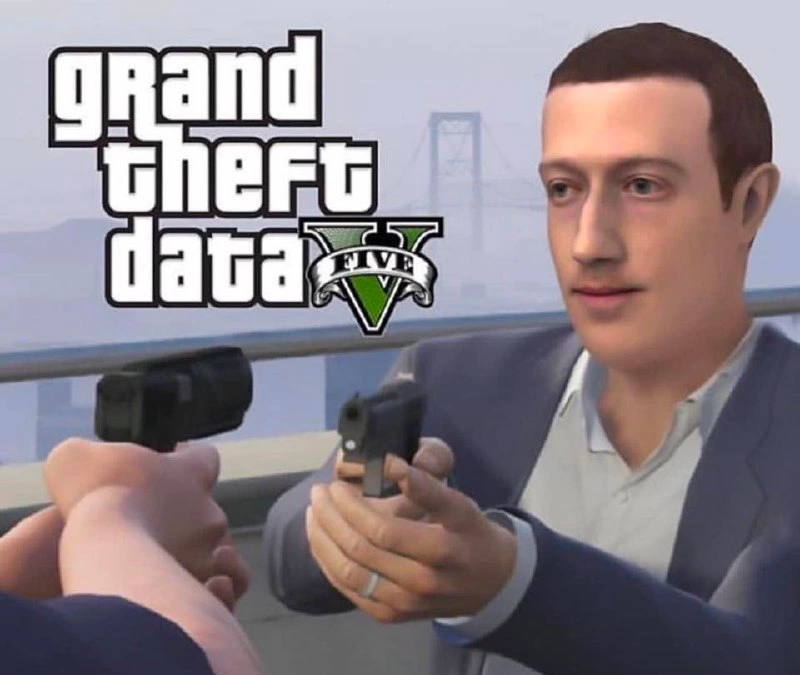
The picture is styled like a cover of a cool action video game (think of a game where characters run around doing crazy missions). It even uses the same big, bold letters and a giant “V” like it’s the fifth game in a series. But instead of saying “Grand Theft Auto” (which is a famous game about stealing cars), it says “Grand Theft Data.” In real life, “data” means information – like your personal secrets, messages, photos, or anything stored on a computer. So the title is like saying “Stealing Information, Part 5.” It’s comparing taking data (like your private info) to the kind of playful car theft you do in video games. Why is that funny? Because it’s a bit shocking – it suggests that stealing people’s personal info has become as casual and common as snatching a car in a game. It’s a way to poke fun at how often we hear about companies losing control of our data.

In the picture, one of the drawn characters looks like a well-known real person: Mark Zuckerberg (he’s the boss of Facebook). The fact that he’s there is a clue – Facebook has had issues with not keeping peoples’ data as safe as they should. It’s like if you saw a joke about cookie jars and it showed Cookie Monster looking guilty. Mark Zuckerberg represents someone with a lot of user data, and some incidents where it might’ve been “stolen” or used wrongly. The other character’s face is blurred out, which makes him look mysterious – probably representing an unknown bad guy, like a hacker. Both of them are pointing guns at each other, like a movie standoff scene. That visual says, “there’s a tense fight going on about data.” It’s almost like the wild west but for information: on one side, big companies (who hold your data) and on the other side, thieves or outsiders trying to take that data. Each is threatening the other. It creates a feeling that in the world of data and privacy, things can get aggressive and dangerous, just like in an action game or movie.

So, in super simple terms, what’s the meme’s message? It’s warning (with a laugh) that if you don’t lock up your “stuff” online, someone’s going to take it. Companies sometimes forget to lock the door – they leave huge files of people’s personal info open on the internet by mistake. When that happens, sneaky people can walk right in and grab it, no need to even “hack” like in the movies. It’s so easy it’s almost like a game for them. Imagine a video game where the objective is to find secret documents left lying around – unfortunately, that’s kind of what real hackers do: they look for careless mistakes.

For a non-technical analogy: think of a library that has a special private diary section that only certain people should access. Now imagine the librarian accidentally leaves those diaries out on the public table. Anyone who wanders in can read them or take pictures. The library would be in big trouble for not protecting those diaries! In the same way, when a company doesn’t secure people’s personal data, and it gets taken, it’s a huge fiasco. People lose trust, and the company might even have to pay fines (like getting a big timeout and losing allowance).

The meme is funny because it uses a game cover and a playful tone to talk about something that’s actually very serious. It’s like drawing a goofy cartoon about a house fire to remind you not to leave the stove on. You chuckle at the cartoon, but the message sticks: be careful. Here, the message is: “Don’t let data get stolen – take security seriously, or else you’ll look as silly as this GTA parody.” And even if you’re not a company but just an everyday person, it’s a reminder that this stuff happens out there. Our personal data is valuable, kind of like money, and there are “robbers” in the digital world. So we should root for those engineers patching things up and also take care of our own “online house” (like using strong passwords and not oversharing information).

In short, “Grand Theft Data V” turns a scary reality into a joke we can understand. It’s telling us that stealing data can be as brazen and common as a car theft in a fun video game, especially if we (or big companies) leave the doors wide open. The title essentially says: Don’t make it easy for the bad guys, because they will take advantage, laughing all the way. So, always lock your digital doors, because unlike in a video game, you can’t just respawn and get your stolen data back!

Level 2: Buckets of Trouble

So, what’s actually happening in this meme? Let’s break it down in simpler terms. First off, it’s a parody of the cover art of a very famous video game called Grand Theft Auto V. Grand Theft Auto (GTA) is a series all about crime – in the game, you play as a criminal running around a big city, and a lot of the gameplay involves stealing cars (that’s the “Auto” in the name) and pulling off heists. It’s one of the best-known games out there, made by Rockstar Games, and its cover art style is pretty iconic: bold blocky title text and a collage of action scenes. This meme imitates that style. Instead of Grand Theft Auto, the title on the image reads “Grand Theft Data” – see how just one word changed? That signals we’re now talking about stealing data instead of cars. And the “V” (Roman numeral for five) with the word FIVE on the ribbon is directly lifted from GTA V’s logo. So the meme is literally screaming “Hey, we’re referencing that video game, but jokingly applying it to data theft!” That’s what the tag grand_theft_auto_parody means – it’s a spoof on GTA.

Now, why “V”? There aren’t actually five games about stealing data; the V here is purely because GTA V’s branding is so recognizable. But it has a tongue-in-cheek effect: it’s like saying there have been so many data breaches, we could number them like sequels. If you’re a developer or in IT, you’ve seen headline after headline about millions of accounts hacked or personal info leaked. The meme exaggerates this into Grand Theft Data V as if we’re already at the fifth edition of “Data Heist of the Century.” It’s a form of PrivacyHumor – making a joke out of something serious like data theft to cope with how common it’s become.

The scene depicted shows two men in suits pointing guns at each other on a balcony overlooking a city (there’s even a bridge visible in the back). One of these men has his face blurred out (pixelated), and the other man… well, he looks like Mark Zuckerberg from Facebook. That’s not a coincidence. Mark Zuckerberg is a real person (and a very famous tech CEO), and his inclusion is a nod to real-life DataPrivacy dramas. Facebook under Zuckerberg has had huge scandals involving user data, such as the Cambridge Analytica affair where a political consulting firm harvested data from millions of Facebook users without proper consent. So the meme artist popped Mark’s face in there as an Easter egg – it’s like saying, “this is a game of data theft, and look who one of the players is.” The other guy’s face is anonymized (blurred) probably to represent an unknown hacker or thief, essentially anyone trying to steal data who remains unidentified (or it could even imply an everyman insider — someone whose identity is hidden). The guns pointing at each other create a standoff. It’s visually implying conflict, like lawlessness or a fight between two criminals. This dramatizes the idea of data breaches as a Wild West shootout or a tense heist standoff. In GTA games, you frequently end up in gunfights during missions, so this imagery fits that crime-action theme but transplanted into a corporate setting (guys in business suits instead of gangsters in hoodies).

Let’s talk data breaches. A data breach is when private information that’s supposed to be secure gets accessed by someone who shouldn’t have access. That data could be anything: names, passwords, credit card numbers, personal messages, medical records – you name it. If it was meant to stay confidential and it got out, it’s a breach. Sometimes you’ll hear the term data leakage similarly – it often means the data kind of “leaked out” due to some mistake or oversight. For example, if a company accidentally leaves a database exposed on the internet without a password, that’s a data leak (and once hackers find it and copy the data, it becomes a full-blown breach event). The meme specifically hints at a modern cause of data leakage: misconfigured S3 buckets.

What is that? Amazon S3 (Simple Storage Service) provides “buckets” where companies store data in the cloud (imagine a bucket as a folder or container in online storage). S3 is super popular for holding everything from website images and logs to user backups. By default, these buckets are private, meaning only the owner (or those they explicitly authorize) can access the content. A misconfiguration happens when someone sets the permissions wrong – for instance, making a bucket public by mistake. Public means anyone on the internet can access it if they know the address. You might misconfigure a bucket if you’re not careful with the settings or if, say, you wanted to share some files publicly and flipped a switch, and then forgot to flip it back for sensitive files. There have been many real incidents where huge amounts of user data were sitting in public S3 buckets without the company realizing. Hackers or security researchers basically just had to stumble upon the right URL or do a search, and voilà – they could download all the data, no hacks required. It’s like leaving a treasure chest out on the street with the lid open. One infamous example: in 2017 a security firm found an open S3 bucket belonging to a big data analytics company that contained detailed personal information on nearly 200 million American voters. Oops. Another: in 2019, millions of Facebook user records were found exposed in public AWS buckets owned by third parties. So misconfigured_s3_bucket has become shorthand for “someone messed up cloud security configuration.” In developer circles, saying “it was an open S3 bucket” is almost like a dark punchline – it means the breach was entirely preventable and kind of basic. Engineers dread making that mistake, and those who have will never forget the lesson.

The meme text mentions engineers “patching misconfigured buckets.” To patch in tech means to apply a fix or update. Usually we talk about patching software (like updating an application to fix a security flaw). In context here, “patching a bucket” would mean quickly fixing the settings on that cloud storage to close the hole — for example, locking it down again or adding encryption or changing access keys, etc. If an S3 bucket was found to be open, the immediate “patch” is to make it private and then rotate any credentials or keys that might have been compromised. Those are intense moments: you’re racing to secure the data before more unauthorized people access it. If we stick to the video game analogy, patching a misconfigured bucket is like realizing you left the bank vault open during a heist and sprinting back to slam it shut before more loot goes missing.

Next, “chasing zero-days.” A zero-day is a special kind of security vulnerability. It’s a flaw in software that was unknown to the software maker and for which no official fix (patch) exists yet. The term “zero-day” comes from the idea that the developers have had zero days to address it — usually because they just learned about it when it’s publicly disclosed or actively being exploited. Zero-days are the nightmares of cybersecurity because they can catch everyone off-guard. When a zero-day vulnerability is discovered in, say, a widely used server software or library, attackers can use it immediately, and system admins have to scramble in real-time (often devising temporary workarounds) until an official fix comes out. “Chasing zero-days” evokes the image of security teams constantly on the run, trying to track down these fresh vulnerabilities and deal with them. It’s a cat-and-mouse game: as soon as you patch one hole, a new unexpected one might pop open. For a junior dev, imagine you just learned about SQL injection or cross-site scripting – those are known vulnerability types we have known fixes and prevention techniques for (like use prepared statements, sanitize inputs, etc.). A zero-day is scarier because there is no ready-made solution yet; it’s unknown and cutting-edge. So when engineers say they spend nights chasing zero-days, they mean they’re vigilantly monitoring news of new threats and jumping into action to mitigate them as soon as they emerge. It’s a bit like being a firefighter: mostly you maintain things and prepare, but when an alarm sounds (say, a tweet goes out about a new critical vulnerability in a software you use), you drop everything and respond.

Now, all these terms — data breaches, misconfigured buckets, zero-days — fall under the umbrella of Security and DataPrivacy. That’s why the meme is tagged in those categories. Security vulnerabilities are weaknesses that could lead to unauthorized access, like an open bucket or an unpatched bug. Data privacy is about keeping users’ personal data safe and only used in the ways they expect. A breach is basically a big violation of data privacy. So the humor here is aimed at the unfortunate reality of modern cybersecurity. We call it PrivacyHumor or CyberSecurityMemes because it takes a serious privacy problem and makes fun of it with a pop-culture twist (the GTA parody). This kind of humor is pretty common in developer circles — we often joke about stressful things to take the edge off. It’s like an inside joke: if you know these terms and you’ve been through these issues, you’ll chuckle at the meme and think “so true.” If you’re new, it’s a way to learn that, yes, even huge companies make silly mistakes and have data stolen.

We should also note the GDPR reference (tagged as gdpr_nightmare). GDPR stands for General Data Protection Regulation. It’s a major law in the European Union that dictates how companies must protect personal data. If they fail and there’s a big breach, they can get fined a lot of money (up to 4% of their yearly revenue). Also, they have to inform the public and regulators within a strict deadline after discovering a breach. This law basically forces companies to care about data privacy by hitting them where it hurts (the wallet and the public image). So when a meme like this shows a corporate data breach scenario, it absolutely is a “GDPR nightmare” for any company involved. A junior dev might not deal with GDPR compliance directly, but it’s useful to know that these data leaks have legal consequences, not just technical ones. It’s one reason companies pressure engineers to fix issues ASAP if there’s even a hint of a leak — the stakes are really high.

Finally, let’s connect this to something relatable. If you’ve deployed an app or worked on a project, you might recall the first time you accidentally pushed something sensitive to a public repo or left a test server running without a password. When you realized the mistake, you probably had that stomach-drop feeling of “oh no… did I just expose something important?” Early in their career, many developers learn these lessons: double-check your access settings, don’t hardcode secrets in your code, review what you’re uploading to GitHub, etc. The folks patching “misconfigured buckets” are dealing with exactly that, but on a much larger scale — like an entire customer database instead of, say, just a test file.

To visualize how a misconfigured bucket breach can happen (and how little “hacking” it actually requires), consider this simple example. If a company’s S3 bucket of user data was left public, an attacker (or any curious person) could literally do something like:

# If a cloud storage bucket is left world-readable, "stealing" data is as easy as:
curl https://s3.amazonaws.com/acme-corp-public-data/customer_credit_cards.csv -o leaked_cards.csv

That command is using curl (a common tool to fetch URLs) to directly download a file (customer_credit_cards.csv) from an S3 bucket that’s publicly accessible (notice the URL structure for an S3 bucket). The -o leaked_cards.csv just means “save it to a file named leaked_cards.csv”. There’s no special hacking skill shown here — it’s just a normal web request. The hard part (sometimes not so hard) is finding out that URL or bucket name, but attackers have ways to scan or guess those. There are even search engines for public S3 buckets. The point is, if the bucket is open, the data comes right down like you were an authorized user. This is why we often stress: don’t put data on the internet without proper protections.

Now let’s decode the emotional aspect: why is this funny (in a dark way)? Because it’s absurd that such serious consequences (like millions of people’s data being exposed) can result from something as silly as a checkbox not ticked or one line of config set wrong. It’s like if a bank vault’s lock had a tiny switch that, if flipped the wrong way, leaves the door wide open – and someone forgot to check the switch. Within the developer and Infosec community, we share these stories and you either laugh or you’ll cry from stress. So making a big, bold meme out of it helps us laugh. It says, “yep, this crap happens a lot” but presents it with the familiar Grand Theft Auto style, which is almost comforting in its pop-culture familiarity. It turns a frustrating part of our job into a visual joke we can nod at.

To recap the key terms and references in plain language:

  • Grand Theft Data V – a play on the video game Grand Theft Auto V, implying stealing data is like a game now.
  • Rockstar Games reference – the meme mimics art from a Rockstar game (GTA).
  • User data heist – just a fancy way to say someone stealing user information, like a bank heist but data instead of money.
  • Data breach / Data leakage – when private info gets out (either by hack or mistake).
  • Security vulnerabilities – weaknesses in software or config that hackers can exploit (could be code bugs or something like a misconfigured server).
  • Misconfigured S3 bucket – a cloud storage container that was set to public when it should have been private, exposing the data inside.
  • Chasing zero-days – the act of continually updating and fixing systems when brand-new security holes are discovered (zero-days are those fresh, not-yet-patched vulnerabilities).
  • GDPR nightmare – the situation a company faces under strict privacy laws if they have a breach; basically huge fines and mandatory public embarrassment, which is indeed a nightmare for them.

All of these together paint the picture of why the meme exists. It’s reflecting real scenarios (like those big hacks you hear about) in a cheeky way. For a junior developer, the take-home might be: security matters! The reason veterans are sardonic is because they’ve seen what happens when security is treated as an afterthought. The meme’s popularity in tech circles is a signal: pay attention to these issues, or you could be the next story. It wraps that message in humor to make it stick. After all, you’re likely to remember “Grand Theft Data” as a concept whenever you think about whether your AWS bucket is locked down. And if it helps even one person double-check their settings, maybe we’ll prevent “Grand Theft Data VI”.

Level 3: Breach and Enter

Now let’s step down a notch and look at why this particular combination of imagery and text makes seasoned engineers smirk (and maybe cry a little inside). The meme remixes the iconic cover art of Grand Theft Auto V (GTA V) into “Grand Theft Data V.” This mashup is immediately hilarious to developers because it equates stealing sensitive data with the casual car-stealing mayhem of a video game. In GTA, you roam a city, snatch cars left and right, commit heists, and generally wreak havoc with little consequence. By swapping “Auto” with “Data,” the meme suggests that modern data breaches are just as brazen, commonplace, and almost sport-like as stealing cars in a game. It’s saying: Stealing millions of user records? Eh, just another Tuesday in the tech world. That dark humor hits home because, frankly, it feels true — large-scale data breaches have become alarmingly routine.

The GTA V parody cover is rich with references. The bold white block letters and the green Roman numeral “V” with the ribbon reading FIVE mimic the exact style of Rockstar Games’ famous franchise. Any gamer or internet denizen recognizes this instantly. By calling it Grand Theft Data V, the meme hints at a “series” of data heists, as if we’re already at the fifth installment of a blockbuster saga of corporate break-ins. And honestly, that’s not far from reality: by 2019, we’d seen so many high-profile breaches that you could label them “Grand Theft Data I, II, III…” and so on:

  • Grand Theft Data I – maybe the early ones like the 2013 Yahoo breach (3 billion accounts stolen, the OG mega-breach).
  • II – the 2017 Equifax breach, where a credit bureau — ironically a company built on safeguarding financial data — leaked ~147 million people’s personal info because they didn’t patch an old web framework. This one felt like a sequel no one asked for.
  • III – pick any major leak of 2018: perhaps the Cambridge Analytica scandal qualifies, where Facebook didn’t technically get hacked but effectively handed over data of 87 million users via an API abuse. Not a breach by intruders, but a privacy heist nonetheless (more on Mr. Zuckerberg’s role in a moment).
  • IV – 2019 had the Capital One breach: a hacker exploited a misconfigured AWS firewall to steal data on ~100 million credit applications from an S3 bucket. Straight-up cloud data heist with a clever twist — like a heist movie where the thief found the vault door ajar.
  • V – And here we are, Grand Theft Data V, the meme itself, summing up the pattern.

This running joke paints a picture: we’re living through a franchise of data breach sequels. Each time one hits the news, engineers worldwide facepalm and mutter some choice words, then get back to work hardening their systems, wondering what Part VI will bring. It’s funny in the same way gallows humor is funny — it’s a coping mechanism for those of us in the industry. We laugh so we don’t cry.

Now, let’s dissect the visual scene on the cover. We see two well-dressed characters on what looks like a high-rise balcony, each aiming a handgun at the other. It’s a dramatic standoff. The character closer to us has his face pixelated into anonymity, and the one facing us… well, that appears to be Mark Zuckerberg’s unmistakable face slapped onto a GTA-style 3D model! This detail is comedy gold for tech insiders. Zuckerberg, the CEO of Facebook, has become something of a poster child for data privacy issues. Under his leadership, Facebook has repeatedly been in the spotlight for things like lax data practices, third-party misuse of user information (hello Cambridge Analytica), and massive leaks (like the time hundreds of millions of user phone numbers were found sitting exposed on a server in plain sight). To see Mark Z. depicted as an armed character in a Grand Theft Auto parody is a sharp jab: it’s as if the meme is saying “Big tech execs are out here stealing data like gangsters stealing cars.” The suited characters and guns give off a vibe of crime thriller or noir drama, suggesting that what’s happening with corporate data is essentially organized crime or a high-stakes heist scenario. And in a sense, large data breaches do feel like that – there are criminal gangs hacking for profit, state-sponsored actors stealing data for espionage, and sometimes insiders or companies themselves mishandling data for gain. So the guns might symbolize that everyone’s guilty or at risk: the hackers (represented by the anonymous pixelated face) and the corporations (represented by Zuckerberg or “the suit”) are in a tense face-off. It could even hint at the mutual distrust between users and big tech: users feel held at gunpoint to give up their data, while companies feel under attack by hackers 24/7.

The backdrop with soft blue-grey tones and a bridge in the distance evokes the GTA V setting (a fictional coastal city). It subtly screams “this is a Rockstar Games reference,” grounding the meme in the pop culture of gaming. That’s a clever way to catch an engineer’s eye — many developers are also gamers, or at least know of GTA’s infamy. So the meme sets a stage that is both familiar and absurd: a user_data_heist action scene on a video game cover, with one character literally being the face behind one of the largest social networks on earth. It’s a perfect storm of references.

Humor aside, there’s a layer of trauma behind the laughter. Engineers responsible for security or infrastructure see something like this and chuckle while suppressing a stress twitch. The meme caption mentions “engineers who spend nights patching misconfigured buckets and chasing zero-days.” That’s me, thinks the overworked DevOps gal or the security analyst guy. It’s painfully relatable. A misconfigured S3 bucket is practically a meme of its own in our field — it’s become shorthand for “indefensibly stupid security screw-up.” Amazon S3 (Simple Storage Service) is where companies store lots of data in “buckets.” By default, these buckets are private, but all too often someone on the team, maybe during testing or to quickly share something, sets a bucket’s permissions to public and forgets to revert it. Boom: all your data files in that bucket are now one guessable URL away from anyone on the internet. It’s the digital equivalent of leaving a warehouse full of valuables with the loading doors wide open. There are dozens of stories of breaches caused this way — from leaked voter databases to unsecured media servers exposing user records. So when fellow engineers hear “misconfigured S3 bucket,” we all do a collective facepalm and sigh, “Not again…” We’ve either made a similar mistake ourselves or cleaned up after someone who did. It’s exhausting and far too common. The meme calling it out means the community recognizes this pattern: DataLeakage through basic misconfigurations is our era’s constant villain.

And chasing zero-days? That’s the other side of the coin — the advanced threat. A zero-day is a security vulnerability so new that there’s zero days’ worth of notice or patch available. It’s the nightmare of every security team: you suddenly learn that, say, the framework your web app relies on has a flaw that lets attackers bypass authentication, and until a patch is developed, your only choices are panic or unplugging your servers. When a big zero-day drops (imagine something like the Apache Struts exploit that nailed Equifax, or the OpenSSL Heartbleed bug a few years back), engineers go into firefighting mode. We comb through systems to see if we’re affected, apply workarounds, update libraries, and pray we weren’t compromised yesterday. These emergencies have a habit of happening at the worst times — late Friday night, holiday weekends — as if to test the devotion of tech staff. Hence the dark humor of “spending nights chasing zero-days”: it’s practically a badge of honor (or scar) in the industry.

The combination of these experiences explains the meme’s resonance. It bundles the SecurityVulnerabilities tag with a dose of PrivacyHumor. We’re basically laughing at our own pain. The absurdity is that despite all the high-end tech and 24/7 vigilance, the bad guys (or sometimes just unlucky circumstances) keep making off with the prize: user data. Whether it’s a nation-state hacking into a database or a company quietly siphoning your info for profit, user data gets treated with about as much respect as a parked sports car in GTA — i.e., not much. And each time a breach happens, there’s the same cycle: public outrage, CEOs making apologetic statements, perhaps an executive sacrificially “resigning”, maybe a government fine (hello GDPR nightmare), and the engineers… well, the engineers are left refactoring the broken doors and changing the locks after the burglars have come and gone.

On that note, let’s talk GDPR for a second, because it’s explicitly tagged. GDPR (General Data Protection Regulation) is the EU’s strict data privacy law that came into effect in 2018. It basically says to companies, “Protect user data like it’s personal treasure, or we’ll fine you so hard your head will spin.” Under GDPR, if you suffer a data breach, you must disclose it quickly and can face fines up to 4% of annual global turnover. For big companies, that could be billions of dollars. So, a major breach truly is a GDPR nightmare for any corporation handling EU citizens’ data. Remember when Equifax lost all that data? That was pre-GDPR, but post-GDPR, companies are trembling at the thought of being the next headline and having to pay for it (literally). So the meme’s scenario of “Grand Theft Data” isn’t just an internal embarrassment; it’s existentially dangerous for a company’s finances and reputation. It’s as if in GTA terms, getting “busted” for the heist has real penalties beyond a quick hospital respawn — more like the game taking a huge chunk of your score (money) and reputation permanently. Engineers dread that their company will be next on the chopping block, so they stress about patching every little hole... hence those sleepless nights.

There’s also an implicit commentary on corporate culture and priorities. Why do these breaches keep happening, really? It’s not like nobody knows about security best practices. Any dev can recite “use strong passwords, update your software, don’t hardcode keys, secure your S3 buckets.” The basics are well-known. And yet, in many organizations, security is underfunded, undersupported, or takes a backseat to shipping features and hitting deadlines. “Move fast and break things,” Zuckerberg’s own famous motto for Facebook’s early days, could be darkly reinterpreted here as “move fast and break things…like user trust.” Many startups and even big firms operate on a “we’ll deal with security later” mentality — until “later” arrives in the form of an actual breach. By then, it’s firefighting time. This meme is essentially the “I told you so” chuckle from all the engineers who warned management about lax security. It’s common in post-breach retrospectives to discover there were internal reports or experts saying “uh, guys, we should encrypt that database / restrict that access / update that software,” but those warnings got deprioritized. The cynical veteran engineers nod knowingly at this: we’ve seen the systemic issues. Incentives in companies often favor new features (which drive revenue) over preventative maintenance (which is invisible if done right). No one pats you on the back for the breach that didn’t happen because you spent weeks securing things — in fact, that work might be labeled “delay” or “cost center” by non-technical higher-ups. But the moment a breach occurs, everyone from PR to legal to the C-suite is in panic mode. Suddenly security is the top priority — for a while, until memory fades and the cycle repeats.

The meme’s gun-standoff imagery could also represent the blame game and tension after a breach. Picture a breach incident response meeting (if you’ve been in one, you know the vibe): executives, engineers, security officers all in a room, figuratively pointing guns at each other in accusation. “Was it an external hacker or our negligence?” “Who left that bucket open?” “Did we or did we not enforce multi-factor auth on that admin account that got compromised?” People scramble to avoid being the one holding the bag. Meanwhile, users and regulators are pointing guns (of anger or penalties) at the company itself. It’s a vicious circle of finger-pointing. The meme captures this chaos with two people at gunpoint. We could even interpret Mark Zuckerberg’s presence as a stand-in for Big Tech at large, and the anonymous gunman as either a hacker or maybe the public. It’s like the collective public saying, “We know what you did with our data,” pointing a gun at Big Tech, and Big Tech simultaneously saying “Don’t you dare hack us or leak our secrets,” pointing a gun back at threats. The result? A standoff where nobody wins, and trust is deadlocked.

Let’s not forget the role of media and PR spin in all this, which is another thing experienced devs cynically laugh about. Every time a company gets breached, the official statement reads something like: “We were hit by a sophisticated cyberattack…. Sophisticated. Sure. That word is doing a lot of heavy lifting. In reality, many breaches are far from Hollywood-level sophisticated. Using password as your database password and getting owned is not the work of a James Bond super hacker; it’s script-kiddie territory at best. Misconfiguring a server so that it exposes data to the entire internet is basically an own-goal. But calling the attack “sophisticated” is PR 101 to save face. It implies, “There was almost nothing we could do, these attackers were that good.” Inside the dev rooms, though, engineers are groaning, because they know the truth: it was likely an easily preventable issue. The meme title Grand Theft Data wryly implies these data thieves are joyriders opportunistically grabbing whatever companies leave unattended. It’s not always a master heist; often it’s an opportunist finding an unlocked door. As a security joke, we sometimes say the attacker didn’t need to pick the lock, because the door was wide open. But hey, to the public, companies would rather paint themselves as the victim of elite hackers instead of admitting they left the keys in the ignition. That dissonance is peak humor for insiders.

From the developer perspective, especially those early in their careers (or those who’ve just had their first pager duty nightmare), this meme is a mix of war story and cautionary tale. Senior folks chuckle because they’ve lived through at least one scenario of frantically fixing a leak, much like a GTA character desperately evading the cops after a botched robbery. The meme reinforces an almost cynical lesson: expect breaches. It’s practically telling junior devs, “Buckle up, kid. Sooner or later, you’ll be on a midnight call dealing with one of these.” And it’s true — if you stay in this industry, the chance that you’ll be involved in a security incident at some point is pretty high. That’s why security-minded development and DevSecOps culture is becoming a big deal: to try to break the cycle. But as of now, we’re still in the era of reactive whack-a-mole.

To sum up this level: Grand Theft Data V cracks a joke about the state of DataPrivacy and Security by blending it with a notorious crime game. It lands so well because it’s satirizing real patterns: frequent DataBreach events, corporate mishandling of user data, the feeling that our personal info is treated like loot in a game, and the tired acceptance by engineers that, yep, this is our life. It underscores the shared understanding in the tech community that this stuff happens way too often. We laugh, but it’s the kind of laughter you have when something is so true it hurts. The meme doesn’t propose a solution (most memes don’t); it’s more of a mirror showing us the ridiculous reality we’re in. And by doing so, it effectively communicates an implicit warning: guard those databases and lock down those buckets, or else you’ll be starring in the next episode of Grand Theft Data.

Level 4: Unpatchable Layer 8

At the deepest level, this meme highlights an intractable truth in security: no matter how strong our math or protocols, the weakest link is often the people and processes using them. In networking lore, practitioners joke about a “Layer 8” (after OSI Layer 7) — the user human layer — which is effectively unpatchable. Why? Because you can’t apply a software update to human nature. This cynicism is well-earned: we design impregnable cryptographic walls and encryption schemes that take billions of years to brute-force, yet breaches still happen with alarming regularity. The contradiction lies in the gap between theoretical security and real-world chaos.

Think about it: a modern web application might use HTTPS with TLS (so all data in transit is encrypted using solid cipher suites), and store passwords hashed with a robust algorithm like bcrypt. From a theoretical standpoint, it’s rock solid. The ciphers are sound, the algorithms proven by decades of academic scrutiny. Breaking AES-256 encryption by brute force, for example, is astronomically difficult (all the computers on Earth couldn’t crack it before the heat death of the universe). But attackers rarely bother with sci-fi supercomputers and math attacks when they can just stroll in through an unattended side door. Why spend CPU millennia factoring RSA keys if a sysadmin left the system’s admin password as admin123? It’s the digital equivalent of having a state-of-the-art steel vault… and keeping a spare key under the welcome mat. Kerckhoffs’s principle in cryptography says a system should be secure even if everything about it (except the key) is public knowledge. Yet many breaches show the inverse: systems are insecure even when secrets are private because someone misconfigures something fundamental. If sensitive data is sitting in an openly accessible database or an AWS bucket without authentication, an attacker doesn’t need to crack encryption or find an obscure CPU side-channel leak—they just need to access the URL or use valid-but-errant credentials. In other words, the math held, but the implementation failed.

This points to a broader, almost theoretical inevitability of breaches in complex systems. Formally verifying that large software is free of all vulnerabilities is akin to solving the Halting Problem – basically unsolvable in the general case. Software with millions of lines, built by dozens of teams, deployed on distributed cloud infrastructure, integrated with third-party services… it’s beyond any single person’s ability to reason about all possible failure modes. Attack surface expands combinatorially: every microservice, every third-party API, every configuration file is another potential weak spot. If each component has even a minuscule probability of a flaw, the probability that at least one flaw exists in the entire system balloons toward certainty as the system grows. We can express it tongue-in-cheek with probability math:

$$
P(\text{at least one breach}) \;=\; 1 - (1 - p)^N
$$

Here p is the probability any given component might lead to a breach, and N is the number of components or configurations. As N grows, (1 - p)^N (the probability that nothing goes wrong) plummets. In plain terms, if you have enough moving parts on the internet, something will eventually go wrong. Data breaches become not a question of “if” but “when”, a dark reality seasoned security engineers accept much like astronomers accept eventual supernovae.

To make matters worse, attackers exploit not just technical bugs but human factors – impatience, error, trust. Social engineering, for instance, can bypass years of hardening: why crack a database when you can trick someone into handing over the keys? (Security folks wryly note that amateurs hack systems, but professionals hack people.) We’ve seen employees fall for phishing emails that happily give away their login credentials. We’ve seen critical servers left running unpatched for months because somebody clicked “Remind me later” on the update prompt one too many times. No advanced zero-day exploit needed – an attacker just waits for a careless moment. In InfoSec terms, layering defenses and Zero Trust architecture are attempts to mitigate this, essentially acknowledging that any single safeguard can and will fail, especially the human safeguards.

The Grand Theft Data V meme resonates on this deep level by tacitly acknowledging this paradox: we’re in a perpetual high-tech arms race, yet major breaches often boil down to absurdly mundane failures. The most sophisticated hacking toolkit might be rendered moot by one intern’s misstep, and conversely, a well-trained malicious actor can bypass fancy AI-based threat detection by simply logging in with a valid password they obtained via a phone scam. It’s both comical and horrifying that our multi-million-dollar security frameworks can be undone by a $0 mistake. In theory, user data should be guarded behind layers of encryption, proper authentication, and audited access — stealing it should be as hard as stealing a tank. In practice, it’s often as easy as stealing a car in a video game: find an unattended one, doors conveniently unlocked, and just drive off. The meme’s humor comes from this cynical reality: after all the ground-breaking research on cryptography, secure protocols, and data privacy techniques, the actual cause of a breach is frequently a sleepy admin who forgot to set the “private” flag on a cloud storage bucket. You can patch software bugs, but you can’t patch Layer 8. This fundamental asymmetry — between airtight theory and porous reality — is the bedrock of why Grand Theft Data feels so on-point to veteran engineers. It’s a bitter laugh at the expense of our own imperfect world, where corporate data can be gone in 60 seconds despite all our best-laid plans.

Description

This meme is a parody of the video game Grand Theft Auto V, featuring a 3D-rendered character resembling Mark Zuckerberg in a tense standoff, pointing a handgun at the viewer who is also holding a gun from a first-person perspective. In the upper left corner, the iconic 'Grand Theft Auto' logo is cleverly edited to read 'Grand Theft Data,' with the 'FIVE' symbol still intact. The background appears to be a cityscape from the game, with a bridge visible in the distance. The image critiques Facebook's (now Meta's) extensive data collection practices by framing it as a criminal enterprise, directly comparing the harvesting of user data to theft. This resonates strongly with the tech community's ongoing concerns about data privacy and the business models of social media giants
Comments

7
Anonymous ★ Top Pick The most impressive thing about 'Grand Theft Data' is that the protagonist convinces billions of people to hand over their assets willingly for a share of baby photos and political rants
  1. Anonymous ★ Top Pick

    The most impressive thing about 'Grand Theft Data' is that the protagonist convinces billions of people to hand over their assets willingly for a share of baby photos and political rants

  2. Anonymous

    Ransomware crews call it “Grand Theft Data V,” but the post-mortem will blame a public S3 bucket - again

  3. Anonymous

    The only difference between GTA's wanted level system and Facebook's privacy settings is that in GTA, you eventually lose the cops

  4. Anonymous

    When your privacy policy says 'we value your data' but the implementation looks more like a five-star wanted level. At least in GTA you can respawn - your personal information, not so much. The real heist isn't stealing cars; it's the terms of service you agreed to without reading

  5. Anonymous

    Grand Theft Data V: the DLC where telemetry, growth, and legal have a Mexican standoff - Zero Trust loses, the S3 bucket stays public, and the postmortem blames “sophisticated actors.”

  6. Anonymous

    Zuck dual-wielding GraphQL resolvers to exfil the entire social graph before GDPR spawns cops

  7. Anonymous

    Grand Theft Data V: growth exploits legitimate_interest() to farm PII while the CISO dual-wields DLP policies - then someone dumps the loot into a public S3 bucket and calls it observability

Use J and K for navigation