The Unholy Offspring of CS and Stats
Why is this AI ML meme funny?
Level 1: Odd One Out
Imagine you have two big groups of things that are usually kept separate, like squares and circles. Now suppose someone shows up with a shape that’s half-square and half-circle – everyone sorting the shapes would go, “Wait, what the heck is this? Where do we put it?” That’s exactly the joke here, but with school subjects instead of shapes.
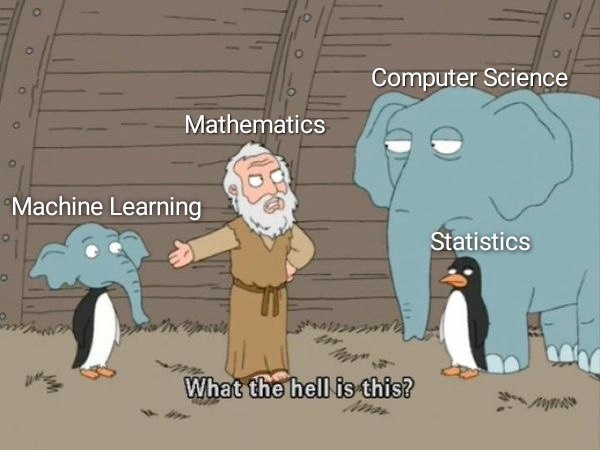
Think of Computer Science like a big elephant – strong and established – and Statistics like a penguin – smaller but very disciplined. They’re very different, like elephants and penguins. Now, Machine Learning is like a tiny elephant that suddenly appears next to them. It kind of looks like the elephant (because it involves computers and coding), but it’s small and standing next to the penguin (because it also involves a lot of data and math like statistics). The old man in the picture represents Mathematics, which is like the wise grandparent of both fields, expecting everything to be in its proper place. In the scene, Mathematics (the grandpa) is pointing at the little elephant confused and a bit startled, saying “What the hell is this?” – which is a rude-funny way of saying “What on earth am I looking at? This doesn’t belong here!”
Why is it funny? It’s like if you were sorting toys into boxes – cars in one box, dolls in another – and suddenly you find a toy that is half car, half doll. You’d probably hold it up and laugh, “What is this supposed to be?!” In this meme, machine learning is that half-and-half toy. It doesn’t fit neatly into the computer science box or the statistics box, and the math grandpa is comically upset about it.
Another simple way: think of two school classes, like a coding class (computer science) and a math class about probability (statistics). Now imagine a project that’s a mix of both – say, a program that guesses your drawing. The coding teacher and the math teacher both claim it’s part of their class. A senior teacher (mathematics) walks in and sees this project and just says, “Uh, what even is this? This isn’t just coding or just math – I’m confused!” It’s a playful take on how new ideas can be combinations of old ones, and it makes people laugh because the characters (elephant, penguin, and old man) react in such a human way to something unexpected.
So, the core joke is that machine learning is an odd one out. Just like a lone puzzle piece that doesn’t clearly belong to one set or another, machine learning leaves everyone a bit puzzled about where it fits. Seeing the serious, rule-following Mathematics act all confused and exasperated – pointing at a baby elephant of all things – is silly and highlights the confusion. Even if you don’t get all the deeper academic references, you can giggle at the basic idea: the poor old math guy is like “This doesn’t match the pairs of animals I expected! Why is there a baby elephant with a penguin?!” It’s absurd in a cartoon way.
In everyday terms, it’s as if someone brought a pet penguin to a dog show – the organizer (math) would be like “What the hell is this? This isn’t a dog!” Here the “dog show” is like the organized academic world, and machine learning is the penguin-crashing-the-dog-party because it mixes categories. The meme makes learning about this overlap funny by using a simple scene. Anyone who’s ever been confused by something that doesn’t fit in can relate. It’s poking fun at how we sometimes want to put things in neat boxes, and life (or in this case, science) comes up with things that just don’t go in one box easily. And that’s okay – but watching Mathematics freak out about it is the comedic twist that makes the meme memorable.
Level 2: Stuck in the Middle
Okay, let’s break down the basics of what’s going on here. This meme uses a Family Guy style cartoon image of Noah’s Ark to represent how different fields overlap (and clash) when it comes to machine learning. We have four main characters in the scene:
- Mathematics – represented by the old bearded man (dressed like Noah). He’s the one pointing and asking “What the hell is this?” In the Ark metaphor, Noah is used because he’s checking the animals boarding the Ark. Here Noah = Mathematics, meaning mathematics is like the overseer trying to classify everything properly.
- Computer Science – represented by the big blue elephant on the right. Elephants are huge, solid creatures – this hints that computer science is a big foundational field. In tech jokes, an “elephant in the room” is also something obvious we don’t talk about, but here it’s labeled outright. The elephant’s size shows CS is a heavyweight, established domain.
- Statistics – represented by the penguin next to the big elephant. Penguins are smaller than elephants, and here it might imply that statistics is a bit smaller or more niche compared to general computer science in the tech world. The penguin looks unamused, possibly indicating statisticians often feel a bit overshadowed or underappreciated when everyone hypes AI/ML.
- Machine Learning – represented by the tiny blue elephant on the left. It’s clearly an elephant like CS (same species), but it’s much smaller – almost like a baby elephant. It stands next to the penguin (Stats), kind of between the big elephant and the penguin. This visualizes that machine learning is related to computer science (both elephants, meaning ML involves programming, algorithms, computers) but also standing near statistics (because ML heavily uses statistical methods on data). It’s literally squeezed in the middle of Computer Science and Statistics in the picture.
Now, what’s the meaning behind this arrangement? The subtitle in the image, “What the hell is this?”, is Mathematics demanding an explanation for that tiny elephant. Why would Math be confused? Because machine learning doesn’t fit neatly into the traditional school subjects. Think of it this way:
- Computer Science (CS) is usually about writing programs, designing algorithms, making computers do tasks. It’s very broad – from theory (like figuring out the fastest way to sort a list) to practical (coding a game or app).
- Statistics is about collecting data, analyzing it, and drawing conclusions. Statisticians use math (especially probability) to test hypotheses, estimate numbers, and see what patterns might be real versus just random chance.
- Mathematics is the pure science of numbers, logic, shapes, and so on. Mathematicians like to create definitions, lemmas, theorems, and proofs. They ensure everything is logically consistent. Math is actually the foundation beneath both CS and Stats (CS uses a lot of discrete math and logic; Stats uses probability and linear algebra, which are math subfields). But math as a field is more about theory for its own sake – it’s not focused on writing code or analyzing real-world datasets; it’s about underlying truths.
Machine Learning is like a newer kid on the block that mixes CS and Stats. In machine learning, we write programs (so that’s CS) that learn patterns from data (that’s Stats). For example, an ML program might take a bunch of pictures of cats and dogs and “learn” how to tell them apart. Under the hood, that involves running algorithms (CS) and adjusting probabilities or model parameters based on data (Stats). This dual nature makes it tricky: should it be taught in computer science classes or statistics classes? Well, nowadays, it’s often in CS departments, but heavily uses statistical thinking.
So in the meme, Mathematics (like a strict school teacher) is looking at Machine Learning and asking “What the hell is this?” because it’s not obvious which category ML belongs to. It’s shown as an elephant (implying it might be related to computer science’s elephant) but it’s clearly not a full-grown elephant – suggesting ML is not a full standalone giant field like CS is. Meanwhile, there’s a penguin (Stats) on the other side, which is a completely different animal, and ML also shares a bit in common with that (because of the data analysis aspect). The mathematician’s confusion is basically: “Is machine learning a part of computer science, a part of statistics, or something entirely different? Please fit into my taxonomy!”
The discipline_overlap is visual: ML is physically between CS and Stats, meaning it overlaps with both disciplines. It’s a fun way to show that ML is interdisciplinary. People in data science often say you need to know programming (CS skills) and statistics/math to do machine learning well. This meme takes that practical truth and makes it into a Noah’s Ark joke: the “animals” (fields) are mixed up and poor Noah (Math) is not having it.
Think about being a student or a new engineer: if you love coding, you take CS classes; if you love data and numbers, maybe you take Stats classes. Then you hear about machine learning – it promises cool AI results but you find out you need both coding and statistics knowledge. It can be confusing! In fact, early-career folks often ask, “Should I learn more math and stats for ML, or more computer science?” because ML straddles the line. The meme humorously dramatizes that exact confusion using the characters:
- Machine Learning: “I write code to let data speak.”
- Computer Science: “That sounds like coding – you’re one of mine.”
- Statistics: “Wait, that sounds like analyzing data – you’re one of mine.”
- Mathematics: “Hold on now, both of you use my concepts. But what on Earth is this half-sized elephant doing next to a penguin? This doesn’t match my nice neat categories!”
The phrase “What the hell is this?” is actually a popular subtitle in many memes (often called the wat_the_hell_is_this_meme format). It usually shows someone pointing at something completely unexpected or out-of-place, exactly like here. It adds a tone of comical disbelief. The mathematician isn’t literally angry; it’s more like he’s bewildered and maybe slightly annoyed that something doesn’t follow the expected order. This exaggeration is what makes it funny. It’s as if the very concept of machine learning is so odd to him that he reacts the same way Peter from Family Guy (the source style) might react to seeing, say, a horse with two heads.
For clarity, let’s connect each label to real life roles:
- Mathematicians often ask: “Is this provable? What are the axioms or definitions?” They like clarity and generality. So a mathematician might find the ad-hoc nature of ML (try algorithm X, if it doesn’t work, try Y, tune some parameters until it works) to be messy or not properly defined. That’s why in the meme he’s upset; ML doesn’t present itself with a clear theorem-proof package.
- Computer Scientists might treat ML as a subfield of CS: “It’s basically just a bunch of algorithms (like decision trees, neural networks) and data structures (like tensors) – so it belongs to us.” In the meme, the big elephant doesn’t look scared or anything, just mildly bothered. CS folks sometimes feel they already cover ML, just like an elephant family might consider the baby elephant obviously one of them.
- Statisticians might claim ML as their own: “We’ve been doing those techniques under different names for decades. You call it ‘kernel machines’, we called it ‘smoothing methods’; you say ‘classification’, we say ‘discriminant analysis’. It’s statistics, just with fancier computers!” The penguin’s expression (if you imagine it) is like someone rolling their eyes or saying “I’ve seen this before.”
- Machine Learning specialists often see themselves as a blend: they have to code and also understand data. They might feel a bit out of place in a pure CS group (where others might be working on, say, operating systems or cryptography, which don’t involve data analysis), and also out of place in a pure Stats group (where others might focus on say epidemiology stats or survey sampling, which don’t involve building large software systems). So ML people sometimes jokingly call themselves the “awkward middle child” of CS and Stats. The tiny elephant being literally in the middle illustrates that.
The setting of Noah’s Ark is also symbolic. On Noah’s Ark, every animal is supposed to board in pairs of the same species (two elephants, two penguins, etc.). If you treat each academic field as a “species,” you’d expect two of each: maybe Noah has a pair of computer scientists, a pair of statisticians, a pair of mathematicians, etc. But here we see an elephant paired with a penguin and an extra odd elephant. It violates the two-of-a-kind rule. That’s why Mathematics (Noah) is saying “What the hell is this?” – it’s a humorous way to say machine learning doesn’t follow the usual rules or categories. It’s like showing up with an unexpected extra animal.
Now, imagine you are new to tech and you have interest in AI. You might wonder: should I study more math, more coding, or more stats? The answer often is: all of the above – because machine learning really is an interdisciplinary field. This meme might even reflect a bit of the confusion a student feels: your CS professor says “It’s just programming plus some formulas,” your Statistics professor says “It’s just advanced stats with more computing,” and your Math professor might say “You need to understand the theory deeply.” They all have a claim on ML. It can feel like multiple parents each telling you the “right” way.
To give a concrete example: think of a simple machine learning task like linear regression, which predicts a number (say, house price from size). If you take a Statistics course, linear regression is taught as a core statistical method (finding the best-fit line by minimizing error, deriving formulas, checking assumptions). If you take a Machine Learning course in CS, the same method might be taught as just one algorithm among many, maybe solved with gradient descent (an algorithmic approach) rather than a closed-form formula, and focusing on how to implement it efficiently. The stat class might dwell on confidence intervals and hypothesis tests; the CS class might focus on computation and prediction accuracy on new data. They overlap but the perspective differs. This is why ML sometimes feels like it’s pulling you in two directions – one toward the theory of data and one toward the practice of computing.
The meme simplifies that whole story into a single funny image: A small elephant that doesn’t know which family to join, and a strict elder demanding to know where it belongs. It’s data science humor in a nutshell: if you’ve been in those interdisciplinary turf debates, you immediately recognize each character’s attitude. If you haven’t, the image still works on a simpler level – it’s just funny to see someone bring a wrong-sized animal and get called out with “What the hell is this?” It’s like someone brought a penguin to an elephant party. It visually exaggerates the mismatch to make the point clear.
In summary, machine learning is shown as stuck in the middle because it truly is a blend of CS fundamentals and statistics. The meme uses a classic cartoon situation to say: Machine Learning is the odd one out that everyone’s trying to categorize. The humor comes from recognizing that truth. Even if you’re a junior dev just learning about AI, you might have sensed that you’re learning coding and a lot of math. This meme basically nods and says, “Yep, and even the experts find that a bit confusing!”
Level 3: The Elephant in the Room
At a practical level, this meme pokes fun at an interdisciplinary identity crisis that many experienced folks in AI/ML and DataScience have witnessed. Machine learning has exploded in popularity, but there’s a long-running joke in the community: “Machine learning is basically statistics reinvented by computer science folks – with faster computers and bigger egos.” The humor here is born from the way each field perceives ML, and the meme illustrates it with a literal elephant in the room scenario.
Picture the Ark as the tech world’s conference room. Computer Science (the full-sized elephant) stands firm with decades of established practice in software and algorithms. Statistics (depicted as a penguin, perhaps smaller but impeccably dressed in formal proofs) eyes new methods with a cool skepticism. Then in waddles Machine Learning, a pint-sized blue elephant that doesn’t quite match either side. The elder figure labeled Mathematics confronts this odd arrival with the blunt question: “What the hell is this?” – essentially calling out the fact that ML doesn’t cleanly belong to either heavyweight next to it. This line is actually the meme’s caption text, making the punchline explicit: mathematics is dubious and maybe a bit exasperated at this anomaly. Every senior developer or researcher who’s seen the academic turf wars chuckles here, because it’s too real.
Why is it so real? Because machine learning really did show up to the party wearing a mashup outfit. In practice:
- A statistician sees an ML engineer using a neural network and mutters, “We’ve been doing curve-fitting and regression for ages, now they call it a fancy new name.” Stats folks often joke that ML is just
new wine in old bottlestheir methods with rebranding. - A computer scientist observes a data scientist prototyping in Python with
numpyandpandasand says, “Sure, but can it scale? How about the algorithmic complexity?” CS veterans recall the AI winters (periods of hype then disappointment) and are wary of trendy techniques that might not be robust in production systems. - The mathematician in the corner attends an ML presentation and asks, “Can you prove it always converges? What about worst-case performance?” – only to receive awkward silence or a reply like “In practice it works… we tested on a validation set.” This lack of a theorem or CSFundamentals-level rigor triggers the mathematician’s inner Noah: the thing doesn’t fit his mental ark of well-classified knowledge.
The meme brilliantly compresses these attitudes: Computer Science’s elephant looks a bit annoyed (arms folded metaphorically), Statistics’ penguin looks unimpressed, and Mathematics is outright flabbergasted at the little ML elephant. It’s a confused_mathematician moment many have seen in interdisciplinary meetings or on blog wars between fields.
Consider real scenarios: A university’s Computer Science department claims Machine Learning as their turf (after all, ML involves writing code, training models on GPUs, and solving problems like a typical CS algorithm, just with data). But the Statistics department might argue that core ML techniques—like linear regression, decision trees, Bayesian classifiers—originated in statistics. There’s even a famous tongue-in-cheek rivalry: the term “Data Science” emerged, some say, because neither statisticians nor computer scientists could claim exclusive ownership of the new data-driven gold rush. Each field sometimes engages in a bit of eye-rolling at the others: statisticians lament how ML papers often ignore proven statistical techniques (or fail to understand p-value and confidence intervals), while CS professionals joke that statisticians can be stuck in theoretical assumptions that don’t scale to real-world big data. Machine learning people often find themselves defensively justifying their approach to both sides, essentially saying “We combine the best of both!” – much like a child trying to appease two parents.
To decode the AIHumor in the image, it helps to know the archetypes being portrayed: Family Guy’s style of humor is irreverent and often involves characters stating the obvious in blunt ways. Here the Ark setting suggests a play on Noah’s Ark: traditionally, Noah (Math) expects two of each kind. On his Ark of Science, he’s got one big elephant (CS) and one penguin (Stats) – two very different “animals”. The small elephant labeled ML is extra and doesn’t fit the expected pattern (it’s not a second penguin to pair with Stats, nor is it a matching big elephant for CS). It’s as if someone tried to smuggle a hybrid animal aboard. Noah/Mathematics pointing and saying “What the hell is this?” is exactly how a purist might react to a cross-disciplinary field that doesn’t fit established categories. It echoes that feeling in academia where someone from math attends an ML talk full of heuristics and empirical results and basically says, “Excuse me, this isn’t pure math, nor is it classic statistics or standard CS – so what on Earth am I looking at?”
This situation resonates with many developers and researchers: we’ve all been in meetings where an outsider voice questions the legitimacy of a new approach. It’s a rite of passage in tech for something trendy to get pushback from the old guard. For example, early on, database experts sneered at NoSQL databases – “What the hell is this? No schemas? Are you insane?” – a similar sentiment of confusion and mild horror that the meme captures. In ML’s case, the confusion is heightened because even the foundational people can’t agree on ML’s home. It’s a classic TechHumor scenario where the joke arises from truth: ML really does feel like an imposter at times, gate-crashing both the CS and Stats parties.
Another layer: the tiny_elephant_problem visually emphasizes that ML, while related to the elephant (CS), is smaller – implying maybe it’s a subset or a juvenile part of CS – but still not a completely separate species. ML often uses CS infrastructure (data structures, computing power) but with a different goal (predictive modeling rather than deterministic algorithms). Meanwhile, the penguin (Stats) stands there perhaps thinking, “Did everyone forget I also had an elephant? We statisticians have been doing predictive modeling and classification since way back – we just didn’t call it AI.” The penguin’s unamused face in the cartoon could very well represent a statistician bitter that machine learning grabs headlines while traditional statistics stays a bit underappreciated.
To summarize the scene in plain terms:
- Mathematics (Noah): the authority figure expecting a clear categorization. He’s basically the academic asking for a definition.
- Computer Science (Elephant): a big established field, maybe feeling superior yet also annoyed at having to accommodate ML as a new fellow “elephant.”
- Statistics (Penguin): a solid field, smaller in representation within the computer science-dominated tech world, possibly judging ML as lacking rigor. Penguins are birds that can’t fly but are excellent swimmers – a cute metaphor for statisticians who prefer deeper analysis in data rather than flashy leaps? (One can imagine Stats saying “stay grounded, don’t overhype” while CS tries to fly with innovation).
- Machine Learning (Tiny Elephant): the newcomer that borrows traits from CS (it’s an elephant too) but isn’t fully grown in the eyes of others. It stands between the big elephant and the penguin, visibly stuck in the middle of two worlds.
These characters reflect real sentiment. A veteran developer with a traditional CS background might find the data-driven, probabilistic approach of ML a bit foreign (“Where are my explicit algorithms and proofs?”). Conversely, a statistician might cringe at how ML sometimes ignores small-sample correctness or interpretable models (preferring giant black-box neural nets). And the mathematician often sees both camps using heavy math tools (like calculus, linear algebra, probability) but without the pure rigor or generality that math usually strives for. The result? Lots of head-scratching and exclamations of “What even is this field?!” in academic blogs and Twitter fights – precisely what the meme captures in one picture.
We can even imagine a humorous dialogue encapsulating the meme’s scenario:
Mathematics (pointing at ML): "What the hell is this supposed to be?"
Computer Science: "This little guy is with me – we coded him up from data."
Statistics: "Hmph, looks like something we’ve been doing, just wearing different clothes."
Machine Learning (sheepishly): "I…I use a bit from both of you..."
Mathematics: "Well, get in line! Are you an elephant or not? Where’s your pair?"
In reality, the resolution has been that ML is a highly collaborative field bridging the others – but that punchline of exasperation from the mathematician nails how people feel when confronted by something that defies their normal categories. Seasoned devs and scientists laugh because they’ve lived this: the awkward but creative blending of domains that produces great results and great confusion. The discipline_overlap is where innovation often happens, but it’s also where identity crises occur. And that’s the elephant (and penguin) in the room: ML is awesome and influential, yet still figuring out how to introduce itself at the academic family reunion.
| Field | Focus & Tools | Reaction to ML |
|---|---|---|
| Mathematics | Formal proofs, abstract frameworks | “Define your terms! Is this a theorem or what?” |
| Statistics | Data inference, probabilistic models | “We’ve done this since forever…just check our textbooks.” |
| Computer Science | Algorithms, computational efficiency, systems | “Cool hack – but will it scale and is it robust?” |
| Machine Learning | Pattern recognition, data-driven algorithms | “We just care that it works (we’ll figure out why later)!” |
This table sums it up: each field’s mindset and their knee-jerk take on ML. It’s a friendly roast of all sides. The meme gets its AIHumor from exactly these contrasting attitudes squeezed into one Ark. For anyone who’s worked on a machine learning project in a diverse team, those speech bubbles practically write themselves. And yes, in many meetings, the quote “What the hell is this?” (or a polite variant of it) has been uttered by someone like our Mathematics character, hands thrown in the air, when encountering an interdisciplinary approach that doesn’t fit their mental model. It’s a scenario as classic (and as funny) as a Family Guy cutaway gag, which is why this meme lands so well with the tech crowd.
Level 4: Taxonomic Turmoil
In the academic ecosystem, Machine Learning (ML) sits at a curious intersection of disciplines, leading to a taxonomy crisis in the halls of academia. The meme’s Noah’s Ark scenario is a wry nod to how fields are categorized: Mathematics (the wise bearded Noah figure) expects each intellectual domain to come in neat pairs (like species on the Ark), but machine learning defies simple classification. Formally, one might attempt to place ML in set-theoretic terms:
$$ \text{MachineLearning} \approx \text{ComputerScience} \cap \text{Statistics}, $$
an intersection of algorithmic techniques and statistical inference. But ML also draws heavily on its parent disciplines’ theoretical foundations without fully belonging to either. This creates a kind of discipline_overlap that can befuddle the purists.
From a theoretical standpoint, machine learning’s identity crisis stems from its blend of CS fundamentals (algorithms, data structures, computational complexity) with statistical theory (probability, estimation, inference). For example, the VC dimension and PAC learning are concepts from computational learning theory that bring rigorous Mathematics into model training – they sound like something out of a pure math textbook (set theory and combinatorics meet probability) but were born to analyze ML algorithms. Meanwhile, the No Free Lunch Theorem (a mathematically proven result in learning theory) underlines that without assumptions, no ML algorithm is universally superior – a sobering theoretical constraint that a mathematician would appreciate on a deep level. This theorem bridges statistics and CS: it’s essentially a statement in mathematical language about every possible learning algorithm’s performance averaged over all problems.
Yet, despite these formal underpinnings, ML often advances through pragmatic, empirical discoveries (think of the success of deep neural networks) rather than complete rigorous theory. This can make a pure mathematician uneasy. The meme personifies Mathematics demanding “What the hell is this?” because ML’s methods can appear as a misfit: lacking the proof-first rigor of pure math, not fitting the classical elegance of statistics, and straying from the clean abstractions of theoretical CS. In academic meetings, it’s not uncommon to find a mathematician asking whether a new ML model is well-defined or provably convergent, while practitioners shrug that it works in practice. ML’s reliance on techniques like high-dimensional optimization (e.g. gradient descent in a million-dimensional space) is built on applied mathematics (calculus and linear algebra), yet the guarantees on these techniques are often loose. Mathematics (think of Noah here) likes well-ordered pairs and clear definitions, but ML presents fuzzy boundaries and hybrid methodologies.
Historically, this tension has deep roots. In the mid-20th century, statistics and computer science evolved separately: statisticians formalized inference and significance testing, while computer scientists honed computability and algorithm design. Machine learning emerged when these paths converged – for instance, when neural networks were studied, requiring both computational algorithms and statistical generalization theory. In 1995, a famous ML paper “Probabilistic Graphical Models” blended graph theory (CS) with probability (stats); by the 2000s, the rise of big data forced a union, but not a fully harmonious one. Each discipline brought its intellectual animals onto the Ark, and ML was this new hybrid passenger. One could say ML’s academic lineage is a chimera: part computer scientist (an elephant never forgetting to optimize), part statistician (a penguin rigorously testing hypotheses), plus a dose of hacker instinct from engineering. No wonder the mathematician on the Ark looks puzzled – ML doesn’t come with a clear species label in the grand taxonomy of science!
To mathematicians, everything should reduce to definitions and theorems. They see an elephant (Computer Science) and a penguin (Statistics) and expect each species to have a matching pair. Instead, they find a tiny_elephant_problem: Machine Learning shows up as an undersized elephant that seems like it should be a part of the elephant family (CS) but clearly has traits of a different species (Stats). This dissonance is essentially an ontological question: what kind of thing is ML? A subset of CS? A subfield of Stats? Or a new genus altogether? There’s even ongoing debate whether data science (the broader practice around ML) is its own discipline or just a rebranding of statistics and CS fused together. The meme cleverly captures this academic turf war using the Ark metaphor – Mathematics (like a taxonomist) demands a proper classification for the strange newcomer.
In theoretical computer science terms, we might formalize the confusion like a logic puzzle: “Given that all elephants board in pairs and all penguins board in pairs, what do we do with an entity that looks like an elephant but statistically behaves like a penguin?” Mathematicians are known for their exactness, so an ill-defined category triggers them. Some have tried to formalize ML’s foundations: e.g., developing category theory approaches to ML or framing learning as function approximation in high-dimensional Hilbert spaces (see: Reproducing Kernel Hilbert Spaces in support vector machines). But even with such efforts, the field retains an empirical wild side. It’s telling that a famous quip often attributed to mathematician John von Neumann goes: “With four parameters I can fit an elephant, and with five I can make him wiggle his trunk.” This tongue-in-cheek quote lampoons overfitting – you can mathematically force a model to fit anything (even the shape of an elephant) if you give it enough parameters. A mathematician referencing this joke might be implicitly saying: “Is machine learning just using huge parameter models (like deep neural nets) to ‘fit the elephant’ without elegantly explaining why it works?” In other words, ML sometimes violates the parsimony and clarity that Mathematics holds dear.
All these deep theoretical nuances hide in the shadows of that simple cartoon frame. The confused_mathematician on the Ark is essentially voicing a foundational question: Is machine learning a legitimate distinct scientific species or a half-grown offshoot of existing ones? The humor lands because anyone steeped in the theory knows this isn’t just a silly question – it’s an ongoing intellectual debate. The meme distills a complex interdisciplinary paradigm paradox into a single, skeptical gesture from Mathematics. And just like Noah pointing at a mismatched pair, the theoreticians keep pointing at ML demanding “Define yourself clearly!” while ML just stands there, a small elephant aware it doesn’t quite have a formal partner in the Ark of knowledge.
Description
A meme using the 'What the hell is this?' format from the animated show Family Guy, set on Noah's Ark. Noah, labeled 'Mathematics,' looks bewilderedly at a hybrid creature that is part elephant and part penguin. This creature is labeled 'Machine Learning.' To the right, a full-sized elephant labeled 'Computer Science' and a penguin labeled 'Statistics' stand together, implied to be the parents. The scene humorously portrays Machine Learning as the strange and unexpected offspring of Computer Science and Statistics, with Mathematics as the foundational discipline looking on in confusion. This resonates with developers and data scientists who understand that ML is an interdisciplinary field combining algorithmic principles from CS with theoretical foundations from statistics

Comments
7Comment deleted
Machine Learning is what happens when you let statisticians write production code and software engineers play with probability
Machine learning: too statistical for CS faculty meetings, too CS-heavy for statisticians - and the mathematician still wants a proof of convergence
Machine Learning is just linear algebra wearing a trench coat, trying to convince venture capitalists it invented thinking while Statistics quietly does all the actual work and Computer Science takes credit for the GPU bills
Machine Learning: the field where statisticians think you're doing computer science, computer scientists think you're doing statistics, and mathematicians are just confused why you keep calling matrix multiplication 'deep learning.' Meanwhile, ML practitioners are too busy tuning hyperparameters to care about their existential identity crisis
ML engineer after years of GPUs: 'Wait, statistics? Isn't that just the prior for my next ensemble model?'
Machine learning is statistics in an elephant costume with a CUDA budget; CS asks about complexity, math wants a proof, and prod just wants an SLA
Every roadmap meeting says “AI,” data science says “statistics,” engineering says “Kubernetes,” and we ship regularized logistic regression behind a REST endpoint - prompting the mathematician to ask, “What the hell is this?”