Skip to content
DevMeme
698 of 7435
The 'I Wrote It Myself' Monolithic Tool
TechDebt Post #791, on Nov 8, 2019 in TG

The 'I Wrote It Myself' Monolithic Tool

Why is this TechDebt meme funny?

Level 1: One Tool, Big Mess

Imagine you have a friend who wants to invent the ultimate all-in-one gadget. They take a hammer, a pair of scissors, and a screwdriver and tape them all together into one contraption. Now they proudly show it to you saying, “Look, now I only need to carry one tool!” The result is pretty silly, right? If you actually try to use it, it doesn’t work well: the heavy hammer makes the scissors hard to handle, the screwdriver pokes your hand while you use the hammer, and overall it’s just clumsy and uncomfortable.

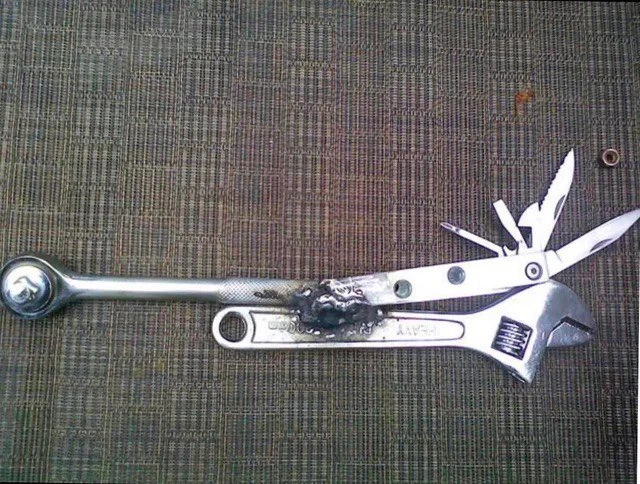
This meme is funny because it’s showing exactly that kind of silly invention, but in real life. Someone welded (kind of like super-glued with metal) a bunch of tools together – a wrench with extra gadgets – and is apparently proud of it, saying “Yeah, I built this myself.” It’s like a child gluing all their favorite toys into one mega-toy and saying, “Now I have the only toy I’ll ever need!” Everyone else can see that it’s a big jumbled mess. Maybe it sorta works, but it’s definitely not a good tool. If you tried to actually fix your bike with that thing, you’d have a hard time.

The core of the joke is about trying to do too much in one go and how that backfires. It’s like if you tried to make one super vehicle that’s a car, a boat, and an airplane all at once. You might end up with a machine that can kind of drive, kind of float, and kind of fly, but it would probably be a terrible car, a leaky boat, and a very unsafe airplane! In the end, using three separate vehicles would work a lot better. So, when that person says “I made this module myself” (or “I made this tool myself”), we laugh because they’re acting proud of something that is obviously not well-designed. It’s the kind of prideful but misguided thing that even kids recognize: like a friend bragging about a complicated LEGO build that’s held together with tape – sure, it’s all in one piece, but you know it’s going to fall apart or not do what it’s supposed to.

Everyone can appreciate how ridiculous the combined tool looks. The humor doesn’t require any special tech knowledge; it’s basically saying: if you try to put everything into one thing, you’ll end up with a goofy, impractical result. And it’s funny because we’ve all been a little over-ambitious at some point, making something more complicated than it should be. This picture is just a perfect, laughable example of that idea – a single tool that tries to do it all and ends up doing it all... badly. So the lesson is simple (and amusing): sometimes using the right separate tools (or making things one at a time) is better than a wacky “one tool to rule them all.”

Level 2: Swiss Army Codebase

Let’s break this down in simpler terms. In software, we usually try to design our code kind of like a toolbox: each class or function is like a separate tool with a specific purpose. One might be a wrench (for tightening bolts, i.e. handling a specific task), another might be scissors (for cutting, i.e. handling another separate feature), and so on. The image shows what happens when someone instead tries to build one giant tool that does everything. It’s as if a programmer said, “Why carry a whole toolbox? I’ll make one super-tool that can do every job!” In code, that might mean writing one huge module or one class that contains all the features and logic for an entire application. This is often called a monolithic design – “monolithic” meaning “one big block”, in this case one big codebase that handles everything internally.

The problem? That one big tool or codebase becomes a mess – hard to use, hard to understand, and hard to change. In software, when we cram too much into one place, we lose something called separation of concerns. Ideally, each part of a program should be concerned with (focused on) one thing. For example, one part handles user input, another handles calculations, another handles saving data to disk. When one part tries to handle everything at once, it’s like our multi-tool: ungainly and awkward. Developers even have a nickname for a class that has too many duties: a “God class” (because it seems to have god-like power over every part of the program). A God class might have methods to start the UI, process data, connect to the database, send network requests, all in one place. Sure, it works, but it’s a nightmare to deal with later on.

Why is it a nightmare? Imagine a single file or class that’s, say, 5000 lines long. If there’s a bug, you have to search that giant sea of code to find it. If you change something, you might accidentally affect completely unrelated functionality because it’s all intertwined. It’s like if your one Swiss Army wrench’s blade got dull – and somehow that also made the wrench part stop working properly because they share some weird spring mechanism. In a code sense, everything is tied together, so a change in one spot can break things in another. Also, it’s hard for multiple people to work on a single big file at the same time without stepping on each other’s toes (just like two people trying to use different parts of the attached tool at once – impossible!).

Let’s relate some of the terms to this scenario:

  • OverEngineering: This means designing something more complicated than what’s actually needed. If you only needed a wrench and occasionally a knife, making this combo-tool is overengineering. In coding, overengineering might be when someone writes a super generic framework for a task that could have been solved with a much simpler script. They might be anticipating future needs or trying to be clever, but often it results in a lot of extra complexity for no gain. Here, adding scissors and a ratchet to a wrench is kind of over-doing it – a wrench by itself, or a separate pocket knife, would probably suffice.
  • TechnicalDebt: This is a term for the cost of quick-and-dirty design choices we make in code. Just like financial debt, technical debt “accumulates interest” – the quick hack you did to meet a deadline might make future development slower or more error-prone (that’s the interest you pay). In the image, the lumpy weld and mismatched parts are like visual technical debt. They got the job done in a hurry (now you have one tool that technically has all features), but it’s ugly and brittle. Eventually, someone will have to “pay back” that debt by redoing the design properly (or suffer when the tool breaks at the worst time).
  • MonolithArchitecture: A monolithic architecture is when an application is built as a single, unified unit. For example, an old-style web app might be one big WAR file or a single server process that does everything – handles login, serves the UI, talks to the database, etc. This is opposed to a microservices architecture (or just a modular architecture) where you split responsibilities into different services or components. Monoliths can start simple, but as they grow with new features, they can turn into that all-in-one tool. The meme tool is a physical monolith of tools. If it were software, it’d be one program handling a dozen tasks that normally you’d split up.
  • ArchitectureTradeoffs: In software design, for every choice you make (monolith vs multiple components, generic vs specific design), there are pros and cons – tradeoffs. The tradeoff of making one big tool is you only have to manage one thing, but you sacrifice flexibility and maintainability. The tradeoff of having separate tools (or code modules) is you have to manage more pieces, but each is simpler and can be changed independently. The meme clearly shows the downside of one big tool approach: it’s not really usable. In code terms, a single blob of code might be easier to deploy (one deploy) but very hard to update safely.
  • DesignPatterns: These are typical solutions to common design problems – templates for how to structure code. Now, “every pattern jammed in” as the description jokes, means the creator probably tried to use many different design patterns all in one project unnecessarily. It might be mocking the tendency of overenthusiastic devs to say “Hey, I read about this pattern, let’s implement it here!” even if it doesn’t fit – ending up with an over-complicated design. It’s like if someone learned how to use a new tool and had to incorporate it into this multi-tool: “I just got this new scissors attachment, so I welded it on because maybe I’ll need it.” The result is clutter. Good design is about choosing the right pattern and keeping things focused, not cramming them all in.

To illustrate, consider a code example. Here’s a very simplified pseudo-code of a God class that tries to do too much:

class OneToolToRuleThemAll:
    def __init__(self):
        self.db_conn = self.connect_database()      # handles database connections
        self.server = self.start_web_server()       # starts a web server
        self.config = self.load_config()            # loads configuration
        # Imagine lots of properties initialized...

    def connect_database(self):
        # ... code to connect to a database ...
        pass

    def start_web_server(self):
        # ... code to start a web server ...
        pass

    def load_config(self):
        # ... code to load configuration ...
        pass

    def process_user_input(self, input_data):
        # ... code to process data from user ...
        pass

    def render_ui(self):
        # ... code to render some user interface ...
        pass

    def send_email(self, recipient, msg):
        # ... code to send an email ...
        pass

    # ... perhaps dozens more methods handling logging, authentication, payment, etc. ...

// This class is an example of a "God class" – it handles database, server, UI, email, all in one. Not good! 🚫

In a more reasonable design, each of those tasks (database, web server, email, UI) would be in separate classes or modules. For example, you’d have a DatabaseClient class, a WebServer module, an EmailService, etc. Then the main program would use those pieces together. That way, if you needed to change how email is sent, you’d go to EmailService and it wouldn’t affect the database or UI code. In the all-in-one approach, everything is intermingled, so a small change can ripple through unexpectedly.

Think of it another way: suppose you had one big workbook for all subjects in school – math, history, science, art all in one notebook. It might seem convenient to carry just one notebook instead of four. But then all your notes are jumbled together. When you want to study just math, you have to find the math sections scattered among everything else. If you lend your notebook to a friend so they can borrow your history notes, oops – they now also have your math and science notes (and could mess them up). Separating subjects into different notebooks (or binders) might be a tiny bit more to carry, but it keeps things organized and manageable. In programming, separating concerns into different files/modules/classes is similar: it organizes the “subjects” of your code so you don’t have one giant jumbled notebook.

The Swiss Army knife comparison is actually widely used in programming discussions. A Swiss Army knife is handy for light tasks, but if you had to, say, cut a thick rope, you’d prefer a real knife with a proper handle. And if you had to tighten a heavy bolt, you’d want a full-size wrench, not the mini wrench or whatever multi-tool attachment. In the same way, a code module that tries to be a Swiss Army knife – doing everything – usually isn’t great at any one thing. It tends to be slow, or difficult to modify, or just confusing. Developers might joke, “Our code turned into a Swiss Army knife, when we really needed a set of proper tools.”

Technical debt is evident in the scorched weld of the tool: think of it like someone saying “We’ll just tack this on for now and fix it later.” If you’ve ever written a quick fix in code (like hard-coding a value or duplicating code because you didn’t have time to make a neat function), that’s taking on technical debt. It’s okay in the short term, but if you keep doing that without cleaning up, you end up with something that’s held together by “welds” and patches, and nobody fully understands how it all works. Eventually, developing new features or even maintaining the old ones becomes really slow and risky, because the code is so convoluted (just like how using that welded tool is slow and risky for the person using it).

The meme is basically a humorous warning: don’t build a “God tool” or “God class”. As a newer developer, it might be tempting to think, “I’ll just write one class that does it all, that’s efficient!” But as systems grow, that approach can lead to a world of hurt. Instead, it pays off to learn about good design practices:

  • Break your program into logical pieces (maybe follow the Single Responsibility Principle, which says each module/class should have one responsibility).
  • Only include features you actually need (You Ain’t Gonna Need It (YAGNI) is a mantra against overengineering – don’t add things now just because you think you might need them later).
  • Use multiple simple tools in harmony rather than one uber-tool. For instance, a microservice architecture would have different services for different capabilities (user service, payment service, etc.) rather than one gargantuan service doing everything.

In short, the “Swiss Army codebase” in the meme reflects a scenario that every developer is warned to avoid. It’s funny to us because the physical absurdity of that welded tool perfectly represents the absurdity of a codebase we might have encountered or inherited. Monolith architecture taken to an extreme looks just as unwieldy in code as that tool does in reality. And while a Swiss Army knife is real and has its uses, this particular “wrench-knife-socket hybrid” is clearly a joke – no one would seriously use that, just like hopefully no one would intentionally design a system that messed up. But sometimes, through bad planning and constant feature creep, you end up with one, and then developers later have to carefully cut it back apart into sane pieces. Let this be a lighthearted lesson in code design: if your solution starts to look like this multi-tool, it’s time to refactor! 🔧✂️⚙️

Level 3: Franken-Tool Architecture

In everyday software development terms, this meme hits home for any senior engineer who’s slogged through a gnarly legacy codebase. We’re looking at the Frankenstein’s monster of tools, an object that’s been mutated over time to meet every new requirement by just bolting another piece on. The humor (and horror) here comes from recognition: we’ve seen this before in our code. That adjustable wrench with Swiss Army knife blades and a ratchet welded on is basically a physical avatar of a bloated code module or an overstuffed class. It’s the kind of over-engineered solution that makes you laugh, then cry a little inside, because you recall that one Utils.java (or MainService.cs or giant_monolith.py) file that had a similar “everything but the kitchen sink” vibe.

Why is this funny to seasoned devs? Because it’s painfully relatable. The caption, > "Ya I wrote this module myself...", is something we’ve effectively heard before – that one developer proudly demoing a massive all-in-one function they hacked together. It’s the same energy as someone showing off a “clever” 1000-line function that scrapes user input, queries the database, sends emails, and draws the GUI, all in one. The rest of the team is giving a polite smile while internally screaming. In the meme, the person has literally welded disparate tools into one monstrosity, and they’re bragging about it. As a senior engineer, you’ve likely done a double-take during code review, seeing a new contributor’s code that looks exactly like this welded tool – a god_object_physical_manifestation if there ever was one. You can almost hear them say, “It may look odd, but trust me, it works!”

This image cleverly captures overengineering and technical debt rolled into one visual. Overengineering, because clearly someone went out of their way to combine every tool imaginable instead of using simple separate tools. In software, overengineering shows up when someone builds an overly complex “framework” for a simple task, or abstracts things to the point of absurdity “just in case we need it later.” Here, maybe the builder thought, “Wouldn’t it be convenient if one tool could do it all? Then I’d only carry one thing!” – echoing a developer saying, “Let’s write a one-size-fits-all module so we don’t have to create multiple programs.” It sounds convenient until that one thing becomes unwieldy. The technical debt angle is seen in that ugly weld seam and the generally haphazard construction. It’s like looking at a codebase with a bunch of // QUICK HACK comments scattered around. Each welded part corresponds to a feature that was tacked on under pressure: the blades added when someone needed cutting functionality last minute, the extra handle welded on when someone complained the wrench didn’t have torque. In a code analogy, maybe the client suddenly needed PDF generation, so you crammed it into the authentication service because “that service was already talking to everything anyway.” Sure, it works in production, but now your auth service can also generate PDFs and send emails and predict the weather – why not? Each addition was faster than refactoring properly, and each left behind some “burn marks” in the architecture. The result is a tech debt time-bomb: just as you wouldn’t trust that welded tool under heavy load, you wouldn’t trust that do-it-all module when the next critical deadline hits. It’s held together by proverbial duct tape (hence the tag devops_duct_tape_solution): it might survive a while, but it’s one stress away from snapping.

Let’s talk architecture trade-offs. In theory, having one tool or one service that handles everything might simplify deployment – one thing to deploy, one thing to keep track of. In practice, it becomes a monolith architecture that’s rigid and fragile. Monoliths aren’t inherently evil, but this image shows a worst-case monolith: tightly coupled to an extreme. All the parts share a common structure (one handle) and can’t function independently. If you break the main handle of that tool, you’ve lost your wrench and your knife and your screwdriver in one go. Similarly, in a software monolith like this, if one part crashes or has a major bug (say the “scissors” function misbehaves), it can bring down the entire application. There’s no isolation. A senior dev looking at this thinks, “One deployment unit, sure – and one giant point of failure.” This is why modern architectures favor microservices or modularization: we’d rather have a set of specialized services (separate tools) connected via clean APIs (like keeping tools in the same toolbox but not literally fused together). If the scissors break, your wrench still works. In a proper system, if the email service goes down, the login service can still function. But in the welded all-in-one approach, everything’s entwined – one breakage or needed update means deploying the whole monstrosity anew, with all the risks that entails.

We can also see commentary on design patterns and anti-patterns. The meme is effectively calling out the “Swiss Army knife” anti-pattern – when someone designs a class or function to handle too many different tasks, often rationalizing it as making the system “configurable” or “extensible”. It’s the opposite of KISS (Keep It Simple, Stupid). A senior engineer has probably encountered that one util library that started as a small toolbox and over years turned into this massive catch-all monster because every time someone had a new need, they were told “just add it to the util library, it already has so much of our code.” Over time, that poor library accumulates everything from date parsers to network clients to HTML templating – a real Swiss_army_wrench codebase. This yields an architecture that looks fine from 10,000 feet (one library! one module!) but up close it’s a horror show of tangled logic. The meme’s tool has an adjustable wrench jaw and tiny folding blades and a ratchet drive sticking out. Likewise, that god-class in code might have methods for computing interest rates, drawing UI widgets, sending network requests, and who knows what else, all jumbled together. Seasoned devs see the joke: we’ve dealt with that “God module” that tries to do it all. It’s often proudly introduced in a sprint demo by someone saying, “Check out our new All-in-OneManager class, it handles user accounts, inventory, and email notifications!” And every senior dev in the room instinctively clutches their head.

The image also gets a chuckle because of the DIY “I can fix it” energy it exudes. There’s a certain type of engineering culture where instead of using multiple properly-designed tools or libraries, someone insists on crafting a single uber-solution. Maybe they wanted to avoid dependency bloat or genuinely believed one unified tool was more elegant. It’s reminiscent of that colleague who says, “I don’t want to pull in another library, I’ll just extend our current one to also do JSON parsing.” Next thing you know, your XML parser library is now also a JSON parser and a web server 🙈. The welded wrench screams that kind of hubris: I got this, I’ll just attach one more thing. It’s a god_object_physical_manifestation of the phrase “when all you have is a hammer, everything looks like a nail” – or rather, when all you want is one hammer, you start welding screwdrivers onto it to handle screws too. A senior dev has learned (often the hard way) that such one-stop solutions become maintenance nightmares. Just imagine trying to sharpen the knife on that tool without cutting yourself on the other pieces, or trying to loosen a bolt and having the knife blades flop out unexpectedly. In code, maintenance gets equally perilous: change one thing in the mega-module and you might break ten other features you didn’t even realize were interconnected through it.

Finally, consider the social aspect – the engineering team dynamic. Whoever made this tool and says “I built it myself!” may feel proud, but what they’ve created is a single point of heroics and failure. In a healthy team, you’d want multiple people comfortable with the code, clear separation so folks can work in parallel on different pieces. With a contraption like this, often only the original author fully understands how it’s put together (and even they might forget over time). It becomes that “hero module” maintained by one person, which is a huge risk. If they go on vacation (or quit), everyone else is afraid to touch the thing – much like nobody wants to actually use that freakish tool for fear of it falling apart. A senior engineer will recognize this scenario and likely chuckle recalling a time they were either the reluctant caretaker of such a beast or the one begging another team member to finally split it into sane parts.

In summary, the meme’s comedic effect is powered by a very real engineering truth: trying to jam every feature and pattern into “one tool to rule them all” results in an ugly, impractical, hard-to-use solution. It’s sarcasm in physical form about poor code quality and bad architecture. The longer you’ve worked in software, the more this image evokes a mix of amusement and war stories:

  • “We once had an app just like that – took us a year to untangle it into microservices.”
  • “This is what happens when you never say no to a feature request and never refactor – you get the Swiss Army wrench from hell.” It’s a senior-level inside joke: we laugh because we’ve survived this architecture horror and have the singe marks (like that scorched weld) to prove it.

Level 4: Big Ball of Mud

At the highest level, this image is a portrait of software architecture entropy. In academic and architecture circles, a system like this gets dubbed a “Big Ball of Mud” – an amorphous, ad-hoc conglomeration of code that lacks clear structure or boundaries. Just as this welded contraption has no single, coherent design, a Big Ball of Mud software system is one where every new feature or fix has been glommed on with little regard for elegance or plan. The result is chaotic: modules interwoven in unexpected ways, much like a wrench sprouting scissors and a ratchet handle.

This monstrosity also embodies the infamous God Object anti-pattern in object-oriented design. A God object (or God class) is a class that knows too much or does too much – essentially trying to be omnipotent within the code. Here we have a literal God object in tool form: one tool that tries to encompass the functionality of a wrench, a screwdriver (ratchet), and a Swiss Army knife all at once. In theory, an object that “does it all” might sound powerful, but theory collides with reality: such an object violates fundamental design principles like Single Responsibility. By attempting to handle everything, it handles nothing well and becomes impossible to maintain. In software, violating the Single Responsibility Principle means one class or module has too many reasons to change; in this welded tool, one device has too many separate purposes to fulfill. The charred, lumpy weld seam on the tool is a perfect metaphor for what happens when a codebase accumulates technical debt. Each quick fix or ad-hoc feature addition leaves behind “scars” in the architecture – little globs of complexity that scorched the original design. Over time, these scars compound, and the original clean structure (the original wrench’s shape and markings like the faint C-FAW 200 stamp) gets obscured under layers of hacks. This is software entropy in action: left unchecked, any system tends toward disorder. Maintaining a clear architecture is like fighting the universal tendency for things to fall apart or become chaotic. Every time a new blade or handle is welded on to solve an immediate problem, the overall structural integrity and clarity of the system degrades a bit more.

From a theoretical standpoint, one could even frame this as a cautionary tale about complexity theory in software design. As you add more components into a single coupled system, the complexity often grows non-linearly. Each new blade (feature) might interact with all the existing ones in unpredictable ways. In a clean modular design, adding a new feature ideally has limited impact on existing ones (like adding a new separate tool to your toolbox doesn’t interfere with the others). But in a tightly-coupled “one tool” system, adding a new capability is like welding on another appendage – you risk destabilizing the whole structure. Mathematically, if every part can potentially affect every other, the number of interaction paths can explode combinatorially (in the worst case, growing on the order of $O(n^2)$ with n features). No wonder the resulting structure looks so unstable.

There’s also a historical lesson here. The pursuit of “one tool to rule them all” is reminiscent of the software industry’s periodic obsession with grand unified solutions – the mythical Silver Bullet that will slay all complexity. Fred Brooks, in his essay No Silver Bullet, famously warned that no single technology or methodology would give an order-of-magnitude improvement in software productivity. Attempting to build a universal solution often backfires. In fact, this multi-tool reminds one of second-system syndrome: the tendency of engineers, in their second iteration of a system, to over-engineer by stuffing in every feature and idea they couldn’t in the first. The logic goes, “Wouldn’t it be great if our tool also handled X, Y, and Z?” So they weld X, Y, and Z on, imagining they’re creating the ultimate all-purpose system. Instead, they’ve created a fragile beast. This physical franken_tool (Frankenstein tool) illustrates second-system syndrome’s endgame: an over-ambitious design collapsing under its own weight.

From the vantage of formal design theory, we can say this welded multi-tool completely sacrifices modularity and separation of concerns. In an ideal architecture, you’d have well-defined modules or components (separate tools) each focused on a particular concern – one for bolting, one for cutting, one for tightening, etc. They might connect through clean interfaces (like how separate tools can be used together when needed). But here, all concerns are mashed together in one physical object with no clear interfaces between them. It’s like trying to enforce all GoF Design Patterns simultaneously in one design – the result isn’t genius, it’s gibberish. The tool tries to be a Factory, a Singleton, a Strategy, and an Observer all at once (to throw in some pattern names for effect), and the outcome is an architectural nightmare rather than a dream. Sometimes in code you see this when a class has multiple design pattern roles mixed together – say, it’s a Singleton global instance that also behaves like a Controller and also fires events as an Observer. That’s equivalent to welding patterns atop each other without thought for the bigger picture.

We could even draw parallels to a Turing Tarpit for tools: a situation where “everything is possible, but nothing of interest is easy.” A tool like this is theoretically very flexible – you could loosen a bolt, cut a wire, and snip paper with it – making it mechanically Turing-complete for handyman tasks. But practically, each task is clumsy and inefficient, just like a Turing-complete esoteric programming language where writing even a simple program is torturous. The Turing tarpit comparison emphasizes how a system that aims to allow any operation ends up being good at none. Similarly, a codebase that tries to implement every feature and pattern will boast broad capabilities on paper, but every single operation (every development task, every debugging session) becomes a slog through the tar.

In sum, this meme encapsulates some deep software engineering truths: Architecture matters. If you ignore sound design principles and let a system accrete features without a guiding vision (beyond “does it work right now?”), you eventually pay the price. The price is an architecture so baroque and tangled that it becomes the butt of a joke – a “Swiss-army-wrench” that provokes equal parts laughter and horror among seasoned engineers. It’s a visual punchline about the fate of all-in-one solutions: in trying to solve everything, they threaten to solve nothing well. Theoretical foundations of software design scream against this kind of outcome, and this meme shows why in one glance. It’s the physical manifestation of a god object – an abomination unto clean code – reminding us that just because you can weld everything together doesn’t mean you should.

Description

A photograph on a textured brown background shows a bizarre, custom-made hand tool. It's a monstrous combination of three distinct tools crudely welded together: a socket ratchet, an adjustable wrench, and a multi-tool pocket knife. The multi-tool part is partially open, showing a blade and other implements. The welding is lumpy and discolored, emphasizing the amateur and forced nature of the combination. The caption, '"Ya I wrote this module myself..."', frames this object as a perfect metaphor for a piece of software. It represents a monolithic, over-engineered module that violates the Single Responsibility Principle. Instead of composing small, focused, and reusable tools (or libraries), the developer has created a single, tightly-coupled, and unmaintainable monstrosity that is clumsy and inefficient at everything

Comments

7
Anonymous ★ Top Pick I see you've implemented the 'Swiss Army Wrench-Knife-Ratchet' pattern. It's perfect for when you need to strip a bolt, accidentally cut a wire, and then realize you needed a Phillips head screwdriver all along
  1. Anonymous ★ Top Pick

    I see you've implemented the 'Swiss Army Wrench-Knife-Ratchet' pattern. It's perfect for when you need to strip a bolt, accidentally cut a wire, and then realize you needed a Phillips head screwdriver all along

  2. Anonymous

    Sure, you *can* consolidate all your microservices - just don’t be surprised when the new ‘God Object’ needs a welding mask and a tetanus shot to maintain

  3. Anonymous

    When your custom module is so tightly coupled it achieves nuclear fusion during the decoupling attempt

  4. Anonymous

    This is what happens when you let a full-stack developer design hardware - they can't resist adding 'just one more feature' until you've got a ratchet that can also open wine bottles, file your nails, and probably has a deprecated SOAP endpoint somewhere in there. It's the physical manifestation of every enterprise framework that started as a simple HTTP library and somehow ended up requiring 47 transitive dependencies and its own orchestration layer

  5. Anonymous

    Execs ask for a single pane of glass; we deliver a god-object with sharp edges, a burnt integration layer, and bash holding it together

  6. Anonymous

    Like a monolith: wrenches infra, slices features, scales... until the first outage and you're welding in the dark

  7. Anonymous

    Behold the internal “platform CLI” after five years of stakeholder asks: a God object with a ratchet interface, an adjustable‑wrench worth of mutable state, and a scorched backward‑compatibility weld - technically works, architecturally screams

Use J and K for navigation