Factorio Base as Perfect Metaphor for Legacy Codebase Entropy
Why is this TechDebt meme funny?
Level 1: Messy LEGO Castle
Imagine you spent a long time building a big LEGO castle. At first, it was small and you had a simple plan – a tower here, a gate there. But you kept adding rooms, walls, secret tunnels, and new towers whenever you felt like it or whenever something didn’t quite work. You even fixed shaky parts with tape and random spare bricks. After two years, this castle has grown into a gigantic maze. It’s so complex that even you, the original builder, get lost when you try to remember how it all fits together. Some parts of it are always breaking or sagging (because of how crazily it’s built), and instead of rebuilding those parts properly, you just stick more tape or add more LEGO pieces to patch it up so it doesn’t fall down. Now your once neat castle looks like a wild fortress of glued and taped bits – it still stands and kind of works, but it’s held together by a bit of luck and a lot of quick fixes. You find it funny and unbelievable that you made this, because it feels like an ancient mysterious castle that’s always on the verge of crumbling. That’s the feeling this meme is joking about – starting with something simple you made, and ending up with a giant confusing creation that even the builder finds baffling, kept intact only by endless little fixes. It’s both funny and a little scary, like looking at a messy room and thinking, “Wow, this really got out of hand!”
Level 2: Spaghetti Factory
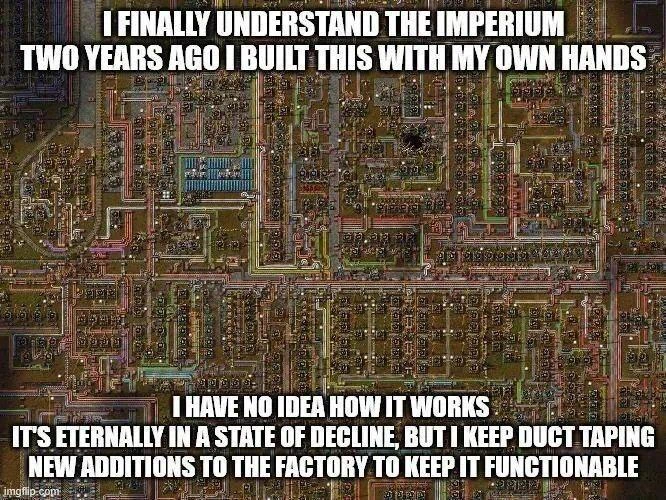
For newer developers, let’s break down what’s happening in this meme. The image shows something that looks like a gigantic, messy factory or a circuit board with an impossibly intricate layout. This is actually a reference to a video game called Factorio, where you build huge automated factories. In Factorio, players often create a massive network of conveyor belts, machines, and pipes to produce items – and these setups can become extremely complex and messy (especially if you keep bolting on new parts without reorganizing). The meme uses that imagery to represent a software project (a codebase) that has become very complicated and tangled over time.
Now, the text of the meme is written in a bold, all-caps font (a typical meme style) and says:
“TWO YEARS AGO I BUILT THIS WITH MY OWN HANDS… I HAVE NO IDEA HOW IT WORKS.”
This expresses the developer’s shock (and a bit of dark humor) that something they themselves created has grown beyond their understanding in just a couple of years. Imagine writing a program and then, after many updates, even you feel lost in it – that’s what they’re joking about. The meme continues:
“IT’S ETERNALLY IN A STATE OF DECLINE, BUT I KEEP DUCT TAPING NEW ADDITIONS TO THE FACTORY TO KEEP IT FUNCTIONABLE.”
Let’s unpack that. When they say the system is in “a state of decline,” they mean the design or quality is getting worse over time – things are breaking or getting more chaotic as they add more stuff. Yet they “keep duct taping new additions” to keep it working. Duct tape here is a metaphor for quick-and-dirty fixes. Just like you might hold a broken piece of something together with actual duct tape as a temporary fix, developers sometimes write quick hacky code to patch a problem rather than fixing it properly. So a “duct tape addition” is a new piece of code that maybe isn’t pretty or ideal, but it keeps the software running for now (functionable isn’t actually a common word, but we get the meaning: “able to function, at least somewhat”). This style of working leads to a duct-tape architecture – a system held together by a bunch of improvised fixes and patches. It’s not sturdy or clean, but it hasn’t collapsed yet.
A legacy codebase is what we call an old or inherited code project that has become hard to change. Even though two years might not sound old, in tech the word "legacy" really means “difficult to work with because of its outdated or messy nature.” The meme is implying that after two years of rushed changes, this system feels like a legacy codebase to its own developer. Technical debt is an important term here: it’s the idea that when you take shortcuts in coding (to meet a deadline or because of lack of time), you incur a “debt” that you’ll have to pay back later by doing extra work to fix or refactor it. If you never pay it back, the “interest” accumulates – meaning the code gets more tangled and future changes become harder. In the meme, all those duct-tape fixes are the interest payments just to keep things running, without ever paying down the principal (cleaning up the design). Over two years, those choices compounded into a big ball of problems – that’s the tech debt metaphor.
You’ll also hear the term spaghetti code. This is a funny way developers describe code with a very tangled, unstructured form – like a pile of cooked spaghetti where all the noodles intertwine. In a well-organized project, you might have clear layers or modules (like organized sections of code that don’t heavily depend on each other). In spaghetti code, everything touches everything. It’s hard to follow the flow because the logic jumps around unpredictably, just like it’s hard to trace one noodle in a bowl of spaghetti. The factory picture in the meme looks like spaghetti laid out over a huge area – a intentional visual pun.
Another phrase in the tags is architecture decay or architecture deterioration. This means that the original design architecture (the big-picture plan of how the parts of the software should work together) has broken down over time. For example, maybe at first you had a clean Model-View-Controller design pattern separating data, interface, and logic. But as new features were added hastily, that separation got blurred – now everything is interfaced with everything else, and the pattern isn’t really followed. The architecture “decayed” like a neglected building. Hidden complexity refers to parts of the system that turned out to be more complicated than they appear on the surface. Perhaps a simple task now triggers a lot of behind-the-scenes interactions because of all the patches; things that should be straightforward become complicated unexpectedly.
The meme’s mention of “the Imperium” is a bit of nerd humor. It’s referencing the Imperium from Warhammer 40k (a science-fiction universe). In that story, the Imperium is a giant empire that’s been around so long its technology is falling apart, and people maintain machines with rituals because they forgot how they really work. The meme creator feels like their two-year-old project is already like that: an ancient empire in decay. Self-inflicted complexity means all this complicated mess is basically the result of the team’s (or person’s) own actions – it wasn’t imposed by outside forces; it accumulated because of how they kept building things. It’s a cautionary idea for junior devs: if you keep adding features without cleaning up, you can trap yourself in a web of your own making.
Finally, post-launch maintenance is what happens after your software is released (“launched”). Initially, you build an application (hopefully with a good design). But once it’s out and users are using it, you’ll start getting bug reports, requests for new features, etc. Maintaining the software post-launch is a tricky phase. If maintenance is done carelessly – like slapping on fixes without considering the overall design – the code quality will suffer. This meme is a dramatized example of poor post-launch maintenance leading to a monstrous mess. It’s basically saying: “I kept adding things after launch in a messy way, and now the whole thing is ridiculously convoluted.”
In summary, at this level: the meme is about a programmer realizing that the software they wrote has turned into a huge, confusing mess (like a Factorio factory or a tangled circuit board). It became that way because of lots of quick fixes and new features piled on without proper reorganizing – which we label as accumulating technical debt, resulting in a spaghetti code legacy system. It’s funny (in an almost sad way) because the person is half-jokingly comparing themselves to someone who built an empire that’s now falling apart. Even though they made it, they’re now astonished by how unruly it has become. If you’re new to coding, the takeaway humor is: “Whoa, if you’re not careful, your nice little program can turn into an indecipherable monster!” seasoned devs will nod and say, “Yep, seen it happen.”
Level 3: Duct Tape Empire
To a seasoned engineer, this image of a sprawling factory evokes the infamous “big ball of mud” architecture in all its glory. The humor here is a knowing, weary laugh – we’ve all seen a project start with pristine intentions (maybe a neat microservice layout or a well-structured layered design), and then fast-forward two years of feature requests, hotfixes, and impossible deadlines… you end up with a sprawling legacy system nobody fully understands. The meme exaggerates that feeling: “I built this with my own hands two years ago, and now it might as well be an arcane empire.” It’s poking fun at how quickly a codebase can accumulate technical debt and become a labyrinth of tech debt. Two years isn’t a long time in theory, but in the world of software it can turn a greenfield project into a legacy codebase if the team is moving fast and breaking things (but not going back to fix them properly).
The top-down factory layout (inspired by the game Factorio) perfectly symbolizes a system that’s grown organically (or rather, chaotically) over time. In Factorio, players often end up with monstrously complex factories: tangles of conveyor belts and pipes routing resources every which way. It’s functional, but boy is it convoluted. The meme compares this to a codebase where features have been bolted on with little regard for overall structure – a true duct tape architecture. Every new addition is slapped on wherever it fits, much like attaching another conveyor belt in a cramped factory because hey, it gets the job done. Over time, these ad-hoc additions interact in unintended ways. Seasoned devs recognize the satire: “It’s eternally in a state of decline, but I keep duct taping new additions to keep it functional.” That line hits home because we often joke that some production systems are so fragile, we’re basically System Janitors, jerry-rigging fixes to keep the lights on.
Why is this funny in a painful way? Because it’s self-inflicted complexity. There’s nobody else to blame – we wrote this beast. The meme’s author says, essentially, “I have no idea how it works, even though I built it.” That’s the punchline born of truth: software tends to become more complex as we extend it, and without vigilant refactoring, it morphs beyond our mental model. It’s the result of countless compromises: maybe a hacky workaround to meet last year’s deadline, a quick integration of a client’s special-case feature, a library upgrade that didn’t quite fit so you shimmed it in – all those post-launch maintenance decisions pile up. Each was a small trade-off favoring short-term functionality over long-term clarity – classic technical debt. And just like financial debt, technical debt accrues interest: the “interest” is the extra effort every future change requires because of the messy context.
In real-world scenarios, this often leads to what we call spaghetti code: logic so tangled that following the flow is like trying to trace a single noodle in a bowl of pasta. Initially, perhaps you had clear separations (modules, classes, APIs), but repeated quick fixes have cut across those boundaries. Functions grown huge with conditionals for every special case, modules tightly coupled because someone hardcoded a call over here to use something over there, since it was the fastest way to get a feature working. Before you know it, the once-coherent design is a maze of global flags, copy-pasted code blocks, and mysterious “temporary” patches that became permanent.
Here’s a taste of what that might look like in code form, for example, a function accreting special cases over time:
function processOrder(order) {
let result = initializeOrder(order);
// Patch: handle legacy orders differently (hotfix from last year)
if (order.type === 'legacy') {
result = legacyProcess(order, result);
}
// New requirement: Apply promo codes for VIP customers (quick addition)
if (order.customer.isVIP) {
result.discount += calculateVipDiscount(order);
}
// Bug workaround: ensure quantity is never negative (duct tape fix)
if (result.totalQuantity < 0) {
result.totalQuantity = 0; // (weird edge case we never fully investigated)
}
// ... (more patches and special cases) ...
return finalizeOrder(result);
}
Each if above was added at a different time under pressure. Nothing inherently wrong with an if, but imagine dozens of such band-aids across the codebase – it becomes a minefield of hidden assumptions. The engineer who wrote a given patch might have moved on (or simply forgotten the context), so the system turns into a mysterious black box even for its creators.
There’s a famous metaphor in software: “adding a new feature to a messy system is like adding a new wing to a house built on a swamp.” The foundation is shaky, but you just keep extending it because rebuilding from scratch is too expensive or risky. The meme’s text about “eternally in a state of decline” acknowledges that the code gets uglier with each addition; yet the business demands new features, so developers soldier on, bolting new parts onto the factory and praying it doesn’t collapse. When something breaks, you patch it with duct tape (quick fix) rather than reworking the foundations, because who has time to re-architect when production is on fire or the next deadline looms? It’s a vicious cycle: the more you duct-tape, the more architecture decay you get, and the harder it becomes to do real maintenance.
Importantly, the humor also lies in the recognition: every experienced developer has felt this. You revisit code you wrote a while ago and think, “Who was the madman that wrote this?” only to do a git blame and realize it was you. 😅 It’s equal parts embarrassing and funny. We laugh because otherwise we’d cry – dealing with such a legacy codebase can be frustrating and stressful. The meme resonates especially in environments where short-term deliverables always trump long-term refactoring. The code ends up like an old machine with levers, pulleys, and hidden complexity behind every panel. Newcomers are terrified to touch it; even the original author navigates it gingerly, like disarming a bomb.
To sum up the senior perspective: this meme humorously encapsulates the architecture degeneration that happens when a codebase grows rapidly without enough TLC (tender love and care). It’s a cautionary chuckle about how an imperium of tech debt can rise from the best of intentions. We see the tangled factory and we’ve lived that chaos – it’s funny because it’s true. Below is a tongue-in-cheek comparison that highlights this journey from idealism to duct tape reality:
| Initial Vision | Two Years Later | Maintenance Style |
|---|---|---|
| Clean, modular architecture | “Big ball of mud” monolith | Patch and pray 🙏 |
| Well-documented components | Mystery meat code & lost docs | Tribal knowledge (ask old-timers) |
| “We’ll refactor next Sprint” | Just add one more quick fix | |
| Scalable design patterns | Scaling out of control | Hope it doesn’t break at scale |
| Confident code ownership | “Who wrote this?!” 😣 | Blame the code gremlins |
Everyone promises to avoid this outcome, but as the meme wryly notes, even our own projects can end up as convoluted empires of spaghetti code before we know it. The table above might be funny, but it’s uncomfortably true in many teams. Thus, the meme gets a knowing sigh and a laugh: we recognize the trajectory all too well. It’s essentially the software engineering equivalent of “I’ve become the very thing I swore to destroy.”
Level 4: Entropy Always Wins
No matter how elegant your architecture starts, the second law of thermodynamics seems to apply to code: software complexity (like entropy) naturally increases over time. In software engineering terms, this is captured by Lehman's Law of Increasing Complexity – as a program evolves, its complexity rises unless explicit work is done to reduce it. After two years of continuous feature churn, what began as a clean design often mutates into a chaotic web of interconnected parts. Each quick fix and ad-hoc feature introduces new dependencies and side-effects, entangling components that were once isolated. The result is an entropic big ball of mud architecture – a colloquial (and academic) term for a system with no clear structure, only makeshift connections everywhere. In such a system, reasoning about behavior can feel like solving a complex puzzle: the number of potential interactions between modules can explode (in the worst case, nearly O(n^2) as modules all start depending on each other). This complexity creep is why a developer might quip that their codebase has become a "Factorio-scale labyrinth" – like a factory with endless spaghetti belts, the code’s internal state space is huge and tangled.
From a theoretical lens, this labyrinth of tech debt is an example of software entropy in action. Every time we "duct tape" a new feature onto the system without refactoring, we increase the system’s disorder. Over time, the cost to comprehend or change any part of the system grows non-linearly. In extreme cases, you get emergent behaviors – minor changes can cascade in unexpected ways (akin to a chaotic system where small tweaks produce big, hard-to-predict effects). It’s reminiscent of trying to modify a complex circuit: changing one connection can send unpredictable currents through the whole board. Here the meme’s image of a densely wired, city-sized circuit-board (or Factorio factory) isn’t just humor – it’s a visual metaphor for the hidden complexity inside a large codebase. The individual pieces (wires, belts, functions, classes) might be simple, but collectively they form an intricate, intertwined network. The humor has a dark edge: the creator is essentially admitting their once orderly creation has verged into an unmaintainable state dictated by entropy, much like a decaying machine that no one fully understands anymore.
For a bit of sci-fi context, the meme’s text invokes “I finally understand the Imperium.” This is a nod to the Imperium of Man from Warhammer 40,000 – a gargantuan, millennia-old empire whose technology is in a state of decay. The Imperium’s engineers (the Tech-Priests) no longer fully grasp how their ancient machines work; they perform maintenance by rote ritual and duct-tape equivalents, praying the whole contraption doesn’t collapse. It’s an apt parallel: the developer looks at their 2-year-old system as if it were a relic of a lost age – an empire of code in decline, held together by hopeful incantations (quick patches) and sheer inertia. In both cases, fundamental architecture principles have given way to chaotic survivalism. The meme lands as both a cautionary tale and a commiseration: even a system you built with your own hands can evolve into an inscrutable beast if you don’t (or can’t) continuously tame the entropy.
Description
A screenshot from the game Factorio showing an enormously complex and chaotic factory layout with intertwined conveyor belts, pipes, and machinery sprawling across the entire screen. The top text reads 'I FINALLY UNDERSTAND THE IMPERIUM TWO YEARS AGO I BUILT THIS WITH MY OWN HANDS' and the bottom text reads 'I HAVE NO IDEA HOW IT WORKS IT'S ETERNALLY IN A STATE OF DECLINE, BUT I KEEP DUCT TAPING NEW ADDITIONS TO THE FACTORY TO KEEP IT FUNCTIONABLE'. The Warhammer 40K Imperium reference combined with the Factorio spaghetti base perfectly captures the experience of maintaining a legacy system you originally authored but can no longer comprehend
Comments
39Comment deleted
The Imperium of Man runs on the same architecture as your codebase: ancient, incomprehensible rituals performed by people who forgot why they started them, held together by the sheer force of duct tape and denial
This is every senior engineer looking at a codebase they wrote two years ago. It was a cathedral of elegant design then; now it's a shrine to a forgotten god, kept running by duct tape and Stack Overflow answers from 2012
It’s the moment you realise your microservice mesh is basically Conway’s Law rendered in belt spaghetti
The only difference between this Factorio base and your production microservices architecture is that at least in Factorio you can see all the spaghetti on one screen
The Imperium of Man and your two-year-old codebase have more in common than you'd like to admit: both are held together by ancient rituals nobody understands, maintained by tech-priests who pray the machine spirits don't revolt, and any attempt at modernization risks catastrophic failure across the entire system
Rewrites are for heretics; true Mechanicus devs appease the machine spirits with duct-tape rituals and pray the smokestacks don't revolt
It’s not architecture anymore - it’s archaeology. Our Adapter pattern is literal duct tape, and the SLO is held together by cron and tribal memory
I love Factorio but the game being 2d made it a pain in the ass, especially as you progressed further. Satisfactory would be my recommendation, if you not factor in the game having dogshit performance (thanks UE5) Comment deleted
I like Satisfactory but the game being 3d made it a pain in the ass, especially as you progressed further. Factorio would be my recommendation, especially if you factor in the game having excellent performance (thanks custom renderer) Comment deleted
Dogshit take tbh The performance is exceptional for the game this complex. Disable lumin if you don't have high-end gpu and have fun. UE5 is only a part of the problem, it can be used to create great stuff, but only if you're not a copro(misspelled on purpose)-dev with photo-realism as your only goal Comment deleted
I have a fairly powerful rig but the performance is still ass. It was somewhat ok when they were on UE4 but the upgrade to UE5 tanked the whole game. And no, I don't have that useless lumen feature enabled. Comment deleted
That's what I thought until I capped the FPS, unlimited FPS in satisfactory fucks everything up Comment deleted
It's capped, but I still don't like having my fans get obnoxiously loud when I'm just sitting in the main menu. Still, it's very addicting and I can't put it down Comment deleted
Lmao who does even need it at all Ppl are stupid I can understand 90, mb 144 if you are playing shooters, but for Satisfactory 60 is just enough Comment deleted
idk, I can clearly see the difference between 60 and 165 frames per second on my monitor, even if I just moving the mouse pointer, and 60 frames per second is uncomfortable for me. A week ago, my ubuntu AGAIN broke the nvidia drivers and fallback to old version that does not support more than 60 frames per second, and I noticed this immediately after reboot. Comment deleted
60 and 165 is poles apart.someone seeing 60 vs 165 side by side can tell immediately Comment deleted
Exactly I have 60, but unlimited is the default setting Comment deleted
Satisfactory doesn't require think. You just place things and connect them. Since it's 3D, you can easily connect everything by simply building over existing buildings. Factorio, on the other hand, gives you puzzles, and the more compact you try to build something, the more interesting those puzzles become. Comment deleted
Worst take of the year Comment deleted
Partially true. I'd say Satisfactory is designed in a way that requires the player to design something monumental, but exactly once per completion, and new each time Comment deleted
It's just slightly uncomfortable, for the real PITA try Dwarf Fortress. Comment deleted
I like Satisfactory and Factorio, but feel that I'm ready for something 4d Comment deleted
There is a 5d chess with time travel and multiverse Comment deleted
https://youtu.be/q7qFuoerlVI?si=jzgx70SE9ZERLB34 https://store.steampowered.com/app/2162800/shapez_2/ much insteresting 4 me tbh Comment deleted
Also, factorio being 2D doesn't take away from any aspect of it being a genre-defining masterpiece Comment deleted
I didn't say it wasn't. I just prefer not to be confined to a 2d space. Hence why the recommendation. Comment deleted
For me the downside of Satisfactory is you can't just copy a thing and plop it right next to the thing you already have Maybe that has changed Comment deleted
It has blueprints now, but with limited size and need special building for blueprint creation. Comment deleted
That's exactly the problem, you don't have the blueprint if you've just designed the thing and now want another copy of it Comment deleted
well, yea, but thats was game design decision. devs clearly says that satisfactory is game for peoples that just enjoy building process, so they dont add any tool that allow you build factories effortlessly Comment deleted
Oh, thats like my code... Comment deleted
And Factorio is meant to be scaled up until your pc is dying, on the other hand Comment deleted
can confirm, there's actual guides on how to reduce lag so your factory can grow even more Comment deleted
I will note that this is usually the ultra-lategame. I've personally only encountered this after 100+ hours on my very weak laptop with zero thought put into what is and isn't performant AND on the 1.x version that had ridiculously unoptimized fluid calculations compared to 2.0 Comment deleted
I think mindustry is also a great game which is free, but its focus is split between production and pve Comment deleted
Satisfactory sucks, Techtonica is the real 3D factory game Comment deleted
factorio is the best way to test you're design patterns and software engineering skills Comment deleted
It's so unbelievably sad, it's so much more mechanically interesting and fun than Satisfactory. Comment deleted
yeah but it's harder and not as easy to make spaghetti Comment deleted