If You Die in US-EAST-1 You Die in Real Life
Why is this AWS meme funny?
Level 1: All Eggs in One Basket
Imagine you have a big basket where you keep all of your eggs. It’s the only place you store them. Now, as long as someone holds that basket carefully, your eggs are safe. But what if the person carrying the basket slips and drops it? Splat! All the eggs crack at once, and there’s nothing left for breakfast. This meme is joking about the same idea, but with computers instead of eggs. One cloud region (like one big basket) is holding everything for a company’s website or app. If that one region has a problem – it’s like the basket dropping – the whole thing breaks. And because they didn’t use a second basket (another region) or have any backup plan, all they can do is hope it never falls. The humor comes from how silly and scary this is at the same time. It’s silly to keep all your important stuff in one place without a backup, right? But it’s also a bit scary because some people actually do that! So, the comic makes us laugh by pretending the stakes are like a life-or-death video game: “If our one basket (us-east-1) breaks, our whole world (the app in real life) breaks too!” In plain terms, it’s funny because it’s a cartoon way of saying, “Hey, don’t put all your trust in one spot – or you’re toast if that spot goes down.” Even a kid can get that: always have a backup plan, not just a prayer.
Level 2: Single Point of Failure
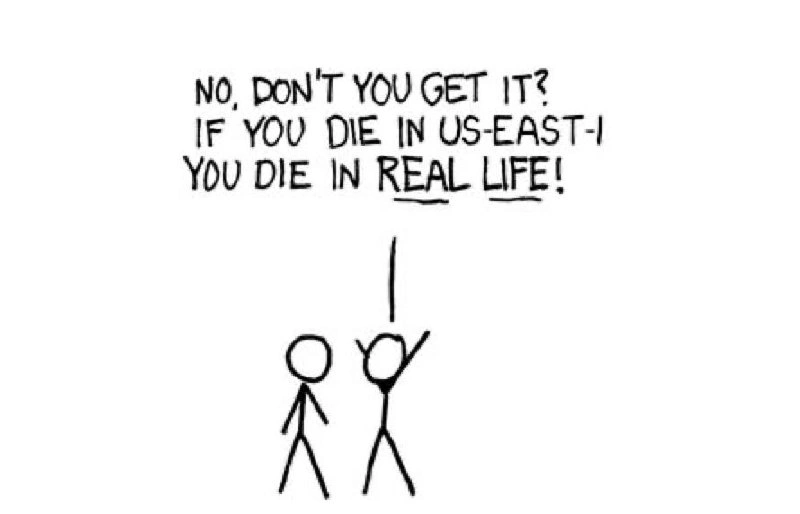
Let’s break down the joke in simpler terms. The comic shows two stick figures (drawn in a minimalist xkcd_style_comic way). One is frantically telling the other: “If you die in us-east-1, you die in real life!” Now, what does that mean?
First, AWS (Amazon Web Services) divides its cloud into multiple regions, which are basically big clusters of data centers in different places. For example, us-east-1 is the name of AWS’s region in Northern Virginia, USA. It’s one of AWS’s oldest and busiest regions – kind of the default choice for many companies hosting their applications. When you hear developers say “our stuff is in us-east-1,” it means all their servers and databases are running in those Virginia data centers.
A Disaster Recovery (DR) plan is a fancy way of saying “what we’ll do if something really bad happens.” In tech, that usually means having backups and procedures if an entire data center or region goes offline. Think of a DR plan as a safety net: if the primary location fails, there’s a secondary location ready to take over, or at least a plan to restore things quickly. Now, the meme’s title “When your entire DR plan is just praying for us-east-1” tells us that, in this scenario, they don’t have a real backup plan. Their “plan” is literally just hoping nothing terrible happens to that one region. In other words, all their systems are in one place (us-east-1), and if that place has a problem, they’re in trouble. This is what we call a single point of failure – one thing fails and everything breaks. Here, us-east-1 is that one thing.
Why the dramatic line about dying in real life? It’s an exaggerated metaphor. Imagine a video game where if your character dies in the game, you actually get hurt in real life – that’s obviously not real, but it raises the stakes massively. In the tech world, saying “if our system dies in us-east-1, it dies in real life” means if AWS’s Virginia region goes down, the real-life business (the website, service, or app) goes completely down with it. There’s no second life, no backup server magically kicking in, because they never set one up in another region. The stick figure shouting “DON’T YOU GET IT?” is like a stressed-out engineer trying to explain to maybe a manager or teammate how serious this is: they treated us_east_1_region as immortal, and that’s a huge risk.
Now, some basic concepts: High availability is the goal of keeping a system up and running with minimal downtime. That usually involves redundancy – having spare systems or running things in multiple places so that if one goes down, others are still up. AWS actually makes it relatively easy to be somewhat redundant: within a single region like us-east-1, there are multiple Availability Zones (AZs). Those are separate data centers, so if one AZ has an issue (like a power failure), your stuff in another AZ can keep running. Many beginners set up their application across 2–3 AZs in the same region and think, “Cool, I’m safe.” And it’s true for some failures – you’re safe if one building in Virginia loses power, because the others are fine. But if something bigger goes wrong that affects the whole region (say, a network outage that cuts off all of Virginia, or a bug in an AWS service that crashes systems across the region), then all AZs in that region can go offline together. That’s rare, but it does happen. When it does, if you haven’t planned for another region to take over, your application is completely down. That’s the nightmare scenario the meme is joking about.
Let’s talk about blast_radius_planning in simple terms. This means thinking ahead about “if this part of our system explodes (fails), how far does the damage spread?” Good planning tries to keep the blast radius small. For example, if one microservice has a bug, maybe only that service goes down, not the whole app. In terms of geography: if one data center goes boom, a well-planned system would limit the damage to just that data center. But in our meme’s story, the blast radius is the entire region – basically the worst-case scenario. They put everything in one place, so the blast radius is huge. It’d be like storing all your important items in one room; if the building has a fire in that room, everything is gone.
The comic uses humor to teach a lesson. The stick figure’s melodramatic phrase is funny because it’s like something you’d hear in a sci-fi movie or an over-the-top video game scenario, not a stiff engineering meeting. It grabs your attention. Developers share this as CloudHumor because it’s an exaggerated version of real conversations we have. Maybe not with those exact words, but definitely the sentiment: “Guys, if we don’t have a backup outside us-east-1, we’re toast if that region has an outage.” It’s also a nod to OnCallHumor: being on-call means you’re the person paged at 2 AM when things break. And trust me, if your whole app is tied to one AWS region, an outage in that region will give the on-call engineer a heart attack (figuratively!). So we joke about “praying to the AWS gods” because sometimes it feels like all you can do during such an incident is watch and pray until Amazon fixes the issue.
In summary, this meme is pointing out a common rookie mistake (and sometimes even a company-wide mistake): putting all your trust in one cloud region and not having a real backup plan. AWS and other clouds encourage using multiple regions for critical systems, but it’s easy to skip that due to cost or complexity. The stick figure cartoon uses simple drawings and a dramatic punchline to make that point crystal clear: Don’t put everything in one place, or you’ll suffer if that one place fails. It’s a mix of cautionary advice and shared laughter at how often we’ve all been there, nervously watching the AWS status page and realizing our ProductionIssues are all tied to a single data center region. The message to a junior dev or anyone new: diversify your infrastructure (kind of like not keeping all your money under one mattress). If you don’t, you end up like the character in the comic – essentially praying that the one basket you used to hold all your eggs (us-east-1) never, ever drops.
Level 3: Architecting on a Prayer
"No, don’t you get it? If you die in us-east-1 you die in real life!"
This exasperated shout from the stick-figure engineer encapsulates a scenario all too familiar to seasoned cloud developers. It’s mocking the unwritten disaster recovery plan at many organizations: pray that AWS’s us-east-1 region never goes down. The humor here is dark but real – for all the talk of HighAvailability and redundant architecture, countless production systems still have a single_region_dependency on that one AWS region. And why us-east-1 specifically? Because it’s the oldest, most iconic AWS region (in N. Virginia) and historically the one where Cloud newbies flock (it’s often the default region for many AWS services and tutorials). It’s also infamous among OnCall teams: a hiccup in us-east-1 has a nasty habit of causing internet-wide ProductionOutage chaos.
The meme’s scenario is basically an ops veteran grabbing a colleague by the shoulders and yelling, “Don’t you understand? Our entire production lives in one place! If that place dies, our business dies!” It’s funny because it’s an over-the-top analogy (nobody literally dies, of course), but also because it’s uncomfortably true for many setups. OnCallHumor often comes from shared pain, and here the pain is: “We said we were fault-tolerant, until AWS us-east-1 had an incident and everything went poof.” 😅 (That’s the laugh of someone who hasn’t slept during a 3 AM outage). Seasoned engineers have been through those war rooms where a whole team is frantically trying to revive systems during a region-wide AWS outage. The comic’s dramatic phrasing nails that desperation.
You might ask, “How could one AWS region failing bring down so much?” But in practice, many companies never truly implement multi-region failover. Sure, they might use multiple Availability Zones (like different data centers within us-east-1) for high availability, which covers hardware failures or a power outage in one building. But all those AZs are still in the same geographic region, sharing certain regional services and network infrastructure. If the entire region has an issue (say a bad deployment on AWS’s side, or a regional network partition, or even AWS DistributedSystems dependencies like a buggy core service), all those AZs can get taken out together. We’ve seen it happen: one notorious AWS outage in us-east-1 years ago knocked out big chunks of the internet. Even AWS’s own status dashboard infamously went down during an S3 outage because – you guessed it – the status page itself was hosted in us-east-1! It’s the ultimate irony when your system for reporting outages is taken out by the outage.
DistributedSystems architecture is supposed to prevent this “all eggs in one basket” situation. Best practices say “design for failure”: use multiple regions, cross-region backups, circuit breakers, the works. But implementing that is expensive and complicated. It often gets deprioritized in planning meetings. (“We’ll add a secondary region next quarter, promise. For now, us-east-1 is rock solid… right?” 🙄). The result is what we see in this meme: teams end up architecting on a prayer. They talk about a DR plan, maybe they even have a wiki page for it, but in reality nothing’s been tested or automated. The plan is essentially “hope we never need the plan.” When someone points this out, it’s both embarrassing and comical – hence the stick figure shouting in cartoonish horror.
The phrase “If you die in us-east-1, you die in real life” riffs on a geeky pop-culture trope (from video games and movies, where a virtual death causes real death). In this context, us-east-1 is like the game world where your entire system lives. If that world crashes, there’s no extra life or second server magically taking over – your ProductionIssues suddenly become very real business problems. The dramatic tone also mirrors how it feels to be on-call during such an incident: adrenaline pumping, dread mounting, as if the life of the application (and your sanity) is at stake. Engineers with on-call experience chuckle at this because it’s a coping mechanism – if you don’t laugh, you might cry. They’ve sat in those post-mortems where someone inevitably says, “We really should’ve had a multi-region setup,” while everyone rolls their eyes because that was obvious in hindsight.
This meme is cutting commentary on cloud architecture folly. AWS gives you regions around the globe and even tools like Route 53 for DNS failover, yet many systems never go beyond a single region. Why? Sometimes it’s budget: doubling infrastructure in a second region isn’t cheap. Sometimes it’s complexity: keeping data in sync across regions and automating failover is non-trivial. And sometimes it’s pure complacency: “AWS is highly available, what are the odds an entire region goes down?” (Anyone who’s been in the industry awhile can answer: the odds aren’t zero, and when it happens the impact is huge). The CloudHumor here is that we trust “the cloud” like magic, forgetting it’s just a bunch of servers in a building that can and do fail in spectacular ways. When they fail, all the fancy microservices, Kubernetes clusters, and autoscaling groups won’t save you if they’re all living in the same doomed place.
Seasoned devs are nodding and smirking at this comic because they either dodged this bullet or took it right between the eyes. It’s a shared joke about ProductionOutage PTSD: “Remember that time us-east-1 went down and we all basically stopped breathing for an hour?” Yeah. That. The stick figure’s panic is hilarious because we’ve been that panicked person, or seen them – the one in Slack at 2 AM typing “Anyone have the CEO’s number? We need to explain that AWS had an outage and yes, our site is completely offline…” Meanwhile the supposedly five-nines SLA everyone bragged about is out the window. The entire Disaster Recovery strategy has boiled down to refreshing AWS’s status page and praying for green lights.
Ultimately, the meme lands because it’s absurd and true at the same time. The absurdity of equating a data center outage to literal death pokes fun at our tendency to stake everything on one component. It’s a cautionary tale wrapped in a joke. Engineers laugh, then nervously think, “Have we actually tested our multi-region failover… do we even have one?” If not, well, they might end up just like the comic – screaming into the void when us_east_1_region blips out, and seeing their “real life” production die on the spot. Better start planning for that blast radius before it’s too late. In the meantime, we cope through humor: making memes, sharing war stories, and half-jokingly bowing to the single point of failure cloud region that holds our fate.
Level 4: One Region to Fail Them All
In distributed systems theory, relying on a single region is the textbook definition of a single point of failure. Here, us-east-1 (AWS’s US East N. Virginia region) becomes that fault domain which, if it goes down, takes everything with it. By concentrating all services in one region, the system’s overall reliability is mathematically bound to that one location’s uptime. In reliability engineering terms, if Region A has an uptime $R_A$, a system using only Region A has an uptime $R_{\text{system}} = R_A$. There’s no redundancy. Contrast that with a multi-region setup: if you have two independent regions, the chance of both failing simultaneously is far smaller. We can express the theoretical availability of two independent regions as:
$$ R_{\text{overall}} = 1 - (1 - R_{1}) \times (1 - R_{2}) $$
For example, if each region provides 99.9% uptime, one region alone means ~8.76 hours of downtime per year. Two such regions in active failover could yield roughly $1 - (0.001 \times 0.001) = 0.999999$ (99.9999%) uptime – mere seconds of expected downtime. That’s the power of redundancy. But here’s the rub: that formula assumes independence. If both “redundant” components share a common dependency, all bets are off. In AWS, Availability Zones (AZs) within a region are engineered to be independent, but a whole region can suffer a common-mode failure (for instance, a bad deployment or network issue that hits all AZs in us-east-1 at once). If all your eggs (or microservices) are in one regional basket, a single rough glitch in that region scrambles everything.
Advanced architects know to distribute systems across regions to avoid a monoculture failure. Yet doing so introduces its own complexities. The CAP theorem comes knocking: if you stretch a stateful app across data centers in Virginia and, say, Oregon, you must choose between consistency and availability during network partitions (like a region becoming isolated). Want strong consistency globally? You might sacrifice availability if one region can’t be reached (since the system might refuse writes to maintain a single source of truth). Opt for availability via eventual consistency? Now you need to handle out-of-sync data for a while. Global consensus protocols (Paxos, Raft) can keep data in sync across regions, but they incur latency and complicated failure modes. It’s a tough trade-off: high availability across regions often means accepting lower immediate consistency or spending a fortune on sophisticated databases and networking. Many teams shy away from this complexity (or cost). Instead, they cross their fingers and stick to one region – implicitly choosing consistency and simplicity over cross-region availability. In CAP terms, they treat a full region outage as something outside the model (a partition they’re willing to not survive) in exchange for simpler operations day-to-day.
Then there’s blast radius planning – the practice of containing failures so they don’t cascade. A well-designed global system limits the “blast radius” of any single component’s failure. If everything runs in us-east-1, your blast radius is literally your entire production. Lose that region, you’ve lost the whole system. Ideally, you want to compartmentalize: database in two regions, front-ends in multiple regions, so that a blast in one data center doesn’t burn down the whole service. But such distributed resilience must be baked in from the start. Otherwise, hidden single-region dependencies lurk everywhere. For example, you might host your app servers in two regions but still keep all customers’ data in one regional database – a sneaky single point of failure. Or you use a global service (like an authentication server or DNS service) that itself has a hard dependency on us-east-1 (historically, some AWS global services had control-plane operations concentrated in that region). This creates a brittle common mode: when that one piece fails, it doesn’t matter that everything else was multi-region; the whole stack comes tumbling down. In theory, a Disaster Recovery design should eliminate such bottlenecks, but in practice it’s easier said than done. Designing a truly failure-proof system means finding and removing every SPOF (Single Point of Failure), from regions down to databases and even third-party services. As this meme darkly jokes, many systems instead settle for a fail-deadly setup: if the single region dies, the entire application dies immediately – game over.
The meme’s dramatic line – “If you die in us-east-1, you die in real life!” – underscores a fundamental truth of cloud architecture: a so-called highly available system is only as resilient as its weakest link. If that weakest link is an entire AWS region, no amount of wishful thinking will save you when it has an outage. The laws of distributed systems and reliability math aren’t swayed by optimism or SLAs; you either design for resilience or you inevitably face the day when that one region’s demise becomes your system’s demise. In short, the meme is a tongue-in-cheek reminder of a serious engineering principle: never let a single region (or component) hold your system’s life in its hands, unless you’re comfortable with that life ending the moment the region flatlines.
Description
A stick figure comic with two characters, one with arms raised dramatically declaring 'NO, DON'T YOU GET IT? IF YOU DIE IN US-EAST-1 YOU DIE IN REAL LIFE!' The joke references AWS's us-east-1 region which is notorious for being the default and most critical AWS region -- when it goes down, it takes half the internet with it. The 'die in the game, die in real life' trope from movies like Sword Art Online is repurposed for cloud infrastructure, capturing the existential dread of us-east-1 outages
Comments
8Comment deleted
us-east-1 doesn't need multi-region failover because there is no 'after us-east-1' -- it IS the real life
We have a multi-region, disaster recovery, active-active setup. Of course, the service that decides which region is active is an S3 bucket in us-east-1
Multi-AZ is cute, but hard-coding the ARN still means the reaper’s IAM role is region-scoped
The real horror isn't vendor lock-in, it's realizing your multi-region failover strategy still routes through us-east-1 for IAM
US-EAST-1: where your multi-region disaster recovery plan goes to discover it was actually single-region all along
Multi-AZ isn't a will; it's just local redundancy. If your blast radius equals us-east-1, your RTO is "pray"
us-east-1: Where Route53 defaults hold your multi-region dreams hostage, turning AZ failures into career-ending red pills
Again? Comment deleted