IonQ CEO Claims Quantum Computing Will Surpass NVIDIA GPUs by 2027
Why is this QuantumComputing meme funny?
Level 1: The Boy Who Cried Quantum
Imagine a kid in your class who claims he’s building a magic calculator that will solve any math homework in seconds. He even says, “Next week, my calculator will be so powerful it can do everyone’s homework faster than all the school’s computers combined – those computers will be jokes compared to mine!” Now, this sounds amazing, but you notice something: so far, his calculator is just a tiny weird gadget that sometimes gives the wrong answer even for 2 + 2. He keeps saying “just wait, it’s gonna be awesome, it uses special magic!” He even shows a chart where in a few years his magic calculator company will be richer than Apple. You and your friends exchange glances and start to giggle. It reminds you of the story of The Boy Who Cried Wolf, except he’s crying “Quantum!” – he’s shouting about something unbelievable over and over. Deep down you suspect that when “next week” comes, his magic calculator will still be struggling, and all the big talk will just look silly. So, instead of buying into it, you grab some popcorn (or let’s say cookies, since it’s school) and decide to watch what happens. It’s funny because the more fantastical his promises get (“it’ll even make McDonald’s fries tastier!” he claims), the more you just want to sit back and see how he explains himself when it doesn’t happen. In simple terms: someone is bragging way too much about something that clearly isn’t ready, and everyone who’s seen these kinds of tall tales before knows it’s probably not true. The humor and the lesson are universal – don’t count your chickens before they hatch, especially if your “chickens” are quantum magic that even grown-up scientists are still figuring out!
Level 2: Qubits vs Bits
Let’s break down the tech and jargon behind this meme in a more straightforward way. At its core, it’s contrasting quantum computing hype with classical computing reality. Classical computers (everything from your laptop to powerful NVIDIA GPUs) use bits – pieces of information that are either 0 or 1 – and they process these bits through electrical circuits. They’re great at a lot of things and have decades of optimizations behind them. GPUs, or Graphics Processing Units, are specialized chips originally for rendering graphics, but now widely used for general computation, especially tasks that can be done in parallel (like drawing many pixels at once or crunching massive matrices in AI models). Nvidia’s GPUs are industry-leading; for instance, their Blackwell GPU (mentioned in the meme) is presumably a next-generation chip family expected to be super powerful by 2027. So, saying a quantum computer will beat all Nvidia GPU compute is saying “our new tech will outdo the fastest conventional supercomputers that exist.”
On the other side, we have quantum computing. Instead of bits, it uses qubits (quantum bits). A qubit isn’t just 0 or 1 – thanks to quantum physics, it can exist in a superposition of 0 and 1. Think of a qubit like a spinning coin that’s not heads or tails yet while it’s spinning; it’s kind of both at once until you catch it. Moreover, qubits can become entangled with each other, meaning two qubits can be linked in such a way that if you look at one, you instantly know the state of the other, even if they’re far apart (Einstein called this “spooky action at a distance”). These properties allow quantum computers to process certain kinds of information in parallel in a way classical computers can’t. It’s a bit like having a bunch of alternate realities compute all at once and then interfere to give an answer – very QuantumComputingConcepts heavy stuff!
Now, quantum computing is super promising for some tasks, but building a practical quantum computer is hard. Companies like IonQ are trying – IonQ’s approach uses trapped ion qubits, which means they use individual charged atoms (ions) held in a vacuum trap, using lasers to do operations on them. It’s delicate – stray noise or a tiny temperature change can mess with the ions. One major issue is decoherence – that’s when a qubit loses its quantum state because the environment disturbed it (like if our spinning coin gets flicked and falls to heads or tails prematurely). Another issue: gate fidelity. A “gate” is just an operation on qubits (like an instruction in a program). Fidelity being 99.8% means each operation has a 0.2% chance to go wrong. While 99.8% sounds high (it’s an A+ on a test), running many operations in a row means those small error chances add up. Imagine doing 1000 steps, each with a 0.2% failure chance – eventually one likely fails, messing up the result.
Because of these issues, quantum computers today can only do short, simple computations before errors creep in. Researchers are working on quantum error correction, which is a way to use a bunch of physical qubits to act as one more reliable logical qubit. It’s like having many people redundantly vote on a decision to make up for a few people who might be yelling random things. But error correction needs a lot of extra qubits. Some estimates say you’d need hundreds or thousands of physical qubits to get one truly reliable logical qubit. IonQ claiming they have “32, but they’re logical in spirit” is joking about how companies sometimes count qubits in a feel-good way. They might say “we have 32 qubits that behave kind of like more qubits” with some error mitigation technique, but it’s not the same as having 1000 true independent qubits all doing your bidding.
Now, the IonQ CEO made a specific bold claim: by 2027, IonQ’s quantum compute will surpass all of NVidia’s GPU compute. That is huge if true. It basically means in two years, their quantum computer would be more powerful than every NVIDIA-powered data center server, gaming rig, and AI cluster out there. People who know the field find that extremely hard to believe, because currently quantum computers are nowhere near replacing classical ones for most tasks. Yes, a quantum computer can in theory solve some special problems faster (for example, Shor’s algorithm could factor big numbers really fast, which matters for cryptography like RSA-2048 encryption – RSA-2048 is a common encryption standard that would be broken if factoring large numbers became easy). But in practice, to do that, a quantum computer would need thousands of near-perfect qubits. Today IonQ might have a few dozen imperfect ones. 2027 is not far away, so bridging that gap is almost like asking a toddler to compete in the Olympics just two years from now.
The meme calls out that this kind of grandiose talk is typical “hype” and that “hype ends in tears.” In tech, hype means excessive publicity and inflated expectations. We’ve seen hype waves before – from dot-coms in the late 90s to AI, VR, blockchain, etc. Often, companies talk a big game to attract investors or media attention, but delivering on those promises is another story. IndustryTrends often follow a TechHypeCycle: everyone gets excited (maybe too excited), reality sets in, and many early claims don’t pan out, causing a crash in enthusiasm. Seasoned engineers have grown a bit jaded because they remember past promises that failed. So they “grab popcorn” – meaning they are watching this show for entertainment, not fully buying it, expecting there might be a dramatic failure or at least a lot of excuses later.
The tweet mentioned the IonQ CEO even trash-talked “Blackwell” (Nvidia’s next-gen GPU, which presumably is super advanced). Dismissing Blackwell as “a joke” is provocative – essentially he’s taunting the leading GPU maker. For context, Nvidia’s GPUs are used in everything from gaming to scientific research to training the latest AI models like ChatGPT. By 2027, Blackwell GPUs will likely be powering some of the fastest supercomputers and data centers. So the CEO is daring to say, “our quantum box will beat all of that.” It’s a David vs. Goliath claim, except our David (IonQ’s current tech) hasn’t even lifted the slingshot yet. It’s part of why this is eyebrow-raising.
The meme’s post_message (the greentext lines) gives a voice to an enthusiast investor who fell for this hype. Let’s decode some of those lines in plain terms:
- “be me, quantum cultist, snorted copium since kindergarten” – This is a humorous way of saying: I’m that person who has always been a die-hard believer in quantum computing. “Cultist” implies blind faith, and “copium” is internet slang combining coping and opium, meaning delusional optimism as a drug. So he’s joking that he’s high on the hopium (hope + opium) of quantum hype from an early age.
- “drop 50k on $IONQ because ‘quantum only goes up’” – He invested $50,000 in IonQ stock (IONQ is IonQ’s ticker symbol on the stock market) believing it will only increase in value. This mirrors how hype can drive people to invest money rashly.
- “CEO: ‘every Fortune-500 CEO has a quantum strat’ – The IonQ CEO apparently claimed that every big company’s CEO has a quantum strategy. That’s likely hyperbole. Maybe some companies have small research teams looking at quantum possibilities, but not literally all Fortune 500s are deeply invested in quantum yet. The meme jokes about it because it sounds like the CEO is trying to make it seem like “everyone is on board, don’t be left out!”
- “mfw McDonald’s gonna supersize fries with entangled salt” – mfw = “my face when”. He’s rolling his eyes imagining even McDonald’s, a fast-food chain, would somehow need quantum computing – like using “entangled salt” on fries. Entangled salt is a silly concept; it means salt particles whose quantum states are entangled, which has no real benefit for making fries taste better. This is poking fun at the absurdity of the CEO’s statement: if every company needs a quantum strategy, why not McDonald’s? It highlights how not every business has an obvious use for quantum tech right now.
Next chunk:
- “CEO says gate fidelity 99.8%, sounds sexy” – The CEO likely boasted about IonQ’s quantum gate fidelity being 99.8%. For a layperson or investor, that sounds impressively precise.
- “realize that's still 0.2% chance my calc turns into alphabet soup” – But to an informed engineer, 0.2% error per operation means if you do a lot of operations, your result could become nonsense (alphabet soup meaning random gibberish output). It’s explaining in a funny way that 99.8% isn’t nearly good enough for long calculations.
- “ask IR when Shor's algo cracks RSA-2048” – He asks IonQ’s Investor Relations (IR) team when they expect to run Shor’s algorithm to break RSA-2048 (that’s a benchmark for “when will you achieve world-changing capability?”).
- “they send me link to 2030 roadmap PDF named cope.pdf” – Instead of a straight answer, they gave him a PDF of their roadmap stretching to 2030, humorously named “cope.pdf”. This implies the roadmap is just there to pacify worries (“cope” with disappointment), promising shiny things far in the future. Roadmaps often push the hardest goals years out to keep investors hopeful.
Next:
- “earnings drop: $11m revenue, $10.9m is gov handouts” – IonQ’s financial results came out. They only made $11 million in revenue, and $10.9 million of that was from government grants or contracts, not from commercial customers. That means only $0.1 million (100k) was actual organic sales – basically nothing. This shows the company isn’t making real money despite the hype.
- “organic sales? less than what I tip DoorDash” – To drive it home, he jokes that the amount of real sales is so low it’s less than his food delivery tips for the year. It’s humorous exaggeration to show how minuscule the real business is.
- “DeMassi on CNBC: "quantum internet is next multitrillion TAM" – Now another IonQ exec (DeMassi) is on TV (CNBC) saying the “quantum internet” will be the next multi-trillion dollar market (TAM = Total Addressable Market, basically how much money there is to be made if the tech is adopted everywhere). Multi-trillion means they’re suggesting quantum networking could be as big as the entire current internet or telecom industry. That’s a massive claim.
- “mfw he pitching teleporting memes while I can't even ping qubit without decoherence” – The investor’s face when hearing that: disbelief. “Teleporting memes” refers to quantum teleportation – a real phenomenon where you transfer quantum states (like a qubit’s state) from one place to another using entanglement. It’s been done with photons, etc., over short distances. It’s very cool science, but it’s not sending actual memes or data in the way normal internet does; it’s not a way to transfer classical information faster or anything. He’s saying the exec is basically making it sound like we’ll be teleporting data (memes) instantly in a sci-fi way, while in reality we can’t even do basic things with qubits reliably (can’t “ping” a qubit = can’t even send a simple signal and get a stable response, because the qubit state would collapse or decohere). In short, the fundamentals aren’t solved, but they’re selling the big future.
Next:
- “ask for 1000-qubit cloud instance” – The investor asks IonQ’s support if he can get a quantum computer with 1000 qubits on their cloud service (some companies let you use their small quantum processors via the cloud).
- “support says "we have 32, but they're logical in spirit"” – The support basically says, we only have 32 qubits available, and even those are not 100% physical – they might be counting some error-corrected or “simulated” capacity as “logical qubits”. “In spirit” is a tongue-in-cheek way to admit they don’t physically have what he’s asking for, but they like to imagine they sort of do.
- ““quantum internet” because regular net too useful” – This is sarcasm. It implies the idea that we need a quantum internet is almost silly because the regular internet works so well and is so useful already. Why fix what isn’t broken? The phrasing “too useful” means the regular internet doesn’t have a problem that quantum internet needs to solve for everyday users, at least not now.
- “need photon routers so Twitter loads in superposition” – This jokes about what a quantum internet might entail: using photons (particles of light) in routers to carry quantum information. Loading Twitter “in superposition” is a goofy concept – perhaps meaning you’d get a timeline that is both updated and not updated until observed, which isn’t actually useful, just a playful jab. Essentially, it’s highlighting that applying quantum to something like Twitter is unnecessary and overkill.
Finally:
- “DeMasi tweets "minimum upside CSCO market cap" – The IonQ exec (DeMasi) tweeted that IonQ’s minimal goal or floor is to reach Cisco’s market capitalization (CSCO is Cisco’s stock symbol). Cisco is a huge networking company worth a couple hundred billion dollars. So that’s setting a very high bar for IonQ’s future value.
- “do quick math: need $200B revenue, currently selling $5m of fairy dust” – The investor calculates that to justify a Cisco-level valuation, IonQ would probably need on the order of $200 billion in annual revenue (since tech companies are often valued a bit above their annual revenue). Right now, IonQ has about $5 million in real revenue from selling its services (the “fairy dust” jab suggests that revenue itself might be from something not tangible, maybe consulting or tiny contracts – basically not solid product sales).
- “that's only 40,000% growth, basically guaranteed” – 40,000% growth is an insane number. He’s being sarcastic – implying that IonQ reaching that is laughably unlikely, but phrasing it as if a bull might, “Oh, only 40,000%? Sure, that’s practically certain!”.
- “google "proven exponential quantum algorithms"” – The investor does a sanity check, searching for how many algorithms have exponential speedups with quantum computing (exponential speedup means solving in a time that’s exponentially faster than the best classical method; these are the real game-changers like factoring, not just minor speedups).
- “find three, all require 1M qubits and liquid-nitrogen cooled unicorn tears” – He finds maybe three known ones (factoring, discrete log, certain simulations), and all of them would need technology far beyond current capabilities – like a million qubits and some magical ingredients. “Unicorn tears” is a jokey way to say something impossible or extremely rare, often used in tech humor to mock marketing that pretends something impossible is just around the corner. Liquid nitrogen cooled means needing extreme cooling (some quantum computers, like superconducting ones, need to be at near absolute zero temperatures). Combining them – liquid-nitrogen cooled unicorn tears – really drives home how fantastical the requirements are. In short: the actual proven powerful uses of quantum computing are still mostly theoretical because we can’t execute them with the hardware we have or will have soon.
- “file taxes, mark investment as "charitable donation to physics LARP"” – He’s basically giving up on the investment return and treating the money he put into IonQ as a donation. A “LARP” is a Live Action Role Play – implying that IonQ is kind of play-acting as a big successful company or that this whole quantum revolution right now is more pretending than reality. It’s a final bit of bitterness: “Well, my money probably just went to supporting some scientists (which is like charity) because as an investor I’m not seeing a dime back – I was funding a fantasy.”
By explaining it in plain terms, you can see the meme is highlighting the disconnect between the hype (big promises, big markets, talk of trillions and supremacy) and the reality (tiny revenues, scientific challenges, slow progress). It uses humor – absurd scenarios and internet slang – to make the point. But even if you didn’t catch every reference, you can relate to the general idea: over-promising leads to disappointment. For a junior developer or someone new to tech, this is also a gentle warning wrapped in comedy: be wary of buzzwords and bold claims. It’s cool to be excited about new tech (quantum computing is exciting and could change the world someday), but when someone promises the moon on a tight deadline, keep a bit of healthy skepticism. Engineers often say “under-promise and over-deliver” is the better approach; hype does the opposite. And as this meme shows, the result of hype can be people joking about your claims instead of taking them seriously.
Level 3: Hype Train Wreck
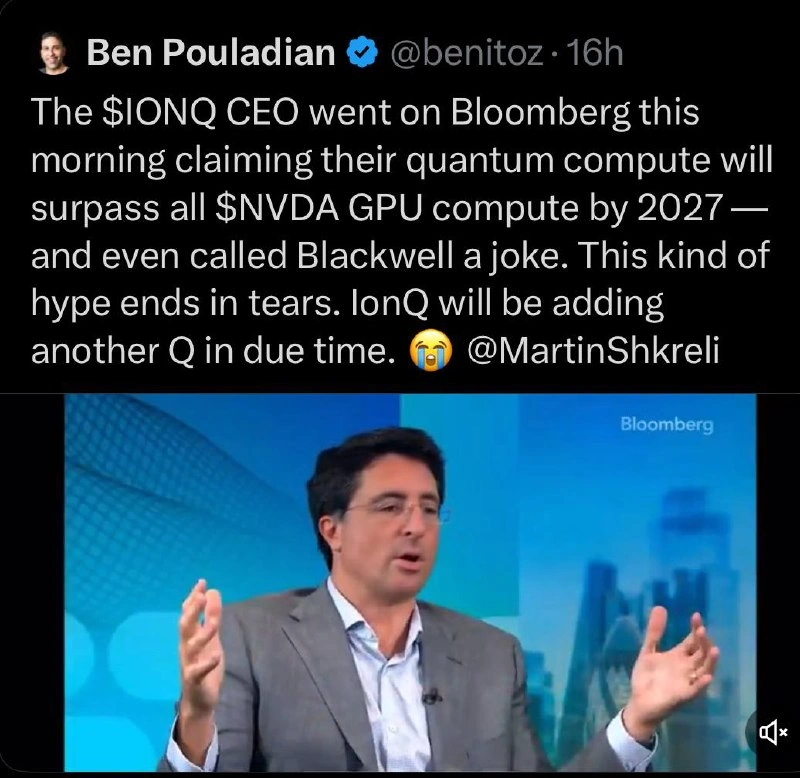
Strip away the quantum buzzwords, and this scenario is a textbook TechHypeCycle spectacle that seasoned engineers have seen play out again and again – often ending in a glorious train wreck of broken promises. You’ve got a CEO on Bloomberg TV making sensational claims that his prototype tech will outclass the industry’s current workhorse by a near-future date. Engineers, naturally, grab popcorn. Why popcorn? Because we’ve all watched this movie before: bold CEO marketing claims on national media, stock ticker symbols flying ($IONQ versus $NVDA), and a confident prediction (“by 2027!”) that sounds too good to be true. The whole performance reeks of deja vu. Today it’s quantum computing versus GPUs; yesterday it was some blockchain startup claiming to replace banks, or an AI company saying software would write itself by 2020, or a VR company insisting we’d all live in the metaverse by last Christmas. The specifics differ, but the pattern is classic IndustryTrends_Hype: pick a hot emerging tech, declare it will shortly surpass and render the established tech obsolete, and ride that hype for as long as you can. Engineers who’ve been around the block can practically set their watches to the ensuing timeline of over-promises, under-deliveries, and investor disillusionment. It’s tech industry irony at its finest – TechIndustryIrony so sharp you could cut a wafer with it – that the more brazen the promise, the more catastrophic the fail tends to be. As the tweet succinctly put it, “This kind of hype ends in tears. IonQ will be adding another Q in due time.” That line is pure gold for the initiated: adding another “Q” would turn IonQ into IonQQ, and “QQ” in old gamer/chat lingo represents crying eyes. In other words, the CEO’s hubris might just reduce the company to tears – a punny prediction of a hype train wreck in the making.
The humor here has layers of insider references. Firstly, the CEO calling NVIDIA’s upcoming Blackwell GPU “a joke” is so over-the-top that it flips from confidence into comedy. NVIDIA’s GPUs are basically the backbone of modern AI, HPC, and even a chunk of the crypto world – telling engineers that a nascent quantum box will make Blackwell look silly is like a rookie pitcher swaggering onto a baseball field and declaring he’ll strike out Babe Ruth and Shohei Ohtani at the same time. Hardware folks know how hard-earned Nvidia’s performance gains are; these GPUs pack tens of billions of transistors, years of R&D in architectures and HardwareTradeoffs to maximize throughput. So a CEO from a company that, to put it bluntly, currently has to fight tooth and nail to get even 30 qubits working in tandem, going on air to dunk on a GPU that hasn’t even been released yet – that’s premium-grade chutzpah. It immediately reads as TechSatire to the skeptical audience. Cue the eye-rolls and the joking comments on engineering forums: “Sure, buddy, and my Raspberry Pi is going to beat an AWS data center next year.” The format of the meme – a screenshot of a tweet about a sensational Bloomberg interview – perfectly encapsulates this collision of marketing and reality. The suited CEO gesturing confidently on TV, the tweet author (@benitoz) adding his snark (“IonQ will be adding another Q in due time 😭”), even the tag of Martin Shkreli at the end to drive home the vibe (Shkreli being infamous for hype and questionable claims in pharma and crypto) – it’s all a signal to tech veterans that we should grab the popcorn and watch this bold narrative unravel.
Now, let’s talk about the quantum_vs_gpu_benchmarks angle that’s specifically tickling engineers’ funny bones. In real engineering life, when someone claims their new system will beat an existing one, they show benchmarks or at least credible roadmaps. Here we have IonQ basically implying, “trust us, in ~2 years we’ll smoke the best GPUs in everything.” That’s a quantum leap of faith (pun absolutely intended). Engineers know that even comparing quantum and classical computing is tricky; they excel at different things. The CEO’s statement ignores that reality entirely and frames it like a boxing match: IonQ Quantum vs. NVIDIA GPU, title fight in 2027. It has a pro-wrestling hype vibe – you almost expect him to drop the mic with “Blackwell is a joke, brother!” The tweet’s author reacts with “This kind of hype ends in tears” because he’s seen startups promise the moon before. For example, remember all those companies in the 2010s claiming to use AI to diagnose diseases better than doctors overnight? Most quietly dialed back their claims once reality hit. Or all the VR companies that said by 2020 we’d abandon keyboards and monitors? (Last I checked, I’m still typing this on a keyboard in good old 2D reality.) The TechHypeCycle always starts at “Innovation Trigger,” shoots up to a “Peak of Inflated Expectations” – and that peak is exactly where IonQ’s CEO planted his flag. Seasoned devs know what comes after the peak: the Trough of Disillusionment – i.e., those tears being referenced.
The greentext portion of the meme (written in that satirical 4chan-esque style with > at the start of lines) really drives home the TechIndustryHumor by narrating an investor’s wild ride on the IonQ hype train. It’s basically a comedic monologue of a true believer (a self-described “quantum cultist”) getting repeatedly smacked by reality:
be me, quantum cultist, snorted copium since kindergarten
drop 50k on $IONQ because “quantum only goes up”
CEO: “every Fortune-500 CEO has a quantum strat”
mfw McDonald’s gonna supersize fries with entangled salt
In these lines, the meme mocks the idea that everyone needs a “quantum strategy” because it’s the buzzword du jour. The CEO’s claim that “every Fortune 500 CEO has a quantum strategy” is classic marketing hyperbole – it suggests you’re a Luddite if you aren’t jumping on this bandwagon. The greentexter’s reaction image (mfw = my face when) about McDonald’s entangled salt on fries hilariously illustrates how absurd that sounds. It’s poking fun at the bandwagon effect: just because quantum computing is hot, suddenly even the most mundane businesses will supposedly use entanglement to improve french fries. It’s an absurd extrapolation that highlights how out-of-touch such corporate statements can be. As an engineer, you chuckle because you’ve seen similar things – some executive insisting “We need blockchain for our sandwich delivery app” or “Our farm needs an AI strategy to milk cows.” It’s TechIndustrySatire pointing out that not every problem is a nail just because you invented a quantum hammer.
The greentext continues to skewer the reality of IonQ’s technology versus the hype:
CEO says gate fidelity 99.8%, sounds sexy
realize that's still 0.2% chance my calc turns into alphabet soup
ask IR when Shor's algo cracks RSA-2048
they send me link to 2030 roadmap PDF named cope.pdf
We grin reading this because it’s exactly the kind of fine print that hype glosses over. 99.8% fidelity is impressive for one quantum gate – and marketing will shout that from the rooftops – but an engineer immediately does the mental math we did in Level 4 and thinks, “hmm, 0.2% error each step, that compounds fast.” The alphabet soup comment nails this: run enough operations and your quantum calculation’s output could become gibberish due to accumulated errors. The investor asking when Shor’s algorithm will crack RSA-2048 – that’s basically asking “when will you achieve the holy grail outcome you teased?” – and getting a roadmap to 2030 named cope.pdf is just chef’s kiss. The use of the word “cope” implies even the company knows it’s hand-waving away the hard questions with optimistic future plans. Roadmaps are the oldest trick in the hype playbook: “Oh, that impossible thing? Sure, it’s on our roadmap for a few years out, here’s a glossy PDF.” We’ve all seen those PDFs – full of quantum vs classical performance charts that magically trend upward if you just trust the extrapolation. The cynical voice in the meme flat-out labels it cope, as in “coping mechanism,” which is hilariously blunt. As engineers, we appreciate this dark humor; it’s a reminder to take any 2030 roadmap with a bucket of salt (entangled or not).
The next part hits on the financial reality versus the hype:
earnings drop: $11m revenue, $10.9m is gov handouts
organic sales? less than what I tip DoorDash
DeMasi on CNBC: "quantum internet is next multitrillion TAM"
mfw he pitching teleporting memes while I can't even ping qubit without decoherence
This is a reality check. Hype meetings and Bloomberg interviews might create huge expectations, but then the earnings report comes out and… IonQ’s revenue is $11 million, of which $10.9 million is literally government grants (i.e., research subsidies, contracts, etc.). That means actual product revenue – money from real customers for real quantum services – is pocket change (“less than what I tip DoorDash” – savage). This stark contrast is funny because it’s true for many hype-y startups: they might be valued in the billions on paper, but bring in almost no actual cash from customers. The meme specifically naming those numbers highlights how reliant IonQ (and many quantum firms) are on government R&D funds – not exactly a robust commercial business yet. So on one hand the CEO talks about beating NVIDIA, on the other the company is basically surviving on NSF grants and pilot programs. The cognitive dissonance is comical.
Then we have an IonQ exec (DeMasi – presumably IonQ’s CFO or another figure) on CNBC touting the “quantum internet” as a multi-trillion dollar TAM (Total Addressable Market). “Quantum internet” sounds flashy – it refers to a future network where quantum information (qubits, entangled particles) can be transmitted securely over long distances, enabling things like unhackable communications or distributed quantum computing. But to the meme’s author (and many engineers), that phrase is a red flag. It’s grandstanding about something that might be decades away or might not even make sense for general use. The quip “pitching teleporting memes while I can’t even ping a qubit without decoherence” perfectly captures the TechIndustryHumor. The exec is selling a Jetsons future (quantum teleportation! entangled internet!) while the current reality is that you can barely maintain a single qubit’s state if you try to communicate with it (“ping” it, as if it were an IP address on a network). In networking terms, a simple ping is the most basic connectivity test – here, attempting the simplest “ping” on a quantum level (like sending or measuring a qubit state) causes it to decohere (lose its information). So picturing a whole quantum internet when one qubit can’t survive a round trip is absurd – thus the mental image of “teleporting memes” (like sending your cat GIFs via quantum entanglement) is hilariously impractical. It highlights the yawning gap between buzzy buzzwords and the lab reality.
Continuing:
ask for 1000-qubit cloud instance
support says "we have 32, but they're logical in spirit"
“quantum internet” because regular net too useful
need photon routers so Twitter loads in superposition
This part satirizes how companies might overstate their capabilities. The user asks IonQ for a 1000-qubit cloud instance (like a VM with 1000 qubits to run a program). The reply: “we have 32, but they’re logical in spirit.” That likely riffs on IonQ’s marketing talking point: they might say they have a certain number of effective logical qubits or “algorithmic qubits” – terms companies sometimes use to measure how many qubits are usable for computations after error mitigation. It’s a bit nebulous and can be generous counting. IonQ might physically have, say, 32 physical qubits connected, and they use some to error-correct others, or use clever tricks to boost effective performance, then perhaps claim it’s equivalent to, hypothetically, a higher number of ideal qubits “in spirit.” The meme mercilessly mocks this as almost spiritual or metaphysical nonsense – “logical in spirit” sounds like a cheeky support answer akin to “the power of quantum friendship gives us 1000 qubits, virtually.” It underscores that IonQ can’t actually deliver what a naive investor might assume (1000 real qubits), but they try to smooth it over with jargon. Cue the engineer chuckles: we’ve all seen specs massaged with creative phrasing.
Then the meme doubles down on the absurdity of the “quantum internet” hype: “because regular net too useful.” This one-liner drips with sarcasm. The regular internet – the one we’re using right now – works astoundingly well for the world’s needs (despite occasional DNS jokes). The idea that we need a quantum internet is debatable; it would be for very niche uses (like quantum cryptography or linking quantum computers). But IonQ’s exec pitching it as the next multi-trillion necessity makes it sound like everyone’s going to abandon classical networks. The meme’s author jokes that maybe the regular internet is too useful, so we need a more convoluted, finicky quantum version to complicate our lives – hence the line “need photon routers so Twitter loads in superposition.” The visual is hilarious: imagine your tweets existing in a quantum superposition of both posted and not posted, or loading Schrödinger’s cat memes that are simultaneously lol and not lol. It’s absurdist humor that any IT person can appreciate – we struggle enough with router firmware and packet loss on the classical internet, and now someone wants to throw photonic qubits into our routers? Sure, what could go wrong! It’s a tongue-in-cheek way to say “this quantum internet idea is a solution in search of a problem.”
Finally, the greentext wraps up with the financial fantasy versus reality:
DeMasi tweets "minimum upside CSCO market cap"
do quick math: need $200B revenue, currently selling $5m of fairy dust
that's only 40,000% growth, basically guaranteed
google "proven exponential quantum algorithms"
find three, all require 1M qubits and liquid-nitrogen cooled unicorn tears
file taxes, mark investment as "charitable donation to physics LARP"
This is the fatality move in the meme, where the investor fully realizes the extent of the hopium. The IonQ exec compares IonQ’s potential to Cisco (ticker CSCO), implying IonQ could reach Cisco’s market cap (Cisco is worth in the hundreds of billions of dollars). That’s a minimum upside apparently – so they’re saying, “we’re at least going to be as big as Cisco.” An engineer hears that and about spits out their coffee. Cisco became a giant by actually selling tons of routers, switches, and powering the internet backbone for decades. IonQ currently sells – well – not much. The meme notes $5 million of actual revenue (the rest being “fairy dust” i.e. grant money and pilot projects). To get from a few million to hundreds of billions is a growth of ~40,000%. The line “basically guaranteed” is weapons-grade sarcasm. We can practically hear the laughter: only in marketing la-la-land would anyone treat 40,000% growth as a given. It’s poking fun at the kind of slides startups show where a tiny bar in 2025 becomes a huge bar by 2030, with no real explanation except “market will expand, we will capture X% of a trillion-dollar market.” Engineers and rational stakeholders know to be skeptical, but in hype-land, these proclamations often go unchallenged until reality intervenes.
The investor then does their due diligence: Googles “proven exponential quantum algorithms.” This is basically checking “okay, what can quantum computers do exponentially faster that’s actually proven?” They find maybe three (which matches what we know: Shor’s algorithm for factoring, perhaps an algorithm for discrete logarithms (similar to Shor’s), maybe the HHL algorithm for solving certain linear systems exponentially faster under specific conditions). The meme exaggerates to make a point: essentially, there’s a very short list of tasks with true exponential quantum speedups known, and each of them requires an impractical amount of qubits (like a million, far beyond IonQ’s reach) and, humorously, “liquid-nitrogen cooled unicorn tears.” That phrase is hilarious and vividly sarcastic – unicorns don’t exist, so good luck getting their tears, and even if you did, you’d need to cool them with liquid nitrogen (a stand-in for all the extreme engineering challenges quantum computing needs, like cryogenics). It’s basically saying: the few things quantum could in theory blow our minds with are so far out of reach technologically that you might as well be asking for magical unicorn byproducts. The seasoned engineer chuckles because it’s true – quantum hype often glosses over that gap with hopeful language, but here it’s laid bare comedically.
In the final line, the investor capitulates: marking the investment as a “charitable donation to physics LARP” on his taxes. “LARP” stands for Live Action Role-Playing – implying that IonQ is more of a pretend-play at being a revolutionary company than actually delivering returns, so the money might as well be a donation to science. That’s dark humor for sure. It’s the kind of joke a burned investor or a jaded engineer might make after seeing a promising tech investment turn into vapor. It resonates because, let’s face it, a lot of us in tech have had moments where we realized something we believed in was mostly smoke-and-mirrors and hope. Calling it a donation to “physics LARP” is a way of saying “at least the scientists got some research budget out of my foolishness, and they got to role-play a bit longer that they’re building the future.” It’s brutal, it’s funny, and it’s very much how a cynical veteran of the industry would close out such a rant.
Put all of this together, and the meme is a brilliant slice of TechIndustrySatire. It lampoons the gulf between ceo_marketing_claims and engineering reality. It reminds everyone of the hardware tradeoffs and fundamental limits that grand visions often ignore. The tweet and greentext format double-team the point: one from the perspective of an external commentator (“this will end in tears”), and one from the perspective of an internal true believer turned skeptic (“I drank the Kool-Aid and now I see the light, ouch”). The reason engineers find this gut-bustingly funny is because it’s painfully relatable. We’ve seen managers buy into hype and set impossible deadlines because some CEO on TV said so. We’ve seen companies pivot to the buzzword of the day and fizzle out. And we’ve seen genuinely cool tech (like quantum computing) get hamstrung by ridiculous expectations set by their own execs or the media. It’s irony writ large: the very people championing a revolutionary technology can sometimes hurt its credibility with outlandish promises. So, as grizzled devs, we respond with a mix of amusement, schadenfreude, and an “I’ll believe it when I see it” attitude – all perfectly captured by the proverbial popcorn emoji. We’re not rooting for failure (most of us love the idea of quantum breakthroughs), but we can’t help smirking when the hype-train is clearly going off the rails. In short, this meme is a front-row ticket to watching overconfidence meet physics, and everyone in the engineering peanut gallery is munching away, waiting for the final act. Pass the butter.
Level 4: Quantum Hype Uncertainty Principle
At the bleeding edge of QuantumComputing, the IonQ CEO’s boast pits theoretical quantum limits against the brute-force reality of classical hardware. This isn’t just bravado in a vacuum – it’s essentially claiming that a fledgling quantum system will outshine every GPU (like NVIDIA’s upcoming Blackwell architecture) within two years. To an expert, that triggers immediate side-eye. Why? Because it takes us into the realm of computational complexity classes and hardware physics where quantum hype often evaporates upon measurement (much like a wavefunction collapsing).
In theory, a quantum computer operates in a different complexity class (often termed BQP for “bounded-error quantum polynomial time”) than your classical machines. Certain problems that stump classical computers could be efficiently solved by quantum algorithms – the classic example is Shor’s algorithm for factoring large numbers exponentially faster than the best known classical methods. If you could run Shor’s algorithm on a sufficiently large, error-corrected quantum computer, you’d crack RSA-2048 encryption wide open (rendering today’s secure internet protocols useless). That’s the holy grail scenario quantum evangelists salivate over. But here’s the rub: running such algorithms at scale requires immense quantum resources – on the order of thousands to millions of high-quality qubits – along with error rates so low that every quantum logic gate behaves near-perfectly in long sequences. Today’s hardware isn’t remotely close to that. IonQ touting “99.8% gate fidelity” sounds impressively high, but a 0.2% error per gate means that in a circuit with many operations, the probability of a perfect run plummets. In fact, if you apply a 99.8%-accurate gate 1000 times in a computation, there’s roughly $(0.998)^{1000} \approx 13.5%$ chance the whole operation comes out error-free – meaning an 86.5% chance you get digital alphabet soup. This is why quantum error correction is the elephant in the room: to perform big computations reliably, you need to encode a single logical qubit into many physical qubits to compensate for errors, incurring huge overhead. IonQ’s qubits (trapped ion-based) have decent fidelity and long coherence times compared to superconducting qubits, but scaling from, say, ~32 physical qubits to 1,000,000 physical qubits (a ballpark some estimates suggest for cracking RSA) by 2027 is science fiction bordering on delusion. We’re talking about profound physics and engineering challenges – from isolating qubits from the environment to decoherence (the tendency of quantum states to lose their “quantum-ness” and become classical when disturbed). Every extra qubit and every additional operation introduces more noise and heat. Overcoming that isn’t just a matter of corporate willpower or doubling down on Moore’s Law; it’s closer to trying to domesticate a school of quantum mechanical cats that all need to behave in a fragile, entangled harmony.
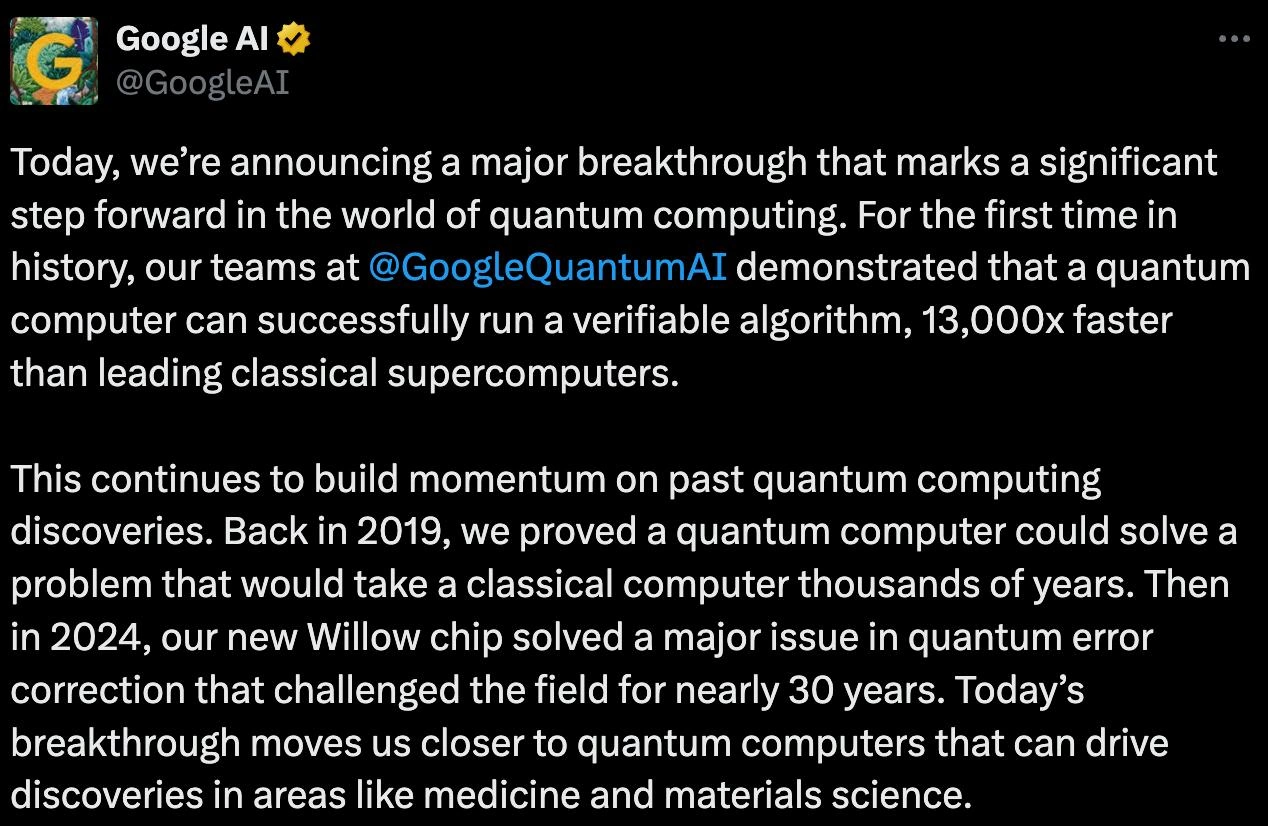
To claim that all NVidia GPU compute will be surpassed implies a broad quantum advantage across the board. This breezily ignores that many tasks GPUs excel at (massively parallel numeric computations, deep learning matrix multiplications, real-time graphics pipelines) have no known efficient quantum algorithms that could replace them. Quantum computers are not general-purpose speed demons for arbitrary code – they’re more like extremely specialized co-processors that shine for certain problems (like factorization, unstructured search, or simulating quantum physics) but flounder on many everyday computations where classical processors (and GPUs) are absurdly optimized. The IonQ CEO essentially posited a future quantum vs GPU benchmark showdown and declared victory preemptively. It’s as if he’s invoking quantum supremacy (the moment when quantum devices outperform classical supercomputers) not just for one niche calculation, but for pretty much everything – and doing so on a very aggressive timeline. Historically, quantum supremacy (as first demonstrated by Google’s Sycamore chip in 2019) was achieved on a contrived random-circuit sampling problem that had zero practical use – it was a proof-of-concept that with 53 qubits they could do in 200 seconds what might take a supercomputer 10,000 years (though even that was later contested when classical algorithms improved). IonQ is hinting at a far bolder claim: a quantum computing leap so massive that the fastest silicon-based architectures (like Blackwell GPUs which by 2027 will themselves be faster and more efficient than today’s) would look obsolete. For seasoned engineers with a grasp of both QuantumComputingConcepts and classical HPC, this triggers the Quantum Hype Uncertainty Principle: the more confidently a timeline for quantum domination is stated, the less certain and more suspect it becomes.
Let’s also dissect the physics vs marketing of “Blackwell is a joke.” Blackwell (as a next-gen GPU) represents decades of refinement in semiconductor physics, architectural design, and HardwareTradeoffs to maximize throughput and minimize latencies in classical computations. GPUs achieve their incredible FLOPS by cramming thousands of cores, heavy pipelining, and fast memory bandwidth – all working reliably billions of times per second. A quantum computer, on the other hand, leverages phenomena like superposition and entanglement, which are powerful but highly sensitive. Trapped-ion qubits (IonQ’s approach) need vacuum chambers and laser pulses to manipulate quantum states of ytterbium ions; operations occur at kilohertz speeds (thousands of ops per second, not billions) and you can’t cram millions of ions on a tiny chip as easily as transistors. Even linking multiple quantum modules introduces complex quantum networking problems – sending qubit states between modules might involve entangled photons and quantum teleportation protocols, which are delicate and lossy. So when the CEO implies a small ion-trap machine will outdo a rack of NVDA GPUs by 2027, he’s essentially betting on solving a list of unsolved research problems (error correction, scaling qubit count, fast entangling gates, reliable photonic interconnects) in a couple of years. It’s not just unlikely; it’s bordering on a violation of the community’s understanding of quantum technological progress to date. In formal terms, it’d be akin to claiming we’ll go from a prototype that can barely factor 21 (yes, 3 * 7) to breaking 2048-bit RSA keys on demand, in the same timeframe that GPUs will likely only modestly improve. That’s a TechHypeCycle spike so steep it would make Gartner analysts spit out their coffee.
To further ground this skepticism, consider the known quantum algorithms that promise significant speedups and what they would demand:
- Shor’s algorithm – The poster child for quantum advantage, factoring an $N$-digit number in roughly polynomial time. This could undermine RSA encryption ($N=2048$ bits for RSA-2048). But running Shor on RSA-2048 isn’t just “a bit beyond” current tech – it’s astronomically beyond. Estimates suggest needing thousands of high-fidelity logical qubits (which could mean millions of physical qubits given error correction). IonQ’s 2025 machines have on the order of tens of qubits. A leap to even a few hundred error-corrected qubits by 2027 would be miraculous; reaching thousands is pure fantasy. Until those unicorn-tier breakthroughs happen, RSA-2048 is safe, and any talk of cracking it on IonQ’s timeline is vaportalk.
- Grover’s algorithm – A general quantum search that gives a quadratic speedup for unstructured search problems (turning $O(N)$ search into $O(\sqrt{N})$). Useful? Yes, in theory it accelerates things like brute-force crypto attacks or searching unsorted data. But it’s not the exponential silver bullet people often assume. If something would take a billion steps classically, Grover brings it down to about 31,622 steps – great but not mythical. And crucially, each step in Grover’s algorithm is a quantum operation that must run without decoherence. Running tens of thousands of coherent operations in sequence again circles back to that fidelity problem. It’s like having a 99.8% reliable rocket and trying to fire it 30,000 times in a row without a single failure. Good luck.
- Quantum simulation of quantum systems – Often cited as a near-term payoff of quantum computing. This is more practical: using qubits to simulate molecules and materials, since nature is quantum and classical computers struggle with the exponential complexity of simulating many-body quantum systems. A quantum computer with, say, 100 high-quality qubits can represent states that would overwhelm a classical supercomputer. This is arguably where IonQ and others hope to deliver value sooner. But even here, surpassing classical methods requires specific conditions and algorithms, and the results must be useful. It’s not a blanket “faster than GPUs on everything,” it’s “faster at certain chemistry or physics calculations that are intractable for classical methods.” That’s exciting, but it’s a far cry from replacing your GPU farm at the data center.
In summary, from a theoretical standpoint the IonQ claim triggers every alarm in a physicist’s lab. The fundamental QuantumComputingConcepts being invoked – superposition, entanglement, quantum speedups – are real, but exploiting them at scale within a couple of years bumps against hard scientific realities. It’s like someone claiming they’ve found a shortcut in the laws of computation and physics that the entire field somehow overlooked. Unless IonQ has secretly tamed some revolutionary new quantum error-correcting code or discovered qubit unicorn tears as a coolant, experienced engineers hear “surpass all GPUs by 2027” as quantum vaporware of the highest order. In quantum mechanics, the Uncertainty Principle tells us there’s a limit to how precisely we can know certain pairs of properties – similarly, there’s a limit to how much stock we can put in precise timeline promises about unproven tech. Every time an exec measures out a bold date and capability (pinning down one value), the uncertainty in the credibility inevitably explodes. IonQ’s CEO basically made a Schrödinger’s cat out of his company’s reputation: until 2027 we won’t know if the claim is alive or dead, but right now it’s in a very dubious superposition.
Description
A screenshot of a tweet from Ben Pouladian (@benitoz) posted 16h ago, reading: 'The $IONQ CEO went on Bloomberg this morning claiming their quantum compute will surpass all $NVDA GPU compute by 2027 - and even called Blackwell a joke. This kind of hype ends in tears. IonQ will be adding another Q in due time.' with a crying emoji, tagging @MartinShkreli. Below the tweet is a Bloomberg TV screenshot showing the IonQ CEO being interviewed. The tweet critiques the overhyped quantum computing claims and draws a comparison to NVIDIA's Blackwell GPU architecture, suggesting IonQ's claims are wildly unrealistic
Comments
22Comment deleted
IonQ claiming quantum will beat GPUs by 2027 is like claiming your startup will be profitable by Q4 -- technically possible in a parallel universe where superposition applies to revenue
The difference between a quantum computer and a regular one? A regular computer has bugs you can reproduce. A quantum computer has bugs that exist in a superposition of states until you observe them, at which point they tunnel into a production server
Sure, by 2027 IonQ could beat NVIDIA - right after my unit tests hit 100% coverage *and* the business finally agrees to deprecate that COBOL service
The real quantum entanglement here is how the CEO's promises are simultaneously in a superposition of 'revolutionary breakthrough' and 'vaporware' until observed by the SEC in 2027
Claiming your quantum computer will surpass all of NVIDIA's GPU compute by 2027 while calling Blackwell 'a joke' is the computational equivalent of announcing your startup's revolutionary blockchain AI will replace AWS by next Tuesday. The only thing achieving superposition here is the CEO's credibility - simultaneously overhyped and collapsed. At least when the stock craters, they can claim they were just demonstrating quantum tunneling through the floor
Wake me when FTQC multiplies a 2048x2048 matrix faster than 8xH100s; until then, Schrödinger’s roadmap is both shipping and slipping
IONQ surpassing NVIDIA by 2027? That's what their qubits promise in superposition - until measurement adds another fiscal Q
When a CEO promises their NISQ box will outcompute NVIDIA by 2027, I just add a zero to the QEC overhead and file it next to ‘rewrite the monolith in two quarters.’
Great post Comment deleted
LMAO @ Shkreli Comment deleted
Буквально 1984 Comment deleted
Please, stick to English around dev meme 🙏 Comment deleted
I dont know English to good, for this comment Comment deleted
Literally 1984 Comment deleted
Maybe Comment deleted
What all this words mean🙈 Comment deleted
I'm not reading all that Comment deleted
Quantum annealers remain the only practical path to quantum computing Comment deleted
Only d-wave actually has systems that can deliver any kind of ROI. Shor’s algorithm is not useful until gate machines have millions of coherent qubits which may never happen. Annealing optimization and constraint solving is real now. Comment deleted
Literally what copypasta is trying to say Comment deleted
Ya know what stock has gone up, is QBTQ, who apply AI to help people model problems so they can be solved on an annealer Comment deleted
It’s still only like a buck a share, go buy a bunch of that, I predict ten bucks next year Comment deleted