Skip to content
DevMeme
7338 of 7435
Gimli and Legolas Unite: C Dev, C++ Dev, and a Rust Hater
Languages Post #8042, on May 30, 2026 in TG

Gimli and Legolas Unite: C Dev, C++ Dev, and a Rust Hater

Why is this Languages meme funny?

Level 1: When Rivals Shake Hands

Two kids have argued forever about whose way of building treehouses is better — nails versus screws. Then a new kid shows up with a robot that staples treehouses together blindfolded, and sells tickets to climb them. Suddenly the nail kid and the screw kid are standing shoulder to shoulder going, "okay, that is dangerous." The grumpy one even admits he'd team up with someone he usually can't stand, as long as they both agree the stapler robot has to be stopped. It's funny because nothing makes old enemies into friends faster than a brand-new thing they can both be horrified by.

Level 2: Language Wars, Briefly

C is the minimal, manual-everything systems language that runs your OS kernel; C++ adds classes, templates, and a famously enormous feature set on top; Rust is the newer systems language whose compiler (the borrow checker) statically proves your program can't corrupt memory. Developers in these languages argue constantly about safety, complexity, and whose footguns are nobler — internet flame wars that have outlived multiple JavaScript frameworks.

"Vibe coding" means letting an AI assistant write your code and accepting it on vibes — it compiles, the demo works, nobody reads it. To systems programmers this is the ultimate sin, because their whole craft is knowing exactly what the machine will do: who owns this buffer, when it's freed, what happens on integer overflow. An LLM that confidently emits a subtle use-after-free is scarier to them than any rival language ever was. So the meme stages the classic narrative beat every junior eventually witnesses on a real team: two colleagues who fought for years over tabs, frameworks, or languages suddenly agreeing fiercely in a code review — because the new threat offends both of their standards at once.

Level 3: The Last Alliance of Manual Memory

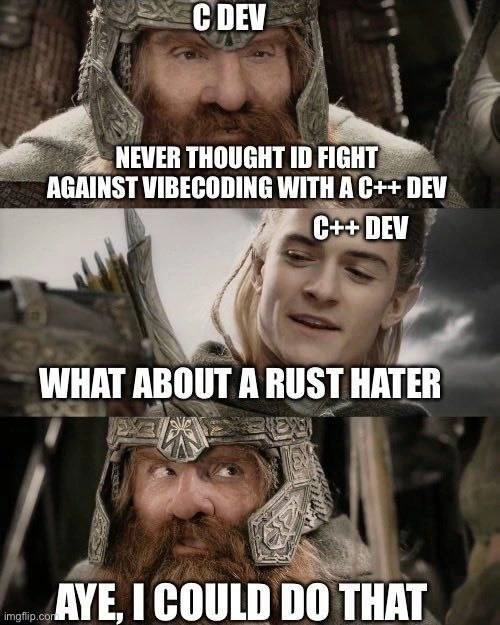
The template is the Helm's Deep exchange from The Two Towers, where Gimli and Legolas — heirs to a millennia-old dwarf–elf grudge — find common cause on the wall. Original dialogue: "Never thought I'd die fighting side by side with an elf." / "What about side by side with a friend?" / "Aye, I could do that." Here the labels rewrite the feud: Gimli is C DEV, declaring

NEVER THOUGHT ID FIGHT AGAINST VIBECODING WITH A C++ DEV

Legolas, labeled C++ DEV, smirks back "WHAT ABOUT A RUST HATER," and Gimli, visibly moved: "AYE, I COULD DO THAT."

To appreciate the alliance, you need the depth of the grudge. The C vs C++ war is genuinely ancient: C partisans (Linus Torvalds famously among them, at least for kernels) see C++ as a bloated cathedral of templates, exceptions, and hidden control flow; C++ partisans see C as willful primitivism — void* and goto cleanup cosplaying as discipline. Then Rust arrived and irritated both camps simultaneously, less for the borrow checker than for the evangelism: the "rewrite it in Rust" reply-guy era, CVE-shaming of C codebases, and memory-safety memos from governments treating malloc as a public-health hazard. Three-way trench warfare, decades deep.

The meme's sharp observation is sociological: vibe coding — shipping LLM-generated code unread — collapsed that three-way war into a two-sided one. All three camps, whatever their disagreements about RAII versus lifetimes versus raw pointers, share one axiom: you must understand the code you ship, down to its memory behavior. Vibe coding rejects that axiom entirely. And the punchline-within-the-punchline is in the C++ dev's middle panel: he offers the alliance not to a Rust dev but to a Rust hater — Gimli's grumbling identity preserved, his prejudice welcomed into the coalition. Common enemies don't dissolve tribal identity; they just re-rank it. The systems-programming priesthood will absolutely accept a heretic at the wall, so long as the heretic also flinches when an agent commits 4,000 unreviewed lines.

Description

A three-panel Lord of the Rings meme (Battle of Helm's Deep scene, imgflip watermark). Panel one: Gimli, labeled 'C DEV', says 'NEVER THOUGHT I'D FIGHT AGAINST VIBECODING WITH A C++ DEV'. Panel two: Legolas, labeled 'C++ DEV', smiles and replies 'WHAT ABOUT A RUST HATER'. Panel three: Gimli looks moved and answers 'AYE, I COULD DO THAT' - riffing on the original 'What about a friend?' exchange. The meme captures how the AI vibe-coding wave forged an alliance between historically feuding systems programmers (C vs C++ vs Rust evangelists) against a common enemy: LLM-generated code

Comments

11
Anonymous ★ Top Pick Nothing unites C and C++ developers - except someone whose memory safety strategy is 'the model seemed confident'
  1. Anonymous ★ Top Pick

    Nothing unites C and C++ developers - except someone whose memory safety strategy is 'the model seemed confident'

  2. @SamsonovAnton 1mo

    You have my sword. SWord = single word 🤓 (16, 32 or 64 bits, depending on platform conventions)

    1. @Johnny_bit 1mo

      There's no "You have my void*" nor "you have my std::unique_ptr" :P

      1. @callofvoid0 1mo

        don't point at me

        1. @b7sum 1mo

          shall i dereference you

          1. @callofvoid0 1mo

            Segmentation Fault use of uninitialized memory

      2. @SamsonovAnton 1mo

        Because a pointer is nothing without what it points to. PS. Can you declare a void variable?

        1. _ 1mo

          No you can't. You can define a void function, which returns nothing

        2. @callofvoid0 1mo

          dereferencing a pointer yields variable value does dereferencing a void pointer count as yielding void?

          1. @feedable 1mo

            no, it's ill-formed

            1. @callofvoid0 1mo

              malicious needs require malicious deeds

Use J and K for navigation