Skip to content
DevMeme
7337 of 7435
Vibe-Coding vs Coding: Two Houses Built on Rocks
TechDebt Post #8041, on May 30, 2026 in TG

Vibe-Coding vs Coding: Two Houses Built on Rocks

Why is this TechDebt meme funny?

Level 1: Two Wobbly Towers

Imagine two kids building with blocks on a pile of beach pebbles. One kid has a magic robot arm that stacks blocks super fast, so their tower is huge, crooked, and wobbling like jelly. The other kid stacks by hand, so their tower is small — but it's just as crooked and wobbly, because it's sitting on the same slippery pebbles. The joke isn't "the robot kid is silly." The joke is that both towers are about to fall over, and the hand-stacking kid is smugly pointing at the big one anyway. It's funny because we all love blaming the new shiny tool for a mess we were already making ourselves — just more slowly.

Level 2: Wires, Cracks, and Rocks

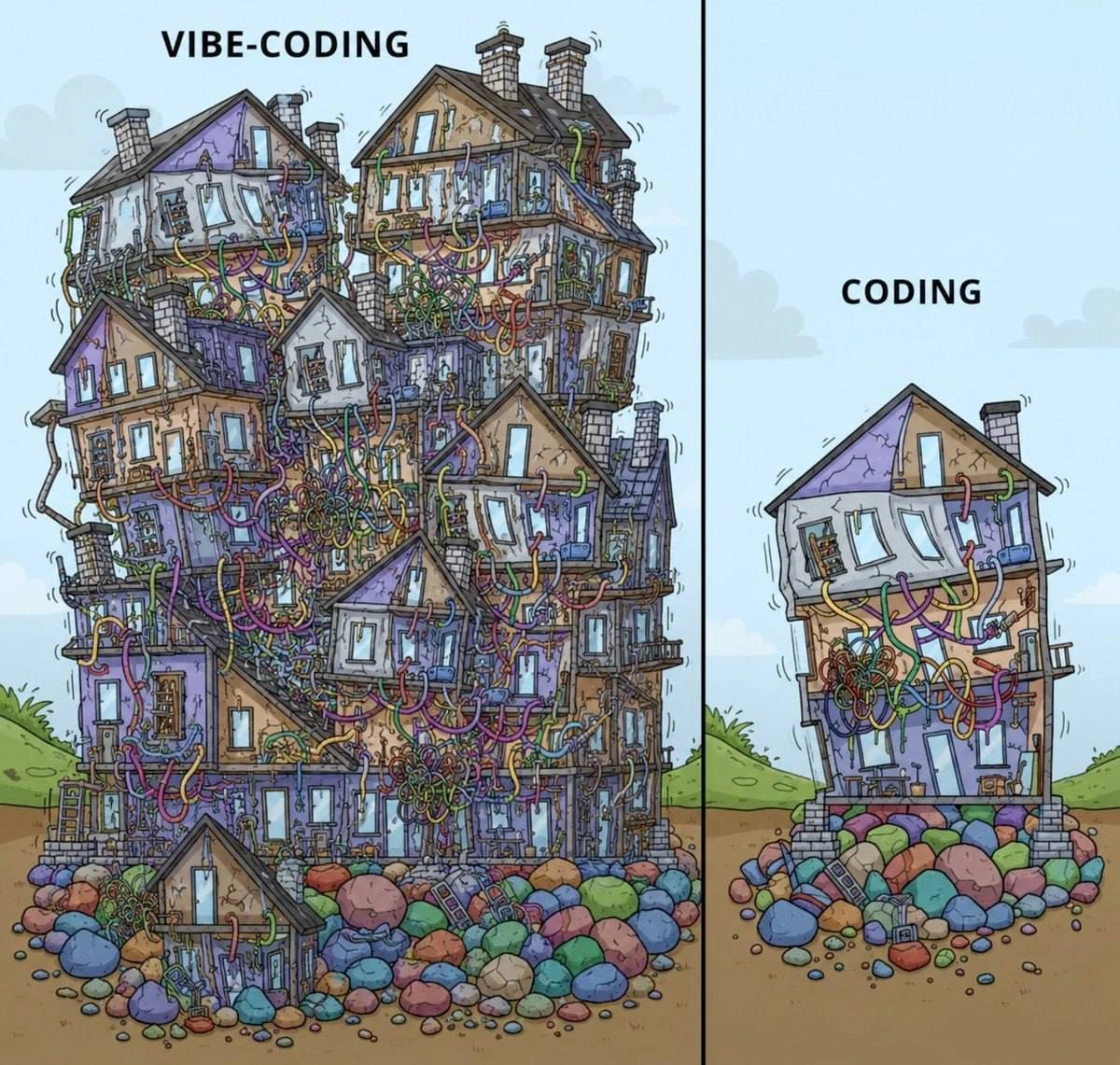
Decoding the visual vocabulary: the tangled wires are spaghetti code — logic where everything connects to everything, so touching one strand yanks five others. The cracks are bugs and brittleness: the system works until someone leans on it. The mismatched stacked houses are architecture by accretion — each feature bolted on in whatever style the moment demanded, with no unifying plan. The loose boulders underneath are a weak foundation: unclear requirements, no tests, no data model thought through before building.

"Vibe coding" means asking an AI assistant to generate code and shipping it on vibes — it runs, the demo works, nobody reads the diff. The meme's warning for early-career developers is double-sided. First: AI will happily build you the left tower, and it will feel like productivity right up until the first real storm (a refactor, a security audit, a 3 AM outage). Second — and this is the part that should keep you humble — writing it all by hand doesn't automatically grant you the right panel's smaller mess being a good mess. It's still leaning. The thing that fixes both panels isn't the typing method; it's boring discipline: tests, reviews, small modules, and pouring an actual foundation before stacking floors.

Level 3: Throughput of Regret

Look closely at the right panel before laughing at the left one — that's where the knife is hidden. The cartoon labeled "VIBE-CODING" shows a dozen-plus mismatched houses stacked into a swaying tower, every floor cracked, rainbow wire-spaghetti erupting from windows and crawling between stories, the whole thing teetering on a pile of loose round boulders. The panel labeled "CODING" shows... a three-story house that is also cracked, also leaning, also stuffed with a fist-sized knot of tangled wires, balanced on the same loose boulders. The motion lines around both structures are identical. Nobody in this comic has a foundation.

That's the honest version of the AI-coding debate, and it's rarer than it should be. The lazy take is "LLM code bad, human code good." The accurate take — the one this artist drew — is that vibe coding (prompting your way to working software without reading what comes back) doesn't introduce a new failure mode. It takes the failure mode we already had — accidental complexity, spaghetti coupling, load-bearing hacks, architecture by accretion — and removes the only governor we ever had on it: typing speed. Hand-written tech debt accumulated at maybe a few hundred lines a day per developer, because regret was throttled by human fingers. An agentic coding loop generates plausible, compiling, test-passing sprawl at thousands of lines an hour. Same crooked houses; the crane got faster.

The boulders matter most. In both panels the foundation is identical: loose, round, ungraded rocks — the unstable substrate of shifting requirements, half-understood domains, and "we'll fix it after launch." No tool operates above its foundation. Seniors know the dirty secret that makes this meme sting: most production systems were always the right-hand panel. We just told ourselves the cracks were character. The left panel is what happens when you scale that self-deception with venture-funded enthusiasm and a model that never gets tired, never pushes back, and cheerfully adds a fourteenth story because the prompt said "and also add user profiles."

Description

A detailed split-panel cartoon illustration. Left panel, labeled 'VIBE-CODING': an enormous, impossibly tall tower of mismatched cartoon houses stacked crookedly on top of each other, riddled with cracks, with colorful tangled wires/pipes spilling through every floor and window, the whole structure visibly wobbling on a foundation of loose round boulders. Right panel, labeled 'CODING': a much smaller three-story house - still cracked, still leaning, still stuffed with a knot of colorful tangled wires, and also balanced on loose boulders. The joke is double-edged: AI-assisted vibe coding produces vastly more precarious sprawl, but the punchline is that hand-written code is the same unstable mess, just smaller

Comments

8
Anonymous ★ Top Pick Vibe coding didn't lower our engineering standards - it horizontally scaled them
  1. Anonymous ★ Top Pick

    Vibe coding didn't lower our engineering standards - it horizontally scaled them

  2. @acidbong 1mo

    right: original Unix coreutils left: GNU rewrite of coreutils

    1. @sysoevyarik 1mo

      Scale is logarithmic, of course

    2. @Agent1378 1mo

      And now we need rust rewrite of the same

      1. @acidbong 1mo

        uutils (github.com/uutils) exist

        1. @Agent1378 1mo

          I meant as house like in picture

      2. Егор 1mo

        that one is on the left again

        1. @acidbong 1mo

          just multiplied recursively

Use J and K for navigation