Skip to content
DevMeme
3534 of 7435
When you realize you’re both the API author and the frontend integrator
API Post #3870, on Oct 28, 2021 in TG

When you realize you’re both the API author and the frontend integrator

Why is this API meme funny?

Level 1: Doing It All

Imagine you’re doing a big school project all by yourself. First, you write a story for the project (that’s like making the backend API). You feel happy for a moment thinking, “Phew, writing is done, now someone else can do the drawings for the story.” You relax because usually your friend does the drawings (that would be like a separate frontend developer handling the visuals). But then suddenly you remember: you’re the only one in this project! 😰 You have to do the drawings too. That burst of panic when you realize you must do everything yourself – that’s exactly what this meme is about.

The picture shows a mannequin head that looks scared (hands on head) then calm, then scared again. It’s a funny way to show the rollercoaster of feelings. At first, the person is scared thinking about the next big task. Then they calm down by telling themselves, “It’s okay, someone else will handle that part.” Finally, they get scared again when they realize, “Oh no, that ‘someone else’ is actually me!” It’s like if you cleaned your room and then thought, “It’s fine, mom will clean the kitchen,” but then you suddenly remember mom’s not home and you have to clean the kitchen as well.

So the joke is: sometimes we trick ourselves into feeling better by imagining help is on the way, but in certain cases – like when you’re the only person responsible – you are the help. It’s a funny-sad feeling. In the world of programmers, being both the “API author” and the “frontend integrator” means you have two jobs: building the tool and using the tool, with no one else to hand it to. The meme makes us laugh because the person forgot for a second that they had both jobs, and that moment of forgetting and then remembering is super relatable (even outside programming). It’s like laughing at yourself when you walk into a room and then remember it’s the wrong room. Oops!

In everyday terms: think of cooking dinner by yourself. You cook the food (backend work), then you think, “It’s okay, someone else will set the table and serve the food” (that’s wishful thinking of another person doing the frontend part). Then you realize, “Ah, I’m alone, I have to set the table too!” So you go from anxious about all the cooking, to relieved thinking you’ll get help, to anxious again realizing nope, all you. The mannequin’s panicked face in the first and last panel is you stressing out, and the calm face in the middle is you briefly forgetting reality.

This meme is funny because we’ve all been in that spot where we are the entire team without realizing it. It’s showing a common human experience – hoping for help and then discovering you’ve got to handle it solo – in a simple, silly way. Plus, the wide-eyed mannequin face is just goofy-looking, which makes the whole thing even more light-hearted. In the end, the message is: take a deep breath, you might have to do it all, but you’ve got this. And if not, well, at least we can laugh about the little panicky moment!

Level 2: Wearing Multiple Hats

For a more junior developer or someone newer to web development, let’s break down what’s happening in this meme. The joke is about being a full-stack developer, which means one person who does both backend (server, database, API) and frontend (user interface, client-side) work. The meme uses the classic "Panik / Kalm / Panik" format with the mannequin head to visually represent the developer’s changing emotions:

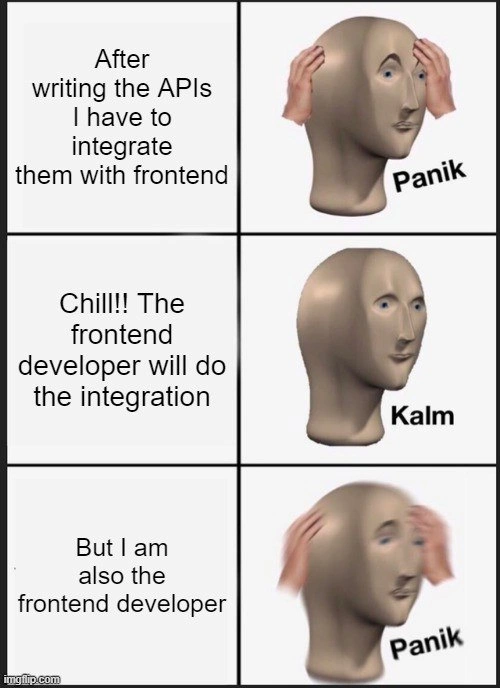
  • In the first panel, the text says: “After writing the APIs I have to integrate them with the frontend”. This is the developer’s first reaction: they finished coding some APIs (the backend endpoints that send data to the frontend), and then realize there’s more work to do – specifically, hooking those APIs up to the user interface. The mannequin’s face on the right is in panic (wide eyes, hands on head) labeled "Panik". So the developer is freaking out because integration work can be tricky and time-consuming. It's like saying, "Oh no, I'm not done at all!". In developer terms, integration means connecting two pieces of a system – here it’s linking the backend API to the frontend app so that they talk to each other properly. This often involves writing fetch calls or AJAX requests in the front-end code and handling the data that comes back.

  • In the second panel, the text says: “Chill!! The frontend developer will do the integration”. The same developer has a new thought: "Relax, I don’t have to worry about this, because the frontend developer will handle it." The mannequin on the right is now calm (pleasant neutral face) labeled "Kalm". Basically, the developer is trying to reassure himself by remembering that integrating APIs is usually the frontend developer’s job. In many teams, backend developers and frontend developers are different people – each has their own specialization. So it’s reasonable for a backend dev to think, "I’ll just deliver the API and someone else on the team will plug it into the UI." At this moment, our character is pretending that’s the situation – hence the calm. This is a moment of forgetting (or ignoring) the fact that he’s actually working alone or is assigned both roles. It’s kind of an internal pep talk: "Don’t panic, someone else will handle the rest."

  • In the third panel, the text reveals: “But I am also the frontend developer”. And we’re back to panic mode (same mannequin clutching its head, caption "Panik"). This is the punchline: the developer suddenly remembers that there is no separate frontend person to take over – he is that person too! So the poor developer has to do the integration after all, which brings the panic right back. Essentially, he tried to relax by treating himself as two separate people (one backend, one frontend), but reality hit that he’s a single person with a double workload. This is very common in smaller companies or projects: one developer builds both the server-side and the client-side. They joke about "wearing multiple hats," meaning doing different jobs. Here the hats are “API developer” and “frontend integrator,” and he’s wearing both at once.

So why is this funny to developers? It’s because of the relatable surprise and slight absurdity. Many developers have experienced being asked to do a bit of everything – one minute writing database queries, the next minute debugging how a button on a webpage gets its data. If you’re new, imagine being in a school project where you thought different team members would each do parts (one person writes the report, another does the presentation), but then you realize you’re the only one in the group, so you must do all of it. It’s that “oh no...” feeling, captured in a meme.

Some key terms and ideas in this meme:

  • API (Application Programming Interface): In web development, an API usually refers to the backend endpoints that send data to the frontend. For instance, a backend API might have a URL like /api/getUsers that returns a list of users in JSON format. Writing the API (backend work) involves coding these endpoints, handling requests, and sending responses (often from a database).

  • Frontend Integration: This means taking those API endpoints and using them in the frontend application. For example, if you have a React or Angular app, you’d write code (maybe using fetch or an axios call in JavaScript) to request data from the API and then display it on the webpage. Integration is basically “connecting the dots” – ensuring the front end knows about the API and can show the API’s data to the user. It often also involves dealing with any mismatches, like if the API sends data in a format the frontend didn’t expect.

  • Full-Stack Developer: This is a developer who does both backend and frontend. Companies love to ask for full-stack devs because they can build an entire feature end-to-end. But for the developer, it can be a lot, as they need to know server-side logic and client-side user experience. In the meme, the person is a full-stack dev (even if temporarily), juggling both responsibilities. So when he says “the frontend developer will do it” and then “I am the frontend developer,” he’s basically acknowledging, “Yup, I’m full-stack on this, there’s no escape.”

  • Panik/Kalm Meme Template: If you haven’t seen it, the meme uses a 3D-rendered mannequin head (sometimes called “Stonks” or “Panik Kalm” meme face). It’s popular for showing a sudden change of emotion. The typical pattern is exactly what we see: something bad -> panic; a comforting counter-thought -> calm; a twist that makes it bad again -> panic. It’s a way to set up a joke where someone briefly relaxes before realizing things are actually as bad as they feared (or worse). Here the twist is self-referential: he calms down by thinking of another person, then panics realizing that person is him. This format is a staple in developer humor because a lot of our problems momentarily seem solved until we face reality (e.g., “I fixed the bug!… Kalm… actually that fix broke something else… Panik”).

  • “Wearing multiple hats”: This idiom means taking on different responsibilities or roles. In startups or small teams, developers often joke, “We all wear multiple hats here,” meaning one day you’re an engineer, the next you’re also the tester, maybe even the DevOps or the UI designer. It’s a lighthearted way to describe context switching. In the meme, the developer figuratively puts on the “API developer hat” then swaps to the “frontend integrator hat.”

Now, importantly, why is integrating your own API such a moment of panic? Integration work tends to surface any problems in how the two sides (client and server) fit together. For a junior developer, it might be surprising that writing an API isn’t the end of the task – you also need to ensure the frontend and backend agree on how to communicate. For example, if the backend sends a date in a format the frontend isn’t parsing correctly, things break. In a team, a frontend dev might come back to you and say, “Hey, I’m getting an error when I try to use your API,” and you work it out together. But when you are both people, you just encounter the error yourself and go “Oh, I didn’t think of that.” It’s almost like setting up a puzzle for yourself to solve.

Let’s imagine a simple scenario: You write an API endpoint to get a list of products for an e-commerce site. It returns a JSON like:

{
  "products": [
    { "id": 1, "name": "Laptop", "in_stock": true },
    { "id": 2, "name": "Mouse", "in_stock": false }
  ]
}

As the backend developer, you’re done and feeling good. Now, as the frontend developer (also you), you start writing code to display that product list on a webpage. If you accidentally expected the field to be named "inStock" (camelCase) instead of "in_stock" (snake_case) in your JavaScript, your code will look for the wrong thing and maybe not show the stock status correctly. Initially, you might scratch your head like, “Who wrote this API? They should have been consistent with naming!” before it dawns on you: you wrote it, and you’ll have to fix either the backend or adjust the frontend code. Cue the panik.

This is exactly the kind of issue that becomes obvious during integration. It’s why integrating is often a distinct phase in development – to catch these misunderstandings or mismatches. When one dev does it all, they have to mentally switch contexts and sometimes almost pretend to be a “different person” to test their own work. It can actually be a cool learning experience because you see the outcome of your backend decisions immediately in the UI. But it’s also a bit like playing chess against yourself; you can’t really surprise yourself, but you can certainly confuse yourself temporarily!

So, for a junior dev reading this meme: it’s poking fun at the moment you realize a task isn’t off your plate just because you finished one part. In software, there’s often another part waiting. The developer in the meme basically tried to comfort himself that someone else would handle the second part, only to recall that in this case, he’s alone in the project. It’s a mix of “darn, more work” and “oops, I forgot I’m responsible for that too.” That feeling is very real in development, especially when you’re new or when you’re working at a small scale. You might finish coding a feature’s backend and then remember, oh yes, I also need to create the UI for it (or vice versa).

Finally, it’s worth noting that the caption or title given – “When you realize you’re both the API author and the frontend integrator” – summarizes the whole joke in plain words. It sets up the scenario directly. “API author” is the person who made the backend endpoints, “frontend integrator” is the person who uses those endpoints in the user interface. Realizing you are both is the comedic aha-moment. The meme image then dramatizes how that realization feels emotionally: panic, calm, panic. It’s a fun way to say: being a full-stack dev means sometimes you catch yourself hoping for help... and then you remember you are the help.

In short, this meme is highlighting a common developer situation in a lighthearted way. As a new developer, you’ll likely experience something similar if you haven’t already: having to see a task through all the way, backend to frontend, and feeling that mix of overwhelm and acceptance. Don’t worry – it happens to everyone, and as the meme suggests, sometimes the only person to pep-talk is yourself!


Level 3: Integration Whiplash

At the senior level, this meme hits on the full-stack developer experience of rapid context switching between backend and frontend roles. The humor comes from a developer’s internal dialogue oscillating between panic and calm as they realize there's no "other team" to hand off to – they are both teams. In a typical large project, the API (Application Programming Interface) is built by backend engineers, and the frontend integration is handled by UI or client-side specialists. Each side often blames the other for bugs: “The data format is wrong!” vs. “The UI isn't handling nulls!” But in a FullStackDevelopment scenario, you’re wearing both hats, so any blame is just pointing at a mirror. This meme brilliantly captures that split-second self-reassurance (Kalm) followed by the crushing realization (Panik) that “Wait... I’m also the frontend developer.”

From a senior perspective, it satirizes the lack of separation of concerns when one person owns both the API and its consumption. In theory, backend and frontend should be modular: the backend provides a contract (endpoints, data schemas) and the frontend consumes it. In practice, a solo developer must context switch between designing that contract and immediately being the consumer of it. This can cause a kind of integration whiplash – you go from thinking about database schemas and server logic to thinking about UI components and JavaScript state, often in the same afternoon. It’s a mental gear-shift that experienced devs know all too well. The meme’s Panik/Kalm/Panik structure humorously mirrors a real thought process:

  1. Initial Panic (Backend Dev’s worry): “I finished writing the API endpoints, but now I have to integrate them with the UI – that’s a whole other mountain of work!” The backend half of your brain freaks out because integration often exposes any inconsistency or oversight in your API design. In complex API integrations, this is where hidden bugs emerge – maybe you realize you didn’t handle CORS, or you forgot an endpoint for a crucial UI feature. There’s an element of IntegrationPain here: connecting two layers of software is often where things get messy (data mismatches, off-by-one errors in pagination, etc.). Seasoned devs have learned to dread the “it worked in Postman, why not in the app?” moments.

  2. False Calm (Hope of Delegation): “No worries, the frontend developer will handle hooking up these APIs.” Here we see a classic mental escape hatch: assume someone else will handle the tedious part. In larger teams, backend devs might toss the API over the wall with minimal documentation and think “the frontend folks will make sense of it.” That’s the brief bliss (Kalm) of believing you can silo your work. It taps into the common BackendVsFrontend dynamic where each side sometimes feels the other has the harder job. For a second, our developer forgets that he is the entire dev team, instinctively imagining the comfort of specialization. This panel humorously exploits the scenario of cognitive dissonance – he literally tells himself to chill because "the other dev will do it." It’s like an inside joke among devs: we all sometimes wish a hard task was someone else’s problem.

  3. Ultimate Panic (Reality of Full-Stack): “But I am also the frontend developer!” The calm shatters as reality hits. The same poor soul must pull data from those APIs into a React/Angular/Vue app, handle state management, update the UI, and perhaps deal with CSS quirks. The meme’s final Panik face is pure FullStackDevelopment angst: no passing the buck this time. For veterans, this triggers flashbacks of late-night coding where you fix a backend bug only to realize the frontend needs adjusting too (and vice versa). The joke is painfully relatable: being a one-person team means integration is entirely your own burden. You can’t even complain about “the API guy” or “that clueless frontend dev,” because you’d just be complaining about yourself!

Technically, this scenario emphasizes how API design and frontend implementation are tightly coupled. A full-stack dev often experiences both sides of an API contract intimately. For example, you might create an endpoint in Node.js/Express or Django that returns JSON, then immediately have to write the JavaScript/TypeScript code to consume it. If you made a mistake in the response format, you discover it while coding the UI – basically catching your own error. In a way, this can improve quality: you’re eating your own dogfood (using the very API you built), which often reveals usability issues quickly. But it’s also double the responsibility. There’s a tongue-in-cheek lesson: be careful what kind of API experience you create, because you’ll be the one integrating it. The absence of a separate integrator means you feel the full impact of any poor design decisions.

Consider a concrete (and humorous) example that senior devs will nod at: say you design a RESTful API endpoint that returns a user’s profile. As the backend dev, you decide to name the JSON fields in snake_case for consistency with your database. A separate frontend dev might have come to you asking for camelCase instead, or at least you’d both agree on a format via an API specification. But since you’re also the frontend dev (and you momentarily forgot that), you’ve essentially set a trap for your future self. When you switch to the frontend code, you might momentarily wonder “What did this field call itself? was it user_name or userName?” and then realize you have to adjust your JavaScript to whatever you chose. If something doesn’t line up – well, you’re the one who has to fix it, on either side. No helpful pull request from another team member is coming to save you. In larger teams, integration issues are discovered in QA or during handoff; in a one-person show, you discover them in real-time, often with a groan and a face-palm. The meme’s panic reflects that self-inflicted pain.

Another layer of humor here is the portrayal of mental “multiple personalities” to cope with workload. The developer essentially has a conversation with himself across different roles. This is a pretty familiar coping mechanism in software teams: we even joke about “hats” – e.g. “Take off your engineer hat and put on your tester hat.” In this case, the same physical hat keeps flipping from “Back-end Developer” to “Front-end Developer,” which is absurd but true for many, especially in startups or freelance gigs. The wearing_multiple_hats trope is common in tech memes because so many of us have been there. Each role expects the other to handle certain tasks, but when you are both, you end up arguing with yourself. (“Why did I design it this way?” “Well, because at the time it seemed fine!” – It’s basically pair programming with your own past decisions.)

From an architectural standpoint, this also touches on the idea of single-point-of-failure. A senior dev knows that having one person own too many critical pieces is risky – if that person is stuck, the whole feature is stuck. In the meme, the single developer is the entire pipeline from data to display, which is funny until you realize it’s also a lot of pressure. There’s no division of labor, which in serious terms can lead to burnout or quality issues due to fatigue. The meme jokes about it with panic, but there’s truth under the laughter: being responsible for both backend and frontend can be overwhelming.

Overall, this meme resonates in software development circles because it exaggerates a common situation: the full-stack panic moment. It pokes fun at the idea of “integration hell” by showing a developer doing a double-take when he remembers he’s a one-person integration army. Experienced engineers chuckle because they've lived some version of this – maybe not literally forgetting their dual role, but certainly feeling that “Oh no, if I don't do it, no one will” dread. It’s both BackendHumor and FrontendHumor rolled into one, with a healthy dose of DeveloperHumor about the realities of modern web development.

To illustrate, here’s a tiny code snippet showing the one-dev scenario in action:

// Backend: define an API endpoint (written by me, the backend dev)
app.get('/api/hello', (req, res) => {
  res.json({ message: "Hello from API!" });
});

// Frontend: call the same API (also written by me, now the frontend dev)
fetch('/api/hello')
  .then(response => response.json())
  .then(data => {
    console.log("Frontend received:", data.message);
    // If this logs "Hello from API!", integration is successful.
    // If something breaks, I know exactly which developer to blame... (me).
  });

In this example, one person is responsible for both the server route and the client-side fetch. The comment jokes "I know exactly which developer to blame... (me)." – which is essentially the meme’s message. In a team, the frontend dev might say “the API is down” and the backend dev might retort “your integration code is wrong”. Here, it’s one brain having both those thoughts. Integration testing becomes a conversation with yourself.

The Panik/Kalm/Panik meme format is the perfect vehicle for this joke. It’s a popular template where a mannequin-head character panics, then calms down after a reassuring thought, then panics even harder when that reassurance backfires. In our context: the developer panics about integrating APIs, calms himself by remembering “that’s the frontend dev’s job,” then panics again realizing he is the frontend dev. It’s a one-two punch that exaggerates the surprise of self-realization. For seasoned devs, it’s a wry reminder of every time they’ve juggled too many roles or responsibilities at once. The format takes an everyday engineering hiccup – momentarily forgetting you are the entire dev team – and makes it meme-worthy.

In summary, at this advanced level we see how the meme uses role-switching humor to highlight real engineering challenges. It underscores why clear boundaries (and sometimes, more staff!) are valued in projects. Yet, it also celebrates the versatile full-stack engineers who tackle both sides. The laughter comes from relatability: if you’ve ever cringed realizing a tough task is still waiting for you (because you’re the only one who can do it), this meme is speaking to you. It’s a high-five (or maybe a sympathetic pat) to all developers who have had to tell themselves, “Don’t worry… oh no.”


Description

Image is a three-row "Panik / Kalm / Panik" mannequin-head meme divided into six panels. Row 1 left text: "After writing the APIs I have to integrate them with frontend"; right panel shows the 3-D beige mannequin clutching its head in fright with caption "Panik." Row 2 left text: "Chill!! The frontend developer will do the integration"; right panel shows the same head relaxed with caption "Kalm." Row 3 left text: "But I am also the frontend developer"; right panel returns to the head panicking with caption "Panik." The meme humorously captures a full-stack engineer’s realization that API creation, integration, and UI work all fall on the same person, reflecting common integration burden and role switching in modern web development

Comments

12
Anonymous ★ Top Pick Achieved true CI/CD: I ship the API at 10 AM, curse the frontend integration at 2 PM, and by stand-up I’m arguing with myself about breaking the contract - single-threaded blame, zero context switch
  1. Anonymous ★ Top Pick

    Achieved true CI/CD: I ship the API at 10 AM, curse the frontend integration at 2 PM, and by stand-up I’m arguing with myself about breaking the contract - single-threaded blame, zero context switch

  2. Anonymous

    The real architectural pattern here is the Singleton Developer Pattern - one instance handling all layers of the stack, with no failover and definitely not thread-safe when context switching between backend logic and CSS flexbox debugging

  3. Anonymous

    The classic full-stack paradox: you meticulously design RESTful APIs with proper versioning, comprehensive documentation, and elegant error handling, only to realize you're also the one who has to consume them with async/await spaghetti and state management nightmares. At least you can't blame the backend team for breaking changes - though you'll still somehow find a way to blame yourself twice

  4. Anonymous

    Full‑stack is when you write the OpenAPI, approve the API review, open a ‘frontend blocked by backend’ ticket, assign it to yourself, and still slip the sprint because context‑switch latency exceeds network latency

  5. Anonymous

    Integration panic: when backend‑me and frontend‑me are the same person, the API contract negotiation becomes a calendar invite with myself, and the postmortem reads “root cause: poor cross‑team communication.”

  6. Anonymous

    Full-stack: Where your own API versioning breaks the frontend you built yesterday

  7. @ZgGPuo8dZef58K6hxxGVj3Z2 4y

    Lol

  8. @VolodymyrMeInyk 4y

    sad but true

  9. @Araalith 4y

    So its easy.

    1. @ZgGPuo8dZef58K6hxxGVj3Z2 4y

      You need to have either experience or you need to plan it properly so the APIs work straightforward yet properly

  10. @karumsenjoyer 4y

    yes

  11. @romanovich_dev 4y

    Don't see a problem in this

Use J and K for navigation