Skip to content
DevMeme
3533 of 7435
Code sprints faster, but has anyone asked what it's escaping from?
Performance Post #3869, on Oct 28, 2021 in TG

Code sprints faster, but has anyone asked what it's escaping from?

Why is this Performance meme funny?

Level 1: Running Scared

Think of a person running really fast. It’s natural to wonder, “Why are they running?” Maybe a dog is chasing them! Now imagine you keep telling your friend to run faster and faster, but you never ask, “Hey, is something chasing you?” That would be pretty silly, right? Maybe if you look, you’ll see there’s a big scary monster behind them. In that case, the smart move isn’t just to run faster – it’s to deal with the monster or get out of that situation entirely.

This meme is joking that we do the same thing with computer programs. We always say, “let’s make the program go faster!” (because faster programs are usually better). But we forget to ask, “why was it slow or struggling in the first place?” It’s like making someone sprint without checking if there are hurdles on the track. The funny tweet pretends the code (the program) is a person that’s running away from something. Maybe the program is running scared from a big mess or a bug. In real life, if your toy car isn’t moving fast because the wheels are stuck with gum, you could put a bigger battery to force it to go faster – but it’s better to just clean the goo off the wheels! The humor here is that treating code this way – only caring about speed and not the reason – is as absurd as a cartoon scene where code has legs and is fleeing an unseen terror. Even if you’re not a programmer, you can laugh at the idea of software with tiny legs pumping furiously, thinking “what on Earth is chasing it?!” It’s a lighthearted way to say: sometimes we should stop and ask why instead of just pushing everything to go quicker.

Level 2: Run, Code, Run!

For a newer developer or someone early in their coding journey, let’s unpack the joke. We often say we want a program or code to “run faster,” meaning we want it to execute in less time – basically, to be more efficient or have better performance. This could involve performance optimization techniques: for example, improving an algorithm so it handles more data without slowing down, or tweaking the code to use less memory or CPU so it finishes quicker. It’s a very common goal in programming because faster code can handle more users, make applications more responsive, and generally provide a better experience.

Now, the tweet in the meme takes this common idea and gives it a funny twist. It asks: if the code is running faster, what is it running away from? This is a play on words (a pun). Normally, “run” in code just means execute, but here it’s treating the code like a person or an animal that might run from something scary. That’s an anthropomorphic joke – attributing human-like behavior (running in fear) to software code. It creates a mental image: imagine your program code with little legs, sprinting as if a monster is chasing it! 😂 It’s a silly image, and that’s part of why it’s funny.

But there’s also an insight behind the humor. The tweet is subtly pointing out that programmers often focus on making code faster without asking why it was slow to begin with. The phrase “what is it running from?” hints at underlying problems or trade-offs we might be ignoring:

  • One possibility is technical debt. Technical debt is a term developers use to describe the accumulated “mess” in a codebase – like quick-and-dirty solutions or old code that hasn’t been improved. It’s like a debt because eventually you “pay” for it in the form of bugs or slowdowns. If our code is doing a lot of extra work because of messy design (imagine a cluttered path with obstacles), we might attempt to make it run faster along that path. But the joke is asking: why not clear the obstacles instead? In other words, maybe the code is slow because of the messy obstacles (technical debt), and that’s the thing it’s metaphorically running from.
  • Another possibility is premature optimization. This is a classic idea in software engineering: it means trying to make things super efficient before you really need to. If someone spends a ton of time making one part of the code ultra-fast without checking if that part was even a big problem, they might be missing the forest for the trees. The tweet jokes that we “rarely ask” why we need it faster – sometimes, code is slow due to a fundamental issue (like using a bad algorithm or waiting on a slow external service). If we don’t address that root cause, making the code faster is like a band-aid.

Let’s illustrate with a relatable example. Imagine you wrote a program that sorts a list of names and then prints them out. You notice it’s a bit slow. As a keen new developer, you think, “I should make my sorting algorithm run faster!” That’s one approach (maybe switch from a simple algorithm like bubble sort to a faster one like quicksort). But suppose the real reason it’s slow is that before sorting, your program is reading the names from a file on a very slow network drive. In that case, the bottleneck (the part that’s holding everything up) is actually the file reading, not the sorting. Making the sort code faster (optimizing the code execution) won’t help much because the program still spends most of its time just waiting for data to come over the network. Here, the program was “running” slowly because of the network – that’s what it’s “running from,” in a sense. A better question would be, how can we speed up reading the file or avoid the slow network call? Maybe by caching the file locally or reading it in a more efficient way.

The meme’s humor works on two levels:

  1. Visual Pun: The idea of code literally running away is absurd and funny. It’s like picturing a piece of software as a cartoon character running from a ghost. This is the anthropomorphic_code_joke element – treating code like a human with fears.
  2. Insightful Question: It’s also a gentle reminder (especially to developers) to think about why we need more speed. Are we improving performance just for its own sake, or is there an actual problem we need to solve? This touches on performance trade-offs – sometimes making code faster can make the code more complex or harder to maintain (hurting code quality). So, we should ask if it’s worth it.

Technical debt, mentioned above, is a key concept here too. Think of technical debt like cutting corners: say you write code in a hurry that isn’t very clean or efficient just to get a feature working. Later on, that messy code can slow down development or execution – it’s like clutter that the program drags along. Developers joke that the code might be “running” faster to escape the weight of all that clutter catching up to it! The tweet is a playful way of saying “maybe our program is trying to get away from the mess we made.”

In summary, for a junior developer, the meme is a fun reminder: speed isn’t everything. Before you make code quicker, it’s good to ask “Why is it slow? Can I fix the root cause?” And importantly, don’t blindly chase optimizations (“don’t make the code run faster”) without considering what problems you might be glossing over (“what it’s running from”). This blend of humor and wisdom makes the meme popular in developer circles – it packages a lesson about code quality vs. performance in a quick, witty one-liner that anyone who’s struggled with slow code can chuckle at.

Level 3: The Great Escape

At a senior engineer’s perspective, this meme lampoons the endless performance tuning cycle in a codebase full of technical debt. The tweet riffs on a common developer mantra “make it run faster,” by cheekily asking, why does the code need to run so fast – what terrifying thing is chasing it? This flips the script from performance optimization to problem diagnosis. Seasoned devs recognize the pattern: teams push code to execute in less time (perhaps under pressure to improve response times or throughput), yet they rarely pause to examine root causes of slowness or instability. The humor comes from anthropomorphizing the code — picturing it with little legs sprinting away from some looming horror in the codebase. 🏃‍♀️💨

What might that horror be? Often, it’s the monster of TechnicalDebt or a design flaw we’ve been avoiding. Maybe the code is “running” from a spaghetti code monster — an entangled mess of patches and hacks. In real terms, that could be an inefficient algorithm nobody refactored, or a cascade of N+1 database queries making each request slower. Senior devs have seen it: instead of rethinking the approach (slaying the monster), developers sometimes just throw optimizations at symptoms. It’s like noticing your app is slow due to 1000 redundant calculations, but rather than removing them, you try to make each calculation 5% faster. Premature optimization and misguided performance tweaks are being poked fun at here. The tweet suggests our code might be in a panicked sprint because we haven’t dealt with something scary in its path.

This resonates as RelatableDeveloperExperience. Imagine a scenario many of us have faced: an API endpoint is slow, so the team decides to supercharge the code inside it. They maybe use fancy bit operations, reduce allocations, even switch part of it from Python to C for speed. The endpoint does run a bit faster… but it’s still slow. Why? Because 90% of the time was spent waiting on a database call or reading from disk! The code was effectively running from the real bottleneck (external I/O latency) which no amount of local code optimizations could fix. We’ve essentially ignored the PerformanceTradeoffs that matter (like I/O vs CPU time) and focused on the wrong thing. The meme highlights this folly with a simple question that rings true: did anyone ask what we’re running from? In the rush to optimize, developers sometimes avoid confronting messy architectural issues – perhaps because refactoring a large component or rethinking data flow is scarier (and more time-consuming) than tweaking a few loops.

Let’s break down the joke’s ingredients in practical terms:

  • PerformanceOptimization Mania: Developers (especially less experienced ones or those under managerial pressure) often equate improvement with “make it faster.” It becomes a hammer for every nail, even when the “nail” is actually a wall that should be bypassed entirely. The tweet pokes at this one-track mindset.
  • Tech Debt Haunting the Code: Over years, projects accumulate ad-hoc fixes and outdated code paths – technical debt. This makes the codebase “heavier” or more convoluted. Chasing micro-speedups is like our code running faster and faster to outrun the growing boulder of debt rolling downhill behind it Indiana Jones-style.
  • Ignoring Root Causes: The real question “What is it running from?” implies there’s an underlying issue we choose not to see. For example, a service might be slow because of a poor choice in data structure or an external dependency throttling us. It’s easier to say “just run that function faster” than to admit “we need to redesign how this works.” The meme humorously reminds us of this tendency.

In essence, the tweet is a gentle jab at short-sighted optimizations. Senior engineers chuckle because they’ve been in war-room meetings where someone proudly reports a 2x speed improvement in a minor function, while the overall system remains sluggish due to an untouched major bottleneck. It’s reminiscent of the classic joke: “We improved the algorithm from 5 minutes to 30 seconds, but the user still waits 5 minutes because of network latency.” The meme’s anthropomorphic framing (“code running from something”) also brings to mind the existential dread programmers feel about legacy code – sometimes we make things faster to procrastinate on confronting the scary, hard-to-fix issues (like a full rewrite or a deep bug) lurking in our systems.

So, has anyone asked what the code’s escaping from? Perhaps it’s fleeing:

  • The Big Ball of Mud: a.k.a. our unmaintainable architecture that threatens to catch up and crash things.
  • Hidden Complexity: layers of kludges and poor algorithms, the way spaghetti code tangles and slows development.
  • Real Bottlenecks: like slow I/O, network delays, or a poorly indexed database – issues that no amount of CPU tweak will solve.
  • Future Outages: the code might be “trying to outrun” the next production fire caused by fragile, overly-optimized but brittle code paths.

By turning a simple performance mantra into a philosophical query, the meme delivers tech humor with a side of wisdom. It reminds experienced devs of the oft-forgotten balance: yes, we can sprint towards speed, but sometimes we need to stop and investigate the dark cave of code quality issues behind us. It’s funny and insightful – a quick quip that exposes how focusing purely on speed can mean running in the wrong direction.

Level 4: Outrunning Big O

At the most granular level, “run faster” in code usually translates to improving its algorithmic efficiency or low-level optimizations. This meme prompts a tongue-in-cheek theoretical question: if our code is sprinting, what fundamental problem is chasing it? It hints at the hard limits imposed by computational complexity and architecture. We can tweak code to shave off microseconds, but Big O notation reminds us that an $O(n^2)$ algorithm will still choke on sufficiently large input, no matter how fast it sprints on small inputs. The code might be “running” from an exponential explosion in work or an inefficiency that grows faster than our optimizations can handle. Consider a simple scenario in pseudocode:

# Example of algorithmic complexity overshadowing micro-optimizations
for i in range(n):
    for j in range(n):
        process(i, j)  # Total operations ~ n^2
# You can micro-optimize process(), but the algorithm still does n^2 work.

In this O(n^2) loop, even if process() is optimized in assembly or C for speed, doubling n roughly quadruples runtime. The code can’t outrun the combinatorial avalanche of work – it’s as if an algorithmic monster is always one step behind, growing faster than your loop unrolling or bit-level hacks can dodge. This is a core insight of theoretical computer science: improving the order of complexity (e.g. switching to an $O(n \log n)$ algorithm or cutting out redundant work) yields far greater speedups than hyper-optimizing a fundamentally slow approach. It’s like outrunning a predator: you don’t just run faster, you find a shorter path or a bicycle.

On the hardware side, code might also be “running from” physical constraints: memory latency, CPU cache misses, branch mispredictions, or I/O bottlenecks. Moore’s Law gave us faster processors for decades, but as that gravy train slows, low-level performance engineering bumps into real-world limits. If a piece of code is CPU-bound, we might feed it compiler optimizations or vectorized instructions to run faster. But if the real villain is a slow database call or disk I/O, then no amount of CPU instruction tuning will save us – the code is essentially waiting (or running in place) until that I/O completes. In performance theory, Amdahl’s Law formalizes this: the maximum speed-up of a system is limited by the portion that can’t be improved. For example, if 90% of a program’s execution time is spent on I/O (which you can’t make faster through code tweaks), even infinitely speeding up the remaining 10% yields at best a 1.11× overall improvement. In short, if the code is “running”, we should ask what portion of the race track is sticky tar?

This meme’s wry question also echoes a classic warning from computer science lore:

Premature optimization is the root of all evil.” — Donald Knuth

Knuth’s famous maxim cautions that blindly making code “run faster” without understanding the deeper context can lead to perverse outcomes: overly complex code, marginal gains, and neglected fundamental issues. The tweet humorously personifies code as if it had fears or ulterior motives: maybe the code runs faster because it’s desperately trying to escape the tar pit of a NP-hard problem or the ghost of a memory leak haunting it. From a hyper-technical angle, it’s a playful jab at our tendency to focus on local optimizations while ignoring global complexity. It reminds the seasoned engineer of the Performance vs. Complexity trade-off: sometimes the only way to truly make code faster is to confront the thing it’s “running from” – be it a better algorithm, a smarter caching strategy, or refactoring a dreadfully inefficient design. The humor lands because it merges a deep truth (optimize what matters, not just what’s easy) with an absurd visual of panicked code sprinting away from an unseen menace.

Description

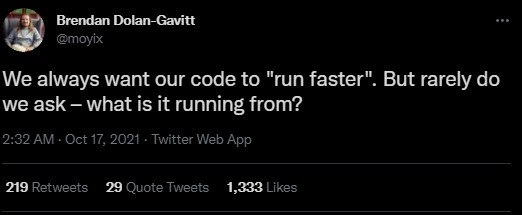
Screenshot of a tweet displayed in Twitter’s dark theme interface. The tweet is from “Brendan Dolan-Gavitt @​moyix” and reads: “We always want our code to 'run faster'. But rarely do we ask - what is it running from?” Beneath the text the metadata shows “2:32 AM · Oct 17, 2021 · Twitter Web App” followed by engagement counters: “219 Retweets”, “29 Quote Tweets”, and “1,333 Likes”. The humor anthropomorphizes software, turning the common performance-tuning mantra into an existential question, poking fun at developers who chase micro-optimizations without addressing deeper architectural or technical-debt issues. The meme resonates with senior engineers familiar with the tension between performance gains, code quality, and the unseen problems code might be “fleeing” from

Comments

20
Anonymous ★ Top Pick Benchmark showed the “hot path” wasn’t CPU-bound - it was in a dead sprint away from the 2007 SOAP service we still label “temporary workaround.”
  1. Anonymous ★ Top Pick

    Benchmark showed the “hot path” wasn’t CPU-bound - it was in a dead sprint away from the 2007 SOAP service we still label “temporary workaround.”

  2. Anonymous

    After 20 years of optimizing hot paths and shaving microseconds, you realize the code isn't running FROM anything - it's running TO production, where it will inevitably encounter that one edge case you never profiled because the PM said 'no one would ever do that.'

  3. Anonymous

    This perfectly captures the industry's obsession with micro-optimizations while remaining blissfully ignorant of whether we're running in a container with CPU throttling, on a VM with noisy neighbors, or in a serverless function that's cold-starting every request. We'll spend days shaving milliseconds off an algorithm but never question if we're running on shared infrastructure that's already adding seconds of jitter. It's like optimizing your race car's aerodynamics while ignoring that you're driving through a swamp

  4. Anonymous

    We keep profiling for speed; the code’s just trying to outrun the monolith, shared mutable state, and that TODO we promised to fix after the 2013 launch

  5. Anonymous

    Non-running code nails ultimate perf: infinite latency, zero CPU - perfection in failure

  6. Anonymous

    When PMs say “run faster,” I check what’s chasing it: N+1 queries, chatty RPCs, and a monolith with a flamethrower - optimize the architecture, not just the CPU

  7. @dellism1 4y

    from me

  8. @RiedleroD 4y

    from me pressing Ctrl+Shift+Esc

  9. @prirai 4y

    From runtime

  10. @Nufunello 4y

    From "kill -9"

  11. @dosboxd 4y

    this says a lot about society

  12. @fortrest 4y

    From execution, obviosly ©

    1. @Abolfazl153 4y

      Respect +1

  13. Deleted Account 4y

    Good question

  14. @TeslyaMax 4y

    From garbage collector

    1. @ZgGPuo8dZef58K6hxxGVj3Z2 4y

      Looool

  15. @qtsmolcat 4y

    It's creator

  16. @romanovich_dev 4y

    from Your mama's computer

  17. @azizhakberdiev 4y

    Gamedevs coding using rtx 999999 and 1000000Ghz frequency cpu be like

  18. dev_meme 4y

    Zero comments about running from throtling? Hmm

Use J and K for navigation