Skip to content
DevMeme
7459 of 7506
The Meta-Tracker That Monitors the Monitors

The Meta-Tracker That Monitors the Monitors

Why is this Observability Monitoring meme funny?

Level 1: The Eighteenth Lookout

Seventeen people are already standing at the same window every half-minute to see whether a shop has opened. One person says this is ridiculous and solves it by hiring an eighteenth person to run around asking all seventeen what they see—then posts the answer on a noticeboard inside his own locked house. It is funny because every new helper adds activity, but none can open the shop or know more than the original window shows.

Level 2: Polling the Pollers

Monitoring means repeatedly observing a system so that changes or failures become visible. A status page communicates whether a service is operating. A poller asks for the current state on a schedule, while a webhook or event feed pushes a notification when state changes. A dashboard presents observations in one place.

A crawler discovers pages by following or searching links. A scraper extracts data from pages designed primarily for people rather than from a stable machine-readable interface. The screenshot’s “meta-tracker” combines both: find checker pages, scrape each checker’s answer, and bolt those answers onto one screen.

Aggregation could be useful if it answered questions the original sources cannot answer. A sound design would record:

  • which underlying endpoint each checker observes;
  • when each result was measured rather than merely displayed;
  • which product, region, and account type the result covers;
  • whether sources are independent or copies;
  • how stale or trustworthy each observation is.

Without that provenance, the dashboard turns 17 × unknown into one larger unknown. The word unified describes the layout, not the truth.

For a simple availability alert, the system could be much smaller:

authoritative status source
          ↓
one rate-limited poller with backoff and jitter
          ↓
cached state + timestamp
          ↓
notify subscribers only when the state changes

The poll interval determines detection delay and load. With a clean thirty-second interval and a change occurring at an arbitrary time, detection will usually take somewhere from nearly zero to thirty seconds, averaging about fifteen seconds before network delay. Adding more synchronized pollers does not guarantee improvement; staggering one reliable poller or receiving a pushed event is cleaner.

The private address is a separate networking joke. Home and office routers commonly use the 192.168 range so many local networks can reuse the same addresses. Network address translation lets those devices initiate connections to the internet, but outsiders cannot normally initiate a connection to an internal machine without explicit public hosting or port forwarding. Port 8080 is also commonly used by local web-development servers. In other words, the screenshot advertises a grand global intelligence system with the deployment reach of a printer settings page.

The filename-like path is a miniature lesson in version control. Names such as final, final-v5, and final3 try to encode history in the filename. A repository instead records each revision, author, timestamp, and difference while the project keeps one stable name. Calling something “ultimate” is branding; being able to roll it back is engineering.

Level 3: Who Watches the Watch Tabs

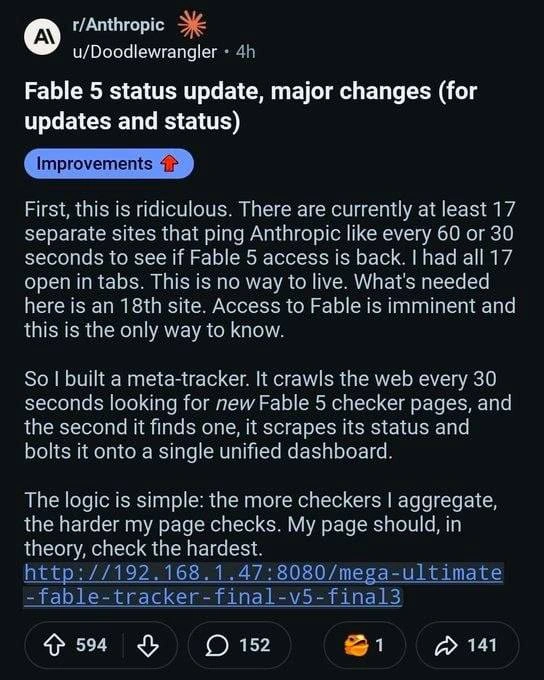
“I had all 17 open in tabs. This is no way to live. What’s needed here is an 18th site.”

That transition is the first perfect layer of yak shaving: the author correctly identifies compulsive status checking as the problem, then automates a larger version of the compulsion. Instead of closing seventeen tabs or subscribing to one authoritative update, the proposed cure discovers new checkers, scrapes their answers, and displays them together. The operational surface grows from one unavailable model to a small, self-expanding monitoring industry.

The recursion keeps going. The Reddit post is titled “Fable 5 status update, major changes (for updates and status)”, but its update concerns a tool for finding tools that provide updates. The “Improvements” flair labels an escalation in machinery rather than an improvement in information. The accompanying channel message says the layers of meta-humor are “off limits,” which is fair: this is a status post about a meta-status page whose status is itself dubious.

“The more checkers I aggregate, the harder my page checks. My page should, in theory, check the hardest.”

That is a quantity fallacy disguised as observability. Seventeen dashboards do not create seventeen independent facts. They may all poll the same Anthropic endpoint, parse the same official page, repeat the same rumor, or copy one another. If their upstream source is wrong, cached, rate-limited, or ambiguous, aggregation merely gives the same uncertainty a larger sample count. A quorum helps only when observations have meaningful independence and a defined decision rule. Seventeen mirrors do not make the reflected object more available.

The claimed polling design can also worsen the system it watches. At a thirty-second interval, one checker makes 2,880 requests per day before accounting for retries or additional endpoints. Many synchronized checkers can form a small thundering herd, especially if they all wake on the minute. Responsible polling uses caching, conditional requests, exponential backoff, and random jitter so clients do not strike together. Better still, the service publishes an event feed or notification mechanism and users react to transitions instead of treating refresh as a competitive sport.

Real meta-monitoring is valuable. Production teams need to know whether the monitor itself is alive, whether alert delivery works, and whether an internal outage has blinded the dashboard. They may use heartbeats, an external synthetic probe, redundant regions, or a dead-man switch. The difference is that those mechanisms test independent failure paths. This meme’s crawler monitors the existence of more monitors and assumes the count increases truth. It is less “Who watches the watchmen?” and more “Who keeps opening watchmen in new tabs?”

The architecture would acquire serious failure modes if implemented literally:

  • HTML scrapers break when a checker changes wording or page structure.
  • Search results can surface stale pages that still say “available.”
  • Discovered sites can disagree about what “back” means: API traffic, a subscription plan, one region, or one provider.
  • Rendering scraped content without sanitization can create cross-site-scripting risk.
  • Fetching arbitrary discovered addresses without network restrictions can create server-side request-forgery risk.
  • Rechecking the entire web every thirty seconds is neither a bounded discovery strategy nor a kind act toward search infrastructure.

Then comes the deployment punchline. The displayed destination uses the private IPv4 address 192.168.1.47 and port 8080. Addresses in that range are intended for local networks and are not routed across the public internet. A Reddit reader would look for that numbered machine on their own LAN, not tunnel into the poster’s home or office. The path’s repeated final, version number, and final3 also evokes the pre-version-control tradition of declaring a file complete until the next completion. The “only way to know” is therefore a development server almost nobody reading the post can reach.

The real June 2026 context makes the obsession understandable. Fable 5 launched on June 9 and was disabled for all customers on June 12 after a U.S. government export-control directive sought to block foreign-national access and Anthropic said it lacked a reliable way to enforce that distinction immediately. On June 26, when this post appeared, Fable remained suspended even as same-day developments fueled expectation around related Mythos access. “Access to Fable is imminent” was hope, not an official restoration notice.

Later events clarify the joke without retroactively validating its dashboard. Anthropic announced on June 30 that the controls on Fable had been lifted and began restoring global access on July 1. The community’s desired state change did arrive, but an authoritative announcement—not the theoretical hardness of eighteen checkers—settled it. The tracker may have optimized detection latency by a few seconds; the engineers had optimized a fortnight of uncertainty into a hobby.

Description

A dark-mode Reddit screenshot from "r/Anthropic" shows user "u/Doodlewrangler · 4h" beneath the community name and an Anthropic-style icon. The bold title is "Fable 5 status update, major changes (for updates and status)", followed by a blue "Improvements ⬆️" flair. The body reads: "First, this is ridiculous. There are currently at least 17 separate sites that ping Anthropic like every 60 or 30 seconds to see if Fable 5 access is back. I had all 17 open in tabs. This is no way to live. What's needed here is an 18th site. Access to Fable is imminent and this is the only way to know. So I built a meta-tracker. It crawls the web every 30 seconds looking for new Fable 5 checker pages, and the second it finds one, it scrapes its status and bolts it onto a single unified dashboard. The logic is simple: the more checkers I aggregate, the harder my page checks. My page should, in theory, check the hardest. http://192.168.1.47:8080/mega-ultimate-fable-tracker-final-v5-final3"; the footer shows 594 votes, 152 comments, one award, and 141 shares. At the June 26, 2026 posting time, Fable 5 access was still suspended, and the post layers recursive monitoring, redundant polling, an unreachable private-LAN URL, and comically repeated "final" version naming into one elaborate status-page joke.
Comments

1
Anonymous ★ Top Pick They solved 17 redundant pollers with an O(internet) crawler and deployed the answer to 192.168.1.47.
  1. Anonymous ★ Top Pick

    They solved 17 redundant pollers with an O(internet) crawler and deployed the answer to 192.168.1.47.

Use J and K for navigation