When the entire project budget goes to the UI/UX team
Why is this Frontend meme funny?
Level 1: Behind the Magic
Imagine you go to a magic show and see a magician pull a beautiful rainbow-colored scarf out of an empty hat. Wow! From the audience side (the front end), it’s bright and impressive, and everyone claps. But what you didn’t see is that backstage (the back end), the magician had this whole complicated setup of mirrors and a helper feeding a long multicolor cloth through a secret compartment. The stage might even be a mess of wires and props – all hidden behind the curtain – just to make that one rainbow trick possible.
This meme is funny for a similar reason: it’s like a big magic trick in software. The people watching the show (or using the app) only see the pretty rainbow result on the screen. They don’t see the twisting maze of work behind the scenes that was needed to make it happen. It’s as if a chef spent days in a messy kitchen baking a cake with rainbow layers and sparklers, and when it’s served everyone just says “Ooh, pretty!” without realizing how much effort (and how many dirty dishes) it took. The humor comes from that contrast – the sparkly outside versus the crazy effort inside. In simple terms, it’s poking fun at how sometimes people care only about the shiny appearance of something, while the poor folks making it happen are dealing with a big, complicated, mess backstage.
Level 2: Polish vs Plumbing
Now let’s decode this joke in more straightforward terms. In software development, we divide work into frontend and backend. The front-end (UI) is everything you see and interact with directly – the buttons, text, images, and in this case the pretty rainbow effect on the screen. Think of it as the storefront of an application, the polished visuals that users and stakeholders notice. The back-end is like the building’s foundation and plumbing – all the hidden systems that fetch data, apply business rules, and basically make the app actually do something. Users don’t directly see the backend, but they sure notice if it isn’t working right.
UI polish refers to those extra touches that make an interface look and feel excellent: smooth animations, attractive color gradients, pixel-perfect layouts, fast interactive responses. It’s the software equivalent of a fresh coat of paint and shiny fixtures in a house. In contrast, backend complexity arises from handling data, ensuring scalability, security, and integrating various components properly – analogous to the complexity of pipes, wiring, and structural beams behind the walls. Ideally, effort is balanced: you want a nice UI, and you want a robust backend so the whole system is stable and maintainable.
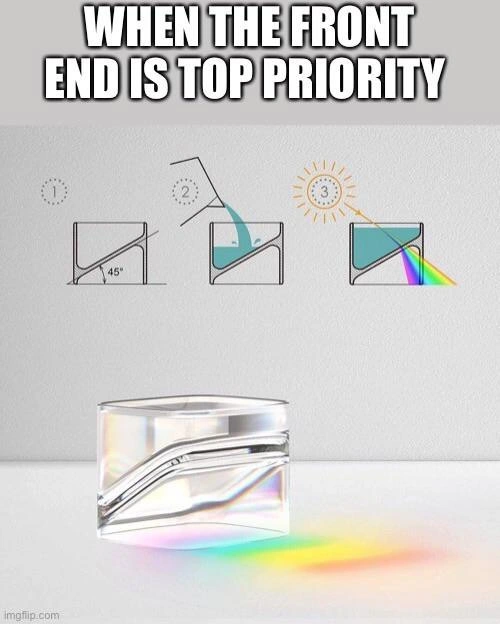
The meme’s image draws a funny parallel using a prism (or rather a block with a channel of water) to symbolize a complex backend mechanism. In the top diagram, there’s a tiny 45° angled tunnel inside a square container. They pour water in (second panel), then shine light (third panel), and a rainbow comes out the front. In reality, making a rainbow from light isn’t trivial – you need that precise angled channel and the water acting as a refractive medium. Translated to developer terms, the water-filled maze inside the block is like the hidden code logic and algorithms working behind the scenes. The incoming light is simple input (maybe a basic user action or request), and the exiting rainbow is the fancy UI output after all the processing.
When the caption says “WHEN THE FRONT END IS TOP PRIORITY,” it’s highlighting a situation where the team is told to focus on how things look rather than how they work internally. The stakeholders (like project managers, clients, or bosses) care most about the rainbow on display – the visible feature that will make users or executives go “Wow!”. To achieve that, developers might have to implement convoluted solutions in the backend (the hidden channel) that no one but the dev team ever sees. This can feel upside-down: huge effort spent on something purely visual. It’s as if the frontend is a shiny sports car exterior, and the backend is the engine. In a normal scenario, you’d invest in a good engine before worrying about a custom paint job; but here the mandate is “paint it rainbow now, we’ll worry about the engine later.”
For a junior developer or someone new to these terms, it’s important to know: making something look cool on the front-end isn’t always easy – sometimes it requires very non-obvious work in the back-end. For example, imagine you want a live updating dashboard with colorful charts (front-end feature). That might force the back-end to constantly compute new data, merge streams, or do real-time aggregation (back-end complexity). If the project leaders only care about the shiny dashboard without understanding the back-end effort, developers end up rushing to build complex data pipelines under the hood just to keep that UI element glowing.
In the image, the rainbow spread on the table is what management wanted – bright, impressive visual output. The snaking path inside the clear block is what the engineers built to deliver it – an internal maze of effort that’s invisible once it’s done. The meme is essentially saying: “Look at how far we’ll go (some might say overboard) to make the UI pretty, even if it means creating a crazy hidden system.” This resonates as BackendHumor too, because backend developers often joke about how much “plumbing” they have to do for one little front-end request.
So, “Polish vs Plumbing” is the trade-off: polish (front-end beauty) often demands intricate plumbing (backend work). New developers learn quickly that a seemingly simple feature on the surface might require a lot of complicated code behind the scenes. This meme is a lighthearted acknowledgment of that reality. It humorously exaggerates the situation – nobody’s actually building water prisms in their code, but we’ve definitely written overly complex functions or microservice chains for the sake of a slick UI deliverable. The joke lands because it’s a relatable scenario of frontend_priority gone a bit wild: all the attention on the rainbow, while the water pipes twisting inside are quietly ignored.
Level 3: Bending Over Backwards
At a high level, this meme captures a scenario every seasoned developer recognizes all too well. Frontend polish outranking backend sanity is a classic anti-pattern in project prioritization. The top caption sets the stage bluntly:
WHEN THE FRONT END IS TOP PRIORITY
implying that everything else (like sound architecture or maintainable backend code) has been shoved aside. The image sequence humorously illustrates a team contorting their system’s internals (like that zig-zag water channel) to achieve a single shiny effect (the rainbow output on the UI). It’s essentially a Rube Goldberg machine in software form – an overly complicated solution for a simple-looking result, all because someone upstairs said, “Make it pop!”
Let’s break down the drama step by step:
- Stakeholder: excitedly demands a dazzling new UI effect “to really wow users” – say, a rainbow gradient on the landing page.
- Tech Leads: exchange weary glances because they know this request isn’t as simple as it sounds. Achieving that rainbow effect isn’t a one-liner; it means introducing complex data pipelines or hacky rendering logic.
- Developers: proceed to architect a convoluted solution. Perhaps they route data through five microservices, each twisting and transforming it (much like light bouncing through the prism’s internal channel) to prepare the perfect output for the UI. The backend becomes an invisible maze of transformations solely to support this visual flourish.
- Demo Day: The front end now sparkles – the rainbow feature works and impresses everyone. Stakeholders clap at the pretty colors. The UI team gets kudos for the “slick design.” Meanwhile, the backend folks who built the crazy plumbing are unsung heroes, silently praying it holds up.
- Maintenance Mode: Weeks later, it’s 3 AM and that rushed, complex implementation is leaking (figuratively, or even literally if we stick to the water metaphor). The on-call developer (👋 likely the same one who built the contraption) is frantically patching issues in the dark. Guess who gets paged when the rainbow pipeline breaks?
In essence, the meme satirizes how stakeholder expectations can skew a project’s focus. Non-technical managers often fixate on what they can see – the frontend UI. If the product “looks” impressive, they assume the job is well done. The backend could be a Jenga tower of quick fixes and fragile code, but as long as the UI shines, everyone’s happy… until something fails. This is painfully relatable DeveloperHumor: we’ve all witnessed a product demo that was held together with duct tape clever hacks behind the scenes. It highlights the divide between Frontend vs Backend priorities: the front-facing features get the glory, while the behind-the-scenes engineering struggles are ignored.
From a senior dev perspective, it’s a cautionary tale of technical debt accruing in real time. Every time we prioritize a last-minute UI request over proper backend design, we’re effectively carving another awkward channel in that acrylic block. Sure, it’ll refract light and make a rainbow today, but down the line those odd angles and quick fixes make the system harder to change or debug (the light can’t turn any sharper without shattering the prism, so to speak). The meme resonates because it humorously exaggerates a real imbalance: polishing the UI to showroom quality while the backend becomes a patchwork of crazy straws. It’s “UI_over_backend” taken to the extreme – something that triggers both laughter and a little PTSD in experienced engineers. We laugh because it’s true: we have bent our systems into pretzels for the sake of a one-time demo or a CEO’s pet feature.
To drive the point home, consider a snippet of “prism logic” in code form. It might look something like this overly simplified pseudo-code (the reality would be much messier):
# Over-engineered backend process to enable a fancy front-end feature
def get_homepage_data(user_request):
data = fetch_data_from_database() # Basic data retrieval
if user_request.need_rainbow:
# Apply special transformations solely for UI sparkle
data = bend_over_backward_transform(data)
data = add_rainbow_colors_layer(data)
result = format_for_frontend(data) # Prepare data for UI consumption
return result
In a sane world, add_rainbow_colors_layer() wouldn’t exist on the server – why is backend generating rainbow color info at all? Ideally the UI could handle presentation. But when performance, timing, or “make it magic now” pressures come in, developers might shove UI-related processing to wherever it fits, even if that means muddying backend logic. The code comment literally says “over-engineered” because we’re acknowledging this is not elegant architecture; it’s a bend-over-backwards approach to satisfy a requirement.
The humor (and horror) is that we’ve all written something like bend_over_backward_transform(data) at least once under pressure. It stands for countless ad-hoc functions named fixFormattingForUI() or generateSpecialCaseReport() that exist only because the front-end needed data in a very specific, pretty way. It’s the embodiment of prism logic: a ton of internal effort and complexity dedicated to producing a bit of eye candy.
In summary, Level 3 exposes the veteran developer’s perspective: this is funny because it’s true. We recognize the pattern of contorting backend systems to deliver flashy frontend features. It pokes fun at how organizations often prioritize the prism’s output (the rainbow) – the part executives can point to in a meeting – while forgetting the crazy path of mirrors and channels inside that makes it possible. It’s a relatable slice of TechHumor that winks at the on-call developer silently screaming, “It’s not magic, I literally built a prism in there and it might explode!”
Level 4: Refraction Over Reason
At the most granular level, this meme hides a lesson in optics and over-engineering. The drawn diagram isn’t just for laughs – it literally outlines a mini prism contraption. In physics, a prism (or any medium change) splits white light into a rainbow via dispersion. Here, a 45° angled channel is carved inside a clear block. Pour in water, shine sunlight at just the right angle, and physics does the rest: Snell’s Law (n1 * sin(θ1) = n2 * sin(θ2)) guarantees the light bends sharply at the material boundary. Different wavelengths (colors) bend by different amounts, spreading into that vivid spectrum. It’s a precise, beautiful phenomenon born of fundamental science – you can’t break those rules if you want a rainbow. The joke is that developers sometimes become accidental physicists or engineers of convoluted solutions just to achieve a flashy outcome. We end up designing software systems analogous to this internal refraction pipeline, where a simple input (plain light or basic data) travels through a twisty path (custom algorithms, multi-step processing) to produce a multi-colored output that dazzles users. It’s an absurd inversion of priorities: apply maximum complexity in pursuit of superficial charm. In an ideal world, we’d balance effort between front and back, but reality often feels like:
$$ UI_{sparkle} ;\propto; \frac{1}{Developer_{sanity}} $$
Yes, the glitzier the UI one demands, the more likely some poor engineer had to bend the laws of software (and maybe physics) to make it happen. The humor here taps into that underlying truth that certain design requirements might as well require rewriting the laws of nature – or at least writing a labyrinth of code – to fulfill. It’s a tongue-in-cheek nod to how stakeholder requests can impose near-physics-defying constraints on the codebase, favoring refraction over reason in the quest for a “rainbow” feature.
Description
A meme with the caption 'WHEN THE FRONT END IS TOP PRIORITY' overlaid on an image showcasing a beautifully designed product. The top half of the image displays a three-step diagram illustrating how a specially designed glass prism, when filled with water, refracts light to create a rainbow. The bottom half is a high-quality photograph of this prism in action, casting a vibrant rainbow onto a clean white surface. The overall aesthetic is minimalist and elegant. The meme humorously equates this visually stunning object with a software project where the front end is given all the attention. The beautiful, polished user interface (the rainbow) is the main focus, while the underlying backend logic (the simple prism and water) is just a means to that aesthetic end, implying that the backend might be simple, non-scalable, or an afterthought compared to the slick presentation layer
Comments
25Comment deleted
The backend is just a single endpoint: `/api/v1/getRainbow`. The entire response is a hardcoded SVG
Marketing: “Can the button literally emit a rainbow?” Engineering: “Sure - just route an event-sourced, water-cooled photon pipeline through a 45° CAP-violating prism; availability is negotiable, but the gradient isn’t.”
Just like that prism, a 'frontend-first' mandate transforms your clean monolithic backend into seven microservices, each a different color of the performance spectrum - and somehow they all need to handle authentication differently
This perfectly captures the frontend journey: you start with a simple 45-degree angle requirement from the backend team, then product adds 'just a splash of interactivity,' and suddenly you're shipping a full WebGL rainbow with 60fps animations, three CSS preprocessors, and a bundle size that would make Newton weep. The backend is still waiting for you to consume their REST endpoint, but hey, at least the loading spinner has a parallax effect now
Frontend priority: instant rainbow from poured hype. Backend: the glass sweating under prod load
PM: make it delightful; we applied Snell’s law - UI refracts perfectly while the call graph hits total internal reflection on our SLOs
Front end top priority? We architect like optics - bend the domain model at 45°, add two layers of indirection, and pray to Snell’s law for the gradient while the backend is stuck in total internal reflection
so, basically, half of the glass is useless, but pretty. We lost half of the capacity of the glass by adding a reflective prism. Comment deleted
haha lol this is profunctor, there can't be anything deep here Comment deleted
Looks like you in a wrong chat mate Comment deleted
Lemme guess, the dev_meme club is 2 blocks down? Comment deleted
You saw our avatar, right? Comment deleted
Oh, so that's a glass, not a rainbow making device... Comment deleted
Here I go explaining the joke. Most of the time profunctor has the same memes as here, because most of the time you both take them from r/programmerhumor, right? Comment deleted
Except cases when they post ru memes Comment deleted
That's kinda gay tbh, I hope you guys won't go the same way Comment deleted
wait, what Comment deleted
Sorry for my Russian Comment deleted
Just don't post russian memes like them, that's all. Comment deleted
You remind me to check their memes to steal something Comment deleted
Wait that's illegal Comment deleted
😂 I would imagine court case of stealing jokes which were stolen somewhere from reddit like "Pirate of Silicon Valley" Jobes vs Gates dialog) Comment deleted
Portable Gayinator Comment deleted
Lol Comment deleted
haha english go typin Comment deleted