Skip to content
DevMeme
2007 of 7435
How to win a Java gatekeeping argument with one word
Languages Post #2236, on Nov 6, 2020 in TG

How to win a Java gatekeeping argument with one word

Why is this Languages meme funny?

Level 1: One-Word Victory

Imagine you’re playing a trivia game with a friend, and your friend tries to stump you with a crazy challenge. They say, “You’re so good at geography, huh? Okay, name every city in the world!” That’s an impossible task — nobody can list every single city. It sounds like your friend expects you to give up. But instead, you smile and give a super clever answer: “Earth.” In one word, you’ve technically included all cities (because all cities are on Earth). It’s not the list they expected, but it does kind of answer the question in a sneaky way! Your friend stops for a second and goes, “wait...” because they didn’t see that coming.

That’s exactly what’s happening in this meme, but with programming. One person asked for something impossible, and the other person found a loophole and answered with a single, very smart word that represents everything. It’s funny because the second person outsmarted the challenge. The feeling is like winning a game by doing something clever that wasn’t expected. Everyone laughs because it’s a surprise and a smart trick at the same time. The one-word answer wins the day, and even the person who asked the question has to pause and appreciate how genius (and amusing) that answer is.

Level 2: Root of All Classes

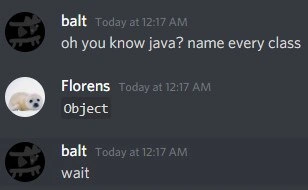
In this meme, we see a Discord chat (a popular group chat app, shown in dark theme) where one user challenges another in a playful way: “Oh, you know Java? Name every class.” If you’re newer to programming, this is essentially asking someone to list all the classes in the Java programming language. That’s an absurd task – Java has a huge number of built-in classes (think of all the tools and libraries Java provides, like String, Scanner, ArrayList, etc.), and on top of that, anyone can write new classes. It’s like asking someone to name every book ever written – impossible! This kind of phrase “name every X” is a meme format meant to be jokingly unreasonable. It’s often used to poke fun at gatekeeping (“Oh, you claim to know this? Prove it by listing EVERYTHING”) or just to set up a funny response. Here, the DeveloperHumor comes from the response given by the second user, Florens. Instead of admitting defeat or trying the impossible, Florens answers with “0bject” (spelled with a zero instead of letter O, shown in a code-style font). That answer is actually referring to Object – specifically java.lang.Object – which is a very special class in Java.

Why is Object special? In Java’s Object-Oriented design, java.lang.Object is the ultimate ancestor of every class. This means every class you create or use in Java (except for basic things like numbers which are primitives, not classes) directly or indirectly extends Object. In simpler terms, Object is like the root of the family tree for all Java classes. For example, if you have a class Car, even if you don’t write “extends Object” in your code, Java treats it as if it does. All classes automatically inherit some basic methods from Object. That’s why any Java object, whether it’s a Car, a String, or an ArrayList, can call methods like toString() or equals() – those methods are originally defined in Object and passed down to every subclass.

So, when Florens replies with “Object”, they’re basically naming the one class that covers every other class in Java. It’s a bit of wordplay and technical insight combined. The first user didn’t expect any single person to actually name all classes (since it’s undoable), but Florens found a loophole: name the top-most class and, by definition, you’ve included them all! It’s as if someone said, “List all the families in this city,” and you replied, “the human family.” It’s cheeky but not wrong. The reaction “wait” from the first user shows that moment of “I can’t argue with that!”

For a junior developer or someone just learning Java, the joke also teaches a fun fact: java.lang.Object is the superclass of every Java class. In code, you might recall seeing something like:

class MyClass { 
    // by default, this is equivalent to extending Object 
    // even if we don't write "extends Object"
}

Even though we don’t write it out, MyClass extends Object behind the scenes. This design is one of Java’s language quirks – it ensures a common baseline for all objects. So, Florens’s answer “Object” isn’t random; it’s the perfect answer from a Java perspective. It’s the sort of clever response that makes programmers grin because it shows you really know your stuff.

Also, notice how Florens wrote “0bject” with a zero and in a monospaced font (in Discord, text between backticks `like this` appears as code). They likely did that to make it clear they’re naming a code entity (the class Object) and maybe to avoid the chat turning it into something like an emoji or mention. It’s stylized as if typing the actual class name in code. This little detail gives the answer a nerdy flair, as if the person is confidently referencing Java code in conversation.

The whole scenario is a light-hearted parody of interview questions or online challenges. If you’ve just started your career, you might not have experienced this, but sometimes people like to test your knowledge in silly ways. For instance, a friend might joke, “Oh, you play Pokémon? Name every Pokémon.” Obviously, they don’t expect you to do that (there are hundreds!). Here it’s the same format with programming. The humor is in turning an unwinnable challenge into a win by thinking outside the box. Florens essentially answered, “the one thing that represents all those things.” It’s a bit like answering an impossible riddle with a clever trick. As a newcomer to Java, once you understand that Object is the common ancestor of everything in Java, you’ll appreciate why this one-word answer is so smart – it’s concise, unexpected, and technically correct. And as the saying goes in programming culture, “Technically correct is the best kind of correct!” 😄

Level 3: One Class to Name Them All

At first glance, this meme is a clever nod to Java’s deepest ObjectOrientedProgramming secret. In the Discord chat screenshot, user "balt" teases: “oh you know java? name every class”. That's an impossible interview question parody – nobody can literally list every Java class (there are thousands in the standard library alone, not to mention user-defined ones!). But user "Florens" flips the script by answering 0bject. It looks like Object spelled with a zero, formatted in a monospaced code style – a cheeky way to highlight it as a code term. This one-word answer is technically brilliant: in Java, java.lang.Object (usually just called Object) is the single root class of the entire Java class hierarchy. In other words, every class in Java is a descendant of this Object class. By naming Object, they’ve essentially named the one class that conceptually includes all other classes. It’s the ultimate root_class_reference. No matter if it’s String, ArrayList, or a custom SpaceShuttle class you wrote – all of them inherit from Object. So from a seasoned developer’s perspective, Florens did “name every class” in one go!

This punchline lands because it shows deep language knowledge wrapped in humor. It’s referencing a core Java design: everything is an Object. Seasoned Java devs immediately recognize this and get the joke. It’s the kind of smart-aleck response you might blurt out when someone challenges your expertise with an unrealistic task. The humor also pokes fun at gatekeeping or absurd interview_question_parody scenarios. (We’ve all heard of those infamously broad interview questions like “Explain the entire internet” or “List all data structures by heart.” 🙄) Here the prompt “name every class” is exactly that kind of over-the-top challenge. Instead of panicking, Florens cleverly uses Java’s language quirks to craft a perfect answer. It’s a bit like a riddle: the solution is to reinterpret the request in a sneaky way. By naming the one class that sits at the top of Java’s inheritance tree, they’ve sidestepped the impossible question. The first user’s reaction – “wait” – captures the stunned realization: the trick answer actually holds up! Experienced devs find this hilarious because it’s a textbook example of knowing your fundamentals and using them for a witty comeback.

Beyond the joke, there’s some tech history in this simplicity. Java was designed so that java.lang.Object is the ultimate parent class – a concept inherited from earlier OO languages (Smalltalk, anyone?). This means every class, directly or indirectly, extends Object unless you explicitly extend some other class (which in turn eventually extends Object). This single-rooted hierarchy was a deliberate design choice to make the language more uniform – every object can be treated as an Object, and you get common methods like .toString() or .equals() on every Java object because of this. Other languages have similar ideas (C# has System.Object, and even C++ often uses void* or base classes, though it doesn’t enforce a single root). But Java’s philosophy is very much “One class to rule them all.” So when Florens responds with Object, it’s not just a random class – it’s the class that rules them all in Java. It’s the pedantic-but-correct answer only an insider would think of, which is why it’s funny. This joke is the kind of DeveloperHumor that makes programmers smirk and say, “Touché! I see what you did there.” It’s a moment of recognizing that insider knowledge: java_lang_Object is literally every class’s ancestor. The meme format itself (a Discord chat with monospaced text) adds to the nerdy vibe, as if the answer was given in proper code form. In short, the humor operates on multiple levels: it mocks absurd challenges, it rewards specific Java knowledge, and it uses the fundamentals of Inheritance in an unexpected punchline. A seasoned Java dev can’t help but appreciate how Florens won this round with a single, perfect word.

Description

A screenshot of a conversation in a Discord chat, showing three messages all posted at 12:17 AM. The first message, from a user named 'balt', poses a gatekeeping challenge: 'oh you know java? name every class'. The second message, from 'Florens', who has a baby seal as a profile picture, gives a short, clever reply: 'Object'. The final message shows 'balt' taken aback, simply writing 'wait'. The humor is rooted in a core concept of Java programming: every class in Java implicitly inherits from the 'java.lang.Object' class. Therefore, 'Object' is the ultimate superclass of all other classes, making Florens's answer technically correct and a perfect shutdown to an impossible question. It's a subtle joke that resonates strongly with experienced Java developers


Comments

8
Anonymous ★ Top Pick This is the most efficient garbage collection I've ever seen. One word and the argument is deallocated from memory
  1. Anonymous ★ Top Pick

    This is the most efficient garbage collection I've ever seen. One word and the argument is deallocated from memory

  2. Anonymous

    “java.lang.Object - there, that’s every Java class. Now let’s talk about why your 4-thousand-line ‘Utils’ god-class still lives in the root package.”

  3. Anonymous

    The beautiful moment when someone tries to gatekeep Java knowledge and gets hit with the architectural truth that every class hierarchy eventually traces back to Object - the same realization you have after implementing your fifth AbstractFactoryFactoryBuilder and wondering if maybe inheritance wasn't always the answer

  4. Anonymous

    When a senior Java architect is asked to 'name every class,' responding with 'Object' isn't just technically correct - it's the most architecturally sound answer. After all, in Java's type system, Object is literally the answer to everything. It's the cosmic root from which all classes descend, making this response both a demonstration of deep JVM knowledge and a masterclass in how to deflect absurd interview questions with precision. The 'wait' response perfectly captures that moment when an interviewer realizes their gatekeeping question just got architecturally deconstructed

  5. Anonymous

    Senior Java move: 'Name every class?' 'Object.' - because instanceof checks don't lie, and neither does the hierarchy

  6. Anonymous

    Turning “name every Java class” into an O(1) operation by answering “java.lang.Object” is the rare moment single-root inheritance actually optimizes an interview

  7. Anonymous

    Name every Java class? "java.lang.Object." Primitives protest, then autoboxing makes them show up to the meeting anyway

  8. @GLXBX 5y

    He knows java really well

Use J and K for navigation