Skip to content
DevMeme
407 of 7435
Modern Frontend Dev Finds a Legacy jQuery Project
Frontend Post #474, on Jul 10, 2019 in TG

Modern Frontend Dev Finds a Legacy jQuery Project

Why is this Frontend meme funny?

Level 1: New Tools, Old House

Imagine you spent a lot of time learning how to use a brand new, modern toy – like the latest high-tech LEGO set that can build moving robots. You’re so excited to show everyone what you can do with it. But when you finally find someone who needs your help, they say, “Actually, can you use these old regular LEGOs to fix this ancient toy house?” Suddenly, instead of building a cool new robot, you’re asked to work with a dusty old toy that isn’t nearly as fun. You’d probably feel pretty disappointed, maybe even a bit cheated, right? That’s exactly the feeling in this meme. The person thought they would get to use the new fancy tools they love, but the job they got needs them to use old tools on an old project. It’s like expecting to play the newest video game, but being asked to fix a VCR from your grandparents’ attic instead. It’s funny in a sad way – you can’t help but laugh because the situation is so unfair and unexpected. The little character in the last panel is crying because he’s basically thinking, “I learned all this cool new stuff, and now I’m stuck with this old thing!” We find it humorous because we feel sorry for him, but also recognize that sometimes life (and jobs) can be like that – full of surprises that aren’t what we hoped for.

Level 2: The jQuery Surprise

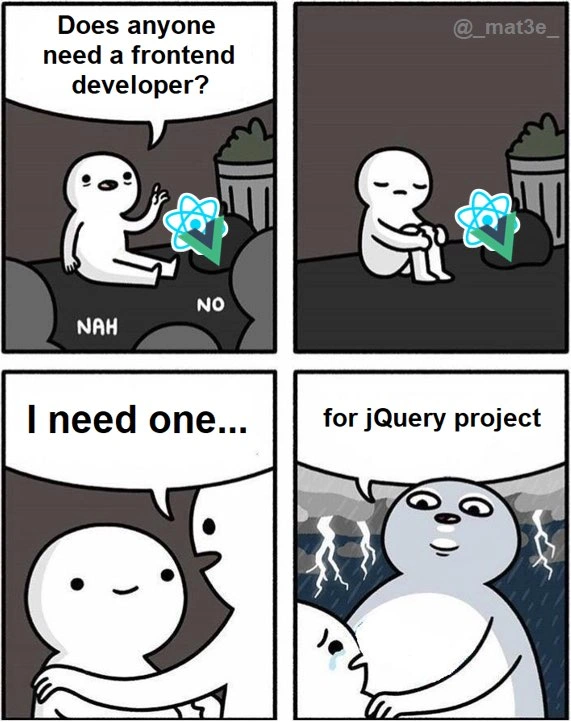
This meme highlights a situation a lot of new front-end developers can relate to. We have a frontend developer – someone who builds the parts of websites that users see and interact with – who has learned modern tools like React and Vue.js. (React and Vue are popular JavaScript frameworks/libraries for building interactive web UIs. React, created by Facebook, and Vue, created by Evan You, let developers build web pages as components with dynamic updates, making it easier to create complex apps.) In the first panel, our developer character is basically asking the world, “Hey, I know React and Vue, does anyone need these skills?” These frameworks are in-demand on paper, so he’s hopeful. The little React and Vue logos next to him on the bench show that those are the skills he’s offering. The response he gets is silence – represented by the “NAH” and “NO” text from off-screen characters who aren’t interested. This represents the tough frontend job market: it often feels like even if you know the hot technologies, landing a job isn’t guaranteed or immediate.

Now, in the third panel, a new character appears and says, “I need one…” actually giving the developer some hope that, yes, someone wants to hire a front-end developer. In the fourth panel, the full request is revealed: “...for jQuery project.” The background turns dark and stormy, and our poor developer starts crying. Why is that? Because jQuery is an older JavaScript library – very powerful in its time, but not as shiny or modern as React or Vue. This is the surprise: he expected to work with new technology, but the job is for something many consider outdated.

Let’s break down those technologies:

  • jQuery: This is a JavaScript library released back in 2006. It became super popular because it made things like selecting elements on a page and handling events much easier, smoothing out differences between web browsers. In the 2000s and early 2010s, almost every interactive website used jQuery. It’s basically a collection of pre-written JavaScript functions that let developers do common tasks with less code. For example, jQuery lets you find an HTML element and change it or attach a click event with a single line like $("#myButton").click(() => {/*...*/}). However, jQuery code often doesn’t enforce a structure – developers just sprinkle jQuery calls wherever needed. Over time, an app built with jQuery can become a tangle of code that’s hard to maintain as it grows (often nicknamed spaghetti code because it’s all tangled up).
  • React and Vue: These emerged later (React around 2013, Vue around 2014) to help structure larger applications better. React and Vue use a component-based approach – you build self-contained components (like Lego blocks of UI) that manage their own state and then compose them into pages. They also use something called a “Virtual DOM” (especially React) which efficiently updates the page. This leads to more organized code especially for big projects. They’re considered more “modern” and many new developers learn these expecting to work on single-page applications or modern web apps.

So, the meme’s joke is essentially about a skill mismatch. The developer has modern skills but the job demand is for an older stack. This is actually common: a company might have an existing product developed with jQuery years ago. That’s a legacy project – meaning it’s built with older technology and persists to the present. The company isn’t going to rewrite it from scratch in React overnight (that can be risky and costly), so they need people to maintain or slowly improve that jQuery code. They hire a “frontend developer” – who probably expects to work with newer frameworks – and then say, “Here you go, it’s a jQuery codebase.” It’s like a bait-and-switch feeling for the developer, hence the crying.

For a newer developer, the prospect of working with jQuery might be daunting or just disappointing. You might have spent a lot of time learning the latest frameworks because job postings often list them. To then be assigned to jQuery maintenance can feel like you prepared for the wrong thing. It’s worth noting that jQuery isn’t bad – it’s just older. But it does require a different approach. Let’s compare a simple task in jQuery vs React to illustrate:

// Using jQuery to show a hidden form when a button is clicked
$("#subscribeButton").on("click", function() {
    $("#emailForm").show();  // directly show the form element
});
// Using React (with Hooks) to show a form when a button is clicked
function SubscribeButton() {
  const [showForm, setShowForm] = useState(false); // track if form is shown
  return (
    <button onClick={() => setShowForm(true)}>
      { showForm ? "Close Form" : "Subscribe" }
    </button>
  );
}

In the jQuery example, you directly select elements by IDs (subscribeButton and emailForm) and define what happens on a click – it’s straightforward, but everything is loosely connected by these selectors. In the React example, you have a component with its own state (showForm). The button’s onClick event updates that state, and React takes care of showing or hiding the form (perhaps by conditionally rendering a <Form /> component when showForm is true, as implied by the button text toggling). The React code is more structured: the logic and UI are bundled together in a component. With jQuery, the logic lives in a script that can target any part of the page at any time, which can get messy as the project grows.

Now imagine an entire large application written with jQuery. There might be jQuery code handling menus, popups, forms, animations – all in different places. There’s typically not a single organized “architecture” if it wasn’t designed carefully. By contrast, in a React/Vue app, you often have a clear project structure (components, state management, etc.). So if you trained mostly with React/Vue, jumping into a big jQuery-based codebase could feel disorienting. It might lack the patterns and structure you’re used to. This mismatch can make a developer feel like they went backwards in time.

The meme uses that exaggerated crying to show the emotional disappointment. It’s developer humor: you laugh a bit because it’s a common experience, but it’s also a nervous laugh because it could happen to anyone. Many junior devs go into the job market advertising modern JavaScript skills, since those are hot. But many companies, especially older or larger ones, still have plenty of jQuery lying around. They might not advertise “jQuery developer” in the job listing (because it doesn’t sound attractive), but once you’re in, you discover the truth.

The legacy codebase aspect is important. Legacy means the code has history – it was written earlier, possibly by other people, and you inherited it. Working on legacy code can actually be a great learning experience, but it’s often seen as less glamorous than starting fresh with new tech. In career terms, it’s a bit of a running joke that no matter what fancy new framework you learn, your first job might involve an older stack. The phrase “for jQuery project” in the meme became a punchline among developers – it represents any scenario where the work turns out to be on older tech than expected.

To sum it up, this level (Level 2) explanation is: A developer skilled in React/Vue (new stuff) finds out his new job will be working with jQuery (old stuff). React and Vue are modern frameworks that many developers are excited about right now, whereas jQuery is like an “old reliable” tool that’s not so exciting anymore but still widely used. The meme is funny because the developer’s expectation was flipped upside down, which is something a lot of us in tech have experienced. It highlights the difference between modern skills vs. old stack demands. Even if you’re new to the industry, you can see the humor: it’s as if you learned to use the latest gadget, only to end up working on last decade’s technology. It’s a little bit of “welcome to the real world” for frontend careers. And hey, on the bright side, if you ever find yourself in that situation, you’re not alone – plenty of devs have gone through the React vs jQuery shock, and they’ll nod sympathetically (maybe while chuckling) at this meme.

Level 3: React vs Reality

The meme delivers a painfully funny truth about frontend careers: the gulf between cutting-edge skills and gritty real-world needs. In the first panel, an eager developer proudly brandishes the React atom logo and the Vue.js logo – symbols of modern frontend prowess – and asks, “Does anyone need a frontend developer?” The response is crickets (or rather, two off-screen voices saying “nah” and “no”). This sets up the joke: despite React and Vue being hot skills, nobody seems interested. By the third panel, someone finally replies “I need one…” giving our dev a spark of hope. But then comes the sucker punch in panel four: “…for jQuery project.” Under looming storm clouds, the small developer character cries in despair. The humor (especially to experienced devs) comes from this framework churn irony – our hero has polished his React/Vue skills, yet the only job offer is to wrangle an old jQuery codebase. It’s resume-driven development colliding with legacy reality.

This scenario hits home because it happens a lot. The industry loves to hype new frameworks – there’s always a Next Big Thing (Angular, React, Vue, Svelte, you name it) – but legacy systems built years ago don’t magically rewrite themselves. Companies still run huge, mission-critical apps on outdated battle-tested stacks like jQuery. So while every developer’s LinkedIn might flaunt “React” and “Vue”, the actual jobs available might be maintaining a decade-old legacy codebase using jQuery. The meme exaggerates it with comedic gloom: the big character literally hugs the sad React dev, almost saying “Aww, you poor thing… here, you can work on our jQuery project,” like offering crumbs. The stormy background and the dev’s tears nail how it feels to get a “modern frontend” job that is anything but modern.

From a senior perspective, this cartoon is too real. We’ve all seen job postings for a “React Developer” role that, once hired, dumps you into JavaScript/jQuery spaghetti code. Why does this happen? Because rewriting an old but functioning product in a new framework is expensive and risky – managers often decide “if it ain’t broke, don’t fix it (just keep patching it).” So the shiny React position quietly turns into maintaining an ancient jQuery pile. The shared joke here is that working on such a LegacySystem often feels like being stuck in a time capsule. Experienced devs chuckle (or groan) because they’ve been that person crying under storm clouds when they discover the codebase’s age. It highlights the gap between tech trends and job market realities. You might spend months mastering a fancy new front-end framework, only to find your new team still uses an old jQuery plugin from 2011 because “it works”. The meme’s contrast is extreme for comedic effect: modern skills, old stack – a classic framework skill mismatch that causes both laughter and a shiver of recognition.

There’s also implicit commentary on career_humor and the hiring process. The little blob asking “Does anyone need a frontend developer?” mirrors real-life job hunting where everyone claims to seek React/Vue experts – yet junior devs often struggle to get hired because the market is crowded. Then when someone finally says “I need you,” it comes with a catch: they need you to work on something you weren’t excited about. Framework churn means today’s hot framework becomes tomorrow’s legacy. In fact, jQuery itself was the shiny new tool in the late 2000s that every web developer had to learn. Now it’s the older thing people secretly hope they won’t have to deal with. The meme plays on that cycle: one day React and Vue will be legacy, and some future dev will cry about being stuck with our beloved React while they wanted to use whatever new thing is in vogue. That dark cloud looming over jQuery in the meme could just as easily loom over any tech once it ages. A seasoned dev might even quip: “Welcome to the real world, kid – sometimes you’ll need to know $().hide() in addition to all that fancy Virtual DOM stuff.”

To really appreciate the humor, consider what diving into a jQuery legacy project entails versus a modern framework project. A veteran dev reading this meme might picture war flashbacks of messy code, such as:

  • Thousands of lines of jQuery in one file (app.js) with no modules, where you’re afraid to change a single line because who knows what global side-effect it has.
  • Multiple $(document).ready() calls and click handlers scattered everywhere instead of a structured component hierarchy.
  • Spaghetti code mixing HTML, CSS, and JS logic all in the same jQuery script – making it a nightmare to add features without breaking something.
  • Outdated hacks for Internet Explorer compatibility lurking in the code (yes, that one if IE6 conditional that nobody removed).
  • Dependencies on old jQuery plugins that haven’t been updated in years, yet the business relies on them for crucial functionality.

Meanwhile, the React/Vue world that our dev wanted to work in is more about organized components, state management, and build tools – a completely different architecture. No wonder the poor blob is crying: it’s like training to pilot a spaceship and then being asked to fix a horse-drawn carriage. The FrontendHumor hits hard because maintaining a legacy jQuery project can feel like cleaning up someone else’s decade-old party: you weren’t there, but now it’s your job to deal with the mess.

Despite the sarcasm, there’s a grain of respect here too. jQuery isn’t mocked for being useless – it’s made fun of because it’s so useful that it refuses to die. A lot of the web still runs on jQuery, and skilled developers are needed to keep those systems running. The big character in the meme smugly saying “for jQuery project” represents the countless companies that haven’t migrated to newer frameworks. In Career terms, it’s a reminder that demand for maintaining older technology persists even as new tech proliferates. It’s funny because the developer’s expectation vs reality is dramatically opposed – and every programmer who’s been through a few job changes knows this plot twist all too well. The meme encapsulates that moment of dismay with dark comedic flair.

In short, “React vs Reality” is the senior-level laugh (and cringe) at how learning the hottest framework doesn’t guarantee you’ll escape working on legacy code. The storm clouds and tears are tongue-in-cheek, saying: Welcome to the job, here’s your jQuery repo. It’s equal parts comforting (you’re not alone if this happened to you) and cautionary (tech moves fast, but old code lingers). The next time you excitedly pick up a new library, remember this meme – there might be a legacy codebase lurking in your future that will put all those fancy skills on hold while you debug 12-year-old jQuery plugins. It’s hilarious, it’s cruel, and it’s absolutely part of the developer experience.

Description

A four-panel comic strip illustrates the plight of a modern frontend developer. In the first panel, a cartoon character is sitting on a sidewalk next to logos for React and Vue.js, asking, 'Does anyone need a frontend developer?'. In the background, unseen figures respond with 'NAH' and 'NO'. The second panel shows the character looking dejected and alone. In the third panel, another character appears and offers hope by saying, 'I need one...'. The final panel reveals the cruel twist, as the second character continues, 'for jQuery project'. The developer is now crying while being held, with a dark, stormy background complete with lightning, symbolizing their despair. The meme humorously captures the disconnect between the skills developers want to use (modern frameworks like React and Vue) and the reality of job offers that sometimes involve maintaining legacy systems like jQuery, which is often seen as less desirable work by those proficient in newer technologies
Comments

7
Anonymous ★ Top Pick Recruiter: 'We have a greenfield project!' Me: 'Awesome, what's the stack?' Recruiter: 'The latest version of jQuery and a custom-built DOM manipulation library from 2012. You start Monday.'
  1. Anonymous ★ Top Pick

    Recruiter: 'We have a greenfield project!' Me: 'Awesome, what's the stack?' Recruiter: 'The latest version of jQuery and a custom-built DOM manipulation library from 2012. You start Monday.'

  2. Anonymous

    “Welcome aboard - your first task is refactoring a 12-year-old jQuery monolith that funds 80% of our revenue; think of it as event-delegated hostage negotiation.”

  3. Anonymous

    The scariest part isn't the jQuery - it's knowing there's a 50/50 chance it's either a Fortune 500's mission-critical payment system held together by document.ready() and prayer, or a startup founder's "quick MVP" from 2011 that now processes $10M annually

  4. Anonymous

    The real horror isn't maintaining jQuery - it's explaining to your React-optimized brain why you need to manually traverse the DOM tree with `$('.parent').find('.child')` instead of just letting the virtual DOM handle reconciliation. Bonus points if the codebase still has `$.ajax()` calls instead of fetch, and the interview mentioned 'modern JavaScript stack.'

  5. Anonymous

    Say “for jQuery project” and every senior immediately drafts a strangler‑fig migration like it’s a disaster‑recovery plan

  6. Anonymous

    Frontend evolution: jQuery spaghetti to React trees. Job market: Hard reset to 2006 selectors

  7. Anonymous

    “We need a frontend dev… for jQuery” is recruiter-speak for “the DOM is our database, event delegation is our message bus, and your first deliverable is a migration plan.”

Use J and K for navigation