Relationship Red Flags or Machine Learning Features?
Why is this AI ML meme funny?
Level 1: Definitely Not Human
Imagine you have a robot boyfriend disguised as a human – how would you know something’s off? Well, picture this: he needs you to show him how to do absolutely everything step by step, he’s constantly asking for a more powerful phone or computer just to hold a conversation, and whenever you ask “Why on earth did you do that?!”, he just stares blankly because he honestly has no idea how to explain it. When you go out to eat, he’s great at ordering the most common item on the menu, but ask him for something unusual or a special request and he completely blanks out as if that scenario doesn’t compute. And don’t try teaching him a new card game – if you do, he’ll suddenly forget the rules of the game you taught him last week entirely. Sounds pretty strange, right? A real human partner wouldn’t act like this all at once. You’d probably conclude, “Uh oh, this isn’t a normal guy... is he secretly a computer or what?” 😜
That’s exactly the joke here. The meme lists a bunch of odd, “red flag” behaviors that no regular person would have altogether – but a deep neural network would! It’s saying: if your “man” behaves like this, he’s not a man at all, he’s basically an AI. In simple terms, the meme is funny because it takes human relationship advice and gives it a nerdy twist – revealing that the troublesome “boyfriend” in question is actually a bunch of computer algorithms acting like a person. Even if you don’t know anything about AI, you can laugh at the idea of accidentally dating a clumsy, forgetful robot who needs constant guidance and still does goofy things. It’s a silly way to highlight how artificial intelligence, for all its smarts, doesn’t behave like a real human.
Level 2: Dating an Algorithm
Let’s unpack the meme’s references in plain terms. Each bullet point about “him” actually describes a property of a machine learning model (specifically a deep neural network) in everyday language:
“Requires lots of supervision” – This refers to supervised learning, meaning the AI needs a teacher. Just like a student who only learns when a teacher provides the correct answers, a supervised ML model learns from many example problems with their solutions (labels). It can’t figure things out by itself from raw data; it needs guidance. So saying the model “requires lots of supervision” is a fun way to hint that it learns only when we constantly show it the right path. In real life, this means if you want a neural network to recognize cats vs. dogs, you might have to feed it thousands of labeled cat and dog photos. It’s very data-hungry – without those labeled examples, it’s lost.
“Yet always wants more power” – This highlights that modern AI models are power-hungry in terms of computing resources. Training a deep neural network is heavy work for a computer. It often requires specialized hardware like high-end GPUs (graphics processing units) or TPUs (Google’s tensor processing units) that can do lots of calculations in parallel. The meme jokes that “he wants more power” the way a demanding person might want a stronger car or more gadgets. In AI terms, more power = more computing horsepower. If you’ve ever seen a gaming PC or a crypto mining rig with multiple graphics cards, that’s the kind of power these models love. And yes, they’ll happily use all the CPU/GPU you give them and then ask for more – training times can go from hours to days to weeks as you push for better accuracy. So the AI is like that friend who always needs the latest, fastest computer to be happy.
“Can’t explain decisions” – This means the AI model is a black box when it comes to reasoning. If you ask the model “why did you make that choice?”, it doesn’t have an easy-to-understand answer. For example, if a neural network predicts “this email is spam,” it can’t respond with a simple reason like “because it mentioned winning money.” The real reason might be buried in thousands of numeric weights and activations – not something it can translate into words or simple logic. This is a known issue in AI: we call it a lack of interpretability or explainability. The meme plays on this by comparing it to a boyfriend who just can’t explain his weird actions. In tech terms, a lot of research in Explainable AI tries to tackle this, so that one day our models can give explanations (like highlighting which words in the email looked spammy). But generally, today’s deep learning models just spit out results without explanations, so we humans have to do detective work to understand them.
“Optimizes for the average outcome” – This is talking about how AI models are trained to do well on average, which can make them indifferent to rare cases. In training, a neural network is given a metric (like accuracy or error rate) that it tries to optimize. Often this essentially means it’s focusing on being right for the majority of the data (the average case). For instance, imagine a medical AI that’s learned to diagnose a common disease correctly for 95% of patients – that sounds good, but maybe it completely misses a very rare disease because that barely affects its overall score. The meme phrases it in a funny way, like a guy who only cares about the “average outcome” – someone who’s just fine pleasing the majority and ignoring special circumstances. For ML, this is a gentle dig at loss functions that compute an average error. The model will try to make that average small, which is great for common cases, but without special handling, it might treat those rare, challenging cases as unimportant. It’s like a student who aims to get a solid B+ in class by doing well on typical questions, but maybe they don’t bother learning the really hard, rare topics that might only be one question on the exam.
“Dismisses problems as edge cases” – An edge case means a scenario that is unusual or rarely happens. When the meme says the AI (as a boyfriend) dismisses problems as edge cases, it’s a witty way of saying the model ignores or doesn’t handle unusual inputs well. Think of a face recognition AI that works great except if the person is wearing a Halloween costume – since that scenario is rare, it wasn’t in the training data much, so the AI might fail or just not deal with it. In everyday terms, it’s like someone saying “Oh, that’s just a one-off fluke, I won’t worry about it.” But sometimes those “flukes” are important! In software development, ignoring edge cases can lead to bugs and crashes. In AI, it can lead to the model making silly mistakes on out-of-the-ordinary inputs. The meme jokes that the “guy” just waves off any tricky, uncommon situation. In reality, if an AI isn’t trained on those scenarios, it really doesn’t know what to do – so it effectively dismisses them by default.
“Forgets things catastrophically” – This is referring to a phenomenon in machine learning aptly named catastrophic forgetting. It happens mostly when a model that learned one task is later trained on a new task. The new training can overwrite the old knowledge entirely – the AI forgets how to do the first task completely, almost like a wipe. Imagine you trained a neural network to play 1980s arcade games. It gets really good at Pac-Man. Now you train that same network on Space Invaders. If you then ask it to play Pac-Man again, it might be hopeless – it “forgot” Pac-Man when it learned Space Invaders. In human terms, it’s like someone learns a new skill and suddenly can’t perform an old skill anymore at all. That’s not usually how human memory works (we build on skills, usually), so it stands out as a very robotic flaw. The meme exaggerates it in a relationship context: a guy who forgets things catastrophically could be like someone who, upon learning a new girlfriend’s name, immediately forgets the previous girlfriend’s name and everything about her. 😬 Obviously, real people (hopefully) don’t do that, but AI models can! This is a big area of research for making AI more flexible and retaining old knowledge over time (so your smart assistant doesn’t forget how to do basic math after learning a new language, for example).
All together, the meme is explaining that if “he” has all these traits, “he’s not your man, he’s a deep neural network.” In other words, those behaviors are not from a normal human – they’re exactly what you’d expect from an AI system. It’s a fun way to learn some machine learning concepts by comparing them to a goofy dating scenario. Each bullet point on that list is basically an Easter egg for a machine learning limitation or concept:
- Supervised learning (needing lots of supervision),
- Lots of compute power (power-hungry training),
- Lack of explainability (black box decisions),
- Focus on average case (optimizing the overall metric, not exceptions),
- Ignoring edge cases (not handling rare inputs),
- Catastrophic forgetting (forgetting old knowledge when learning new things).
So, if you ever see an AI described in human terms like this, now you know what it really means! The meme is a lighthearted way for ML enthusiasts to nod and say, “Haha, yep, that’s our neural net alright,” while also giving newcomers a peek into what can go wrong (or at least, what’s hard) when making AI “smart.”
Level 3: Black-Box Boyfriend
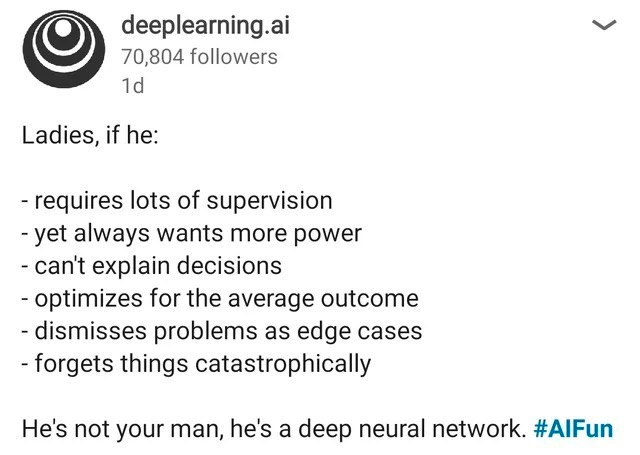
For seasoned ML engineers and data scientists, this meme hits home on multiple levels. At first glance, it adopts a familiar social media trope: “Ladies, if he… [list of bad traits] … he’s not your man, he’s X.” We’ve seen this format used for humor before, but here X is a deep neural network, and each “bad boyfriend” trait is actually a well-known quirk of AI models. The humor works because it anthropomorphizes the technical flaws of neural networks as red flags in a relationship. And let’s be honest, working with some machine learning models can feel like being in a challenging relationship! 😅
Each bullet in that list is something an experienced developer has likely struggled with:
“Requires lots of supervision” – Any senior engineer in AI/ML reads this and chuckles: Oh, the endless grind of labeled data. It’s a nod to how supervised learning dominates practical AI. We’ve all been there, babysitting models with huge training datasets, or spending weeks cleaning and labeling data because without that “supervision,” our model is hopeless. You can almost hear the collective groan remembering projects where gathering a quality labeled dataset was 90% of the work. The meme reframes it as a needy boyfriend who can’t do anything without oversight, which is hilarious because it’s true – a cutting-edge image classifier can identify hundreds of object types, but only after you spoon-feed it tens of thousands of examples of each. It’s that needy.
“Yet always wants more power” – This one elicits a knowing grin from anyone who’s tried to train a modern deep net. We recall how training even a moderate model had us begging our boss for a GPU upgrade or renting cloud TPUs at insane hourly rates. The meme’s “he always wants more power” is spot-on: these models scale their performance with more computing resources, and it never feels enough. It’s like building a bonfire – the moment you throw on more wood (compute), the flames (performance) get bigger, and the model just keeps asking for more. Experienced folks might joke about how their power-hungry models at work have made them de facto hardware experts, constantly monitoring GPU utilization, temperature, and memory. In a relationship context, a person always demanding more “power” sounds absurd – what is he, a supervillain? – which makes it extra funny when you realize it’s literally describing your greedy AI model that maxes out a 16-core CPU and still asks for a bigger server.
“Can’t explain decisions” – Veteran developers know this pain as the black box problem. We’ve sat in meetings where someone asks, “So why did the model make that recommendation?” and all we can do is shrug and say, “It’s complicated… the weights decided that way.” 😬 It’s a bit of an industry joke that, when pressed for an explanation, some engineers might half-jokingly anthropomorphize the model: “Well, the network feels that these features correlate with a positive outcome.” In reality, we have techniques to probe models, but it’s never a satisfying, clear answer like the logic you’d get from a human or a simple rules engine. So reading “he can’t explain decisions” immediately screams “black-box boyfriend” – the kind of partner who does crazy things and when you ask why, he just goes “I dunno, it made sense in my head.” That’s our neural nets! We’ve all debugged a model behaving bizarrely on one input, and we’re like “Why on Earth…?” Sometimes the best we can do is run feature importance tools or visualize a saliency map and interpret it, akin to relationship counseling for your AI. Seasoned ML folks find this hilarious because we know how absurd it is that we create these powerful models that we ourselves struggle to interpret. The meme nails that irony by comparing it to a boyfriend with zero communication skills.
“Optimizes for the average outcome” – Here the meme is poking fun at how models are laser-focused on their training objective. In practice, a senior dev knows that if you train a model to maximize overall accuracy, it might do so at the expense of rare cases. For example, if 99% of users are right-handed and 1% are left-handed, a classifier might just learn to always assume “right-handed” to get 99% accuracy – great average success, terrible for that 1%. We recognize this as the model effectively ignoring the minority to score high on the majority, which is exactly what a naive optimization of average outcome yields. In a human context, saying someone “optimizes for the average” sounds like a person who never goes out of their way for anything special – they just do the bare minimum generic stuff. That’s a pretty unflattering trait in a boyfriend, and it’s an equally problematic trait in an AI system when you care about edge cases or fairness. Experienced folks might recall real incidents, like models that achieved impressive overall metrics but failed badly on a subset of important cases (leading to embarrassments or ethical issues). The meme’s humor is that we all have seen models that are honor students in overall score but total dunces on anything unusual. It’s a sardonic reminder: if your AI were a person, it would be that guy who just coasts by doing the average expected thing and ignores anything that doesn’t fit the mold.
“Dismisses problems as edge cases” – How many post-mortems and bug reports have we seen where the root cause was an “edge case” that was overlooked? In software, brushing off something as “just an edge case” is often last words before a disaster. In ML, we know our models do this implicitly – they often fail silently on edge inputs. The meme paints a picture of a boyfriend who just doesn’t want to deal with any complicated, rare issues – like if there’s a very specific, important date or an unusual request, he’d say “ah, that’s an edge case, not my problem.” As engineers, this resonates darkly: we’ve confronted how an AI might be 99% accurate but that 1% (“edge”) can include critical instances (like a rare disease in a medical diagnosis dataset, or an uncommon phrase in a translation app) that get handled poorly. A seasoned ML practitioner finds truth in the joke: the number of times we’ve had to explain to stakeholders that “the model wasn’t really trained for that scenario” or “that input is kinda outside what it knows”… yeah, that’s the model effectively dismissing it as an edge case. The meme gets a laugh because it’s exactly how it feels – our fancy AI just says “meh, I’ll ignore that weird thing” and moves on, much like a self-absorbed partner ignoring your specific needs.
“Forgets things catastrophically” – If you’ve ever fine-tuned a model or done multi-task learning, you probably cringed in recognition at this line. The meme’s scenario is like the boyfriend who forgets your birthday and also forgets you told him not to bring up your embarrassing high school story – just total memory wipe at the worst times. Technically, this is referencing catastrophic forgetting, which senior folks know all too well when deploying models in production. For example, you finally train a chatbot to answer new support questions really well, but suddenly it can’t answer the old ones it used to know — it “forgot” when you updated it. It is catastrophic: something that worked fine yesterday vanishes today because the model’s brain got rewritten. There’s a collective experience in the AI community of grappling with this. Perhaps you’ve tried progressive training tricks or had to revert to training a big model on all data at once (because incremental learning wrecked the old knowledge). So seeing it phrased as a relationship red flag – like a partner who catastrophically forgets important things – is both funny and painfully true. We laugh but also think, “yep, been there, done that, got the t-shirt from that fire-fight.”
Beyond the individual points, there’s an overarching layer of humor: the meme is blending a dating advice meme with AI humor. It’s essentially an “AI meets relationship” joke. The format is something you’d see on LinkedIn or Instagram for a chuckle – with the account name (deeplearning.ai) and even a hashtag #AIFun to signal it’s lighthearted. For those in the field, it’s immediately clear this is insider humor made accessible. We’re personifying our complex deep learning systems as if they were awkward, high-maintenance boyfriends. That anthropomorphic spin makes the technical ideas approachable and funny. It’s also a bit of a nod to how ubiquitous and perhaps trendy discussing AI quirks has become – you can post this on a professional network and tens of thousands of followers (as indicated by the “70,804 followers” on the post) will “get it” and likely chuckle. It’s a sign of the times: even our memes are about neural networks now. And they’re relatable, because so many practitioners share these experiences: wrangling supervised data, scaling up models, struggling with lack of interpretability (explaining to your boss why the AI did something weird is as futile as explaining that boyfriend’s weird habit), dealing with average-case metrics that hide important issues, and fighting the forgetfulness of models when updating them.
In short, to a seasoned developer or ML researcher, this meme is a perfect comedic summary of “the things we love and hate about deep learning models.” It wraps up the inside jokes of our industry in a playful, universally understandable analogy. We grin because the next time someone says “my model needs more epochs and another GPU,” we might just reply: “Careful, sounds like you’ve got a diva boyfriend there.” 😉
Level 4: Deep Red Flags
Under the hood of this tongue-in-cheek list lie some fundamental AI limitations and trade-offs in deep learning. Each "red flag" is actually pointing to a known technical quirk or theoretical challenge of deep neural networks:
Insatiable Supervision Needs: The joke about “requires lots of supervision” alludes to supervised learning. Deep nets typically learn by example – millions of labeled examples. Theoretically, a network has an enormous number of parameters (weights) to tune; by the Universal Approximation Theorem, a sufficiently large neural net can represent almost any function, but only if it’s guided by enough data. This vast capacity means without tons of training examples (supervision), the model either won’t learn effectively or will overfit. In academic terms, the model’s VC dimension is huge, so you need proportional data to generalize. No surprise: if you don’t constantly “watch” and correct it with labeled data, it’s like an overly literal student that just doesn’t learn the right lessons.
Compute-Hungry and Power-Hungry: “Always wants more power” hints at the extraordinary computational appetite of deep learning models. This isn’t about political power – it’s computing power (though some might argue big AI models rule the world in their own way!). Training a large neural network means billions of matrix multiplications. The growth in model size (from millions to now billions of parameters in cutting-edge models) has outpaced even Moore’s Law, leading to specialized hardware like GPUs and TPUs. Each new breakthrough model often demands more GPU hours, more memory, more electricity. This reflects the scaling laws in deep learning: bigger models plus more data generally yield better results, but at exponential cost. There’s a physical reality here – the power draw of giant server farms running AI training is non-trivial. So yes, advanced AI models literally consume more power (energy) and figuratively they always beg for a more powerful processor. The meme anthropomorphizes this as a needy boyfriend who always wants a bigger engine – in reality, it’s those clusters of GPUs heating up the data center.
The Black Box Problem (Lack of Explainability): When it says “can’t explain decisions”, it’s spotlighting the notorious black-box nature of deep neural nets. Unlike a simple textbook algorithm or even an expert system with clear rules, a trained neural network doesn’t provide human-readable reasoning. Mathematically, it has formed an extremely high-dimensional internal representation of the data. Its decision process is encoded in thousands of neuron weights activations – try explaining that in plain English! This is why Explainable AI (XAI) is a whole research field: engineers and researchers devise techniques like feature importance scores, visualizing intermediate layers, or local surrogate models (
LIME,SHAP, etc.) to peek into why the network made a certain call. On a theoretical level, extracting an exact explanation might be as hard as the original problem – it’s like compressing the complexity of the world back into a few sentences. In complex models, there isn’t a single neat rule like “if credit score < 600 then deny loan”; instead there’s a soup of weighted factors. So when the meme says the “guy” “can’t explain decisions”, an ML researcher hears: high-dimensional nonlinear function with no interpretable output. It’s humor hiding a real concern: we have incredibly powerful models operating without clear transparency, almost like an AI version of a boyfriend giving you only a shrug when you ask why he did something.Average Optimization Bias: The line “optimizes for the average outcome” points at how training objectives in machine learning work. Most loss functions (like mean squared error for regression, or cross-entropy for classification) boil performance down to a single scalar – often an average of errors over all examples. By design, this means a model is trying to do well on average, which can neglect the extremes. The meme humorously frames this as if the “guy” only cares about the most typical scenario and is blind to nuance. In deep learning theory, we know models are optimizing an expected risk $E[\text{loss}]$ over the data distribution. If certain cases (say, minority classes or rare conditions) barely contribute to that expected value, the model has little incentive to learn them well. This is related to the long tail problem: neural networks excel at capturing dominant patterns in data but can be notoriously brittle on edge cases or less frequent patterns. There’s also an implicit assumption that the training distribution represents what you care about – if it doesn’t, those “edge” problems get dismissed as statistical noise. In essence, the network is a turbo-charged curve fitter aiming to minimize overall error – much like a student who studies only the commonly asked questions to maximize their test score average, possibly at the expense of the rare, tough questions.
Edge Case Blindness: Building on that, “dismisses problems as edge cases” is a cheeky way to say the model doesn’t handle rare inputs or unusual situations well. In engineering, we gripe when someone says “oh, that bug is an edge case, don’t worry about it” – because it often causes trouble later. In ML, an edge case might be a data point far from anything seen during training (an out-of-distribution sample). Theoretically, unless a model has been explicitly designed for robust extrapolation, its behavior on edge cases is undefined – it may give a wrong answer with high confidence or just hiccup. There’s no magical reasoning to cover scenarios that weren’t in the training data. This ties to the No Free Lunch Theorem in a loose sense: a model that’s optimally tuned for the average case of one distribution will, in the absence of further info, perform arbitrarily on a different case or distribution. Researchers attempt to mitigate this with techniques for outlier detection, adversarial training, or by expanding training datasets to include more “corner cases,” but the meme cuts through all that nuance with a one-liner: our "AI boyfriend" just brushes off any weird situation as unimportant. In other words, the network lacks robustness to handle the full complexity of the real world’s long tail of oddball cases.
Catastrophic Forgetting (Memory Wipe): Finally, “forgets things catastrophically” references catastrophic forgetting, a well-documented issue when neural networks learn sequentially. Unlike humans, who manage to retain old memories while acquiring new ones (most of the time!), a standard neural network tends to overwrite its existing knowledge when you train it on new data. This is rooted in the stability-plasticity dilemma: the model needs to be plastic (flexible) enough to learn new tasks, but also stable enough to not erase previously learned tasks. Mathematically, when you continue training on a new task, the gradient descent algorithm doesn’t know to preserve the solutions to the old task – it just adjusts weights to minimize the new task error, often moving away from the old task’s solution manifold. The result is that performance on the old task can drop off a cliff (hence “catastrophically”). It’s like writing new text over old text without saving another copy. There are ongoing research paths to address this: for example, regularization methods that penalize changing weights that were important to the old tasks, dynamic architectures that grow new neurons for new tasks, or rehearsal methods that mix old task data in when learning the new task. But in the meme’s anthropomorphic terms, this “guy” has a serious memory issue – he’ll forget your anniversary (old data) the moment he learns your new phone number (new data) 😜. For ML pros, that line elicits a knowing sigh: “yep, classic neural net issue – we fine-tuned our model on new data and it totally forgot how to handle the original domain.”
In summary, each bullet point in that list isn’t just a random jibe – it’s pointing at a core difficulty in modern AI systems. From the need for massive labeled datasets to power-hungry models, from opaque reasoning to focus on average-case optimization, and from ignoring outliers to catastrophic memory resets – these are the deep (learning) red flags that any practitioner will recognize. The meme cleverly abstracts these complex issues into the format of dating red flags, making us laugh while reflecting on the deep learning hurdles we grapple with. It’s a testament to how far AI has come (and how much further it has to go) that we can joke about these very specific problems in such a relatable way.
Description
A screenshot of a social media post from the 'deeplearning.ai' account, which has over 70,000 followers. The post uses a popular meme format, starting with the text 'Ladies, if he:'. It then lists several bullet points: '- requires lots of supervision', '- yet always wants more power', '- can't explain decisions', '- optimizes for the average outcome', '- dismisses problems as edge cases', '- forgets things catastrophically'. The punchline at the bottom reads, 'He's not your man, he's a deep neural network. #AIFun'. The meme humorously anthropomorphizes a deep neural network by equating its technical challenges with undesirable traits in a romantic partner. For developers, the joke is relatable as it cleverly maps concepts like supervised learning, the need for powerful hardware (GPUs), the 'black box' problem of explainability, model generalization, handling of edge cases, and the phenomenon of catastrophic forgetting to common relationship complaints
Comments
7Comment deleted
My last model relationship ended because it kept overfitting to my preferences and then suffered catastrophic forgetting the moment I introduced new data. Now I'm training a new one with more robust regularization
When your partner needs constant validation, blows the cloud budget on every date, and forgets your anniversary after a single fine-tuning session, stop debugging the relationship - you accidentally deployed a production-scale neural net without a retention policy
After 5 years of fine-tuning in production, he'll suddenly start hallucinating about features you never trained him on, but management will insist it's a breakthrough in emergent behavior
This hits different when you've spent three weeks trying to explain to stakeholders why your production model confidently misclassified their CEO's face as a mop, only to be told 'it's probably just an edge case' - meanwhile the model is demanding a V100 upgrade and you're pretty sure it just forgot everything it learned about faces from last quarter's fine-tuning session
If he keeps asking for one more GPU, calls your concerns “edge cases,” and forgets everything after fine‑tuning, you didn’t find a soulmate - you deployed an under‑regularized black box without SHAP receipts
Deep nets are interns with eight A100s: need supervision, make black-box decisions, optimize for the mean, call the tail "edge cases," and catastrophically forget everything after the next fine-tune
Empty replay buffer in continual learning: nails the flirting epoch, catastrophically forgets loyalty at inference time