Skip to content
DevMeme
7474 of 7506
From Keyboards to Literal Neural Interfaces

From Keyboards to Literal Neural Interfaces

Why is this AI ML meme funny?

Level 1: No More Typing

It is like ordering food in three ways: first you write the whole recipe, then you tell a cook what meal you want, and finally the cook tries to read your mind. Each method is faster for the customer, but the cook can still misunderstand—and most people would prefer that thinking “maybe cake” does not instantly deliver forty cakes. The head cable is funny because it removes the final effort while making the possible misunderstanding wonderfully enormous.

Level 2: Three Ways to Tell

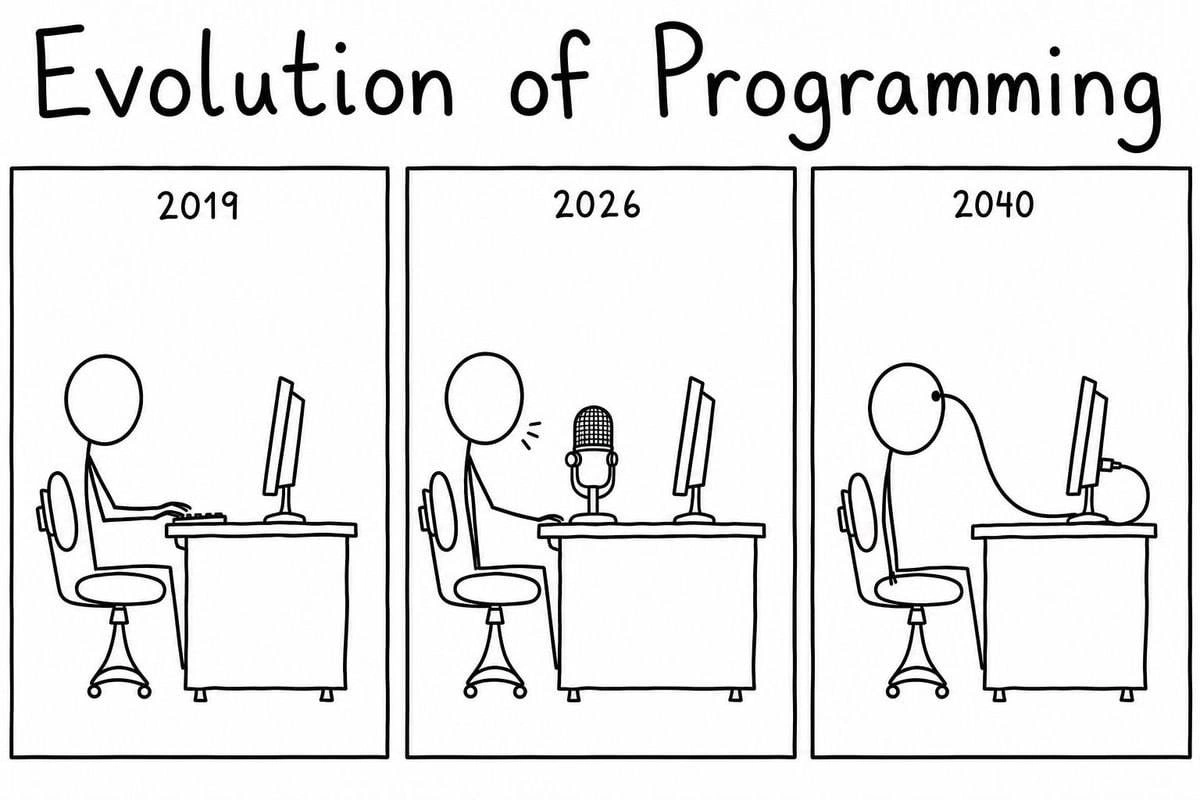
In the first panel, the programmer uses a keyboard to write source code: precise instructions expressed in a programming language. The computer translates that code into operations it can execute.

In the second, the microphone represents a voice user interface. Speech-recognition software converts sound into text, and an LLM interprets that text. A coding assistant may then inspect files, propose changes, and run developer tools. The person is no longer spelling out every instruction, but somebody still has to check whether the generated result matches the request.

Consider the spoken command:

“Make login faster and fix the timeout.”

That sounds clear conversationally, but an engineer—or an agent—still needs answers. Which login path is slow? What timeout is failing? What latency is acceptable? May caching change security behavior? How will improvement be measured? Natural language communicates the goal efficiently while leaving many implementation constraints unstated.

The final panel imagines a brain–computer interface, hardware that measures brain activity and turns recognizable patterns into computer controls. Current interfaces are much better understood as trained signal decoders than as perfect mind readers. A user and system may practice together until a particular pattern reliably means “move,” “select,” or “type this character.” Turning a complicated architectural idea directly into correct software would be a much larger leap.

The evolution in the picture therefore moves the programmer from writing exact code toward expressing higher-level intent. That can reduce repetitive work, but it increases the importance of specifications, tests, code review, and permission controls. The easier it becomes to request a large change, the more important it becomes to verify what the request actually caused.

Level 3: Intent, Now Hands-Free

“Evolution of Programming”

The three panels preserve the programmer, chair, desk, and monitor while progressively deleting the input device. In 2019, fingers touch a keyboard. In 2026, speech lines point toward a comically prominent microphone. By 2040, a cable runs directly from the programmer’s head into the display. The joke treats programming history as a march toward removing every physical step between “I have an idea” and “the computer has made it someone else’s maintenance problem.”

The progression is really about abstraction, not typing. Programming has repeatedly moved away from the machine’s native representation: numeric instructions gave way to assembly mnemonics, high-level languages hid register manipulation, frameworks packaged recurring structures, and IDEs automated navigation and refactoring. AI coding assistants add another translation layer by accepting natural-language intent and producing edits, commands, tests, or entire applications.

The middle panel is therefore plausible because its microphone is not directly “writing code.” A voice-first coding system typically forms a pipeline:

speech → automatic transcription → language-model interpretation
       → coding-agent tools → source-code diff → tests → human review

Each arrow can lose information. Speech recognition can mishear a library name. The language model can resolve an ambiguous instruction differently from the speaker. The agent can select the wrong file or imitate an outdated project pattern. Tests can validate the generated implementation without validating the unstated requirement. Voice makes the prompt easier to enter; it does not make the prompt complete.

That distinction exposes the meme’s hidden productivity assumption: perhaps the keyboard was never the main bottleneck. For many engineering tasks, typing the implementation is smaller than understanding a legacy system, choosing a design, negotiating behavior, reproducing a defect, waiting for a build, reviewing a patch, and observing a release. Saving seconds on text entry helps, especially for accessibility and mobile work, but it does not compress the hours spent deciding what the software ought to do.

The modalities also trade precision for expressive ease:

Interface Strong at Awkward at
Keyboard Exact syntax, symbols, small edits, silent work Conveying rich context quickly
Voice Goals, explanations, hands-free direction File paths, punctuation, noisy offices, private details
Brain interface Potentially detecting selected intent or control signals Reliably decoding nuanced thoughts and consent

The 2040 cable makes the trend absurdly literal: if natural language is still too much interface, connect thought itself. A real brain–computer interface would not simply mount the mind as /dev/brain0. Neural activity must be sensed, filtered, decoded, calibrated to an individual, and mapped to a limited command vocabulary. Non-invasive sensors avoid surgery but receive noisier signals through skin and bone; implanted electrodes can record more locally but introduce medical risk, long-term stability problems, and a serious maintenance policy for hardware whose reboot instructions should not begin with “open skull.”

Decoding deliberate motor intent—such as selecting a cursor direction—is different from extracting a complete software specification. Human thoughts are not neatly serialized source code waiting behind the forehead. They are partial, changing, contextual, and often mutually contradictory. A developer may “know what they mean” while still needing conversation, diagrams, prototypes, and tests to discover the actual requirement. A faster channel can transmit ambiguity faster.

The direct cable also makes the hardware-versus-software boundary part of the joke. Today the microphone creates audio data that software can transcribe. A neural interface would create exceptionally sensitive biological data that a decoder interprets. Questions that are merely inconvenient for voice become fundamental: Who stores the raw signal? Can the model infer something the user did not intentionally submit? How is an accidental command distinguished from an idea being considered? Can an employer inspect the stream? What counts as undo when input precedes conscious wording?

Those privacy and agency problems mean the most important future interface may be a stronger confirmation boundary, not a faster input channel. A useful thought-driven agent would still need scoped permissions, explicit previews, reviewable diffs, and a clear distinction between consider this and execute this. The final panel is funny because it removes the last visible barrier just when barriers may be most valuable.

The comic’s sparse art strengthens the satire. Nothing about the surrounding work improves: the same person remains seated before the same screen. Only the route into the computer changes. That is a neat correction to future-of-AI hype. Tools can radically alter how intent becomes code, yet programming remains the discipline of turning incomplete human wishes into behavior precise enough for a machine—and taking responsibility when those wishes were incomplete in interesting new ways.

Description

A black-and-white hand-drawn comic titled “Evolution of Programming” is divided into three boxed panels labeled “2019,” “2026,” and “2040.” In 2019, a stick-figure programmer types at a keyboard; in 2026, the programmer speaks toward a large desk microphone beside the monitor; and in 2040, a cable runs directly from the programmer’s head into the computer. The progression turns today’s shift from typed code to natural-language, voice-driven AI assistance into a speculative brain-computer endpoint. Its sparse line art makes the escalating removal of conventional input devices the entire visual punchline.

Comments

1
Anonymous ★ Top Pick By 2040, segmentation faults will finally qualify as a medical diagnosis.
  1. Anonymous ★ Top Pick

    By 2040, segmentation faults will finally qualify as a medical diagnosis.

Use J and K for navigation