Thirteen Hours Into the Agentic Sprint
Why is this Management PMs meme funny?
Level 1: Dinner Is Still Cooking
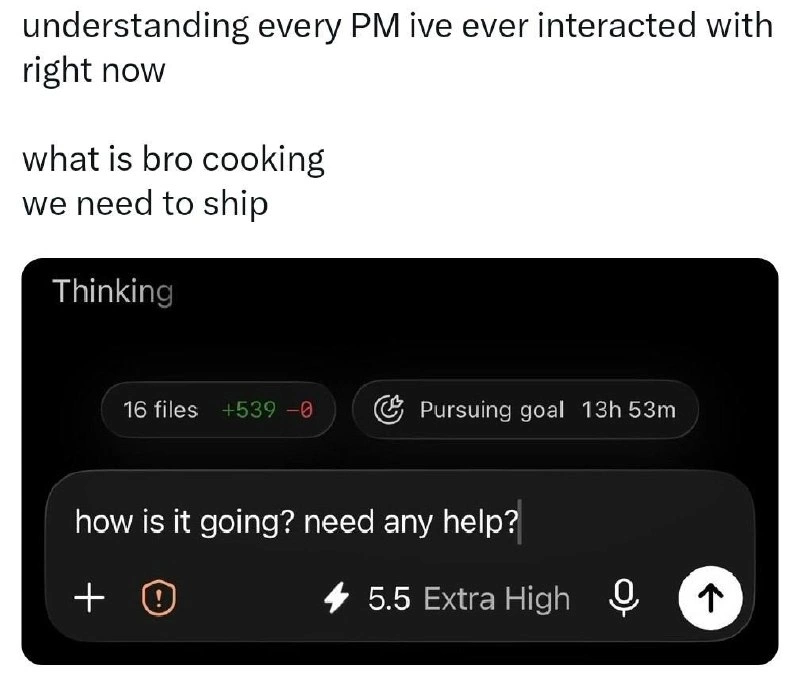
It is like asking someone to make dinner, then finding them in the kitchen nearly fourteen hours later with sixteen bowls dirty and 539 ingredients on the counter. They keep saying, “I’m working toward dinner,” but cannot say when anyone will eat. The person who promised not to be annoying finally asks, very gently, whether they need help—because patience feels different when everyone is hungry.
Level 2: From Prompt to Shipment
A PM, or product manager, helps decide what should be built, why users need it, what matters most, and when it must be delivered. A PM usually does not need every implementation detail. They do need enough information to manage deadlines, dependencies, trade-offs, and risk. The meme’s developer finally feels that uncertainty from the other side.
An AI coding assistant can inspect a repository, edit files, run commands, and use test results as feedback. In goal mode, the user describes an outcome and the agent continues taking steps toward it instead of stopping after one response. “Pursuing goal” likely means the task has not reached its completion condition.
The numbers are a Git-style summary of the working changes:
16 filessays sixteen files currently differ from their earlier versions.+539says 539 lines were added.-0says no lines were removed.
Those figures help estimate review size, but they are not a progress bar. A five-line fix can be finished; a thousand-line patch can still miss the requirement. To ship means more than produce code: the change normally must be understood, tested, reviewed, merged, deployed, and observed after release.
The typed message—how is it going? need any help?—is actually a reasonable intervention. Useful follow-up questions would ask the agent to summarize its current approach, list completed checks, name any blocker, explain why sixteen files changed, and present the smallest reviewable diff. If it cannot give a coherent answer, pausing the run may be safer than granting it another open-ended afternoon.
Level 3: Managing the Machine
“understanding every PM ive ever interacted with right now”
“what is bro cooking”
“we need to ship”
The developer has delegated implementation to an agent and, after 13h 53m, undergone the complete management empathy speedrun. The agent still says “Thinking” and “Pursuing goal” while its only concrete evidence is a diff spanning 16 files with +539 additions and -0 deletions. That is exactly the information gap that turns a relaxed stakeholder into someone typing, “how is it going? need any help?” with the careful politeness of a person standing beside a server rack that may already be on fire.
The joke reverses the familiar management-versus-engineering complaint. Developers often experience a product manager’s status request as an interruption: the work is complex, progress is nonlinear, and explaining it consumes time that could be spent finishing it. Once the developer supervises an autonomous coding agent, however, they inherit the PM’s actual problem. A deadline exists, a result is expected, and the worker’s internal process is largely opaque. “Still pursuing the goal” is technically a status, in the same way “somewhere in the Atlantic” is technically a shipping update.
The interface exposes activity metrics, not outcome metrics:
| Visible signal | What it proves | What it does not prove |
|---|---|---|
13h 53m elapsed |
The task has remained active a long time | It is close to completion |
16 files |
The workspace changed broadly | The scope is appropriate |
+539 -0 |
Lines have been added | The behavior is correct or necessary |
| “Thinking” | The agent reports ongoing work | It is making forward progress |
| “Pursuing goal” | A goal-mode loop has not terminated | The goal is still reachable without intervention |
This distinction matters for long-running agents. A model can spend time productively reading code, running integration tests, waiting on builds, inspecting a UI, or revising a failed approach. It can also cycle between fixes, repeatedly rediscover the same failure, wait on a stuck process, expand scope, or preserve a bad premise because the acceptance criteria never contradicted it. Elapsed time cannot distinguish those states.
The +539 -0 diff intensifies the anxiety without proving wrongdoing. A new feature may reasonably add code without deleting any. But after almost fourteen hours, additions across sixteen files suggest that the cost of review is growing while the user still lacks an explanation of the plan, the remaining blocker, or the expected terminal state. Every extra file increases the surface that may need tests, security review, documentation, and future ownership. The machine may be cooking; it has not shown that anyone ordered the banquet.
The “5.5 Extra High” setting adds another layer of irony. Higher reasoning effort can allocate more computation to planning and problem-solving, which may help on difficult work. It is not a correctness mode, and it does not turn an underspecified objective into a good specification. More effort applied to the wrong goal can produce a remarkably thorough wrong answer. The label reassures the developer that the agent is trying very hard, which is different from reassuring them that it should continue.
A mature agent workflow needs the same control surface a competent PM wants from a human project—not keystroke surveillance, but legible checkpoints:
- a short plan before broad edits begin;
- explicit acceptance criteria and non-goals;
- the current step and the evidence completed so far;
- surfaced blockers instead of silent retries;
- time, tool, and cost budgets;
- reviewable intermediate commits or patches;
- a stop condition for success, stagnation, or uncertainty;
- a safe way to pause, redirect, or request human judgment.
That changes the interaction from “Are you done yet?” to “Which assumption or check prevents completion?” It also prevents automation bias, where the agent’s confident status and expensive model setting persuade the user to wait longer simply because cancelling feels like wasting thirteen hours. That is sunk-cost reasoning: previous time is already gone; the decision should depend on the expected value and risk of the next hour.
The deeper industry satire is that AI does not eliminate coordination work. It moves it upward. The developer writes less code directly but spends more time defining outcomes, constraining scope, judging evidence, and deciding when to intervene—the same family of work that product managers, technical leads, and engineering managers have always performed. Agentic productivity can be real, but only if supervision costs, review load, compute cost, and failed runs are counted. Otherwise the dashboard celebrates autonomous hours while the release waits patiently in another quarter.
Description
On a white background, lowercase text says “understanding every PM ive ever interacted with right now,” followed by “what is bro cooking” and “we need to ship.” Beneath it, a black rounded AI coding-agent panel is labeled “Thinking” and shows “16 files,” “+539,” “-0,” plus a status pill reading “Pursuing goal 13h 53m.” The message box contains “how is it going? need any help?” alongside plus, warning, lightning, microphone, and send icons, with “5.5 Extra High” indicating a high-effort model setting. The meme captures product-management anxiety when a long-running autonomous coding task produces a large, opaque diff while the delivery clock keeps moving.
Comments
1Comment deleted
The coding agent has a fourteen-hour context window; the PM has a fourteen-minute patience window.