The Friday Bug 'Fix'
Why is this Bugs meme funny?
Level 1: This Will Hold Till Monday
Imagine you’re riding a bike and suddenly one of the pedals breaks off just as you’re about to go on a weekend trip. You don’t have time to properly fix the bike before you leave. So what do you do? Maybe you grab some tape or a piece of string to tie the pedal back on just enough so it doesn’t fall off while you ride. You know it’s not a real fix – it’s a quick patch, like a band-aid – but you tell yourself, “Eh, this will get me through the weekend. I’ll fix it right on Monday.” The comic is funny for the same reason: the programmer had something “break” (the train track in the picture), and instead of fixing it the right way (which would take too long on Friday), he just throws a plank of wood over it as a temporary fix. He basically says, “Good enough for now, we’ll deal with the real fix later.” The boss or friend next to him looks worried, just like a friend might say, “Are you sure that’s safe?” We laugh because we’ve all done something like this in real life – using a quick fix to solve a problem when we’re short on time, even though we know it’s kind of flimsy. It’s that relieved-but-nervous feeling: you’re glad you solved the problem today, but you really hope it doesn’t fall apart before you can properly repair it.
Level 2: Hotfixes and Wooden Flags
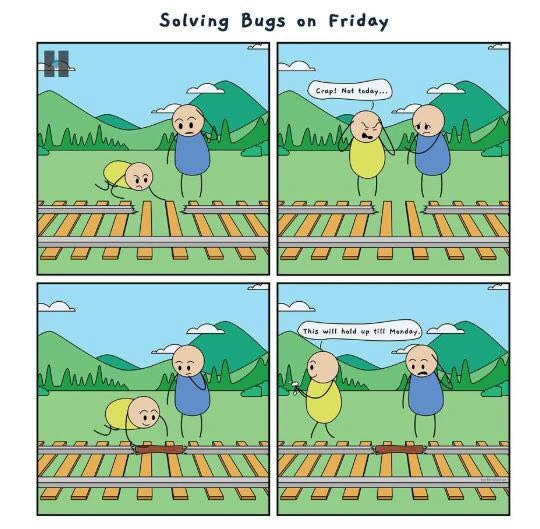
In this four-panel comic, a bug in a system is being represented by a broken railroad track. Let’s break down the analogy clearly: the railroad is like the software or product, and the gap in the rails is the bug – a problem that will cause a crash if not fixed. It’s Friday, which in developer culture is famously the worst time to find a serious bug, because most people are about to sign off for the weekend. The yellow stick figure is the developer who found the bug and is responsible for bug fixing it. The blue stick figure standing by is like the manager or a colleague (maybe the team lead) watching anxiously. In the second panel, the dev is sweating and saying “Crap! Not today…” – basically, “Oh no, why did this have to break now, at the end of the week?!” This captures debugging frustration: that feeling of dread when an issue pops up right before a deadline or break.
Now, in panels 3 and 4, instead of doing a thorough repair (which would be time-consuming), the developer takes a shortcut. He literally uses a random plank of wood to bridge the gap in the rails. That plank is a metaphor for a hotfix – a quick, improvised code change applied directly to a live system to fix an urgent problem. Hotfixes are often done under pressure with minimal planning. They’re meant to be temporary patches just to keep things running. Here the dev says “This will hold up till Monday.” That’s exactly the kind of thing an engineer might say after deploying a quick fix at 5 PM Friday: “It’s not a permanent solution, but it will keep the system working through the weekend. We’ll do a proper fix on Monday.” The blue figure’s worried face reflects what everyone’s feeling: hope mixed with worry, because this solution is not very sturdy. In software terms, you’d deploy the patch and then monitor the system closely, fingers crossed.
Let’s connect to some key terms and practices:
Friday deployments – Pushing new code or fixes on a Friday is usually avoided because if something goes wrong, engineers might have to work late or over the weekend. The phrase “Don’t deploy on Friday” is well-known. But bugs don’t schedule themselves conveniently, so sometimes a Friday bug fix is unavoidable. This comic dramatizes that situation.
Feature flags – These are a smart software technique: a feature flag is like a switch in the code that can turn certain functionality on or off without redeploying new code. For example, if a feature is causing errors, you can flip its flag to “off”, hiding or disabling that feature for users until it’s fixed. Feature flags allow quick responses to problems. The meme’s title jokes about “wooden feature flags” because the wooden plank is acting like a very crude feature flag: it’s an external, hacky way to bypass the broken part. Instead of gracefully toggling something off in software, the dev physically covers the gap. It’s as if in code they wrote, “if problem happens, just skip that part”. Not elegant, but it works (temporarily).
Technical debt – This is an important concept introduced here. Technical debt means when you take a shortcut in coding (often to meet a deadline or solve an urgent issue) instead of doing things the clean, proper way. It’s like borrowing time: you saved time now, but you “owe” a fix later. The wooden plank solution is classic technical debt: the developer knows it’s not the right long-term fix, but it’s the only thing they can do quickly. Come Monday, that debt needs to be “paid back” by fixing the rails properly (rewriting the code properly). If you don’t, the system remains fragile. In software teams, leaving such quick fixes for too long can cause bigger problems down the line, just like a weak patch on a railroad could cause a derailment if not addressed soon.
Deadline pressure – This refers to the stress of having to get something done by a certain time. Here, the deadline is basically “the end of Friday” (because the team doesn’t want this bug open over the weekend). Under deadline pressure, developers might do things like this – just make it work in any way possible, and plan to refine it later. It’s not ideal, but it’s often the reality when the clock runs out. The comic’s humor hits us because pretty much anyone in software has experienced this scramble: the adrenaline of a last-minute bug, the manager hovering (like the blue guy) asking “Is it fixed yet?”, and you hacking together a solution moments before you’d otherwise log off.
Production hotfix – The term “production” means the live system (the one real users are interacting with). A hotfix implies making a change directly on that live system outside of the normal, careful development process. This can be nerve-wracking because if your quick fix has any issue, it could crash the live system or cause new bugs. That’s why the blue figure looks so nervous. In real life, a team might say, “We pushed a hotfix to production to address the bug.” Then everyone watches telemetry (logs, error alerts, etc.) to be sure it’s stable. The meme illustrates this tension in a simple visual way: the train hasn’t come yet, but you just know everyone will be watching that patched section of track, hoping it doesn’t fail under pressure.
Here’s a little pseudo-code to imagine what a Friday quick fix might look like in software:
// A rushed fix on Friday:
if (fridayEvening && criticalBugFound && !safeToDoMajorChange) {
applyHackyWorkaround(); // use a quick, ugly fix
console.warn("Temporary fix applied. Should hold until Monday..."); // Developer's hope
// TODO: implement real fix after the weekend
}
In the code above, applyHackyWorkaround() is like the developer throwing that wooden plank on the tracks – it’s a function that contains whatever quick patch is needed to stop the bug from happening. The console.warn line is equivalent to the dev saying “This will hold up till Monday” in the comic (with maybe a nervous laugh). The // TODO: comment is a reminder to future selves to fix it properly later. This is something you actually see in codebases: comments left in a hurry when doing temporary fixes.
The railroad track metaphor is really effective because even someone new to coding can get the idea: a train track must be continuous or the train crashes. Similarly, a program’s execution must handle every step or it will crash (bug). If there’s a “gap” (error), you need to patch it. Using a random plank = using any quick solution you can find, even if it’s not perfect. It conveys that sense of a stop-gap solution—that’s actually a term used often, meaning a temporary fix that fills a gap.
The caption “How it’s going guys, still holds?” in the post text further adds to the humor. It’s like someone (maybe that blue supervisor or the dev checking in) asking over the weekend, “Hey, is our hack working? Did it survive?” Often on Saturday or Sunday, someone might half-jokingly ping the team chat, “Everything still okay? 😂 ”. It’s funny because it’s true: once you’ve done a band-aid fix, you can’t fully relax; you end up semi-checking in, hoping not to find a disaster.
Overall, for a junior developer or someone outside software, the meme is showing the trade-off between doing it right and doing it fast. On Friday, “fast” often wins. The comic resonates with developers because of the shared understanding that sometimes we do use digital “duct tape” to patch things up under pressure. And yes, it usually becomes technical debt to clean up later. If you’re new to the field, just know that while everyone aims to write perfect code, reality often forces these compromises. The real key is to remember to fix the temporary patch soon (and not let that plank stay there too long!). The humor comes with a knowing grin: we laugh because we’ve been that yellow guy, and we’ve had that exact conversation — “It’s not pretty, but it’ll hold for now. Let’s get out of here and deal with it next week.”
Level 3: Band-Aid Bridge to Monday
On late Friday afternoons in software teams, a critical bug is like discovering a broken segment of railroad track at 4:45 PM. In this cartoon metaphor, the yellow developer kneeling by the rails has found a gap (a production-breaking bug), and the blue figure hovering is essentially the manager or on-call teammate watching in nervous silence. Instead of a proper repair (which would require pulling up the tracks for a full fix, akin to refactoring or comprehensive bug fixing), the developer resorts to a quick-and-dirty hotfix: grabbing a random wooden plank to fill the gap. This plank is the code equivalent of a one-line hack or a hard-coded return value that miraculously papers over the issue. It’s a classic “deploy now, fix later” maneuver, the kind every seasoned engineer has pulled when a surprise bug collides with Friday deadline pressure.
Why is this so funny and painful? Because it’s relatable developer experience to anyone who’s been around the block (or around the track, in this case). You’ve got a Bug in production and the clock is ticking towards the weekend. The last thing you want is a phone call on Saturday saying the system derailed. So you do what you must: implement a temporary fix that’s just good enough to survive the weekend. In the meme, the yellow character literally says “Crap! Not today…” — the universal reaction to finding a nasty bug right before quitting time. The next panels show the makeshift solution: jam a plank in, wipe your brow, and declare “This will hold up till Monday.” It’s the software engineering equivalent of duct-taping a leaky pipe at 5 PM and praying it doesn’t burst when you’re off the clock. Patch-and-pray, if you will.
This scenario lampoons multiple industry anti-patterns at once: technical debt creation, last-minute bug fixing under duress, and the well-known peril of Friday deployments. Seasoned developers know that feeling in their gut when pushing a change late on Friday — a mix of hope and dread. The meme nails it: the blue supervisor’s worried expression in the final panel is basically your on-call instincts screaming “Are we really leaving it like that?” But often, yes, we do, because the alternative is a risky major change or unplanned overtime. In many real-world cases, a team might slap a “wooden” patch in code (perhaps disable a feature flag or add a quick conditional) to avoid a user-facing error, then inform everyone: “We applied a hotfix to production, it’s not pretty but it should hold over the weekend.” The phrase “wooden feature flag” from the title brilliantly captures this: instead of a proper software feature flag to turn off the broken functionality, the dev literally used a plank of wood as a flag to bypass the broken track. Feature flags are meant to be elegant switches in code; here it’s a literal piece of wood acting as an off-switch for disaster. 😅
Every senior engineer reading this can recall war stories of quick hacks on Friday that lived far longer than intended. In theory, you promise to revert or replace the hack on Monday. In practice, Monday comes and either:
- The issue miraculously stayed stable, so everyone forgets about it amidst new fires.
- Or the hack did blow up on Sunday at 2 AM, leading to frantic debugging frustration by whoever was unlucky enough to be on call.
- Or you remember it, but there’s no immediate time to do the “real fix,” so that wooden plank stays there week after week, becoming permanent technical debt — a makeshift piece of code holding together critical logic, scary but untouchable.
This comic pokes at that dirty secret: many production systems are held together by proverbial popsicle sticks and glue, especially under deadline pressure. It highlights the disconnect between best practices and reality. Best practice says “never deploy on Friday,” and if you must, do a thorough job – write tests, do code reviews, fix it right. Reality often laughs and says, “There’s a client demo Monday, just patch it now and we’ll clean up later.” That’s how you get entire codebases full of // TODO: fix this comments and kludges that everyone is slightly afraid to touch. The technical debt built on that Friday feeds future bugs, like a small crack in the rail that grows if not properly mended.
Importantly, the humor also comes from the physical metaphor: a lone wooden plank bridging a rail gap is blatantly precarious. Any sensible person knows a passing train might smash through that improvised fix. Similarly, in software, we know a hastily-coded patch might not handle all edge cases or load. The risk of a trainwreck (literally and figuratively) is real. The blue figure’s face says it all: “I hope this doesn’t end in flames.” Meanwhile, the yellow dev walks away, channeling every engineer telling themselves, “It’s fine, it’s fine… it just has to be fine until I’m back.” It’s darkly comedic because we’ve all done this and then spent the weekend with a faint worry at the back of our mind — or put our phones on loud just in case an “alert storm” comes from that area of the code.
In sum, this meme strikes a chord by illustrating the ritual of the Friday hotfix. It’s a tongue-in-cheek reminder that a quick fix can be a double-edged sword: it saves your bacon in the short term but sets a trap for the future. The term “technical debt” was coined for exactly this scenario: you incur a “debt” by choosing an easy but suboptimal fix, and you will pay interest on it later in the form of tougher problems or extra rework. Solving Bugs on Friday is really about kicking the can down the road (or in this case, over the gap on the tracks) and breathing a sigh of relief—while knowing Monday’s you might be cursing Friday’s you. The codebase, much like that railroad, now has a weak patch that everyone hopes will survive heavy use. Spoiler: sometimes it doesn’t, and that’s when the real fun (or 3 A.M. emergency) begins. But hey, at least you got to enjoy your weekend… maybe.
Description
A four-panel comic strip in the style of Cyanide & Happiness, titled 'Solving Bugs on Friday'. In the first panel, two characters find a broken railway track. In the second, a third, angry-looking character arrives, saying, 'Crap! Not today...'. In the third panel, the first two characters look on. In the final panel, the angry character places a small, flimsy piece of wood over the large gap in the track and declares, 'This will hold up till Monday,' while the other character looks worried. The comic is a metaphor for software development culture, where a critical bug (the broken track) discovered on a Friday is given a shoddy, temporary patch (the piece of wood) to avoid working over the weekend. This act of creating technical debt to preserve the weekend is a deeply relatable experience for senior engineers
Comments
7Comment deleted
That's not a bug fix; it's a high-risk, short-term feature flag set to 'catastrophic_failure_imminent' for Monday morning's on-call engineer
That plank is basically `if (day==FRIDAY) { bypass(); }` - undefined behavior scheduled for Monday’s stand-up
The Friday afternoon fix that somehow survived three quarters, two architecture reviews, and is now load-bearing for half the microservices because someone built a critical feature on top of your "temporary" workaround
Every senior engineer knows the Friday 4 PM bug discovery follows an immutable law: severity is inversely proportional to time until weekend, and the probability of 'holding till Monday' approaches 1 as clock approaches 5 PM. It's not technical debt - it's strategic temporal load balancing with a two-day SLA
Friday protocol: bridge production like a rail tie, label it “temporary mitigation,” mute PagerDuty, and call it a canary until Monday’s postmortem
Friday debugging: Prioritize availability over consistency per CAP theorem - bugs commute till Monday
A Friday hotfix is just change management’s duct tape - approved by the error budget and signed by future-you’s pager