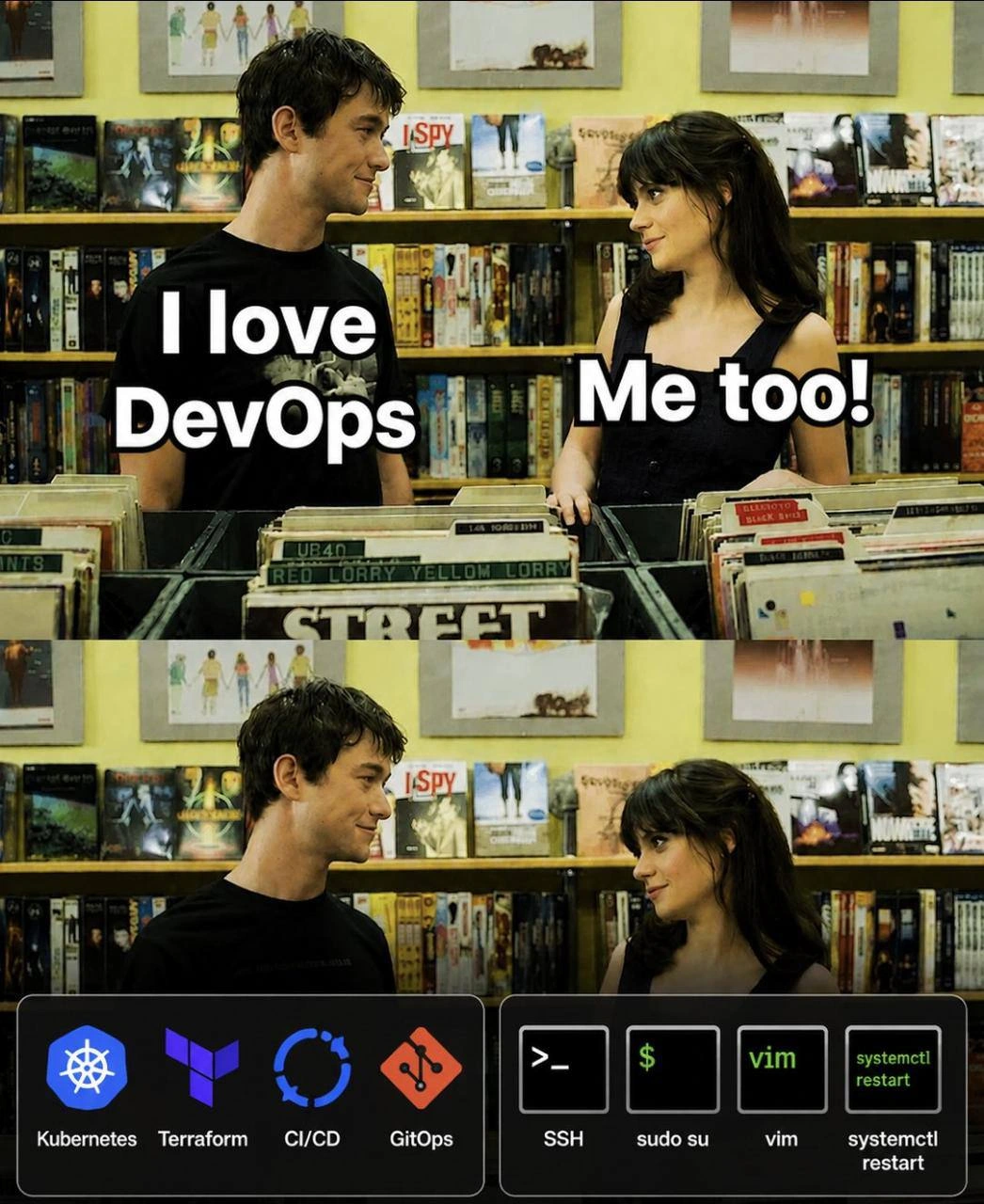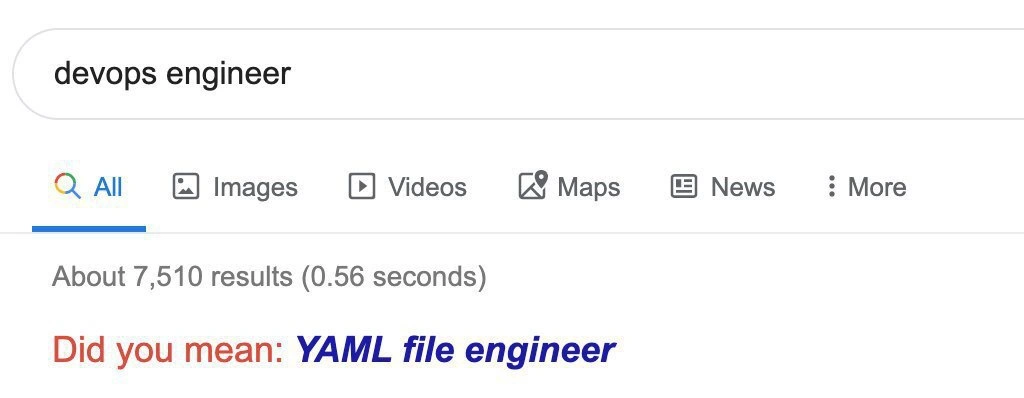
Google Suggests a More Accurate Job Title
Why is this DevOps SRE meme funny?
Level 1: Name vs. Reality
Imagine you have a fancy job title like "Space Mission Designer," but all day long your job is to carefully fill out checklists and forms with very specific instructions. You thought you’d be flying rockets, but instead you’re mostly writing instructions on paper. That’s the joke here.
They call this job "DevOps engineer," which sounds super cool – like someone who makes big decisions and builds awesome computer systems. But in reality, a lot of the job is like writing very detailed recipes for computers to follow. These recipes are written in a special format (kind of like writing a list with strict rules about how you write it). That format is YAML. It’s a bit like writing a LEGO instruction manual: you have to put everything in the right order and in the right place, or the final model won’t turn out right.
So the meme is saying: DevOps engineer? Did you actually mean YAML file engineer? It’s poking fun at how the cool-sounding job is often mostly about those dull-looking text files. People find it funny because it’s a little bit of truth wearing a joke costume. It’s as if someone asked "I want to be a chef!" and a voice replies, "Did you mean: recipe copier?" It’s teasing the difference between the name of something and what it feels like you do all day.
Even a kid can get this idea: imagine you brag to your friends that you’re a master builder because you got a big LEGO set. But when you arrive, instead of snapping bricks together, you spend all day reading and following the instruction booklet to the letter. At the end of the day, yes, you built something – but it felt more like being a professional instruction reader than a creative builder. That’s the humor here. "DevOps Engineer" is the awesome title, but "YAML file engineer" is the everyday reality. It makes us smile because we all know titles can be deceiving, and sometimes the real work isn’t as glamorous as it sounds.
Level 2: DevOps Means YAML
Let’s break down what all this means in simpler terms. DevOps is a role or culture that combines Development and Operations. A DevOps engineer is typically responsible for building and maintaining the pipelines and tools that get code from a developer’s laptop into a production environment (like servers or the cloud) reliably and quickly. This often involves CI/CD (Continuous Integration/Continuous Deployment) systems – basically automation that builds the code, runs tests, and deploys new versions of an application.
Now, how do we tell these automation tools what to do? We use configuration files – and a lot of them are written in YAML. YAML is a format for writing data that is meant to be easy for humans to read and write. It looks a bit like writing out an outline with indentations to show structure. For example, instead of curly braces {} like JSON or angle brackets < > like XML, YAML uses indentation (spaces) and colons to organize information. A simple YAML snippet might look like:
name: "Build Website"
steps:
- task: "Install dependencies"
- task: "Run tests"
In this snippet, we have a name and a list of steps for something like a build process. Each dash - indicates a list item (like a step in a sequence). The indentations (the spaces before task) are significant – they show that those tasks belong to the steps list. If one of those lines isn't indented properly, the computer might not understand that it's part of the list, causing errors. This is what we mean by YAML being whitespace-sensitive: the number of spaces literally can make or break the configuration.
"DevOps engineer" vs "YAML file engineer": The meme jokes that a DevOps engineer's actual job is largely editing YAML files. Why? Because almost every tool in the DevOps/Automation toolbox uses YAML for its config:
- GitHub Actions (for CI/CD workflows): You create a YAML file to define the actions (build, test, deploy) whenever new code is pushed.
- GitLab CI: Also uses a
.gitlab-ci.ymlfile in the repository to define pipeline stages. - Kubernetes (a system to run containers/applications at scale): You describe all your resources (like deployments of your app, configuration maps, services that route traffic) in YAML files called manifests. Deploying a new server or microservice often means writing or updating a bunch of YAML.
- Ansible (automation for setting up servers or deploying apps): Uses YAML "playbooks" to list tasks (like "install Nginx", "copy these files", etc.) to run on remote machines.
So if you're a newcomer (junior) in a DevOps team, you might be surprised how much time you spend writing these configuration files. You might have thought you'd be doing heavy coding or server hacking, but day-to-day, you’re often maintaining CI/CD pipelines (which live in YAML) or tweaking a Kubernetes configuration to get the system working just right. For example, deploying a simple web service might involve writing a Kubernetes deployment YAML, a service YAML, plus updating a CI pipeline YAML so that it knows how to build and deploy that service.
The phrase job-title inflation means giving a grand title to a job that might not be as glamorous in practice. "DevOps Engineer" sounds cutting-edge and broad, but in some companies it essentially equates to "the person who fixes the build pipeline and writes config files to automate things." The meme’s "Did you mean: YAML file engineer" is calling that out humorously. It suggests that maybe the more truthful title for many DevOps folks would be something like "YAML configuration specialist," since that's a big chunk of what they do.
Let's talk about why YAML specifically can be frustrating (hence the joke). YAML files are configuration-as-code, meaning instead of clicking buttons in a UI to set up a pipeline or a server, you write everything down in a text file so it can be version-controlled and reviewed like code. This is a best practice in DevOps for consistency and repeatability. But YAML has its quirks:
- It requires correct indentation: Unlike many programming languages where spaces are mostly for readability, in YAML the structure depends on spaces. Add one extra space somewhere, and the parser (the program reading the YAML) might throw an error or, worse, accept it but interpret it differently.
- It’s very picky about formatting: e.g. using tabs instead of spaces will cause errors. Keys and values must be just so. If you see an error like "mapping values are not allowed here" or "bad indentation of a sequence entry", it’s pointing to those formatting issues.
- YAML files can get very long and nested: A non-trivial Kubernetes config or a complex CI pipeline can be hundreds of lines of YAML. It's easy to lose track of which level of indent you're in. Many juniors face the dreaded experience of a pipeline failing due to a YAML syntax mistake and have to comb through the file to find the issue.
The DevOpsHumor here is in recognizing this common experience. People in DevOps and build/release roles often share memes about fighting YAML or joking that they have a love-hate relationship with it. It's a kind of bonding over the frustration. For someone early in their career, the meme is a lighthearted warning: "DevOps isn't all cloud diagrams and docker magic – be ready to edit a ton of config files." It also validates their struggle: if you spent your first week on the job googling YAML errors, hey, you're not alone – even Google itself (in the meme) teasingly acknowledges it!
Lastly, let's note the Google search parody aspect. Google typically uses the "Did you mean" suggestion for spelling corrections or if it thinks you might be looking for something else. For example, if you search for "Javascirpt" it might say "Did you mean: JavaScript" because it's correcting a typo. Here, no one genuinely thinks "DevOps engineer" is a typo – the meme creator is using that format to imply a truth: that lots of people searching about DevOps engineering end up dealing with YAML topics. It’s like Google is saying, "Oh, you searched for DevOps engineer, you must actually be interested in YAML engineering." It’s tongue-in-cheek, because there's obviously no official role called YAML engineer, but it feels that way sometimes.
In simpler terms, Level 2 boils down to: a DevOps engineer is supposed to do all sorts of automation and deployment work, but that often translates to writing YAML config files for pipelines and cloud setups. The meme jokes that maybe we should just call it what it is, since so much of the job is YAML, YAML, YAML.
Level 3: Whitespace-Driven DevOps
This meme hits senior engineers right in the Kubernetes manifest. It portrays a faux Google search where the query "devops engineer" triggers Google's famous spell-check suggestion: Did you mean: YAML file engineer. The humor is painfully accurate. In modern DevOps and SRE roles, you often spend more time wrestling with .yaml configuration files than writing application code. The meme brutally translates the inflated job title "DevOps Engineer" into what it can feel like in practice: a full-time YAML wrangler.
Why is this so funny (and tragic)? Because it's true. The daily grind of a DevOps engineer frequently involves authoring and tweaking endless YAML files for CI/CD pipelines, deployment descriptors, and configuration-as-code. Think of all the tools that lean on YAML:
- Continuous Integration pipelines: GitHub Actions workflows (
.ymlfiles), GitLab CI (.gitlab-ci.yml), CircleCI, Travis CI – all defined in YAML. - Kubernetes: Deployments, Services, Ingresses – the whole cluster is defined by sprawling YAML manifests. A single microservice might spawn multiple YAML files describing pods, configs, and policies.
- Infrastructure as Code: Tools like Ansible use YAML playbooks. Cloud configs (AWS CloudFormation) support YAML. You're writing desired state in meticulous indent-sensitive text.
- Automation: Whether it's a Jenkins pipeline (if not Groovy, then scripted declarative YAML in newer systems) or a Docker Compose file, you are effectively programming in YAML.
Seasoned engineers will chuckle (or groan) because they've experienced "YAML pipeline overload." Every new feature or microservice means yet another YAML file to describe how to build, test, and deploy it. What was supposed to be a broad Automation and reliability role devolves into a narrow focus on formatting and maintaining configuration files. It's as if the industry said, "Here’s a revolutionary role to bridge Dev and Ops," and then handed you a text editor with a YAML file open and 1,000 lines to fix before the 5 PM build.
Job title inflation is another target of the joke. Once upon a time, you might be called a build engineer or sysadmin. Now companies slap the shiny title DevOps Engineer on the role, implying you're an architect of seamless developer-to-production workflows, a master of scalability and reliability. In reality, much of that mastery involves editing YAML to glue together tools and environments. Google cheekily "correcting" the term acknowledges this disconnect between title and task. It's a wink to how companies sometimes rebrand mundane duties with fancier titles. A cynical veteran might say: "DevOps Engineer? Oh, you mean the person diffing Kubernetes YAML at 2 AM to figure out why the new deployment keeps crashing."
The whitespace-sensitive nature of YAML is another pain point underlying the humor. One tiny misaligned indent, one wrong number of spaces, and suddenly your CI pipeline fails or the Kubernetes pod won't start. It's the kind of trivial syntax error that can bring a production deployment to its knees. Many of us have stared at a YAML file with red eyes at 3 AM, hunting for an extra space or missing dash that broke everything. There’s a running joke in Ops circles: “If it’s not DNS, it’s usually a YAML syntax error.” In other words, when an automation mysteriously fails, often the root cause is something dumb in a .yml file. Pipeline syntax errors caused by a stray space are the new null-pointer exceptions of infrastructure work.
Consider the sheer volume of YAML a DevOps engineer manages. They write configuration as code for deploying applications (Kubernetes YAMLs), for building/test automation (CI YAML), for monitoring and alerting (Prometheus config in YAML), and more. Day in and day out, it's tweak this key, add this list item, adjust this indent. After a while, you half-jokingly wonder if your IDE’s primary language is YAML instead of Python or Go. In fact, some battle-hardened folks quip that YAML stands for "Yet Another Markup Language" or "Yelling About Missing Lines" because of the frustration. (Officially it’s “YAML Ain’t Markup Language,” a recursive joke in itself – but who's laughing when a missing quote in a YAML file takes down your build?).
The meme’s format as a Google search is perfect satire. Google usually only offers a “Did you mean” for obvious typos or when it confidently knows you got something wrong. Here it pretends that searching for DevOps engineer must be a mistake, as if the more common term is YAML file engineer. It’s a sly way of saying: "We all know what that job really entails." The fake search result count (“About 7,510 results”) is low and oddly specific, highlighting how niche and absurd the term YAML file engineer is – you’d never see that in real life, yet it feels more accurate than the official title.
For senior tech folks, there’s also an historical irony: a decade or two ago, XML was the verbose configuration king – we were drowning in <tags> for Ant build scripts, Maven pom.xml, SOAP configs, you name it. YAML was supposed to be the lightweight salvation from XML’s angle-bracket hell. And yes, YAML is more human-readable… but the joke is that we've simply traded one form of tedium for another. We eliminated end-tags and obtuse syntax, only to be defeated by indentation and format quirks. As the cynical saying goes, "YAML is what happens when XML and Python have an illegible baby." Today’s DevOps engineer might feel like an XML enterprise architect from 2005, except all the angle brackets have been replaced with colons and spaces. Meet the new boss, same as the old boss, just in a .yml file.
Real-world war story vibes resonate here. DevOpsPainPoints like spending hours debugging a broken pipeline due to a single mis-spelled key or figuring out why your Kubernetes service won't load only to discover you indented the ports: section one space too many – these are rites of passage now. The meme lands its punchline by effectively stating a universal truth in DevOps: you will become a part-time YAML therapist. Even the best of us, who set out to build robust deployment Automation, end up dealing with endless config maintenance. It's YAML all the way down. A senior engineer sees this meme and smirks in solidarity, remembering that their fancy orchestration of cloud infrastructure ultimately boils down to committing another YAML file with hopefully the right syntax this time.
To sum up the Level 3 insight: the term "DevOps engineer" conjures images of a versatile tech magician streamlining software delivery. But in practice, much of that magic is enacted through plain old text configuration. The meme humorously strips away the pretense, suggesting even Google knows you'd better update your LinkedIn to "YAML File Engineer". It’s a sarcastic salute to all the CI/CD pipeline heroes and infrastructure-as-code wizards whose spellbook is written in YAML, whitespace and all.
# Example of YAML where one wrong indent can ruin your day:
steps:
- name: Build and Test
run: make build && make test
- name: Deploy to Prod
run: deploy.sh # <-- Oops, this line has one space too few. YAML parse error!
Above, a single space omission before run: in the second step would throw a cryptic error and possibly halt a production deployment. This little code snippet is the kind of byzantine detail that gives a YAML file engineer nightmares. The meme humor is coming from that trauma: We laugh so we don't cry about how such a small thing can have big consequences.
Description
A screenshot of a Google search result. The search query in the search bar is 'devops engineer'. Below the search bar, the results section shows the common Google 'Did you mean:' suggestion, which has been edited to read 'Did you mean: YAML file engineer' in bold, colored text. This meme is a satirical commentary on the modern role of a DevOps engineer, which often involves writing and managing vast amounts of YAML configuration for tools like Kubernetes, CI/CD pipelines, and other infrastructure-as-code platforms. The joke resonates with senior engineers who understand that a significant portion of the job can feel less like high-level engineering and more like wrestling with the strict syntax, indentation, and complexities of YAML files

Comments
7Comment deleted
I'm not a DevOps engineer, I'm a principal indentation specialist with a minor in bracket placement
90% of my “operations” now is persuading YAML indentation to compile; pretty sure the CAP theorem stands for Consistency, Availability, and Proper-spacing
My job title says DevOps but my git history says I'm a whitespace sensitivity consultant who occasionally gets Helm charts to work through trial and error
Google's algorithm has achieved sentience and is now trolling DevOps engineers by exposing the uncomfortable truth: after years of Kubernetes adoption, infrastructure-as-code evangelism, and GitOps workflows, we've essentially become highly-paid YAML indentation specialists. The search engine isn't wrong - it's just brutally honest about how we spend 80% of our time debugging whitespace errors in manifests while pretending we're doing 'cloud-native architecture.'
DevOps Engineer → YAML File Engineer: the career progression no one applied for
In 2025, 'DevOps' is basically being the SPOF for indentation - when uptime depends on two spaces, you’re maintaining the config plane, not the servers
At this point DevOps is just SRE spelled in YAML - most incidents trace back to a two‑space indent in a Helm chart triggering a 60‑minute postmortem