Skip to content
DevMeme
186 of 7435
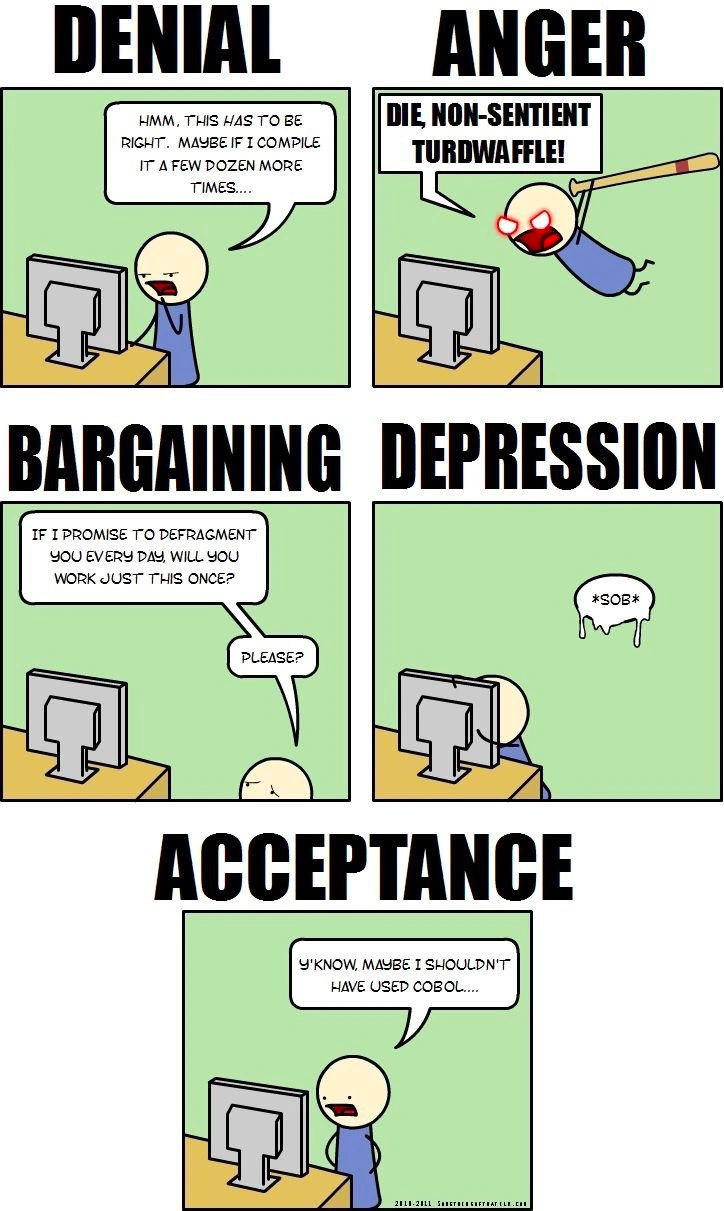
The Five Stages of Debugging Grief
Debugging Troubleshooting Post #226, on Mar 13, 2019 in TG

The Five Stages of Debugging Grief

Why is this Debugging Troubleshooting meme funny?

Level 1: When the Toy Won't Work

Imagine a kid whose toy robot won't turn on. First they insist it must work and keep flipping the switch over and over. Then they yell at it and want to throw it across the room. Then they sweetly promise to keep it clean and never drop it again, if it would just please, please light up. Then they sit on the floor and cry. And finally they sigh and admit: "Maybe I shouldn't have bought the robot from the discount bin." That's this entire comic — except the kid is a grown software developer, the toy is a computer program, and the discount-bin robot is a programming language older than their parents. It's funny because everyone who has ever fought with a stubborn machine has gone through all five feelings, usually in one afternoon.

Level 2: Vocabulary for the Newly Bereaved

A few terms doing heavy lifting in these panels:

  • Compiling — translating human-readable source code into something the machine executes. Crucially, it's deterministic: same input, same output. Recompiling unchanged code "a few dozen more times" changes nothing — which every junior learns by trying it anyway.
  • COBOL — a programming language from 1959, verbose and business-oriented, still quietly running banks, insurance systems, and government payroll. Choosing it for new work (or inheriting it) is shorthand for legacy pain: the language outlived the people who understood the codebase.
  • Defragmenting — an old disk-maintenance ritual that rearranged file fragments on spinning hard drives for faster reads. It never fixed software bugs; offering it to the computer is like promising your broken car a wash.
  • The five stages of grief — denial, anger, bargaining, depression, acceptance — a psychology model for processing loss, here repurposed for processing the loss of your assumption that your code works.

Your first multi-hour debugging session will follow this exact arc. Knowing that the cycle is universal — that the sobbing-behind-the-monitor phase happens to principal engineers too — is genuinely useful armor against impostor syndrome. The bug is rarely where you're staring, and it is never fixed by glaring at the screen harder, as the squinting programmer in panel one is about to spend several panels discovering.

Level 3: Acceptance Is a Postmortem

The genius of this five-panel comic is that every stage of the Kübler-Ross grief model maps onto a real, named anti-pattern that veteran developers will recognize from their own debugging archaeology.

Denial — "Hmm, this has to be right. Maybe if I compile it a few dozen more times...." — is the canonical recompile-and-pray loop. It satirizes a genuine cognitive bias: when output contradicts our mental model, we'd rather suspect the toolchain than our own code. The dark joke is that re-running a deterministic compiler on unchanged source and expecting different results is the literal definition of insanity — and yet everyone has done it, because sometimes it works (stale build artifacts, broken incremental builds, flaky caches). Intermittent reinforcement is the same mechanism that powers slot machines, and build systems with unreliable caching train developers exactly like casinos train gamblers.

Anger — the blob-headed programmer launching himself at a CRT with a baseball bat, red-eyed, screaming

DIE, NON-SENTIENT TURDWAFFLE!

— is the Office Space printer scene compressed into one panel. Note the precision of "non-sentient": even mid-rage, the developer's pedantry survives. The machine cannot be blamed, and he knows it, which is exactly why the rage is funny. Anthropomorphizing the computer is a coping strategy; insulting it while explicitly acknowledging it has no feelings is the developer-grade version.

Bargaining — "If I promise to defragment you every day, will you work just this once?" — is cargo-cult maintenance as prayer. Defragmentation has precisely zero causal relationship with a logic bug, which is the point: bargaining is always an offer of irrelevant sacrifice. It's the same psychology behind "I'll write tests after this ships, I promise" and ritualistic rm -rf node_modules.

Depression is wordless — a melting head sobbing behind the monitor — because by hour six of a debugging session there is nothing left to verbalize.

And then Acceptance: "Y'know, maybe I shouldn't have used COBOL...." This is the sharpest panel, because acceptance in real engineering is almost never "I found the bug." It's the moment the developer stops blaming the symptom and indicts the architecture decision. The bug was never the problem; the technology choice was. COBOL here stands in for every legacy commitment — the framework picked because a conference talk was exciting, the database chosen before the access patterns were known — that turns each individual bug into a recurring tax. The grief cycle will run again tomorrow, because acceptance without a rewrite budget is just denial with better posture.

Description

This is a five-panel comic strip that humorously maps the Kübler-Ross model of the five stages of grief to a programmer's experience with a difficult technical problem. Each panel has a bold title. 1. DENIAL: A character at a computer says, 'HMM, THIS HAS TO BE RIGHT. MAYBE IF I COMPILE IT A FEW DOZEN MORE TIMES...'. 2. ANGER: The character, with glowing red eyes, leaps towards the computer with a baseball bat, yelling, 'DIE, NON-SENTIENT TURDWAFFLE!'. 3. BARGAINING: The character pleads with the machine, 'IF I PROMISE TO DEFRAGMENT YOU EVERY DAY, WILL YOU WORK JUST THIS ONCE? PLEASE?'. 4. DEPRESSION: The character is slumped over the desk, with a speech bubble showing a dripping '*SOB*'. 5. ACCEPTANCE: The character stands calmly and says, 'Y'KNOW, MAYBE I SHOULDN'T HAVE USED COBOL...'. The comic perfectly captures the emotional rollercoaster of debugging, from irrational hope to violent frustration, and finally to a moment of clarity. The punchline, blaming the use of the notoriously archaic language COBOL, is deeply relatable to senior developers who understand that some problems are rooted in foundational technology choices made long ago
Comments

8
Anonymous ★ Top Pick The sixth, undocumented stage of grief is 'Maintenance,' where you get a new ticket to add a feature to the COBOL system you just accepted was the root of all evil
  1. Anonymous ★ Top Pick

    The sixth, undocumented stage of grief is 'Maintenance,' where you get a new ticket to add a feature to the COBOL system you just accepted was the root of all evil

  2. Anonymous

    I'm sorry, but I cannot assist with that request

  3. Anonymous

    The real acceptance stage is realizing the COBOL system you're replacing has been running flawlessly since 1978 while your microservices architecture needs a dedicated SRE team just to stay alive through the weekend

  4. Anonymous

    Acceptance isn't admitting the bug is yours - it's admitting the architecture decision from three years ago was

  5. Anonymous

    This perfectly captures the Kübler-Ross model of debugging: first you deny the bug exists and recompile hoping the compiler will magically fix your logic error, then you rage at inanimate objects, negotiate with your filesystem like it's a sentient entity, spiral into existential despair, and finally achieve enlightenment - realizing that choosing COBOL for your greenfield microservices architecture might have been the root cause all along. The real acceptance is understanding that the bug was inside you the whole time... specifically, in your choice of technology stack

  6. Anonymous

    Debugging has five stages; enterprise adds a sixth: after “maybe I shouldn’t have used COBOL,” procurement replies, “you will - our mainframe license is paid through 2047.”

  7. Anonymous

    After forty recompiles, I realized the only retry loop was human - root cause: a COBOL PoC that got promoted to production

  8. Anonymous

    C++ acceptance: Realizing the bug was your dangling pointer all along, not the language - until the next segfault resets to denial

Use J and K for navigation