Some Devs Just Want to Watch the Build Burn
Why is this BuildSystems CICD meme funny?
Level 1: The House Was Already on Fire
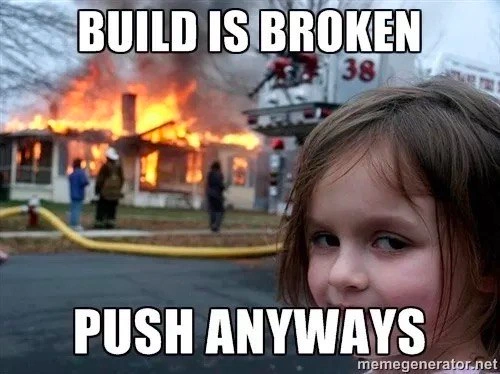
A little girl stands in front of a burning house, smiling like she has a secret. The joke is someone making a mess in a place that's already messy and using that as an excuse: "The kitchen was already dirty, so I didn't bother using a plate either." The house is the team's shared project, the fire is an existing problem, and "push anyways" is dumping your own pile onto the flames because, hey, who's going to notice? It's funny because everyone — kids and grown-up programmers alike — has used "it was already broken!" as a get-out-of-trouble card, and that smirk is exactly the face we make doing it.
Level 2: What's Actually Burning
- The build — the automated process that compiles your team's code and runs its tests, usually via CI (continuous integration) servers like Jenkins or GitHub Actions. "Broken" means the latest code on the shared branch fails to compile or fails tests — the dashboard turns red.
- Push —
git pushuploads your local commits to the shared repository. Once pushed to the main branch, your code is everyone's problem: teammates pull it, the pipeline builds it, deploys may ship it. - Why pushing onto a broken build is bad: your new changes get tested on top of already-failing code. Nobody can tell whether the red light is the old failure or yours. Every extra commit makes untangling it slower.
Early in your career you will face this exact moment: it's 5:55 PM, the build is already red because of someone else, and your branch is ready. The tempting thought — it can't get more broken — is the smirk in this image. The professional move is the boring one: hold the push, or better, help fix the build first. Teams notice who pours water and who pours gasoline.
Level 3: Tragedy of the Red Pipeline
The pairing here is surgically precise: Disaster Girl — the smirking child in the foreground, house fully ablaze behind her, fire truck 38 and firefighters already on scene — is the internet's patron saint of unrepentant culpability. She didn't just witness the fire; her smirk says she's at peace with it. Caption that with
BUILD IS BROKEN PUSH ANYWAYS
and you get a perfect portrait of one of CI culture's most corrosive rationalizations.
The logic being satirized is real and runs on game theory. A green build is a shared resource: everyone benefits from master being deployable, but keeping it green costs each individual developer time (run the tests locally, wait for the pipeline, fix your breakage before merging). The moment the pipeline goes red, the incentive structure inverts. A second failing commit is invisible — CI can't get redder than red. So the rational-but-toxic move is to shovel your changes in while the signal is already dead, exactly like the girl shrugging because the house is, after all, already on fire. This is the broken windows theory applied to build status, and it's why mature teams treat a red main branch as a stop-the-line event: the cost of a broken build isn't the first failure, it's the stack of failures that pile on top of it.
The compounding damage lands on whoever finally tries to fix it. With one bad commit, git bisect and the CI history point straight at the culprit. With five interleaved bad commits, failures mask each other — fix commit A's test failure and you uncover commit C's compile error — and "who broke master" becomes archaeologically unanswerable. That's blame diffusion in action: each pusher reasonably claims the build was already broken when they got there, exactly like the firefighters in the background hosing down a fire nobody admits to starting.
The fixes the industry invented — merge queues, pre-merge required checks, branch protection that physically refuses the push — are all confessions that this meme describes default human behavior. We didn't solve the smirk; we built fences around the house.
Description
This meme uses the iconic 'Disaster Girl' format, which shows a young girl with a subtle, mischievous smirk looking towards the camera while a house burns in the background. The scene is chaotic, with firefighters and a fire truck visible, but the girl's expression suggests she might be the cause of the disaster. The top text, in a white Impact font, reads 'BUILD IS BROKEN'. The bottom text completes the scenario with 'PUSH ANYWAYS'. The humor comes from applying this 'let it burn' attitude to a critical software development process. A broken build in a CI/CD pipeline is a major issue that stops all development, and pushing code to it is a cardinal sin. The meme perfectly captures the nihilistic or reckless impulse of a developer who, for whatever reason, decides to ignore best practices and merge their code despite the consequences, making everyone else's job harder
Comments
8Comment deleted
That's not a broken build; that's a surprise disaster recovery drill for the SRE team. You're welcome
Optimization strategy: wait until the CI is already blazing red, then land your risky refactor - zero marginal regression, 100 % shared blame
The same developer who adds --no-verify to their git hooks is now architecting your distributed transaction system
A broken build is the developer's tragedy of the commons - once it's red, everyone's commits are someone else's bisect
The modern interpretation of 'move fast and break things' - except here we're breaking things first, then moving fast to the next standup before anyone notices who force-pushed to main at 4:47 PM on a Friday. Bonus points if you disabled the pre-commit hooks and branch protection rules to make it happen faster
Build's on fire; push anyway - proof that in our CI, availability beats consistency whenever an admin needs to merge
Builds are for mortals; seniors know --no-verify turns red pipelines into philosophical suggestions
If a force push still lands while CI is red, you don’t have a pipeline - you have an anecdote generator for the next postmortem