Missing a single SQL character and your career evaporates instantly
Why is this Databases meme funny?
Level 1: One Little Mistake
Imagine you’re writing a sentence and you forget a tiny comma or letter, and it completely changes the meaning. For example, there’s a famous joke: writing “Let’s eat Grandma” instead of “Let’s eat, Grandma.” That little comma is just one character, but without it the sentence goes from inviting your grandma to dinner to… talking about eating Grandma! 😨 In the same way, when programmers write instructions for computers, leaving out one small symbol can turn a harmless task into a big mess. This meme is joking that a programmer who forgets just one little character in an SQL database command might cause the computer to do something really bad — like erasing important information it wasn’t supposed to. It’s using a funny rap battle picture where someone says “I’m about to end this man’s whole career!” to exaggerate how that tiny mistake feels. In simple terms, it’s saying: in coding, even one little mistake can have huge consequences, so be careful! It’s funny and scary at the same time, because it’s a tiny error that makes everything go wrong, kind of like pressing the wrong button and accidentally deleting your favorite game instead of just one save file.
Level 2: Semicolon Slip-Up
Let’s break down what’s happening here. SQL (Structured Query Language) is the language used to manage and query databases – essentially large structured tables of information (imagine a giant Excel sheet full of important data). In SQL and many programming languages, seemingly minor details like punctuation really matter. A syntax error (caused by a missing or wrong character) can completely change what a command does, or whether it runs at all. The meme highlights a scenario where a developer "misses one character" in an SQL command, and that tiny mistake turns a safe operation into a disaster.
Consider an example of an SQL command that deletes a user’s account:
-- Correct command: only deletes user with id 42
DELETE FROM users WHERE id = 42;
-- Oops! Missing the WHERE clause means delete *every* user
DELETE FROM users;
In the first command, WHERE id = 42 is a condition that makes sure only the one user with id 42 is deleted. In the second command, that condition is missing – so the database interprets it as “delete all rows from the users table.” 😱 That’s not just a bug, that’s a catastrophe! With one oversight (omitting the WHERE), the developer has inadvertently wiped out the entire users table. This is the kind of career_ending_mistake the meme is joking about. In a real-world scenario, deleting all user data in the production database would be a fire-alarm event. The team would have to scramble to restore from backups (you do have backups, right?) and pray no permanent data loss occurred. It’s every developer’s nightmare in Debugging_Troubleshooting: you’re not just chasing a pesky bug, you’re doing disaster recovery.
Another common slip-up is forgetting a semicolon (;) or a quote in a long SQL script. In many SQL systems, a semicolon is used to mark the end of a statement. If you forget it, the database might think you’re still writing the same command and concatenate the next line, leading to a completely different command than intended. For instance, a missing quote can cause part of your query to be seen as data or code incorrectly. This is how sql_syntax_errors can lead to unintended commands. A notorious example is SQL injection: if a programmer doesn’t handle quotes properly, a malicious user can input something like '); DROP TABLE users;-- as their name, and the program might actually run the DROP TABLE users part. That’s essentially a trick that exploits a missing character or bad validation, causing the database to execute a destructive command. The meme’s exaggerated phrasing “your career evaporates instantly” refers to how such mistakes can be so bad that you might jokingly fear getting fired on the spot.
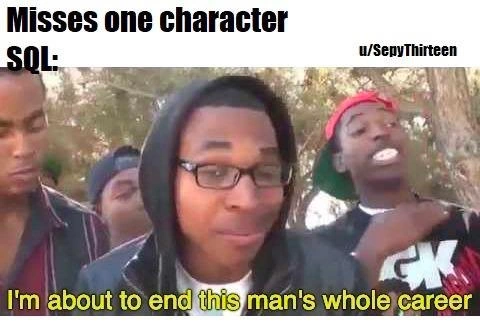
The image used in the meme is from a popular Supah Hot Fire parody video (a mock rap battle). In that video, one rapper delivers a comically over-the-top “burn” (insult), and his crew erupts as if it’s the greatest hit ever, yelling “I’m about to end this man’s whole career!”. The meme repurposes that pop-culture reference to dramatize a tiny coding mistake. Here, SQL is personified as the rapper about to “drop” a devastating line. And indeed, if you run a destructive query by accident, the database drops the data (and might as well drop the mic). The humor comes from mixing this goofy rap battle imagery with the very real panic of a developer who realises they messed up a database command. It’s a form of relatable pain in coding humor: if you’ve ever written code or database queries, you know how a small typo or missing character can cause huge problems. Once you understand these references, the meme’s message is clear: be very careful when writing SQL, because even a tiny slip can lead to a monumental “oops” moment.
Level 3: DROP TABLE career;
One missing character in an SQL command can escalate a routine day into a legendary disaster. Seasoned developers swap war stories about the times a stray semicolon or absent quote ended up executing something catastrophic. Imagine running a database script at 3 AM to hotfix production data: you’re bleary-eyed, you miss a tiny ; or forget a WHERE clause, and boom – the database does exactly what you inadvertently told it to. Suddenly you’ve executed DELETE FROM users; instead of DELETE FROM users WHERE id=42;. The production database doesn’t care that you omitted a single character or a few letters; it obediently follows orders and wipes out far more than intended. In that instant, the database essentially says, “I’m about to end this man’s whole career.” The meme nails this dark humor by casting SQL as the ultimate savage in a rap battle, ready to drop the mic and drop your tables.
This joke hits hard because it’s painfully relatable: the difference between a harmless tweak and a career-ending mistake can be one character out of place. For example, an absent quote in a string might accidentally terminate a command early and inject a new command – the classic Little Bobby Tables scenario from XKCD, where the input Robert'); DROP TABLE Students;-- turns a school database into dust. Here a missing escape character turns a student’s name into a destructive SQL command. It’s both terrifying and absurd that a single quote or semicolon can unleash such havoc. This is why senior engineers double-, triple-check any ad-hoc SQL, especially on production. They’ve learned (often the hard way) that an off-by-one-character error in a database script can have consequences far worse than a typical bug – we’re talking permanent data destruction and an all-hands-on-deck recovery nightmare.
The industry has plenty of guardrails because of these horror stories. Seasoned DBAs insist on transactions (BEGIN; ... COMMIT;) around manual fixes, so if you catch an error you can roll it back before it does damage. Others enable safety switches (like MySQL’s safe-updates mode) to prevent UPDATE or DELETE without a WHERE clause. But in the heat of a production incident, under pressure, it’s easy to skip best practices. That’s why this meme’s humor has an edge of truth-induced anxiety. It satirizes that gut-dropping moment when you hit Enter and realize you missed a character – and you just metaphorically nuked the database. The debugging_troubleshooting phase after such a bug isn’t the usual find-and-fix; it’s frantically digging for backups, hoping your debugging skills can resurrect lost data, and crafting a very uncomfortable apology to the team. It’s a bug you can’t quietly push under the rug – everyone from the CTO to the customers will know something went very, very wrong.
In true cynical fashion, experienced devs joke about updating their résumés or LinkedIn profiles as the database locks them out (either by data loss or by IT revoking access). It’s dark developer humor – laughing so we don’t cry. The meme’s use of the Supah Hot Fire reaction (the guys hollering in shock as one performer declares a career-ending rhyme) perfectly frames how it feels to make this mistake. SQL is the hype man here, delivering that final blow: one mistyped character and your database drops you. It’s the software equivalent of a fatality in Mortal Kombat – flawless victory for the bug. Remember, in coding as in comedy, timing and detail are everything. Missing a ; in a joke might just confuse the audience, but missing a ; in SQL? That can drop the curtain on your whole show.
Description
The meme uses the well-known “Supah Hot Fire” reaction frame: a group of young men standing outdoors, their faces blurred, with one person dramatically gesturing while the subtitle in big yellow text states, “I'm about to end this man's whole career.” Above the image on a plain white background, bold black text reads “Misses one character” and just below that, also in black, is “SQL:”. The humor plays on database fragility - omitting a lone semicolon, quote, or bracket can turn a harmless query into a destructive command. Senior engineers will recognize the existential dread of running ad-hoc SQL in production where a minor typo can drop tables, corrupt data, or trigger a runaway update, effectively “ending a career.” The meme combines pop-culture imagery with developer anxiety around tiny syntax errors in critical database operations
Comments
7Comment deleted
Pro tip: wrap every ad-hoc prod query in BEGIN TRANSACTION; - not because you’ll remember the COMMIT, but because nothing screams “senior engineer” like having a career rollback button
After 20 years, I've learned SQL error messages are just the database's way of saying "you know what you did wrong, figure it out yourself" while pointing vaguely at line 1
SQL doesn't have error recovery, it has error retribution - one missing quote and suddenly you're reading 'syntax error near line 1' for a bug on line 400
The difference between 'DELETE FROM users WHERE id = 1;' and 'DELETE FROM users;' is one WHERE clause and approximately 47 million rows, three regulatory violations, one resume update, and a very awkward conversation with your CTO about why the entire customer database just vanished at 3 PM on a Friday
Amazing how one absent WHERE turns UPDATE into resume-driven development - autocommit ensures your RPO becomes 'hope' and your RTO becomes 'now'
Prod SQL: misplace a single quote and your RPO becomes hope while your RTO becomes LinkedIn
SQL: where one missing semicolon doesn't just break your query - it DROP TABLEs your career