Python Learner Gets Boa Type Feedback
Why is this Languages meme funny?
Level 1: The Wrong Snake
It is like seeing someone eating an apple beside a computer and announcing that it must be a joke about Apple computers—only for the fruit to say, “I am a pear.” The word trick would have worked if the object were what you assumed, but it is not. Here, everyone expects the long animal near a Python lesson to be a python, and the boa is embarrassed that nobody bothered to ask her.
Level 2: Snakes, Names, Values
Python is a general-purpose programming language known for readable syntax and a large ecosystem. A person learning it might start with a tiny program such as:
name = "Boa"
print(f"Hello, {name}!")
An interpreter executes the Python instructions. Syntax is the grammar that makes those instructions valid, while a type describes what kind of value something is and which operations make sense. In the example, name refers to a string, so Python can insert it into text.
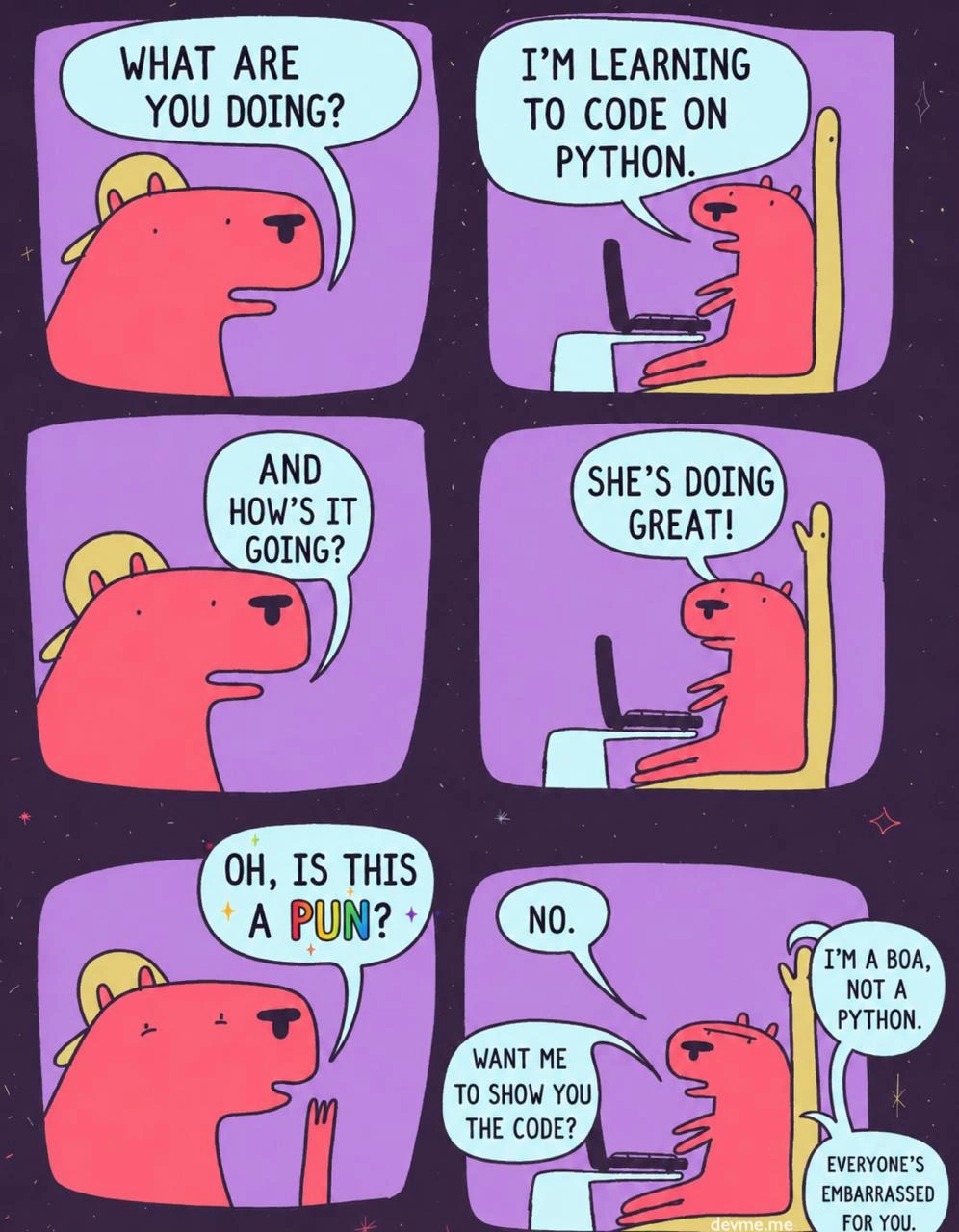
The comic uses literal interpretation instead. The word “Python” normally means the language in a coding conversation, but the visible snake makes the animal meaning available. This is wordplay based on a homonym-like shared name: one written and spoken label points to unrelated concepts. The friend thinks the learner arranged the scene deliberately, which is why the speech bubble emphasizes PUN.
The last panel says that assumption is wrong. A boa is not a python, even though both are snakes and may look similar to someone who is not identifying species carefully. The programming equivalent is confusing two values because they share a broader category:
| Broad category | Specific thing A | Specific thing B |
|---|---|---|
| Animal | Boa | Python |
| Sequence | List | Tuple |
| Number | Integer | Floating-point value |
| File-like object | Open file | In-memory text buffer |
Related objects can behave similarly without being interchangeable in every context. A list and tuple both hold ordered items, for example, but a list can be modified while a tuple normally cannot. Accurate names help programmers know which guarantees they can rely on.
For someone on a learning-to-code journey, the friendly lesson is that errors are often category mistakes rather than failures to understand everything. A variable contains a different type than expected; a function returns a value in a different shape; an instruction uses an ambiguous term. Checking actual values and reading the error closely is more reliable than reasoning from appearances. When even the boa supplies clear type feedback, the debugger has no excuse.
The panels also make beginner awkwardness affectionate rather than cruel. The learner is genuinely coding, the friend tries to join the conversation, and the snake has the sharpest review comment. Nobody's program is shown failing. The only rejected artifact is an overconfident pun.
Level 3: Pun Fails Type Check
The comic constructs a programming pun, explicitly asks whether it is a pun, denies that it is a pun, and then lets the supposed punchline reject the premise:
I’M LEARNING TO CODE ON PYTHON.
SHE’S DOING GREAT!
The standing character notices the language/animal ambiguity and asks, OH, IS THIS A PUN?—with PUN highlighted in orange so nobody can pretend the setup is subtle. The learner says no and offers to show the code. Only then does the long yellow snake speak:
I’M A BOA, NOT A PYTHON. EVERYONE’S EMBARRASSED FOR YOU.
This is not merely a Python joke; it is a type error wearing a zoology hat. “Python” can name a programming language or a kind of snake. The scene appears to instantiate the second meaning, but the visible animal identifies herself as a boa. The joke therefore fails because the runtime object does not match the type assumed by the observer. The boa performs stricter validation than many production API clients.
In object-oriented terms, both animals could inherit from a general Snake class while remaining different sibling types:
class Snake:
pass
class PythonSnake(Snake):
pass
class Boa(Snake):
pass
snake = Boa()
isinstance(snake, Snake) # True
isinstance(snake, PythonSnake) # False
Being a valid Snake does not make an object an instance of every snake subtype. That is nominal typing: identity follows declared class relationships rather than a vague resemblance. The standing character essentially sees a long, limbless interface and performs an unsafe cast to PythonSnake. The object responds with a custom exception whose message is social rather than technical.
Python the language makes that analogy especially satisfying because it is dynamically typed. Values carry types at runtime, and a variable can refer to values of different types over its life. Python also encourages duck typing, where code often cares about supported behavior more than an object's exact class: if an object provides the operations a function needs, it may be usable regardless of its family tree. A generic snake-display function might happily accept the boa. A function that specifically requires python biology—or a joke whose entire invariant is species == python—cannot be so relaxed.
There is another historical twist: the programming language was named for Monty Python, the comedy group, rather than for the reptile. Snake imagery became a convenient visual identity afterward. So even a correctly identified python would be a secondary word association, not the origin of the technology's name. The comic builds a pun on an association, assigns the wrong species, and then has the prop file the bug report itself. That is admirable defense in depth.
The preposition on helps create the ambiguity. Developers usually say they write code in Python or build something using Python. “Code on Python” can sound like a beginner's harmless language quirk, but it also suggests coding physically on top of an animal or working with Python as a platform. The black laptop, tall yellow chair, and snake rising directly behind the learner turn that grammatical looseness into a visual setup.
Pronouns deepen it further. When asked how the learning is going, the learner replies, SHE’S DOING GREAT! rather than “it” or “I am.” That line reassigns agency to the snake: perhaps she is the one learning, perhaps she is the platform, or perhaps the learner has already lost control of the metaphor. The later offer—WANT ME TO SHOW YOU THE CODE?—returns attention to actual software just before the boa insists that taxonomy, not source code, is the failing test.
This is recognizable developer-community humor because programming constantly overloads ordinary words. Developers discuss cookies that are not food, shells that contain no mollusks, forks without cutlery, and threads that cannot sew. Shared jargon makes communication efficient inside the group and ridiculous outside it. The comic reverses the usual pattern: the nontechnical-looking snake is the one who demands precise naming, while the aspiring coder commits the category error.
The learner's flat NO. also protects the scene from being only a groan-worthy pun. If the learner knowingly staged a python beside a Python lesson, the joke would end when the friend noticed it. Denying the pun creates a mystery; the boa's correction resolves it by showing that the friend, not the learner, forced the wordplay onto the scene. Everyone is embarrassed because the observer confidently explained a joke that was never type-correct.
Description
A six-panel cartoon on a purple, star-speckled background features two pink-red animal characters, one seated with a black laptop on a tall yellow chair while a long yellow snake rises behind it. The first exchange reads, "What are you doing?" / "I'm learning to code on Python," followed by "And how's it going?" / "She's doing great!" The standing character asks, "Oh, is this a PUN?" with "PUN" highlighted in orange, but the learner replies, "No. Want me to show you the code?" In the final panel the snake interjects, "I'm a boa, not a python. Everyone's embarrassed for you," combining Python-language ambiguity, literal animal taxonomy, and a deliberately rejected programming pun; a small `devme.me` watermark sits at the bottom.
Comments
1Comment deleted
`isinstance(boa, Python)` is false, and now so is the friendship.