Skip to content
DevMeme
606 of 7435
The Definition of Insanity vs. The Reality of Debugging
Debugging Troubleshooting Post #693, on Sep 20, 2019 in TG

The Definition of Insanity vs. The Reality of Debugging

Why is this Debugging Troubleshooting meme funny?

Level 1: One More Try

Imagine you have a toy car that isn’t working. You press the ON button and nothing happens. A reasonable person might think, “It didn’t work. Doing it again won’t magically make it work.” But what do we often do? We press the button again... and again. Maybe we’re hoping that if we just try one more time, the car will zoom off like it’s supposed to. It sounds a bit silly, right? Usually, if nothing changed, the toy should behave the same each time. But maybe, just maybe, the battery was loose and on the fifth press it jiggles into place and the car starts! That little hopeful (or desperate) voice in our heads says, “Maybe this time it’ll be different.”

That’s exactly what this meme is joking about, but with computer code. The top part basically says “Hey, you shouldn’t expect different outcomes if you repeat the same action.” The bottom part replies, “Well, let me show you debugging!” — which is when programmers run their broken code over and over hoping to see a different (correct) result. It’s funny because it’s a bit like believing in magic: logically, nothing changed, yet we keep trying as if the next attempt might fix everything. We laugh because we’ve all done it. It’s that mix of frustration and hope. Just like pressing that toy’s button multiple times, a programmer will rerun a program thinking, “One more try… maybe now it’ll work!” The meme makes us smile because it’s a truth we all recognize: sometimes, even when we know it’s crazy, we just can’t help but try again, fingers crossed for a miracle.

Level 2: Welcome to Debugging

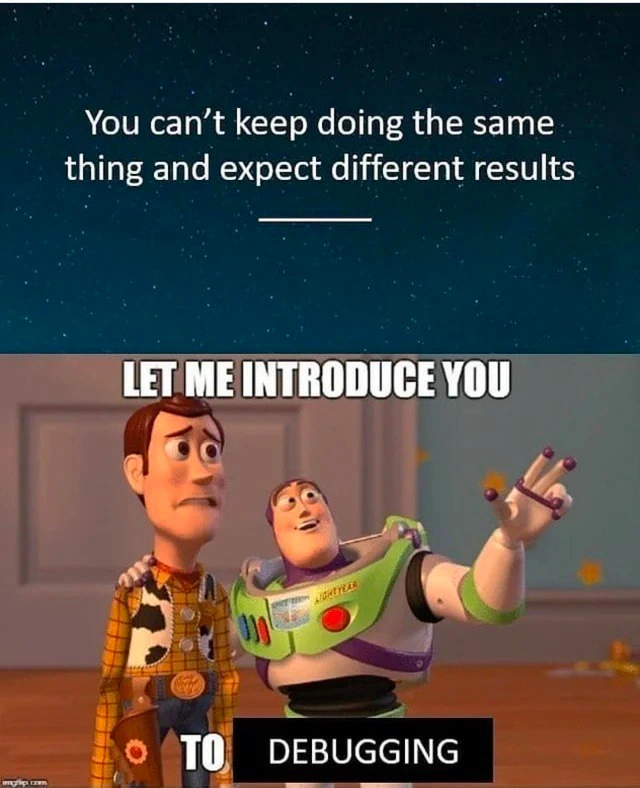
Let’s break this down in simpler terms. Debugging is the process of finding and fixing errors (bugs) in code. It’s a huge part of a programmer’s life. Now, there’s a famous saying: “Doing the same thing over and over and expecting different results is insanity.” Normally, that means if something doesn’t work, you should try a different approach, not just repeat yourself. The meme’s top panel shows that quote against a starry background (a serious, wise vibe), with an empty line as if to say “— who said this?”. Typically, people joke that Albert Einstein said this as a definition of insanity (even if that’s not historically confirmed). So the top text sets up the idea that repeating an action won’t change the outcome.

Enter the bottom panel: characters from Toy Story. On the left is Woody (the cowboy doll) looking a bit confused or skeptical. On the right is Buzz Lightyear (the space ranger toy) gesturing broadly as if presenting something amazing. The large caption on that image says, “LET ME INTRODUCE YOU TO DEBUGGING.” This is essentially Buzz replying to the top quote: “You think doing the same thing expecting a different result is crazy? Well, let me show you something called debugging!” Woody’s face embodies the newbie or common-sense person who just said the first line, and Buzz is the experienced developer responding. It’s a classic two-panel meme format where the bottom panel delivers a punchline that twists the top panel’s statement. Using Buzz and Woody is a popular toy_story_meme_format – these characters often appear in memes (you might recall the "X, X everywhere" meme with the same duo). Here, Buzz is proudly introducing the concept of debugging as if it’s an epic discovery.

Now, why is this funny and relatable in a coding context? Because debugging a program often weirdly involves doing exactly what that quote says not to do! Imagine you run your code and it crashes or shows a wrong output. You know nothing changed in the code, but you run it again anyway. Sounds silly, right? But developers do this all the time. Maybe the bug is intermittent, meaning sometimes it happens and sometimes it doesn’t. For example, if your program contacts a server on the internet, maybe it failed the first time due to a network hiccup. Running it again, it might succeed if the hiccup is gone. Or let’s say you wrote a test for your code and it failed – sometimes tests fail because of random reasons (like timing issues or a full moon 🌕... just kidding on that last one). These are often called flaky tests or Heisenbugs (a fun term where a bug seems to change or disappear when you try to observe it). So a developer, especially a new one, might be baffled: “It failed, but I didn’t change anything. Why would running it again help?” And the experienced dev chuckles because sometimes, in programming, you do get a different result the second or third time due to those unpredictable factors.

The meme nails a common DebuggingFrustration: that desperate, repetitive trial-and-error cycle. It’s basically saying: Sure, in general life doing the same thing over and over expecting change is foolish — but in coding, welcome to debugging! We’ve all been there, re-running our code or test suite hoping that maybe this run will be different. It’s both funny and a little painful because it’s true. That’s why the meme is tagged as RelatableDeveloperExperience and DeveloperHumor. Even if you’re relatively new to coding, you quickly encounter this. Perhaps you wrote a program that kept crashing, and you just kept hitting the “Run” button again and again after minor tweaks or sometimes with no changes at all, thinking “Come on, work… please!” This meme is basically Buzz Lightyear saying to you: “Ah, I see you’re doing that crazy thing. Let me welcome you to the world of debugging, my friend.” Woody’s skeptical look is like the part of your brain that knows it’s absurd, but Buzz’s enthusiasm is the part of you that still hopefully hits “run” again. In short, the meme humorously personifies the internal dialogue of a programmer during a debug session, using a beloved Pixar duo to deliver the punchline. It’s a friendly reminder that what seems like insanity to the rest of the world is often just another day in a programmer’s life.

Level 3: The Heisenbug Uncertainty

In the realm of debugging, the meme hilariously spotlights what could be called the definition of insanity as a service. The top panel quotes the famous adage, "You can’t keep doing the same thing and expect different results", often attributed (perhaps wrongly) to Einstein. It’s sage advice in life—but DeveloperHumor gleefully subverts it. The bottom panel (with Woody and Buzz from Toy Story) retorts: “Let me introduce you to debugging.” Why is this so on point? Because any seasoned programmer knows that debugging a gnarly bug often does involve running the same code over and over, praying for a different outcome.

Ironically, in software, doing the same thing twice can indeed yield different results. This isn’t magic or madness; it’s the nature of complex systems and elusive Heisenbug phenomena. A Heisenbug (named after the Heisenberg Uncertainty Principle) is a bug that seems to vanish or change behavior when you try to study it. It’s the kind of bug where inserting a printf or running a debugger makes the problem disappear or shift. Seasoned devs have all cursed at such non-deterministic issues, which is why this meme strikes a relatable nerve. The humor comes from that shared “yup, been there” moment: we all know re-running the same failing program shouldn’t change anything… and yet, when chasing a tricky issue at 3 AM, we’ll do it anyway. Insanity Debugging has its own rules.

Why might re-running identical code ever produce a new result? Experienced engineers can list a litany of causes:

  • Race conditions: In concurrent code, the outcome might depend on unpredictable thread timing. Run it again and the timing changes, so the bug might not manifest.
  • Uninitialized variables or memory: If a program uses a variable before setting it, it might contain whatever junk was in memory. Each run, that memory could hold different data, leading to different behavior.
  • External state & environment: The code’s result might rely on things like network responses, file system state, or caches. For example, the first run might fail due to a network glitch or empty cache, but the next run finds the cache warm or the server responsive.
  • Flaky tests (non-deterministic tests): In build pipelines, sometimes a test fails one moment and passes the next without any code change. Perhaps it depended on the system clock, random numbers, or just had a timing issue. We label these flaky. The knee-jerk reaction? Hit rerun and hope it goes green.

To concretely illustrate a flaky scenario, consider this little pseudo-test:

import random

# Simulate a flaky test that passes or fails at random
if random.random() < 0.5:
    print("✅ Test passed.")
else:
    raise Exception("❌ Test failed!")

Running this test multiple times might produce “Test passed.” on a second try after a first failure. In real life, a developer encountering a failing test like this might genuinely just run it again, half-expecting a different result (especially if they suspect the failure was a fluke). It’s a tongue-in-cheek RelatableDeveloperExperience – we know it’s bad practice to rely on luck, but every developer has desperately rerun a program or test, thinking “Maybe it’ll work this time.”

The meme’s Toy Story format adds extra charm. Buzz Lightyear’s grand gesture (LET ME INTRODUCE YOU) and Woody’s befuddled stare perfectly embody an experienced dev explaining to a newcomer the reality of DebuggingAndTroubleshooting. It’s as if Buzz (the seasoned coder) is proudly presenting the concept of trying the same thing again to Woody (the skeptical junior or the logical voice saying “that’s insane!”). This contrast is pure CodingFrustration comedy: Buzz knows that in the world of debugging, normal logic (and sometimes sanity) doesn’t fully apply. Welcome to the club, where hitting the same button repeatedly is somehow part of the job. The meme resonates because it’s a shared industry in-joke: under the stress of a stubborn bug, even the most rational programmers will exhibit a bit of insanity. After all, as many bitter veterans will tell you with a smirk, “Works on my machine, maybe it’ll work on yours… eventually.”

Description

A two-panel meme contrasting a famous quote with the realities of software development. The top panel displays the text 'You can't keep doing the same thing and expect different results' against a serene, starry night sky. The bottom panel features the 'Buzz Lightyear and Woody Everywhere' meme format from the movie Toy Story. Buzz Lightyear has his arm around a worried-looking Woody, gesturing expansively with the caption 'LET ME INTRODUCE YOU TO DEBUGGING'. The meme humorously points out that debugging, especially for non-deterministic issues like race conditions or Heisenbugs, often involves running the exact same code repeatedly, hoping to trigger the fault and observe a different outcome. This process, which seems to fit the definition of insanity, is a standard and sometimes necessary practice for developers

Comments

7
Anonymous ★ Top Pick The definition of insanity is running the same code and expecting a different result. The definition of a senior engineer is knowing exactly which race condition you're trying to provoke
  1. Anonymous ★ Top Pick

    The definition of insanity is running the same code and expecting a different result. The definition of a senior engineer is knowing exactly which race condition you're trying to provoke

  2. Anonymous

    Rerunning the same failing test 200 times isn’t insanity - it’s Monte Carlo debugging, and I’m just waiting for the P-value to drop below “works on my machine.”

  3. Anonymous

    The real insanity is knowing the bug is a race condition, adding more logs to catch it, then watching it disappear because the logging changed the timing

  4. Anonymous

    Debugging is the art of proving Einstein wrong: we absolutely CAN keep doing the same thing and expect different results - especially after changing that one semicolon, adjusting log levels, restarting the IDE, clearing the cache, rebuilding from scratch, and sacrificing a rubber duck to the compiler gods. Eventually, the Heisenbug will reveal itself... or we'll just ship it to production where it mysteriously works

  5. Anonymous

    Senior debugging often means changing nothing and re-running until the cache TTL lapses, the scheduler picks a new race winner, and the Heisenbug pretends it’s fixed

  6. Anonymous

    Debugging: iteration disguised as insanity, where F5 is your Sisyphean boulder

  7. Anonymous

    Debugging: doing the same thing repeatedly until caches warm, the JIT stabilizes, the race loses, and you can confidently mark it “cannot reproduce.”

Use J and K for navigation