The Paranoia of an Error-Free First Run
Why is this Bugs meme funny?
Level 1: Too Good to Be True
Imagine you have a friend who always plays pranks on you. One day, that friend comes over, smiles nicely, and hands you a big piece of candy with no tricks attached (or so it seems). You're happy to get the candy, but you also feel a bit nervous, thinking "This is way too nice... what's the catch?" It’s that too good to be true feeling. That's exactly how a programmer feels when their code runs without any errors: they're excited for a moment (Yay, it worked!), but also a little suspicious, wondering if something secretly went wrong that they just haven't noticed yet.
Level 2: False Sense of Security
Let's break down the situation in simpler terms. In programming, "no errors" can mean a few different things, and it's important to distinguish them:
| Stage | Outcome | Example |
|---|---|---|
| Compile error | The code won't run at all because of a mistake in the code. The compiler catches it before execution. | Missing a semicolon or a parenthesis, or using a variable that wasn't declared. The program won't even start until you fix it. |
| Runtime error | The code starts running but then crashes or throws an error while running. You'll see an error message or a stack trace. | Dividing by zero in your code, or trying to access an array index that doesn't exist. The program will abruptly stop and complain (e.g. a NullReferenceException or a segmentation fault). |
| Logic bug (no error) | The code runs without crashing, so it seems "fine," but it does the wrong thing. There are no error messages because from the computer's perspective, it "successfully" did what you told it to do — it's just not what you meant to do. | You wanted to add two numbers but accidentally wrote subtraction. The program runs to the end, but your result is incorrect. No obvious errors are shown, even though the output is wrong. |
In our meme scenario, when you "run your program and it doesn't display any errors," it means you got past the first two stages: no compile errors, no runtime errors. That is good! Your code didn't crash. But it still doesn't guarantee everything is perfect. The worry is about that third case: a logic bug that isn't immediately visible.
For example, imagine this simple function:
function add(a, b) {
// This function runs fine, but it's secretly wrong:
return a - b; // Oops! Used subtraction instead of addition.
}
console.log(add(2, 2)); // 0 (no error thrown, but the result is incorrect!)
The code above doesn't produce any error messages. It executes completely. But clearly, 2 + 2 should be 4, and our function mistakenly gave 0. The program had no runtime errors, yet the logic was flawed. This is why developers say "no errors" can give a false sense of security — everything looks okay on the surface, but you might not have noticed a mistake in the results.
Now, about that word Heisenbug you've seen: this is a playful term developers use for a very tricky kind of bug. A Heisenbug is a bug that seems to disappear or change its behavior when you try to study it. The name comes from the physicist Werner Heisenberg (think of the Heisenberg Uncertainty Principle about observing particles). In coding, it’s like when you have a glitch that only shows up under certain conditions, and if you, say, add extra logging or run the program in debug mode, the bug magically stops happening. It's super frustrating because it feels like the act of checking for the bug makes it hide. For instance, you might have a program that occasionally crashes, but when you run it with a debugger or add console.log statements to see what's going on, it runs perfectly. That's a Heisenbug — the ultimate peek-a-boo bug that makes developers very cautious even when a program seems to run fine. They know there could be something lurking that just hasn't shown itself yet.
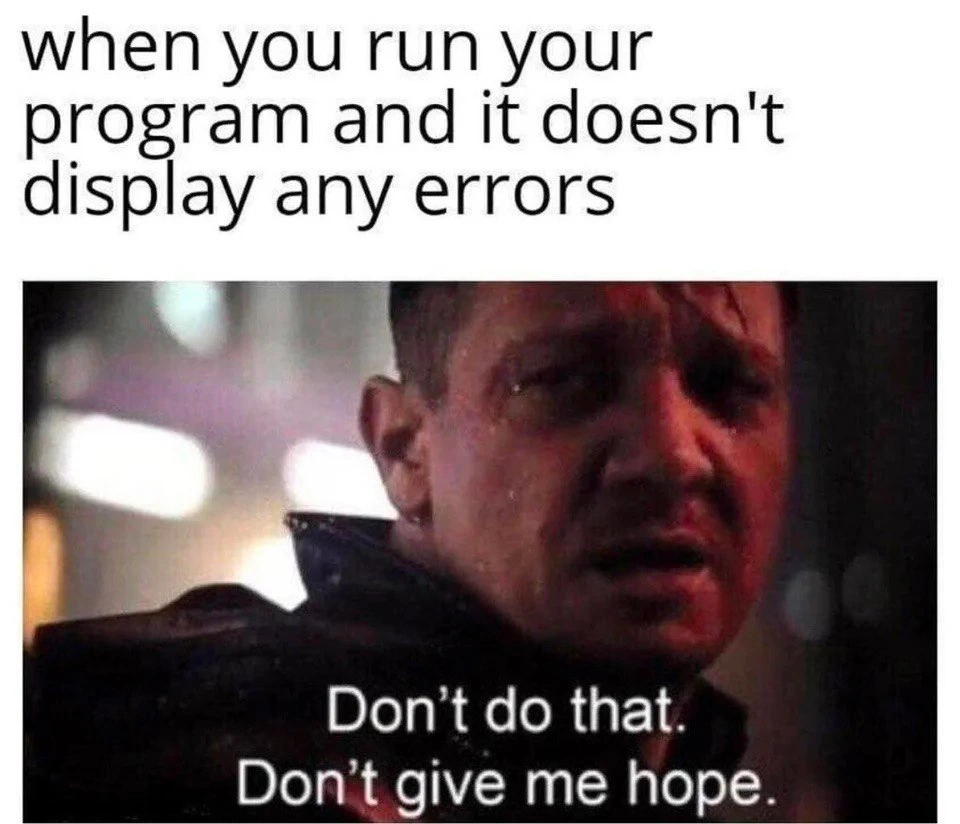
The meme image itself helps explain the emotion. The bottom panel is a scene from Marvel's Avengers: Endgame, with the character Clint Barton (a.k.a. Hawkeye) looking heartbroken and tearful. In that scene, he's told something that gives him hope his family might be saved after he thought he lost them. He says, "Don't do that. Don't give me hope." Why? Because he's been hurt and doesn't want to feel hope just to be disappointed again. In the context of the meme, the developer is Hawkeye and the "no errors" output is like someone telling him "maybe everything's okay with your code now." The developer, having been burned by bugs before, is essentially thinking, "Please, don't give me hope (if it's going to turn out to be false)."
So when your code compiles and runs without errors, you're happy and a little nervous. It's a mix of relief and uh-oh. You feel good because maybe you finally solved the problem, but also cautious because you know from experience that sometimes the worst bugs don't show up until later. It's a cautious optimism. You don't fully trust the success until you've double-checked the program's output or run more tests. The meme is funny to developers because it's so relatable: we've all had that moment of tentative hope when nothing immediately went wrong, combined with the fear that we've simply missed something. It's the classic "too good to be true" feeling in software development.
Level 3: No Stacktrace, No Peace
For any seasoned developer, seeing your program run without throwing a big scary stack trace (the multi-line error dump) is only a half victory. Sure, the code didn't blow up immediately — no NullPointerException, no segfault, nothing caught fire. But that instant relief quickly turns into suspicion. Why? Because experienced devs know that an absence of errors can give a false sense of security. It's like the code is saying, "All good, boss!", but your gut is muttering, "It can't be that easy...".
We've all been there. You run the app, and no errors pop up. Instead of fist-pumping, you squint at the screen and think: Did it even run the part I think it ran? Is my logging broken? There's even a joke among developers: "If it worked on the first try, I probably forgot to compile the latest code." An error-free first run is so rare that it's almost a red flag. This borderline paranoia comes from real trauma: the countless times something seemed to work in dev, only to blow up in production. "Works on my machine" becomes a dark punchline, because we know that just because it works here and now doesn't mean it'll work for every user or every time.
Often, the most insidious bugs don't announce themselves with loud errors. Instead, they lurk in the shadows. Here are a few seasoned-developer nightmares that explain the "Don't give me hope" reaction:
- Silent failures: The program might have actually hit a problem, but you never saw it. Perhaps an exception was caught and intentionally or unintentionally suppressed (
try { ... } catch (Exception e) { /* ignore */ }). No error message, but also no actual success — the bug is just hiding. - Race conditions: In multi-threaded or asynchronous code, a bug might only appear 1 in 100 times. Maybe thread A and thread B didn't collide this run, so everything looks fine. Next run under heavy load, you might get a bizarre crash or corrupted data. This run's "no error" was pure luck.
- Memory leaks & performance time-bombs: Your program might be slowly leaking memory or building up an issue that isn't evident in a short test. It could run fine for 5 minutes and then grind to a halt after 5 hours. No immediate error yet, but give it a few hours... boom.
- Logical bugs: Everything ran, and you even got output. But is the output correct? A program can produce the wrong result with complete composure. For example, if a calculation or algorithm is flawed, you'll get a quietly incorrect answer with no error message to warn you. Without tests or manual checking, you'd never know.
In other words, "didn't crash" is a pretty low bar for software quality. No wonder that instead of celebrating, developers often feel compile-success anxiety — that weird mix of hope and worry when a program finally runs without errors. The meme captures this beautifully. The top caption sets the stage: "when you run your program and it doesn't display any errors". The image below, showing Hawkeye (Clint Barton) tearfully saying "Don't do that. Don't give me hope.", is the developer's plea to the universe: Please don't trick me into thinking everything is fine. It's both humorous and painfully true. An error-free run does give us a glimmer of hope, but we're almost afraid to embrace it. We've been hurt before. In the world of debugging and Developer Experience, this kind of cautious optimism is standard. We hope it's truly fixed, but we're always ready for the other shoe to drop.
Level 4: Heisenbug Uncertainty Principle
In theoretical computer science, there's a humbling truth: the absence of errors in one run never proves your program is correct. Even an error-free execution is far from a mathematical guarantee of bug-free code. We can thank fundamental results in CS like the Halting Problem for reminding us that fully verifying arbitrary program behavior is impossible in the general case. If you could automatically detect every bug or confirm perfect correctness, you'd be solving unsolvable problems (this touches on Rice's Theorem, which basically says any non-trivial property of a program's output is undecidable). In short, it's not paranoid to suspect a bug still lurks — it's theoretically justified.
"Program testing can be used to show the presence of bugs, but never to show their absence."
— Edsger W. Dijkstra
Veteran developers internalize this quote as gospel. We write tests, use static analysis, and rely on type systems to catch mistakes, but we know these tools have limits. A program that compiles without errors has merely passed the syntax and type checks; it means the code can run, not that it will do the right thing. Even a program that runs and produces no immediate runtime errors has only proven that one specific path or input didn't crash. It's practically impossible to exhaustively prove correctness for all cases without formal methods, and those are notoriously hard to apply at scale. Formal verification tools (like theorem provers or model checkers) exist to mathematically prove code properties, but using them is an expensive, specialized effort. For everyday software, we live with uncertainty — making that cautious optimism in the face of "no errors" quite rational.
This meme even invokes the infamous Heisenbug phenomenon: a bug so elusive that observing or debugging it alters its behavior. The term is a nod to the Heisenberg Uncertainty Principle in physics. Heisenbugs often occur in complex systems (like multi-threaded programs) where adding a debug print or running a program in a debugger changes timing and makes the bug seemingly disappear. Just because our program ran fine once doesn't mean it isn't in a fragile superposition of success/failure. Race conditions are a classic example: two threads might interleave perfectly during your test run, giving no errors, and then collide disastrously in production. The code's current "no-error" state might just be hiding a bug that hasn't been triggered yet. Thus, from a high-level theoretical perspective, seeing no errors should give you only a very cautious hope — because deep down, you know there's no guarantee the code is truly bug-free.
Description
A two-panel meme that captures a common developer sentiment. The top panel has white background with black, centered text that reads, 'when you run your program and it doesn't display any errors'. The bottom panel is a well-known screenshot of the character Hawkeye (Clint Barton) from the movie 'Avengers: Endgame'. He has a look of weary desperation on his face, and the subtitle reads, 'Don't do that. Don't give me hope.'. The meme humorously conveys the deep-seated skepticism of experienced developers. An error-free first execution of a complex program is often met not with relief, but with suspicion, as it could indicate silent failures, incorrect test setups, or subtle bugs that are much harder to trace than conspicuous crashes
Comments
7Comment deleted
A junior developer is happy when their code runs with no errors. A senior developer is suspicious and immediately checks if the logging framework has been accidentally disabled
Exit code 0 just means the bug has successfully propagated to the parts of the system our observability still calls “eventually consistent.”
After 20 years in this industry, I've learned that code working on the first try just means you haven't discovered which logger you accidentally set to FATAL_ONLY yet
Ah yes, the classic 'exit code 0' paradox - where success is merely the absence of detected failure. Any architect who's debugged a production incident at 3 AM knows that silent execution is often more terrifying than a stack trace. It's the difference between a process that crashes loudly and one that quietly corrupts your data lake while returning HTTP 200. The real horror isn't the exception you catch; it's the invariant violation you never logged, the race condition that only manifests under load, or the NULL that propagated through six microservices before finally causing a cascade failure. When junior devs celebrate 'no errors,' senior engineers start writing postmortem templates
When a program runs with no errors, I assume the logger is at WARN, the trace sampler is 0%, and the metrics pipeline is down - silence just won the leader election
When the console is quiet, it's usually because the feature flag is off, the logger is set to WARN, and our tests assert nothing - Schrodinger's deployment
Empty stderr? That's just the Heisenbug suiting up for its prod debut