Skip to content
DevMeme
1071 of 7435
Developers Rediscover an Old Protocol During Pandemic
API Post #1204, on Mar 29, 2020 in TG

Developers Rediscover an Old Protocol During Pandemic

Why is this API meme funny?

Level 1: Wash Your Hands!

Imagine you have a favorite toy you play with every day, and you also have an old toy that you didn’t really like much anymore because it was complicated. One day, something big happens around the world – a sickness is spreading – and on TV everyone keeps saying, “Make sure to wash your hands with soap!” They’re talking about the soapy water you use to clean your hands. But you, being a playful listener, suddenly remember SOAP is also the name of that old complicated toy (let’s pretend it’s a type of game). Normally, you wouldn’t care about that old toy at all, since you have new ones you love. But just because you keep hearing the name, you jokingly turn around like, “Oh, SOAP? Maybe I should play with that again,” even though you know they really meant the soap for handwashing. Your new toys (the ones named REST and GraphQL in the meme) look at you totally confused and a bit annoyed, like “Hey, why are you looking at that old thing instead of us?!”

This meme is funny in a very simple way: it’s a big misunderstanding used as a joke. The boyfriend in the picture is like a developer who usually spends time with modern, cool toys (the REST and GraphQL ways to get data, which are very popular right now). The SOAP in the picture is like an old toy (an old way of getting data) that the developer had mostly stopped using. But because everybody during the pandemic kept saying “soap” (to mean the hand soap for cleanliness), the developer acts as if he suddenly finds SOAP (the old toy) interesting again. It’s as silly as if someone told you “cookies are bad for your health” and you immediately thought of computer “cookies” and decided to stop using the internet – mixing up two totally different things that just share a name. The girlfriend’s shocked face in the meme (labeled “REST & GraphQL”) is basically the reaction of “Wait, you’re suddenly into THAT?!”

In everyday terms, the meme is a goofy play on words. It reminds us to wash our hands (that was the big message during COVID-19) by joking that even programmers are “using soap” more – though in their quirky way, they pretend it’s about the old tech named SOAP. The reason it makes people laugh is because it’s unexpected: developers almost never want to go back to that older method, so seeing it happen in the meme is like a little cartoon absurdity. And behind the joke, it also gives a nod to the real advice: yes, use soap (the real kind!) to stay safe. So it’s both a tech joke and a tiny public service reminder wrapped together. In short, the guy (developers) is distracted by SOAP because of the word’s double meaning, and it’s making fun of how a serious message can get turned into a nerdy joke. Even if you don’t know the tech details, you can relate to the idea of someone suddenly paying attention to a forgotten old thing just because its name is everywhere. It’s a fun way to say: sometimes we geeks can’t resist a pun, even in a pandemic – and also, hey, don’t forget to wash your hands!

Level 2: Protocol Love Triangle

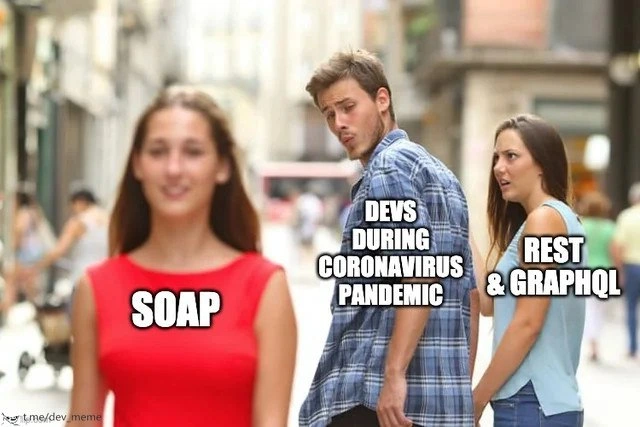
In this meme, the three characters symbolize a choice between technologies – with a pandemic twist. The boyfriend in the center represents developers during the COVID-19 pandemic, the girlfriend on the right represents the tech they normally use (REST & GraphQL), and the woman on the left is labeled SOAP, an older technology that suddenly looks “attractive” again. The image comes from the well-known distracted boyfriend meme format, used to show someone ignoring their usual partner in favor of a new interest. Here it’s played for laughs with tech terms: devs are shown turning their back on REST and GraphQL (the current favorites for web APIs) to stare at SOAP (a largely outdated approach). The humor hinges on two meanings of “soap”: one is soap_protocol (the XML-based web service tech), and the other is literal soap for handwashing. During the covid19_pandemic, everyone kept saying “Use soap and water” to stay safe. Developers, being pun-loving creatures, couldn’t resist the overlap. They made jokes that implied, “Maybe we should also use SOAP – you know, that old API method we usually avoid!” It’s a classic case of a naming coincidence letting off some steam through pandemic_humor. The girlfriend’s shocked face (labeled “REST & GraphQL”) represents how absurd it would be for devs to actually abandon their modern tools for SOAP. After all, in normal situations, REST and GraphQL are the go-to choices, and SOAP is often regarded as old, heavy, or unfashionable. So the meme exaggerates a silly scenario just for a laugh.

To understand the joke, let’s break down the tech terms (especially if you’re a newer developer or not familiar with web service lingo). SOAP stands for Simple Object Access Protocol. It’s a way to send messages between computer systems, usually over HTTP, using XML format. Think of SOAP like a very formal way of asking for something – it’s wordy and strict about format. Years ago, it was widely used in enterprise systems. For example, a SOAP message might be an XML document with an <Envelope> wrapper, a header, and a body that contains a request (like “Get me the weather for ZIP code 10001”). It requires both sides (client and server) to agree on a contract (often described by a WSDL file) so they know exactly what messages to exchange.

Now, REST (which means Representational State Transfer) is not a specific protocol but an architectural style for designing networked applications. In simpler terms, RESTful APIs are built on top of the HTTP protocol in a straightforward way. If SOAP is like a formal letter, a REST call is more like a quick text message or phone call. With REST, you use HTTP methods (verbs) like GET, POST, PUT, DELETE, and URLs (endpoints) to operate on resources. For instance, to get weather by ZIP in a REST API, you might just do a GET request to https://api.example.com/weather?zip=10001 and get back a short JSON response. JSON (JavaScript Object Notation) is a lightweight data format that’s easy to read and write, which made REST APIs popular among web developers (much easier than parsing XML). By the time we hit the late 2000s and 2010s, RESTful JSON APIs had largely overtaken SOAP in popularity for most web applications, because they are simpler to develop and consume (especially for front-end developers).

GraphQL is the newest of the trio – introduced around 2015 by Facebook. It’s a different approach where the client can ask for exactly the data it needs, and the server returns that data in one go. You write a query (almost like asking a database) specifying the fields you want. Using the weather analogy: instead of hitting multiple REST endpoints or getting a big response with fields you don’t need, in GraphQL you’d send one query for weather(zip: "10001") { temperature, humidity } and get back just those two pieces of information. GraphQL uses a single endpoint and a schema that describes all the queries and data types available. It aims to solve some common issues with REST (like needing multiple calls to gather related data, or over-fetching too much info). Many developers enjoy GraphQL for its efficiency and strong typing, though it introduces its own complexity on the server side.

Given these definitions: by early 2020, most developers were building APIs with either REST or GraphQL. They’re the girlfriend in the meme – the familiar, current companions in a dev’s life. SOAP, in contrast, had become an older legacy thing. Plenty of newbies have never written a SOAP service at all, and those who have might recall it felt a bit cumbersome. So normally, a dev’s attention would not be on SOAP – just like the boyfriend normally should pay attention to his girlfriend, not some random passer-by. But the meme humorously imagines devs collectively doing a double-take at SOAP purely because the word “soap” was suddenly everywhere (for health reasons). It’s as if a trend from outside tech briefly made us reconsider an outdated tech, but only for laughs. The meme format (distracted_boyfriend_meme) is perfect here because it visualizes that joke: you can almost hear REST and GraphQL gasp, “Wait, seriously? You’re interested in SOAP now?!” and the dev boyfriend replying, “Well… everyone keeps telling me to use soap…” with a goofy grin. It’s a light-hearted meme, blending API in-jokes with a bit of timely DeveloperHumor to bring some silliness to an otherwise stressful period. In essence, it’s pointing out the absurdity in a playful way: no, developers weren’t actually swapping out GraphQL for SOAP during the pandemic, but the wordplay was too good to pass up. This gave the community a quick chuckle and perhaps a nostalgic reminder of tech days past, without anyone actually diving back into XML hell.

Level 3: The SOAP Opera

At the height of the COVID-19 pandemic in early 2020, a peculiar twist of fate thrust an old web-service protocol back into the spotlight. SOAP (the Simple Object Access Protocol), a technology many developers considered practically dead or at least “resting,” suddenly became the butt of a topical joke. In this meme, we see the classic distracted boyfriend format: “Devs During Coronavirus Pandemic” (the boyfriend) turns away from his steady partners “REST & GraphQL” (the girlfriend) to gawk at “SOAP” (the passer-by). This humorous tableau is an API love triangle, with each character labeled as a different web service approach. It’s a clever blend of developer humor and pandemic_humor, playing on a naming coincidence. As the world urgently repeated “use soap” for hygiene, developers jokingly pretended to misinterpret it as “use SOAP” – the old-school API protocol – sparking this hygiene_in_dev_culture meme. The result is an inside joke where external events (a global health crisis) collide with tech terminology, creating a surreal scenario only programmers would find funny.

From a senior developer’s perspective, the meme lands because it riffs on both tech history and shared trauma. Seasoned devs remember the soap_protocol era: in the early 2000s, SOAP was the enterprise go-to for building web services. A SOAP service defined a rigid contract via WSDL (Web Services Description Language) and exchanged XML messages over HTTP. The protocol was anything but simple in practice – it came with a whole constellation of WS-* standards (for security, transactions, addressing, you name it). Working with SOAP could feel like unraveling a complex soap opera: endless XML schemas, verbose envelopes, and debugging cryptic <Fault> messages at 3 AM. Many of us still have war stories of wrestling with SOAP toolkits and massive XML payloads. So, the “girlfriend” labeled REST & GraphQL in the meme represents the modern, simpler alternatives developers prefer today. REST (Representational State Transfer), popularized in the mid-to-late 2000s, was a breath of fresh air – a lightweight architectural style that embraces HTTP verbs and simple URL endpoints, often returning JSON. No elaborate envelopes, no strict contracts required on day one. Meanwhile, GraphQL, introduced by Facebook in 2015, is the shiny new star of APIs: a query language that lets clients ask for exactly what they need, all in one request. By 2020, the combination of REST and GraphQL was the cool, preferred stack for APIDevelopmentAndWebServices, whereas SOAP was largely seen as a legacy relic, something you only touch when interfacing with old enterprise systems or archaic government APIs.

This context is exactly why the meme’s scenario is so absurdly funny to experienced devs. It’s as if a battle-scarred veteran suddenly got nostalgic for a tool they’d sworn off. The boyfriend (devs during the pandemic) eyeing SOAP is like a jaded engineer turning back to an outmoded technology simply because the name is trending. It recalls the shared industry knowledge of how SOAP was supplanted by RESTful design and more recently edged aside by GraphQL. The humor blooms from that contrast: ordinarily, one wouldn’t be caught dead flirting with SOAP if they have REST and GraphQL at hand. It’s the soap_vs_rest debate stood on its head – not about technical merit this time, but about an external force (hygiene advice) making us look again at a bygone tech. Everyone in the developer community understands that under normal circumstances, switching from REST/GraphQL back to SOAP is a nonsensical move (like trading your Tesla for a horse and buggy). But in March 2020, hearing “SOAP can save lives” on the news, our collective nerd brains couldn’t resist the pun. The meme captures that moment of collective geeky giggling: we all knew we were stress-joking, finding levity by conflating vastly different meanings of “soap.” It’s developer humor at its finest – a mashup of a real-world crisis with an API protocols comparison.

On a deeper level, this meme also nods to how tech trends come and go in cycles – sometimes even reappearing unexpectedly. The TechHistorian inside us notes that technologies often have life cycles. SOAP was once the hot new thing itself, created to enable cross-language remote procedure calls with the rigor of XML schema validation and formal contracts. It solved problems of its era (like interoperable enterprise computing) but at the cost of complexity and performance overhead. REST rose as a counter-movement, emphasizing simplicity, stateless interactions, and aligning with how the Web itself works. REST’s adoption was aided by the simplicity of JSON data format (much lighter than XML) and the lack of required heavyweight toolkits – a developer could hit a RESTful API with nothing more exotic than curl or a web browser. GraphQL’s rise, in turn, addressed some pain points of REST (over-fetching or under-fetching data, multiple round-trips) by letting the client craft queries, almost like SQL for APIs. Each new approach learned from the past: GraphQL learned from REST’s strengths and limits, just as REST learned from SOAP’s over-engineering. This evolution is common in our field – a swinging pendulum between complex powerful tools and simpler flexible tools. The meme wryly suggests the pendulum swinging back, if only jokingly: “Hey, maybe that overly complex SOAP thing wasn’t so bad after all, hehe.” Of course, no one’s seriously advocating for SOAP’s comeback here – this is purely a joke. But the reason it elicits a knowing chuckle is because it taps into those shared memories and the bizarre sensation of hearing a very specific tech term (SOAP) suddenly echoed in everyday pandemic talk. If you spent years happily avoiding SOAP’s XML hell, hearing “Use SOAP” on the radio 10 times a day has a dark irony to it.

To really appreciate the technical contrast, consider the syntax and feel of these approaches side-by-side. It highlights why turning back to SOAP would normally be unthinkable for a modern dev:

<!-- SOAP: A request to get weather by ZIP code -->
<soap:Envelope xmlns:soap="http://www.w3.org/2003/05/soap-envelope">
  <soap:Header/>
  <soap:Body>
    <GetCityWeatherByZIP xmlns="http://ws.example.com/Weather">
      <ZIP>10001</ZIP>
    </GetCityWeatherByZIP>
  </soap:Body>
</soap:Envelope>

Above is a simplified glimpse of a SOAP request. It’s all XML: wrapped in an <Envelope> and <Body>, with explicit namespaces. Even a simple query ends up verbose. Contrast that with a typical RESTful request for the same idea, which might just be an HTTP GET call:

GET /weather?zip=10001 HTTP/1.1  
Host: api.example.com  

The REST approach leverages the URL and query parameters, and the response would likely be a compact JSON payload:

{  
  "zip": "10001",  
  "temperature": 72,  
  "unit": "F"  
}

And if we use GraphQL to fetch, we might send a query specifying exactly what we want:

query {
  weather(zip: "10001") {
    temperature
    humidity
  }
}

This yields back just those fields in a JSON structure. The differences are stark: SOAP is ceremony-heavy, REST is resource-centric and simpler, GraphQL is flexible and precise. Developers know and live these differences. So seeing “Devs during pandemic” lustfully eyeing that SOAP envelope again is ridiculously out-of-character – which is precisely why it’s funny. It’s poking fun at our API preferences and the lengths we’ll go for a joke. It also reflects how the DeveloperHumor community finds comic relief by linking our work world with real world events. During a scary time (a pandemic), joking that even SOAP the protocol is getting love again was a way to laugh in the face of adversity. In short, the meme is one big nerdy wink: a timely pun that combines API nostalgia, a famous distracted_boyfriend_meme format, and the universal advice to “wash your hands!”.

Description

This image uses the 'Distracted Boyfriend' meme format to make a multi-layered pun. The man, labeled 'DEVS DURING CORONAVIRUS PANDEMIC', is looking away from his current partner, labeled 'REST & GRAPHQL', to admire a passing woman in red, labeled 'SOAP'. A small watermark for 't.me/dev_meme' is in the bottom-left corner. The humor operates on two levels. First, it's a technical joke for experienced developers. SOAP (Simple Object Access Protocol) is an older, often considered clunky and verbose, web service protocol that has largely been superseded by the more modern REST and GraphQL. The meme humorously suggests that developers are suddenly interested in this legacy technology again. The second layer is the real-world context of the coronavirus pandemic. At the time this meme was created (March 2020), public health advice heavily emphasized hand washing with soap, making the word 'SOAP' ubiquitous. The joke cleverly connects the real-world importance of soap with the technical term, creating a timely and witty piece of commentary

Comments

7
Anonymous ★ Top Pick The pandemic reminded us of the importance of SOAP. Not the protocol that wraps every function call in 10 layers of XML, but the one that actually helps you get rid of bugs
  1. Anonymous ★ Top Pick

    The pandemic reminded us of the importance of SOAP. Not the protocol that wraps every function call in 10 layers of XML, but the one that actually helps you get rid of bugs

  2. Anonymous

    One WHO briefing about “use more soap” and suddenly the senior architects are rummaging through SVN for those 2005 WSDLs - turns out a pandemic can enforce standards no RFC ever could

  3. Anonymous

    The pandemic finally gave us a valid business reason to abandon that 15-year-old SOAP service nobody wanted to touch - "we need to modernize for remote development efficiency" sounds better than "the guy who understood the WSDL retired in 2019."

  4. Anonymous

    Ah yes, the pandemic era when we all had time to finally read those SOAP specifications we'd been avoiding for a decade. Nothing says 'I have too much time on my hands' quite like voluntarily parsing WSDL files while REST and GraphQL are right there, offering you type safety and developer ergonomics. But sure, let's debate whether we need WS-Security or WS-ReliableMessaging for our microservices - because clearly what 2020 needed was more complexity and angle brackets

  5. Anonymous

    SOAP's verbose XML couldn't compete with REST's HTTP simplicity during lockdown - GraphQL just queried the final nail in the WSDL coffin

  6. Anonymous

    For one quarter in 2020, our API roadmap finally mandated SOAP - turns out leadership meant 20‑second idempotent hand‑wash cycles, not WSDLs in prod

  7. Anonymous

    2020 was the only time REST and GraphQL lost to SOAP - the protocol with a clean handshake and idempotent retries: wash, rinse, repeat

Use J and K for navigation