Skip to content
DevMeme
1072 of 7435
Game Devs Underestimate Pandemic-Level Server Load
GameDev Post #1205, on Mar 29, 2020 in TG

Game Devs Underestimate Pandemic-Level Server Load

Why is this GameDev meme funny?

Level 1: Too Many Players

Imagine you ran a little amusement park ride that could handle maybe 10 kids at a time. Dad (the CEO) tells you, “Maybe we should be ready for a big crowd on the weekend.” You (the game dev), confident and relaxed, say, “Nah, don’t worry, we’ve only ever had 8 kids max, we’ll be fine even if a few more come.” You think you have plenty of space and tickets for everyone who’ll show up.

But then, unexpectedly, all the schools close and every kid in town is stuck at home with nothing to do. On Saturday, every single kid in the neighborhood – no, in the entire city – shows up at your ride at the same time! You only prepared for a few dozen at most, and now there are hundreds and hundreds of eager, bored kids lined up around the block. Your eyes go wide like, “Oh no… this is way more than I ever imagined.”

Before, you proudly said “Relax, we’re good,” but now you see an ocean of children chanting for a turn. The little ride is overwhelmed: it’s like a tiny ice cream stand that suddenly has a gigantic queue because it’s the hottest day of the year and the beach is closed. You try to serve everyone, but the line isn’t moving fast enough. Some kids start getting restless or leaving because it’s taking too long. You even try calling a friend to bring another ride (like adding another server), but by the time it’s set up, the crowd has already gotten impatient.

In simple terms, too many people showed up all at once, and it was way beyond what you planned for. It’s a bit funny looking back, because you told Dad “we have enough” but reality gave you a big surprise. The cartoon veggies in the meme are like three unexpected guests at once saying, “Hello, we’re here and we brought everyone with us!” It’s the shock of going from a normal day to an out-of-control day in a blink. The humor comes from that huge difference between what you expected and what actually happened – it’s like expecting a small birthday party and instead the whole town comes knocking on your door for cake. You stand there, frozen with a forced grin, saying, “Oh, haha, I guess we needed a lot more cake…”

Level 2: We Good, Right?

Let’s unpack this meme in simpler terms and explain the tech concepts for someone newer to backend or cloud engineering. The situation is about scalability and what happens when suddenly way more people use your online game than you ever anticipated.

First, some definitions:

  • Backend: This refers to the server side of a game or application – all the behind-the-scenes components that players don’t directly see. For an online game, the backend includes things like the game servers that run the world or matches, databases that store player data, and services for login or matchmaking. It’s basically the game’s engine room.
  • Scalability: This is the ability of a system to handle an increasing number of users or load. If a game is scalable, it means if 100 more people start playing, the system can handle it by using more resources (like CPU, memory, or additional servers) without breaking or slowing to a crawl. A highly scalable system can go from 1,000 players to 100,000 players and still run smoothly, usually by scaling out (adding more machines) or scaling up (using more powerful machines).
  • Autoscaling: In the context of cloud computing, autoscaling is like having an automatic gearbox for your servers. If traffic (number of players) increases, autoscaling rules can automatically launch extra server instances to handle the load. If traffic decreases, it can shut down those extra instances to save cost. For example, if normally you need 5 servers to handle 1,000 players, and suddenly 2,000 players show up, an autoscaler could detect the high usage and start, say, 5 more servers to share the work. This way the players still get good performance. The key is it’s automatic – you set it up in services like AWS or Azure, and it responds to metrics like CPU usage or number of requests.
  • Capacity Planning: This is the practice of estimating how much load your system will need to handle, and ensuring you have the infrastructure for it. It’s like planning a party: if you expect 50 guests, you buy enough food and chairs for 50, plus a little extra maybe. In tech, if you expect a maximum of 10,000 concurrent players, you set up servers and network capacity to handle maybe 12,000 (a safety margin). Good capacity planning means you don’t run out of resources at peak time. But it’s tricky – plan too low and you crash when more users show up; plan too high and you waste money on idle servers when fewer users are around.
  • High Availability: Often abbreviated as HA, this means designing a system to be reliable and available nearly all the time. For games, high availability might involve having redundant servers (so if one fails, others pick up), distributing servers across data centers (so a power outage in one place doesn’t take you completely offline), and using load balancers to spread player traffic so no one server gets overloaded. The goal is to avoid downtime and ensure players can always connect. If something is highly available, it’s resistant to crashes – or if crashes happen, it recovers quickly with minimal impact on users.

Now, what’s going on in this meme:

  • The Game company CEO is basically saying: “We expect sometimes a lot of players. We must be sure our system can scale up to handle those busy moments.” This is a sensible concern – think of a new game release day or a weekend evening; those are times more people play. The CEO wants the tech team to prioritize keeping the game running smoothly even when it’s very popular.
  • The Game devs respond casually: “Dude, chill, we are good.” In other words, “Don’t worry, boss, our system can already handle the peak loads. No need to invest more or panic.” They’re confident, possibly implying they’ve done the work: maybe they have auto-scaling set, or they did load tests simulating heavy use, or they just believe the current server setup is robust enough. This statement sets the stage for irony: it suggests the devs might be underestimating potential load or overestimating their preparation. It’s like famous last words – “we’re all set!” just before something goes wrong.
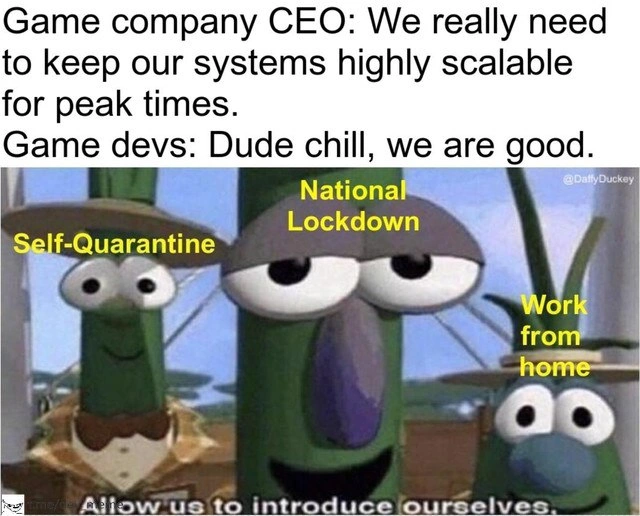
  • Below that text, we have the image from VeggieTales (a children’s cartoon featuring talking vegetables). There are three green VeggieTales characters (actually they look like peas or cucumbers) with big surprised eyes. They each have a yellow label on their forehead: Self-Quarantine, National Lockdown, and Work from home. At the bottom, a subtitle says: “Allow us to introduce ourselves.” This is a popular meme format: whenever someone is oblivious to some looming characters or factors, those factors show up with “Allow us to introduce ourselves,” as if saying “Surprise! Here we are, and you’ll have to deal with us now.”

In the context of this meme:

  • Self-Quarantine, National Lockdown, Work from home are all references to the COVID-19 pandemic response in early 2020. Let’s recall:
    • Self-quarantine: People who might have been exposed to the virus (or just everyone as a precaution) were staying at home, not going out, to prevent spread.
    • National lockdown: Many countries enforced strict rules where schools, offices, shops, theaters – basically everything – were closed, and people had to stay at home except for essential needs.
    • Work from home: Offices told employees to work remotely from their homes. Suddenly, a huge portion of the workforce that used to be in offices was at home on their computers.
  • All three of these factors meant millions of people had a lot more free time at home and fewer outside entertainment options. Naturally, many turned to online games as a way to pass time, socialize (virtually), or cope with stress. Gaming culture actually saw a boom – friends who normally might go to bars or movies started teaming up in video games; families played casual games together online; even work colleagues organized virtual game nights since they couldn’t meet in person.
  • So, from a systems perspective, these factors caused unexpected load on game servers. A game that usually had, say, 50,000 concurrent players might suddenly see 200,000 concurrent players because everyone is logging in more often and staying longer. This is the “pandemic traffic spike” mentioned in the description.

The VeggieTales characters with those labels act like they’re introducing themselves to the game devs who said “we are good.” It’s as if the events of the pandemic are knocking on the door of the game company, saying, “Hello, scalability demand here – remember how you said you’re good? Well, deal with ALL of us at once.” The big wide eyes on the veggies match the surprise or shock that the developers likely felt when they saw the sudden surge in users.

Now, what typically happens in such a scenario (and why it’s funny in hindsight):

  • The devs might have genuinely thought they could handle peak times. Maybe their peak assumption was something like “Double our normal traffic.” They built for that. But the pandemic created peak on top of peak – not just double, but potentially an order of magnitude more.
  • When too many players join an online game simultaneously, a few things can happen:
    • Lag: The game responds slowly because servers are overloaded. Players might press a button and experience delay (e.g., other players teleport around or actions take longer to register).
    • Queue systems: Some games implement a login queue when there’s overload. You might see a message “Servers are full, you are in position 1200, estimated time 15 minutes.” This is a controlled way to handle overload by letting only a certain number in at a time. If this pandemic spike hit, games that never needed a queue before might suddenly have to add one.
    • Crashes / DownTime: In worst cases, servers might crash or be taken offline. You might recall times when a popular game or new update came out and nobody could play the first day because the servers kept going down. Here, the same could happen because the system wasn’t ready for so many people. It’s a bit like blowing a circuit breaker – too much current (users) and the system just trips.
  • When the CEO said “highly scalable for peak times,” he likely envisioned scenarios like a big marketing campaign or a new feature that attracts users. The game devs responding with “we’re good” implies they thought those scenarios were covered. But nobody in those early days foresaw a global lockdown forcing everyone indoors. This was beyond typical capacity planning. It would be like planning a small concert and the entire city showing up.

For someone early in their career, it’s useful to see the humor but also the lesson:

  • Always have respect for the unknown unknowns. You can’t plan for everything, but a bit of humility goes a long way. Saying “we’re definitely good” might come back to bite you if something unprecedented happens.
  • Understand how your system scales. If you’re using cloud services, know your limits. For example, maybe your database can only handle a certain number of writes per second – if you double or triple player count, will that limit be hit? If you use autoscaling, test how quickly it reacts. It might add servers in 5 minutes – can your current ones survive being 100% loaded for that long?
  • Communication between business and tech is key. The CEO in the meme isn’t being silly – peak times are critical moments (that’s when you have the most users, and if your service dies then, it’s very costly in terms of reputation and lost opportunity). The devs appeared to brush it off perhaps because from their viewpoint, everything looked fine in metrics and testing. This meme humorously reminds both sides that unexpected things (like covid_lockdown events) can invalidate all your assumptions overnight.

Also, let’s appreciate the Cloud humor element: Cloud computing often markets itself as “infinitely scalable” – just pay more, and you can have more servers! It’s supposed to handle spikes by design. But the joke here is that even with cloud, if you haven’t configured or anticipated properly, you can still get caught with your pants down. Maybe the auto-scaling was misconfigured, or maybe they were on fixed servers (some game companies still use physical servers or limited cloud regions) that couldn’t be increased fast enough. It’s a tongue-in-cheek reminder that “the cloud” isn’t a silver bullet; you still have to architect your system correctly.

Now, if you’re new to this, you might wonder: How could they not see this coming? Well, back in early 2020, it was genuinely a shock. Game devs plan for big events in gaming (like a major tournament or a holiday when lots of kids are home). But planning for an actual pandemic that forces billions inside – that was science fiction until it became reality. So this meme gets its humor from the absurdity of the situation. It’s like if someone said, “What if an asteroid hits and everyone has to stay indoors and play our game?” – people would laugh it off… until something analogous actually occurred with the pandemic (minus the asteroid).

Finally, notice the bottom caption: “Allow us to introduce ourselves.” That’s basically the three factors (quarantine, lockdown, WFH) speaking to the devs. In plain terms, it’s saying: “Hi, you didn’t know about us when you said you could scale. We’re here now, all together, and we’re about to truly test your system.” It’s a lighthearted way to frame a rude awakening. VeggieTales being a cute, innocent cartoon adds to the silliness – these goofy veggies are delivering the bad news of “we brought a million new players, hope you’re ready!”

To sum up Level 2: This meme is illustrating how an online game’s backend that the developers believed was ready for high traffic gets absolutely slammed by an unprecedented surge of players due to COVID-19 lockdowns. Key concepts like scalability and autoscaling are at play – and the joke is that the devs’ confidence was misplaced because they didn’t foresee a once-in-a-lifetime event filling up their servers. It’s funny in that ironic way and also educational: always design with some buffer and be ready for the unexpected, because sometimes reality is stranger (and scales bigger) than fiction.

Level 3: The Lockdown Load Tsunami

At this level, we look at the meme through the eyes of an experienced developer, who probably chuckles and winces at the scenario. The meme’s text sets up a classic confrontation between business foresight and developer overconfidence:

Game company CEO: “We really need to keep our systems highly scalable for peak times.”
Game devs: “Dude chill, we are good.”

Anyone who’s been in tech for a while has sat through those meetings. The CEO (or CTO) is worried about peak traffic – they might recall outages during last year’s holiday sale or the time a big streamer brought in a flood of players. They’re essentially warning, “Are we prepared for a sudden surge in users? Do we have enough servers, enough bandwidth, the right architecture?” The dev team, perhaps a bit tired of hypothetical worst-case scenarios, assures them everything is fine. Maybe they’ve done load tests, maybe they have some autoscaling set up in the cloud, or maybe they just think the CEO is exaggerating. “Dude, chill, we got this,” is dev-speak for “Relax, we’ve accounted for our capacity planning; trust us.”

Then 2020 rolls around and fate says: Allow us to introduce ourselves. The image beautifully punchlines this with the VeggieTales characters labeled Self-Quarantine, National Lockdown, and Work from home. Those labels are basically the unexpected guests at the party, each one a reason millions more people are suddenly logging in. The subtitle “Allow us to introduce ourselves” is a cheeky way of saying “Hi there, we are the peak times you didn’t see coming.” In the VeggieTales episode, that line is delivered by surprise characters appearing out of nowhere, and memers turned it into a template for any situation where someone is about to get blindsided by new problems. Here, the blindside is that “peak times” just got redefined beyond anything the devs imagined.

From a senior developer perspective, the humor is equal parts funny and too real. In March 2020, when this meme was posted, the world was going into lockdown due to COVID-19. People were suddenly stuck at home in self-quarantine, entire countries were on national lockdown, and everyone who could was working from home. For online games, this was like a perfect storm of user activity:

  • All-day peaks: Normally, game traffic has daily cycles – a peak in the evening when people get home from work or school, and a lull overnight or mid-day. With so many at home, those “lull” periods shrank. People squeezed in a game session at lunch, or kids logged on in what used to be school hours. The result: an elevated baseline of activity all day long. Systems that were only stressed 2-3 hours a day were now running hot for 12+ hours.
  • Record concurrency: Many gaming platforms experienced record-high concurrent user counts. For instance, Steam shattered its all-time user records multiple times in 2020, and popular games like Call of Duty: Warzone or Animal Crossing saw huge surges. A senior dev reading this meme remembers headlines like “XYZ game’s servers buckle under the strain of a bored housebound populace.” It’s gaming culture lore now how the pandemic created an unexpected load of players. Some services adapted well (using cloud elasticity), while others suffered outages and long login queues. It’s a shared memory for devs: those frantic off-hours where everyone is spinning up extra servers, patching code, or apologizing on Twitter for downtime.
  • Unplanned stress-test: The meme calls out “pandemic traffic suddenly stress-tests your ‘totally scalable’ servers.” That phrasing hits home because we often use stress tests in QA: deliberately pushing a system to its limits in a controlled way. But here the stress test happened in production, nationwide, without warning. It’s as if the universe became the QA engineer, saying “Oh, you think your backend is strong? Let’s see what happens if literally everyone uses it at once.” The CEO’s cautious request for high scalability was actually very prescient – this really was a peak time beyond all peak times. And the devs’ casual confidence (“we are good”) turned out to be hubris. In many companies, those same devs were suddenly scrambling when the lockdown load tsunami hit. What’s funny is the dramatic irony: the audience (us, in hindsight) know that “we are good” was terribly optimistic, even as the devs in the meme don’t yet see the freight train coming.

Digging a bit deeper, this scenario highlights a bunch of classic industry lessons and pain points:

  • Capacity Planning vs. Cost: In a perfect world, you’d size your game servers for the worst-case scenario. But that costs money. If you’re running 100 servers at quiet times but need 500 servers for a one-time spike, do you keep 400 idle servers around just in case? Often the answer is no – finance and ops teams push back on spending for unused capacity. So devs compromise: plan for what seems like the reasonable peak (maybe 2x your normal load). The CEO in the meme might have been willing to invest more (“keep our systems highly scalable”), but maybe the devs or middle management thought it wasn’t worth it. They said “chill, we’re good” meaning “our current setup can handle what we expect.” This pandemic surge completely blew apart those expectations. The humor has an undercurrent of “told you so” from the CEO’s perspective. Every veteran engineer remembers (or has been) the person warning “We need to prepare for X!”, which everyone else dismisses as overkill – until X actually happens and causes a meltdown.
  • Tech Debt & Elasticity Limits: The meme hints the game devs might have overestimated their scalability. Perhaps they were using cloud servers and assumed autoscaling would save them. But autoscaling only works if the software can successfully clone itself horizontally. Many online games have stateful components (like player sessions, in-memory caches, or a single shared world state) that aren’t trivial to duplicate on the fly. If their architecture had any single-threaded or poorly scalable sections (say, a matchmaking coordinator or an outdated piece of code not optimized for multi-core), that would become a bottleneck under extreme load. Senior devs recognize this scenario: one old service that hasn’t been refactored becomes the weakest link. Suddenly, your “totally scalable” system isn’t totally scalable at all – it hits a hard wall. For example, imagine the game had a lobby server that can handle up to 10k concurrent players. Normally that’s fine because you never exceed 8k. But lockdown pushes it to 20k attempts, and boom – no new players can join until numbers drop. The devs might not have realized the lobby server had a fixed limit (or they assumed it’d never be hit). We’ve all seen something like that: a distributed system is only as scalable as its least scalable component.
  • Autoscaling Mishaps: There’s also a shared memory of autoscaling gone wrong. Maybe the devs did set up auto-scaling on their cloud infrastructure, but with conservative thresholds or caps. For instance, if their cloud budget was tight, they might have limited the cluster to, say, 50 servers maximum. Under normal peaks they needed 20, so 50 seemed plenty. Cue the lockdown – demand requires 100 servers, but the autoscaler stops at 50. The result is 50 servers running at 100% CPU, players getting errors, and everyone wondering why the cloud didn’t just expand further. Another classic mistake: not accounting for scale-up lag. Let’s say the autoscaler adds 10 servers when CPU goes above 70%. But user load grew so fast that by the time those servers boot, the existing ones are at 100% and players are already dropping. Scaling rules often have cool-down periods (to avoid oscillation) and might not trigger again immediately. So you get a situation where the system could scale more, but it’s a few steps behind the curve and never catches up to the tsunami of traffic. Developers with on-call experience might recall watching graphs in horror as a traffic spike outpaced the scaling policy. It’s a gut-churning feeling: seeing that your automated safety net isn’t reacting quickly enough, and user experience is deteriorating right now. This meme definitely taps into that particular nightmare.
  • Shared Trauma, Dark Humor: By framing it as a VeggieTales joke (“Allow us to introduce ourselves”), the meme adds a layer of wholesome absurdity to what was, for many engineers, an extremely stressful time. We laugh because it’s easier than crying! In early 2020, plenty of tech workers were suddenly firefighting scaling issues from their living rooms, VPNing into servers, watching error logs scroll like a doom cascade. The tags like CloudHumor and GamingCulture fit here: it’s humor born out of real events in the cloud computing world and gamer communities. Gamers themselves joked about “breaking the internet” because so many people were online. Developers joked (with some pain) about their systems getting “Corona-tested.” This meme encapsulates that shared experience with a single image and punchy captions. It’s the kind of joke a Slack channel of SREs (Site Reliability Engineers) would forward around, each adding “#Truth” or “this was us last night!”.
  • Organizational Dynamics: Notice how the CEO is emphasizing scalability and the devs dismiss it. This reflects a common dynamic: leadership is thinking big picture (“what if we suddenly have huge success or a big event?”), whereas developers are often focused on immediate concerns and current load. The devs saying “dude, chill” suggests perhaps they were a bit tired of what sounded like paranoia. In fairness, nobody predicted a pandemic a year prior in their meeting room. So from their point of view, they probably thought the CEO was worrying about something like a spike during a product launch – something they felt they’d handle. The comedic irony is that the CEO’s broad mandate “keep it highly scalable” was 100% right, just for reasons no one imagined. After the fact, you can bet that conversation changed. Companies started asking “how can we design for extreme unpredictability?” and maybe those devs were spending late nights refactoring code or improving their high availability setups. The meme hints at that organizational lesson: listen to scalability concerns, because sometimes the crazy what-if scenario comes true. In the post-mortems from that period, teams likely had to explain to the CEO what failed and how they’d prevent it next time. So in a way, the CEO’s prophecy vindicated, and the devs learned some humility courtesy of unexpected load.

Overall, at the senior perspective, this meme is funny because it dramatises a scenario we all dread: the perfect storm of traffic hitting an unprepared system. It references real contemporary context (the COVID lockdowns) that industry veterans will never forget. And it uses a bit of gentle ribbing – the “Dude chill, we are good” dev attitude – which we might recognize in ourselves from before we got burned by a production fiasco. It’s a clever mashup of Backend nightmares and current events humor. The veggie characters’ wide eyes are basically the face of every on-call engineer who saw their monitoring dashboard go off the charts in spring 2020.

So the Level 3 takeaway: Even if you think you’re ready for peak load, the universe might have a special, larger peak in store. It’s both a cautionary tale and a hearty laugh at how quickly “we are good” can turn into “we were so very wrong.” In tech, one can never be too smug about scalability — those VeggieTale “introductions” can happen when you least expect them!

Level 4: The Thundering Herd

In distributed systems lore, there’s a notorious scenario known as the thundering herd problem. It’s what happens when a massive crowd of clients all stampede to your service at the same time, overwhelming the gates. In theory, a “totally scalable” architecture should absorb surges by dynamically allocating resources. But reality has physical and algorithmic limits. When the COVID-19 lockdown hit, millions of bored people turned into a thundering herd of gamers. Autoscaling algorithms, which typically add servers based on rising load, suddenly faced a near-instantaneous pandemic traffic spike. This wasn’t a gradual rush hour; it was like opening the floodgates all at once.

Let’s break down why this was so challenging at a fundamental level:

  • Queueing Theory Bends (or Breaks): In networking and server design, if arrival rate ($\lambda$) of requests far exceeds what the system can handle, queues explode and response time skyrockets. A normally well-tuned game server cluster might handle, say, 100,000 concurrent players with 20 servers. But if 1,000,000 players suddenly show up, no queue or HighAvailability design can magically process 10× load without delay. A backlog forms – like cars piling up in a traffic jam – and some requests get dropped entirely. In technical terms, you’ve exceeded the capacity planning assumptions so drastically that Little’s Law ($L = \lambda W$) goes out the window: the number of users $L$ in the system soars because the service time $W$ can’t shrink enough to compensate for the huge arrival rate $\lambda$. The result? Lag, timeouts, and server crashes. The system hits a capacity cliff, where beyond a certain load, performance isn’t just a bit worse – it falls off a steep drop into chaos.

  • Autoscaling is Reactive, Not Magic: Cloud platforms like AWS do offer auto-scaling groups that monitor metrics (CPU, requests per second) and spin up new instances to share load. But this process has latency. It can take minutes to boot new game servers and register them with load balancers. During a lockdown load tsunami, those minutes are an eternity. By the time extra servers come online, the original instances might already be melting under 400% load. If the autoscaling rules were tuned for gradual evening traffic, they might scale up too slowly or hit a preset maximum number of servers (since nobody expected every single user online simultaneously). Picture a bakery that can start baking more bread when more customers arrive – great for a normal rush, but useless if a thousand people pour in within seconds. The first batch of customers empties the shelves before the ovens even preheat. In computing terms, the autoscaler is always one step behind during a spike, leading to a game of catch-up that systems often lose.

  • Resource Contention and Cascading Failures: Beyond just adding servers, truly scalable design demands that no central component becomes a bottleneck. Many online games rely on centralized services for things like authentication, matchmaking, or player inventory databases. These are often the least elastic parts – you can’t spawn a new main database or rewrite core logic in minutes. During the quarantine gamer stampede, if every user’s client tries to log in at 7 PM, the authentication service might choke (a classic thundering herd in action). One server or lock in the code can handle only so many handshakes per second. Once that choke point maxes out, requests queue or fail, which can trigger cascading failures: e.g., login fails so players keep retrying (doubling the traffic), or parts of the system time out and crash, possibly bringing down other dependent services. Distributed systems are like an ecosystem – strain one part too hard and others can topple like dominoes. It’s why seasoned engineers design backpressure mechanisms: for example, the game could intentionally slow down logins or put players in a queue screen (“waiting to join”) instead of letting the herd hit the server all at once. By throttling the herd, you trade a bit of delay for system survival. If not, the alternative is everyone getting booted offline when the distributed system ties itself in knots trying to handle an impossible load.

  • Black Swan Events & Scalability Budget: COVID-19 was a classic black swan – a rare, unpredictable event with huge impact. Systems are usually built for peak times we expect: typical nightly peaks, maybe a big esports tournament final, or a game update release. Building for unprecedented load (like the entire world’s gamers online 24/7) means a lot of extra infrastructure sitting idle during normal times. Many companies choose a reasonable safety margin – say 2× average load – but not 10× or 20×, because that would waste money on servers that mostly do nothing. This is an economic and architectural trade-off known as the scalability budget. You assume an extreme scenario probably won’t happen. In early 2020, that gamble backfired spectacularly. The humor of the meme hides a real lesson: systems fail at the margins. The CEO’s insistence on high scalability was essentially about preparing for a black swan. The devs’ “Dude, chill” response was an acknowledgment of the usual cost-vs-benefit mindset – why prepare for something that never happens? Until it does. When everyone went into self-quarantine, that “never” turned into right now, and the only thing left was stunned, wide-eyed servers begging for mercy.

Behind the laughter, this meme demonstrates fundamental truths of distributed computing. It’s a showcase of distributed systems theory colliding with reality: your system is only as strong as its weakest link under pressure, and scaling isn’t infinitely attainable due to real-world constraints (whether hardware limits, propagation delays, or just budget). The VeggieTales characters labeled “Self-Quarantine”, “National Lockdown”, “Work from home” are essentially the personification of a thundering herd event — all these factors synchronized millions of players to log in together. No whitepaper or algorithm easily handles an unexpected simultaneous worldwide demand spike without hiccups. It’s both a humbling reminder of the physical limits of our tech and a darkly funny example of Murphy’s Law in computing: anything that can overload, will overload (and usually at the worst possible time). The game devs in this scenario learned the hard way that “totally scalable” isn’t a checkbox you tick, but a relentless architectural challenge, one that Mother Nature was happy to stress-test for them with the greatest beta-testing team ever: everyone on the planet with an Internet connection.

Description

A meme using the 'Allow us to introduce ourselves' format from the animated series VeggieTales. The top text displays a conversation: 'Game company CEO: We really need to keep our systems highly scalable for peak times.' followed by 'Game devs: Dude chill, we are good.' Below this, three VeggieTales characters are shown. The character on the left is labeled 'Self-Quarantine,' the large one in the middle is 'National Lockdown,' and the one on the right is 'Work from home.' The bottom text of the meme reads, 'Allow us to introduce ourselves.' The meme humorously depicts the unexpected and overwhelming stress placed on online gaming infrastructure at the start of the COVID-19 pandemic in March 2020. It highlights the failure of capacity planning when faced with a 'black swan' event, where the game developers' confidence in their system's scalability is about to be shattered by the unprecedented surge in user activity from global lockdowns and work-from-home policies


Comments

7
Anonymous ★ Top Pick The CEO wanted to provision for a 10x event, but the universe shipped a 100x event with no release notes or option for rollback
  1. Anonymous ★ Top Pick

    The CEO wanted to provision for a 10x event, but the universe shipped a 100x event with no release notes or option for rollback

  2. Anonymous

    Nothing exposes the gap between theoretical QPS and existential QPS like the moment your auto-scaler discovers “global quarantine” wasn’t in the load-generator’s dataset

  3. Anonymous

    "We tested for Black Friday, Cyber Monday, and Christmas morning combined... turns out we needed to test for 'entire civilization discovers they have nothing else to do simultaneously.'"

  4. Anonymous

    Ah yes, the classic 'we're good' from devs who load-tested for Black Friday traffic, not realizing the entire planet would simultaneously discover they're gamers during a global lockdown. Nothing says 'highly scalable' like your autoscaling groups frantically spinning up instances while your on-call rotation discovers that 'peak times' was a quaint pre-pandemic concept. At least the postmortem was easy to write: 'Root cause: Unprecedented global event. Mitigation: Should have read that Nassim Taleb book about black swans.'

  5. Anonymous

    Turns out “we’re good for peak times” only lasts until quarantine turns peak into baseline and the autoscaler runs face-first into the cloud account’s hard quota

  6. Anonymous

    Who needs Chaos Monkey when lockdown turns every basement into a 10k-player raid instance?

  7. Anonymous

    Our peak model assumed independent users; then quarantine executed a global barrier sync on free time and the HPA’s warm‑up quietly became our RTO

Use J and K for navigation