Skip to content
DevMeme
1316 of 7435
Solving Global Pandemics with F12
Frontend Post #1471, on May 2, 2020 in TG

Solving Global Pandemics with F12

Why is this Frontend meme funny?

Level 1: Make-Believe Cure

Imagine you have a big chalkboard at school showing how many students are sick. It says a huge number, like 100, and that makes everyone worried. Now, instead of actually helping those sick students get better, you just walk up to the chalkboard, erase “100” and write “0”. Then you turn around and say, “Good news, nobody is sick anymore!” 😂. Of course, that doesn’t really heal anyone – it just looks like the number of sick people is zero because you changed the board. The joke here is the same: the person in the meme “fixed” the problem only by changing the sign that shows the count, not by actually curing the illness. It’s like pretending the problem is gone just because you covered it up. We find it funny because we all know erasing the number doesn’t solve the real problem, but oh, if only it were that easy! In other words, the meme is showing a make-believe solution to a very real problem – and that pretend fix, though completely silly, makes us laugh.

Level 2: Right-Click Reality Check

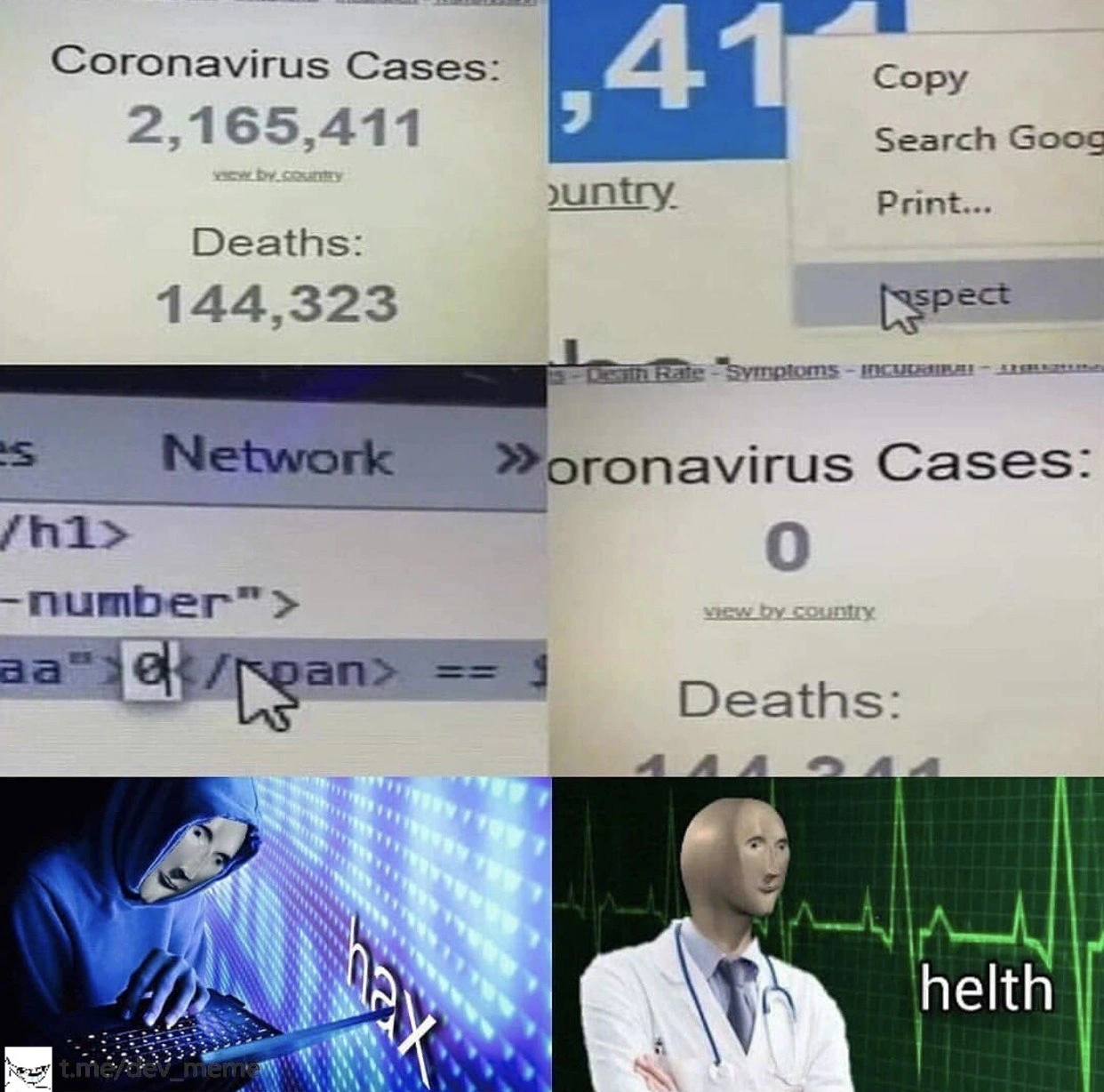
For those newer to coding, let’s break down what’s happening. The meme shows a developer using the browser’s Developer Tools (often opened by right-clicking on a webpage and choosing Inspect). This tool lets you see and even edit the website’s code that’s running in your browser. In the second panel, we see the right-click context menu with the “Inspect” option highlighted. When the developer clicks that, the browser opens an interface where you can view the page’s HTML structure (the DOM, or Document Object Model) as well as its CSS styles, and more. In panel 3, the meme zooms in on the HTML code for the number showing total coronavirus cases. It looks like there’s an <h1> heading or a <span> element containing the number 2,165,411. The cursor in the image is editing that number, changing it to 0. This is done right in the browser – kind of like opening a Word document and changing a word. Panel 4 then shows the webpage with the updated number: it now reads “Coronavirus Cases: 0”. So essentially, the developer used Inspect Element to change the text on the page from 2,165,411 to 0.

Now, here’s the catch: this change is purely client-side, meaning it only happened in the copy of the webpage you are looking at. The website’s real data (on the server) hasn’t changed at all. It’s like editing the scoreboard on a TV screen during a game – you can make it look like your team has more points, but the actual score out in the world stays the same. The meme specifically targets this difference. Front-end (client-side) is what you see and interact with in the browser. Back-end (server-side) is where the data, logic, and files usually reside on a server computer somewhere else. When you opened the coronavirus stats page, your browser requested data from the server and then displayed it. By the time you’re using DevTools, you’re only changing the already loaded data in your own browser memory. This doesn’t send any update back to the server. So the official count of cases remains 2,165,411 on the server and for everyone else – only your personal view says 0.

This is a common thing new web developers learn: the browser gives you a lot of power to experiment. In fact, BrowserDevTools are meant for developers to play with HTML/CSS, debug JavaScript, and test changes on the fly. For example, a newbie might right-click and inspect_element on a page just to see how it’s structured, or try changing some text or color to see the effect. It’s a great way to learn WebDevelopment. Many of us have had that “wow!” moment when we discover we can edit any site’s text locally – as if we “hacked” the page. You could go to a news site and change the headline on your screen, or change the price on an Amazon product page just for fun. It feels like magic – but it’s really just a frontend prank. This meme plays on exactly that feeling. The developer in the joke is doing a tongue-in-cheek “hack” by setting the COVID case count to zero, as if they cured the disease by editing HTML. It’s a form of developer_trolling or playful trick, because anyone who understands how it works knows it’s not a real solution, just a visual gag.

Let’s also talk about why this hack does nothing in reality. Modern web apps and sites separate concerns: the client_side_only change here doesn’t persist or affect the database. If a website is well-built, all the important data (like the number of cases, or your bank balance, or your exam scores) is validated or stored on the server. The client (your browser) is considered untrusted from a security standpoint – it can display data and send requests, but the server should never blindly trust the client to tell it “everything’s fine, I have 0 cases now!” This is why, for example, if you try to cheat in an online game by editing values in your browser or using local scripts, the server usually catches it or ignores it, because the real game logic runs on the server. In the context of this meme, the coronavirus_statistics_site presumably updates its numbers from a server database tracking real infections. Editing the number on the web page doesn’t tell the database anything. It’s the ultimate illusion_of_security or success: the problem is merely hidden on one screen. That’s why it’s funny – everyone else in the world still sees the real numbers and the virus hasn’t gone anywhere, but on this one developer’s monitor it says 0 and the doctor meme declares “health”. It’s poking fun at the idea of solving a hard problem with a trivial right_click_menu trick. In tech terms, it’s reminding juniors that client-side rendering is just presentation; the truth lives on the server. You can’t really fix a bug (or a pandemic) by only changing what’s on your screen.

Finally, notice the last panel’s humor: it shows a doctor figure in front of a heartbeat monitor with the caption “helth” (a misspelling of health). This image is a meme in itself – a variant of the popular “Meme Man” format where things are spelled wrong on purpose (like the famous “stonks” meme for stocks). By saying “helth”, the meme signals that this is a joke and not real medicine. It’s the meme’s way of saying “Yay, we did it... not really 😂”. The developer’s fake l33t_hax might make the stats look perfect, but actual health outcomes haven’t changed at all. For a junior developer or a non-developer, the takeaway is: just because you can alter what a website says on your own screen, it doesn’t mean you’ve changed the underlying reality or fooled the system. It’s a neat trick, a useful tool for testing or jokes, but it isn’t a real hack. The internet (and the pandemic) won’t be impacted by one person editing HTML. So the meme is basically a geeky way to say, “If only solving problems was as easy as changing the text on a website – haha, it’s not!”

Level 3: Security Theater of the Absurd

At first glance, this meme dramatizes a developer “fixing” the COVID-19 pandemic by editing a website’s HTML. The humor comes from the absurd mismatch between a global pandemic and a trivial frontend tweak. In the top panels, a live statistics page shows Coronavirus Cases: 2,165,411 and Deaths: 144,323. Instead of developing a vaccine or a real data update, the developer simply opens the browser’s DevTools via a right-click Inspect. By manually altering the page’s DOM element from 2,165,411 to 0, they make the site display zero cases. The bottom panels then exaggerate this “hack” as if it were some elite exploit – showing a hooded hacker with giant “hax” text and a goofy doctor figure labeled “helth”. It’s a perfect send-up of security theater in a web context: a purely cosmetic change presented as a world-saving triumph. Developers recognize that what’s changed here is only the client-side representation, not the actual server-side data or reality. The meme highlights the illusion of security or control – you can manipulate the DOM to pretend the problem disappeared, but it’s just that: pretend. It’s the tech equivalent of sticking your fingers in your ears and saying “problem solved!” while the real issue rages on.

From a seasoned developer’s perspective, this joke lands because it riffs on a common scenario: the difference between appearance and reality in software. We’ve all encountered management or clients who focus on “just make the error message go away” or “can’t we fake the numbers for the demo?” Instead of addressing the root cause (whether a bug or, in this case, a literal virus outbreak), someone opts for a quick UI band-aid. In web development, using the browser’s Inspector to edit HTML is a harmless everyday trick. You might use it to test CSS changes or prank a coworker by altering text on a page – a classic bit of FrontendHumor. But it’s comically ineffectual for any real change. Here the meme dialed that up to 11 by applying it to something as serious as pandemic statistics. It satirizes the impulse to cover up a problem instead of solving it. The hooded “hacker” imagery and the leetspeak “hax” lampoon how non-developers think hacking works – as if pressing F12 and changing a number is some 1337 hacker move. Seasoned devs chuckle because we know real exploits or data fixes don’t work that way. It’s a gentle poke at novices who might excitedly edit a site and momentarily feel like they “hacked the planet” when in fact they only changed their own browser’s data.

Under the hood, this is a reminder of how web technology separates client-side and server-side. The number “2,165,411” likely came from a server database or API providing up-to-date COVID stats. When the page loaded, that number was just rendered into an <h1> or <span> on the browser’s Document Object Model (DOM). By opening DevTools, the developer directly modifies that DOM element. For example, the HTML might have been:

<h1>Coronavirus Cases: <span id="case-number">2,165,411</span></h1>
<!-- After the "hack" it becomes: -->
<h1>Coronavirus Cases: <span id="case-number">0</span></h1>

They literally replace the text inside the span with “0”. This DOM manipulation is done locally – it doesn’t tell the website’s server anything. The backend (where the real data and state live) remains untouched. So the real COVID case count is still 2,165,411, but the developer’s personal view says 0. It’s the same as editing a Word document on your computer – you haven’t changed the original source, just your copy. In web security terms, this is a no-op: the site isn’t compromised, no data on the server is changed, and no one else visiting the site will see 0 cases. The meme’s term “illusion_of_security” captures it well: it’s a faux fix. In fact, web developers deliberately design systems so that client-side changes can’t directly alter critical data – all important updates must go through proper server-side validation. This ensures that a prank like changing a number in your browser doesn’t, say, let you actually withdraw a million dollars by setting your bank balance to seven figures. The meme plays on that principle by showing an obviously fake victory: if only solving a deadly disease were as easy as editing a webpage! And the final punchline, the doctor with the misspelled “helth” (a nod to meme culture’s ironic misspelling, akin to the “stonks” meme), underscores how silly and hollow this pretend solution is. In short, the meme is a pointed WebDev inside-joke: it mocks the idea that a superficial ClientSideRendering trick – a bit of front-end trolling – could fix a real-world catastrophe. It’s funny because every experienced dev knows the difference between making things look fixed and actually fixing them.

Description

A six-panel meme satirizing the concept of 'hacking.' The first panel displays a webpage with high Coronavirus case and death numbers (Coronavirus Cases: 2,165,411, Deaths: 144,323). The second panel shows the user right-clicking and selecting 'Inspect.' The third panel zooms in on the HTML, where the user is changing the case count number to zero within a span tag. The fourth panel shows the updated webpage with 'Coronavirus Cases: 0.' The fifth panel depicts a classic movie-style hacker in a hoodie and Guy Fawkes mask with the word 'hax.' The final panel features the 'Meme Man' character dressed as a doctor, with a stethoscope, in front of an EKG line, captioned with the deliberate misspelling 'helth.' The meme humorously contrasts the simple act of client-side HTML editing using browser developer tools with the sensationalized media portrayal of hacking. For experienced developers, the joke lies in the absurdity of presenting a trivial, local-only change as a powerful hack that solves a real-world crisis, a common misconception among the non-tech-savvy public

Comments

7
Anonymous ★ Top Pick The classic 'F12 hack': a client-side solution to a server-side problem. If only global health scaled as easily as changing a number in a `<span>`
  1. Anonymous ★ Top Pick

    The classic 'F12 hack': a client-side solution to a server-side problem. If only global health scaled as easily as changing a number in a `<span>`

  2. Anonymous

    Quarterly OKR: “drive reported cases to zero.” Solution demo: `document.querySelector('#cases').textContent = 0;` - because in frontend-first architecture, perception is just eventual consistency

  3. Anonymous

    Finally solved the pandemic by implementing proper error handling: catch the virus, return null. WHO should've hired frontend developers from the start

  4. Anonymous

    Ah yes, the classic 'Inspect Element' - where every junior dev becomes a 1337 h4x0r by changing a `<span>` tag's innerHTML. It's the digital equivalent of using Photoshop to edit your bank statement, except even less convincing because F5 exists. The real engineering challenge isn't manipulating the DOM client-side; it's explaining to non-technical stakeholders why their 'brilliant idea' to just 'change the numbers in production' won't actually solve the data pipeline issues, no matter how many times they've successfully done it on their local browser to win arguments on Twitter

  5. Anonymous

    Cases flat at zero, deaths climbing true - classic CAP choice: availability for the apocalypse endpoint

  6. Anonymous

    Changing innerText to 0 and declaring “helth” is KPIs-by-screenshot - no backend writes, but the OKRs turn green

  7. Anonymous

    Cases reduced to 0 via DevTools - frontend-only hotfix. When your “source of truth” is a span, reality is just a rendering bug

Use J and K for navigation