Skip to content
DevMeme
1315 of 7435
The unsung IT heroes of the pandemic
SystemsAdministration Post #1470, on May 2, 2020 in TG

The unsung IT heroes of the pandemic

Why is this SystemsAdministration meme funny?

Level 1: Keeping Everyone Connected

Imagine your house has electricity and internet that never seem to go off. Ever wonder why it just always works? It's because there are people working behind the scenes to keep it that way. Think about the electricity example: there's an electrician or a power company worker out there making sure the power stations and lines are running properly, even late at night. You usually don't think about that person at all. But if the power goes out and everything goes dark, suddenly you really notice their job! You wait anxiously for the lights to come back on, and when they do, life continues and you forget about the power worker again.

This meme is saying that IT people (the folks who take care of computers, servers, and the internet) are like that electrician. They work day and night so that your internet, your apps, and all the online things you use stay available. When everything is fine, you don't see them or think about them. You're happily watching YouTube or playing online games, and it just works. But if the internet stops or an app goes down, everyone gets upset and looks for the "IT person" to fix it. As soon as it's fixed, people are relieved and go back to what they were doing, and the IT person goes back to keeping things running quietly in the background.

During big emergencies (like a pandemic), we praise doctors and nurses for helping people, which is great! This meme adds: let's not forget there's also a kind of "internet doctor" working nonstop to make sure we all stay connected. It's a funny way of pointing out that we often take our connection for granted. The guy in the picture is one of those people making sure everything keeps working. He might spend nights in a room full of machines so that others can video chat, do homework online, and stream movies without problems. The joke (with a bit of truth) in the meme comes from the fact that these IT helpers don't get much credit publicly. They're not usually seen as heroes by the general public because people just expect the internet to work. So the meme is giving a little wink of appreciation to them. It's basically saying: "Hey, we see you — the person who never sleeps and keeps the network running. Thanks for keeping us all connected!" In very simple terms, it's a reminder that not all heroes wear capes; some heroes wear comfy hoodies and spend their nights in server rooms, making sure the world stays online.

Level 2: The On-Call Life

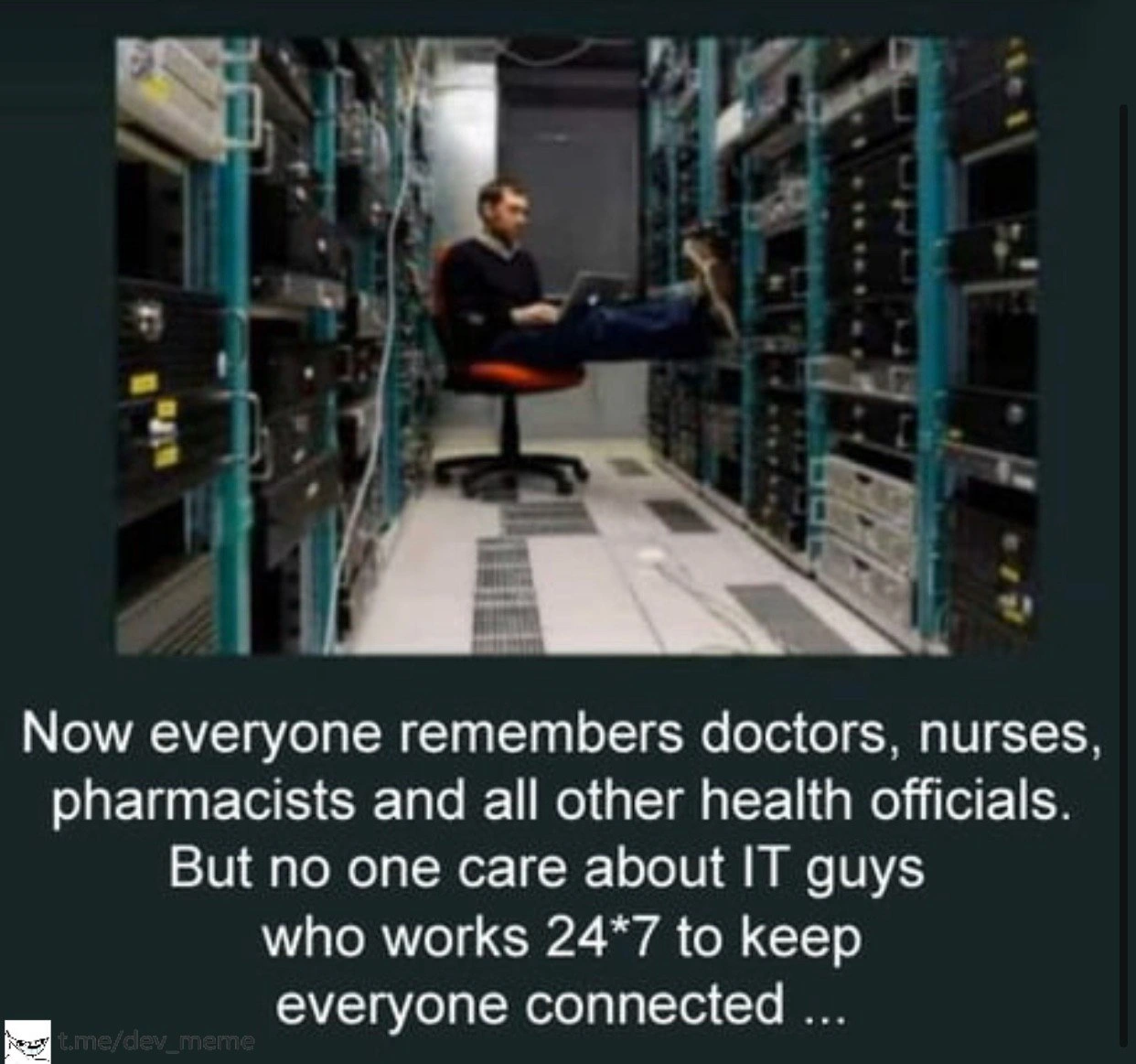
Let's break down what's happening here in simpler terms. The person in the photo is a systems administrator (or sysadmin for short). A sysadmin's job in systems administration is to manage and maintain computer servers and networks so that everyone else can use them without problems. Think of them as the caretakers of all the behind-the-scenes computers. The image shows a typical server room: those tall cabinets (racks) on both sides are filled with servers (powerful computers that run websites, applications, databases, etc.) and networking equipment (like switches and routers that direct internet traffic). All the cables you see — notably those blue Ethernet wires dangling around — connect these machines so they can communicate with each other. The floor is raised off the ground to allow cool air and wires to pass underneath, helping to keep the equipment cool and the cabling organized (servers can get hot, and nobody wants to trip over a thick cable).

Now, 24×7 operations means the systems are expected to run 24 hours a day, 7 days a week. Unlike a store that closes at night, a website or online service usually needs to be available all the time, especially if people around the world rely on it. For example, if we're talking about a company’s email server or a popular app, users might need it at any hour. That’s why companies set up on-call schedules. On-call duty is when a specific IT team member is responsible for handling any urgent problems that come up, no matter the time. They carry a work phone or pager and must respond if it goes off. If a critical server crashes at 2 AM, the on-call person’s phone will ring — often with a loud alert from a monitoring app like PagerDuty that basically shouts “Wake up! Server down!” — and they have to spring into action. Usually, the first step is to try and fix the issue remotely from home. Many problems can be solved by logging into the server over the internet (using tools like SSH) and restarting a service or adjusting a setting. But if that doesn’t work, or if it's a hardware failure (say a piece of equipment died), they might have to go in person to the data center. That’s exactly what the meme picture shows: a sysadmin who’s physically present in the server room, laptop in hand, probably after answering such an after-hours call. He’s essentially at ground zero of the issue, ready to pull out a faulty hard drive or plug in a loose cable if needed.

The term production in tech refers to the live environment that real users are interacting with. So a production issue means something is broken in that live system (for example, a website is down or a company’s internal network is unreachable) and it’s affecting people right now. It's the highest priority kind of problem because it disrupts normal operations. Production support is the work of fixing those issues and getting everything back to normal. This could involve a wide range of tasks: debugging software errors, rebooting servers, replacing faulty hardware, or even just turning something off and on again (the classic simple fix!). Because production systems have to be reliable, companies often promise targets like "99.9% uptime" to their customers or users. Uptime is the percentage of time the service is available. Achieving 99.9% uptime means at most only about 8 hours of downtime per year (and 99.99% would be about 1 hour per year). The only way to hit those kinds of goals is to have folks available to respond quickly whenever issues happen — even if that’s late at night or on a weekend. That's why on-call exists: to ensure that if something breaks at an odd hour, it gets attention immediately, keeping downtime as short as possible.

Now, what about DevOps and SRE? These are modern terms you might hear in tech companies. DevOps is a set of practices (a combination of "Development" and "Operations") that encourages software developers and IT operations folks to work closely together. Instead of throwing code over the wall for the sysadmins to deal with, developers and ops collaborate through the whole process. DevOps often involves a lot of automation and tools — for example, scripts to automatically set up servers or deploy updates, so there’s less manual work at 3 AM. SRE stands for Site Reliability Engineer. This role, which was popularized by Google, is kind of like a specialized sysadmin who uses programming and automation to improve reliability. SREs spend time writing code to automate tasks, building better monitoring systems, and generally making sure that the site/service stays up. But make no mistake, SREs also take part in on-call rotations. In many companies, the job titles might differ (Operations Engineer, Systems Engineer, DevOps Engineer, SRE, etc.), but all these folks are part of the broader infrastructure team responsible for running and protecting the systems. So whether we call the person in the meme a sysadmin or an SRE, the scenario is the same: this is the person on duty to fix things when the servers misbehave.

When the caption says "keep everyone connected," it's talking about keeping the network and online services working so that people can communicate and do their jobs. Imagine if your office’s internet went down during a workday — meetings would freeze, emails would stop, everyone would be stuck. The sysadmin or network engineer’s job is to prevent that, or quickly resolve it if it happens. During the COVID-19 pandemic, for instance, millions of people were suddenly working from home or attending school online. VPN (Virtual Private Network) servers — which let remote workers securely connect to their office network — had to handle far more load than ever before. Video conferencing services and collaboration tools saw huge spikes in usage. All that put a strain on IT infrastructure. The reason most of those services continued to work is because IT teams scrambled behind the scenes: they added more server capacity, optimized networks, and kept a 24×7 watch on systems to tackle problems the moment they popped up. It was an intense period for anyone in infrastructure roles. So "working 24×7 to keep everyone connected" isn’t just a figure of speech; in times like that, it’s practically what was happening.

It’s worth mentioning that this meme isn’t trying to take anything away from doctors or nurses. Rather, it's using a bit of humor to remind us that there are other heroes in less obvious places — like the IT department. When it says "no one cares about IT guys," it’s an exaggeration born from that feeling of being invisible. Within a company, people do appreciate their IT support (especially when they save the day!), but outside in society, you rarely hear, "Wow, thank goodness for those network engineers!" For someone new to tech, this highlights a part of the culture: a lot of IT and ops work is behind the scenes. If you become a sysadmin or SRE, you might not always get public credit when things go well, and you have to be okay with that. The reward is often internal — the personal pride of solving a tough problem and knowing that because of your actions, thousands of people can keep working or a major website stays online.

To put it simply, this meme is showing the life of an on-call IT hero. The guy lounging (probably momentarily) in the chair has likely been up for hours, making sure the servers are up and the network is stable. It highlights the often 24/7 nature of jobs in infrastructure management and support. Everything we rely on online — from social networks to email to critical business apps — lives on servers in places just like that room. And there are always people like him ensuring those servers are running happily. The humor has a bit of an edge to it, a mix of pride and frustration: pride in doing important work, and frustration that it's largely unnoticed until something breaks. For a junior developer or someone just entering IT, it’s a glimpse of the reality that beyond writing code, a huge part of tech is keeping systems running. And for everyone else, it’s a gentle reminder next time you enjoy seamless internet or cloud services: there's an army of unsung IT folks making that possible, one late-night shift at a time.

Level 3: Chasing Five Nines

Picture a typical high-stakes midnight scenario: it's 3:00 AM in a dimly lit server room. Our on-call sysadmin sits in that orange swivel chair, feet propped on a rack, with a laptop balancing on their lap. They’re running on caffeine and duty, surrounded by the hum of fans and the blink of LED indicators. Something has gone wrong in the infrastructure (doesn't it always at 3 AM?), and they're here to fix it. This meme captures that exact vibe of the OnCall_ProductionIssues grind, where the world sleeps while the IT people fight fires in silence.

The caption highlights a bitter truth that every seasoned ops engineer knows too well. During crises like the COVID-19 pandemic, society rightly showered appreciation on doctors, nurses, and other healthcare heroes. Meanwhile, the folks keeping our digital world alive — IT guys pulling all-nighters to maintain VPNs, cloud servers, and network uptime — got little public recognition. In early 2020, as offices went remote and internet traffic surged, these sysadmins and SREs were essentially first responders of the internet. They were racing to expand server capacity for online classrooms, shoring up hospital networks for telemedicine, and making sure everyone could stay connected. Yet, you didn’t see public service announcements thanking the "brave sysadmins who saved the day." That's the dark humor here: it’s pointing out the unsung_it_heroes of the tech world.

Industry veterans chuckle at this because it’s so relatable. In IT, if you do your job perfectly, nobody notices. Users just assume the cloud is magically self-healing. But the moment there's a glitch — say, an outage takes down the company website or your video call lags — everyone is suddenly frantic, and all eyes turn to the tech team: “What went wrong?! Fix it now!” As long as things are running smoothly, the contributions of the ops team remain invisible. This is a running joke in the ops community (the kind of thing you'd find in SysadminHumor or SREHumor threads): no news is good news when it comes to system uptime. A quiet day means you, the sysadmin, prevented issues before any user felt them. Of course, that preventative work doesn't earn you a parade or even a shout-out at the all-hands meeting; it's simply expected. But let one server catch fire, and the SysadminLife goes from invisible to under the spotlight (and not in a fun way).

The phrase 24×7 in the meme is not much of an exaggeration. Critical systems truly require round-the-clock attention. Companies often use on-call rotations to share the load, but during big incidents or on small teams, some poor IT soul really might be working almost 24 hours a day, 7 days a week. Even with rotations, being on-call means your peaceful night's sleep can be shattered by a phone buzzing with an alert at any time. (Murphy's Law of On-Call: if something is going to break, it'll break at the least convenient time — hello 3 AM on a Sunday.) Maintaining five nines (99.999%) uptime is practically a holy grail in infrastructure — it allows only a few minutes of downtime per year. To chase those nines, companies invest in redundant hardware, failover systems, and automation. But guess what? When the really weird outages happen, it still falls to a human to jump in. Automated monitoring might catch that a server’s CPU is overheating or the database locked up, but only a living, breathing human can truly untangle the messy reality and get things back on track. So our sysadmin here is essentially the last line of defense, sacrificing sleep and sanity to meet those reliability targets (often defined in formal SLAs (Service Level Agreements)). It's a tough gig: your work is mission-critical, yet if you succeed perfectly, end-users will just shrug and say, "Was there ever a problem?"

The photo itself tells a story that makes seasoned techies smirk. Those tall server racks full of machines are the beating heart of some service or network. Each box could be a database server, a web server, a storage unit, or a network switch. Notice the tangle of Ethernet cables running along the side and that one loose power cord snaking across the floor tiles. To an experienced eye, that stray cable is a familiar sight — probably a quick workaround deployed during some emergency. Perhaps a switch failed earlier, and in the heat of the moment, the sysadmin strung a temporary power line or network patch cable across the aisle to bypass the issue. At 3 AM, you don't have time to meticulously re-lace every cable; you just get things working again. We chuckle because we've been there: stepping over a spiderweb of wires that we ourselves hastily ran in a panic, thinking "I'll clean this up later" (but later might not come until someone trips on it). The raised floor in that room is also classic data center design: underneath those tiles are cold air vents and thick bundles of cables. Data centers use raised floors to manage cooling and wiring. The meme's dim lighting and the solitary figure evoke that sense of isolation that comes with being the only person awake and working while the world sleeps — a scene every on-call engineer knows intimately.

There’s an old scenario every sysadmin understands: if you prevented a disaster, people assume there was never a threat to begin with. In 1999, countless IT teams labored quietly for months upgrading systems to avoid the Y2K bug. When January 1, 2000 arrived and no catastrophic failures occurred, many folks shrugged it off as overblown hype, not realizing it was the sysadmins’ victory that nothing happened. It’s the same pattern: if you do everything right, it seems like you didn’t do anything at all. This meme channels that exact feeling. It’s not knocking the praise that doctors get (healthcare workers absolutely deserve it); it’s just wryly noting that IT professionals fought their own kind of battle to keep the world running, and hardly anyone outside our field even knows. Within tech circles, though, we get it. We share these ServerRoomStories and pat each other on the back with a knowing grin.

From an Infrastructure and DevOps_SRE point of view, the scene is a reminder of why reliable backend systems and the people who maintain them are so crucial. Modern DevOps practices try to bridge development and operations, encouraging things like "automate all the things" and "design systems to be self-healing." And yes, we have made progress — auto-scaling servers, redundant networks, etc. But no matter how much automation you throw at the problem, there will always be those bizarre 3 AM emergencies that no script can fix without human creativity and decision-making. Site Reliability Engineering (SRE) as a discipline even acknowledges this with concepts like error budgets and on-call rotations to prevent burnout. They aim for a sustainable approach so that the on-call person isn’t literally a zombie working 24×7. Yet here we are: someone still has to be the knight holding vigil overnight.

The meme strikes a chord because it's a salute wrapped in a complaint. As experienced devs or sysadmins, we find it funny in a "haha, it's true" way. We’ve all had that feeling after restoring a critical service at odd hours: the satisfaction that we saved the day, mixed with the realization that hardly anyone will ever know or appreciate it. This image of the lone IT guy in the data center, casually keeping the network alive while others sleep or applaud someone else, perfectly encapsulates that reality. It's a little comic and a little tragic. But if you're in this line of work, you wear it as a badge of honor. You laugh at the meme, maybe share it with the team at your next morning stand-up, and then you carry on — ready to dive back into the fray whenever (inevitably at the worst time) the next problem arises.

Description

The meme consists of a photograph and text below it. The photo shows a man, presumably a system administrator or IT professional, sitting on an office chair in a narrow aisle between two tall racks of servers in a data center. He has his feet propped up on the server rack opposite him and is working on a laptop. The text below reads: 'Now everyone remembers doctors, nurses, pharmacists and all other health officials. But no one care about IT guys who works 24*7 to keep everyone connected ...'. The image and text, posted in May 2020, capture the sentiment among IT professionals during the early COVID-19 pandemic. While healthcare workers were rightly celebrated as frontline heroes, the critical infrastructure that enabled remote work, communication, and online services was maintained by IT staff who felt largely invisible. The humor is slightly ironic, as the man in the picture appears relaxed, which is often the sign of a well-maintained, stable system - the very goal of a 24/7 operations team
Comments

7
Anonymous ★ Top Pick Of course no one notices IT. 99.999% uptime just looks like a guy with his feet up
  1. Anonymous ★ Top Pick

    Of course no one notices IT. 99.999% uptime just looks like a guy with his feet up

  2. Anonymous

    Behind every proudly advertised “five-nines” SLA is a sleep-deprived sysadmin shivering in a server aisle, hot-patching BGP at 03:00 so your Slack reaction can render in under 100 ms

  3. Anonymous

    While everyone was discovering what 'mute yourself' meant, we were the ones explaining why turning it off and on again wouldn't fix the fact that half the internet was trying to use Zoom simultaneously on infrastructure designed for cat videos

  4. Anonymous

    While the world applauds healthcare heroes, somewhere in a climate-controlled data center at 3 AM, a sysadmin is SSH'd into a production server, frantically running `systemctl restart networking` because Karen from Marketing can't access her email. The SLA doesn't care that it's Saturday, the monitoring alerts don't take holidays, and that PagerDuty notification at 2 AM doesn't distinguish between 'minor hiccup' and 'the entire CDN is on fire.' But sure, let's celebrate with another pizza party while the NOC team keeps civilization's digital plumbing flowing - because nothing says 'we value you' quite like being the only thing standing between global connectivity and complete chaos, armed with nothing but SSH keys, a runbook from 2015, and the faint hope that this time, turning it off and on again will actually work

  5. Anonymous

    Ops: the only team whose OKR is "nothing happens," until a 3 a.m. expired cert reminds the company that uptime isn’t a law of physics

  6. Anonymous

    Doctors battle viruses with vaccines; IT battles outages with VLANs - zero fanfare, eternal vigilance

  7. Anonymous

    We completed the cloud migration - I'm reseating a NIC in aisle B at 03:17, so apparently our “cloud” still requires badge access

Use J and K for navigation