The dev team's reaction to unethical data requests
Why is this DataPrivacy meme funny?
Level 1: Selling Secrets
Imagine you have a diary where you write your secrets and private thoughts. You trust that no one else will read it without your permission. Now suppose the school principal (like the boss of a school) comes to your class and says, “Hey, let’s take everyone’s diaries, read all the secrets, and sell them to make some money!” 😳 You and your friends would immediately feel this is very wrong. You’d probably sit in stunned silence, thinking, “Did the principal really just ask us to betray our friends’ trust for money?”
In this meme, the CEO is like that principal, and the users’ private data is like those diaries full of secrets. The dev team (the people who build the app) are like the kids in the class who know it’s a bad idea. Their faces show they’re uncomfortable and unhappy. They don’t want to share personal secrets without permission because they know it’s not right and people will be hurt or upset. It’s basically showing that telling someone else’s secrets to gain something (like money) is a bad plan. The reason it’s funny is because it’s so obviously a bad idea that everyone just freezes with a “Did you seriously just say that?” look. In simple terms: the boss’s plan is to do something wrong, and the team’s blank reaction is the only sensible response – they know you should never trade trust for profit, just like you wouldn’t sell your friend’s secrets for candy.
Level 2: Consent Crash Course
For those not steeped in tech jargon, let’s break down what’s happening. The CEO basically suggests: “Let’s use all the user’s personal data however we want, to make more money, and not bother asking permission.” This is what we mean by “violate user’s privacy.” User privacy is about respecting personal information — things like names, emails, locations, messages — and not abusing or sharing it without consent. When someone signs up for an app, they trust the company to handle their data responsibly. Here, the boss is pushing the devs to betray that trust for profit. 😬
Now, developers (even fresh junior devs) are taught the importance of privacy and consent. You know those pop-ups on websites asking if you accept cookies, or app notifications saying “This app wants to access your photos”? That’s part of consent management. It’s the practice of giving users a choice in what data is collected and how it’s used. A plan to “violate user privacy” likely means skipping those choices — collecting everything quietly and using it in ways the user never agreed to. It’s like turning on all the tracking features by default and not giving folks an opt-out. 📉 Not good.
Let’s introduce GDPR, a big term the dev team in the meme would be painfully aware of. GDPR (General Data Protection Regulation) is a strict privacy law in the European Union. It basically says companies must ask permission (consent) before using personal data and must protect that data from misuse. If a company fails to do so, they can get huge fines or other penalties. So when the CEO floats a plan to exploit user data freely, any developer who knows about GDPR is going to cringe. It’s like a huge “DO NOT CROSS” line is being crossed. Other places have similar rules (like CCPA in California), all aiming to protect people’s information. In developer terms, user data isn’t an unlimited free resource; it comes with responsibility attached.
Another concept here is Privacy-by-Design. This means building software with privacy in mind from the start. For example, collecting only the data you actually need, securing it properly, and being transparent with users about it. Many dev teams pride themselves on these principles. If you’ve ever heard a developer say, “Do we really need to store this information?” that’s Privacy-by-Design thinking. Now imagine the CEO essentially saying, “Forget all that, let’s gather everything and sell it.” It’s the exact opposite approach, and it undermines everything these developers have learned about ethical software development. No wonder their faces in the meme look like 😐 “uhh, this is not okay.”
This meme also highlights a real corporate_culture issue: sometimes business leadership (CEOs, managers, etc.) focus so much on growth or profit that they ignore the advice of their technical teams. It’s a common friction point. Developers often have to remind their non-technical bosses about important things like security, user trust, and legal obligations. When those warnings are ignored, you get that awkward silence — the dev team thinking, “Should we speak up? Do they seriously expect us to go along with this?” It’s both funny and uncomfortable because it happens: bosses propose something wild, and the room goes quiet, aside from maybe one nervous cough.
We also see an ethical_dilemma here. An ethical dilemma means a tough choice between doing what’s right and what’s being asked of you (especially when what’s being asked is wrong). The dev team likely knows that violating privacy is wrong — both morally and for the company’s long-term health. But they’re being pressured by a powerful figure (the CEO). That’s stakeholder_pressure: when someone with a stake in the project (often a boss or client) pushes the team to meet their demands. Junior devs experience this too, like when a manager insists on rushing a feature that you know is buggy. In this case, it’s not just a buggy app at risk, but users’ personal information and trust. Realizing your higher-up is willing to cross lines can be pretty disheartening for a developer at any level.
In simpler terms, this scenario is the classic privacy_vs_profit tug-of-war. The CEO is squarely on the “profit” side, seeing user data as dollar signs. The dev team is on the “privacy” side, understanding the value of user trust and the rules in place to protect it. The dev_team_reaction (those blank, conflicted stares) is basically the team thinking, “Is making a quick buck worth breaking our users’ trust and possibly the law? Nope.” Their silence speaks volumes. It’s a mix of shock, concern, and a tiny hope that maybe the CEO is just joking. (Pro tip: If your team thinks your big idea must be a joke, it’s probably not a good idea 😅.)
So, to recap at this level: The meme is funny to developers because it’s a PrivacyHumor scenario many recognize. Management comes up with a sketchy plan, and the devs react with a collective nope. It teaches anyone observing that in tech, protecting user privacy is a big deal, and when higher-ups ignore that, it creates tension and ironic humor. The tags like DataPrivacy, PrivacyConcerns, and ManagementHumor all point to this exact divide – those who worry about doing the right thing vs. those who worry about the bottom line. And the DeveloperHumor here? It’s in that knowing, here-we-go-again look on the engineers’ faces when confronted with a ridiculously bad idea from the top.
Level 3: 404 Ethics Not Found
Picture a conference room where the CEO excitedly unveils a "brilliant" new revenue idea: harvest every ounce of user data and monetize it—permission? who needs it! The dev team’s reaction is the meme image: a deadpan, you-can’t-be-serious stare. This is a textbook clash of DataPrivacy principles with cutthroat CorporateCulture. Seasoned engineers immediately recognize the red flags. They’ve sat through countless security reviews and privacy-by-design meetings, and now the boss suggests tossing all that out the window. It’s like hearing someone propose DROP TABLE Users; in prod as a feature.
From an experienced dev’s perspective, the humor (and horror) comes from how tone-deaf this executive directive is. We all know a stakeholder pressure moment when we see it: a higher-up fixated on short-term profit, utterly blind to the technical and ethical debt it creates. The CEO likely sugarcoated the plan with buzzwords: "unlock customer insights," "data-driven monetization," etc. But all the devs hear is "violate GDPR, invite lawsuits, and nuke user trust". This is where the tag ceo_privacy_justification comes in—the boss has rationalized the scheme (“everyone’s doing it, we’ll rake in profits!”), but the team knows it’s snake oil.
PrivacyConcerns aren’t just abstract ideals for veteran developers; they’re daily responsibilities. These devs have implemented cookie consent banners, built encrypted databases, and ensured compliance with laws like GDPR (General Data Protection Regulation). They know personal data is more like uranium than gold: handle it wrong and you’re facing a meltdown. For context, GDPR can fine a company up to 4% of global revenue for serious privacy violations. That’s “close the company” money. So when the CEO blithely suggests a plan that screams “Hello, GDPR fines!”, the team’s blank stare is half Are you insane? and half Do you want to get us all sued?
Let’s not forget the ethical_dilemma plaguing these engineers. Many developers genuinely care about user privacy—it’s part of their professional ethics (and often their personal pride). Being told to betray that for profit feels dirty. It’s a surefire way to kill morale faster than a 3:00 AM sev-1 pager. This meme nails that shared experience: the uncomfortable silence when leadership proposes something that everyone in the trenches knows is wrong. It’s a mixture of disbelief, disappointment, and a dash of dark humor: “We’ve finally reached peak corporate ethics: not.”
Historically, we’ve seen this movie before. 🤦♂️ Privacy vs profit is an age-old battle in tech. Remember the Facebook-Cambridge Analytica scandal? A platform pushing the limits of user data exploitation led to public outrage, congressional hearings, and the #DeleteFacebook movement. Or when major companies got burned by secret data collection (looking at you, large tech firms that needed to apologize and backtrack)? Those fiascos live rent-free in developers’ heads. Veteran devs know that violating user privacy isn’t a bold innovation—it’s a mistake with very predictable consequences. In strong engineering cultures, someone would stand up and shout, “This violates our principles!” But in dysfunctional ones, you get this meme: a team silently processing the request like it’s an unhandled exception in the company’s moral code.
The DeveloperHumor here has a bittersweet edge. It’s funny because it’s true: tech workers often have to listen to higher-ups pitching questionable schemes. The devs in the image look morally conflicted because they’re imagining the fallout:
- Legal nightmares: compliance officers frantically citing DataPrivacy laws, regulators knocking on the door.
- User backlash: customers discovering their data was misused, resulting in lost trust and deleted accounts.
- Dev on-call misery: being woken up at 3 AM to handle the PR fire or a data breach caused by this very plan (because Murphy’s Law loves unethical shortcuts).
In short, the meme highlights a corporate_ethics failure in a way every experienced engineer gets. The CEO’s proposition isn’t just a little off—it’s a full-on HTTP 418 I’m a teapot level request (i.e., utterly ridiculous). The dev team’s silent, stunned reaction is the punchline. They’re mentally calculating how many ways this could go wrong, from PrivacyConcerns to engineering integrity, and wondering if their LinkedIn is up to date. The humor lands because it’s a scenario that walks the tightrope between absurdity and reality — an all-too-familiar “WTF, management?!” moment etched in every senior dev’s memory.
Description
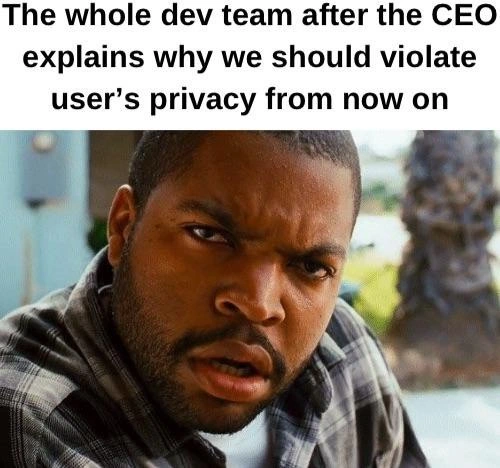
A popular reaction meme. The top part has white text on a black bar that reads, 'The whole dev team after the CEO explains why we should violate user's privacy from now on'. The bottom part of the image is a close-up photo of the actor Ice Cube, who is looking at the camera with a furrowed brow and an expression of intense skepticism, disgust, and disbelief. This meme format is used to represent a strong, negative, and judgmental reaction to a statement or situation. The joke centers on the common ethical conflict between business objectives (like aggressive data monetization) and engineering principles that prioritize user trust and data privacy. For experienced developers, this is a deeply relatable scenario, reflecting the pressure they can face to implement features that cross ethical boundaries
Comments
16Comment deleted
That's the face a senior engineer makes right before they ask, 'Could I get that request in writing, preferably with a signature from legal?'
Happy to code the new data-siphon, boss - just need to know which namespace you’d like the €20 000 000 GDPR fine deployed to: prod, staging, or investor-relations?
After 15 years of implementing GDPR compliance, zero-trust architectures, and end-to-end encryption, nothing quite prepares you for the quarterly board meeting where 'user engagement metrics' suddenly outweigh the entire privacy policy you helped draft - time to update that LinkedIn profile to 'actively interviewing.'
That moment when the CEO's 'innovative growth strategy' translates to implementing third-party tracking pixels, fingerprinting users across sessions, and storing PII in plaintext S3 buckets - and you realize your next sprint is basically speedrunning GDPR violations while your LinkedIn profile still says 'Passionate about building user-centric solutions.'
CEO flips consent to 'opt-out optional'; devs contemplate forking the entire ethics repo
Engineering plan: implement 'collect everything' behind feature flag privacy_violation_enabled=false, rollout strategy 'never', gated by a DPIA that never passes
Great, so the new architecture is event-driven: user click -> Kafka -> S3 -> subpoena
oh yeah? Comment deleted
cc @RiedleroD Comment deleted
If the CEO wants to go to jail, who are we to stop him? Developers need not bother with user privacy, PII, or the like, as they bear no legal accountability. Comment deleted
Tell it to tornado cash devs Comment deleted
How do you equate an open-source project, where developers are the management and it's designed and used for money laundering, with violations of user privacy? Comment deleted
I'm just refering to this statement, there are legal burdens on the developers too Comment deleted
They are not just developers - they are founders, operators, and beneficiaries, which makes them owners and therefore responsible. Beside, violating user privacy isn't always a crime. For instance, if it's an internal tool, if there is a plan to obtain a license for handling PII, or if it's merely a proof of concept and not actual software, privacy violation isn't an issue. As a developer, you can't predict management's intentions or be held liable for them. Negligence suggests an error, but in this scenario, the CEO intentionally directed the design. Comment deleted
Even if you work in a company, yea you might not be the data owner but if a negligence it's proven to be your fault you could be found legally responsible Comment deleted
Again, I'm just refering to the frase "Developers need not bother with user privacy [...] as they bear no legal accountability" which is untrue in a broader sense Comment deleted