Skip to content
DevMeme
5232 of 7435
Festive Security: The OWASP New Year's Meetup
Security Post #5739, on Dec 15, 2023 in TG

Festive Security: The OWASP New Year's Meetup

Why is this Security meme funny?

Level 1: Who’s Got the Master Key?

Imagine a group of neighbors having a little holiday gathering to talk about home safety. They’ve put up colorful lights and even wear Santa hats to keep things festive. The idea is to learn how to keep everyone’s house secure – like making sure doors are locked and not giving out your keys carelessly. In the middle of this serious-but-friendly chat, one neighbor jokes, “Hey, did anyone bring the master key that opens every house?” The others all laugh because it’s a funny, ironic question. It’s like they’ve been saying “be careful, don’t give anyone total control,” and then someone asks if a universal key is floating around! The joke makes everyone smile, mixing an important safety lesson with some holiday cheer.

Level 2: Holiday Lights & Admin Rights

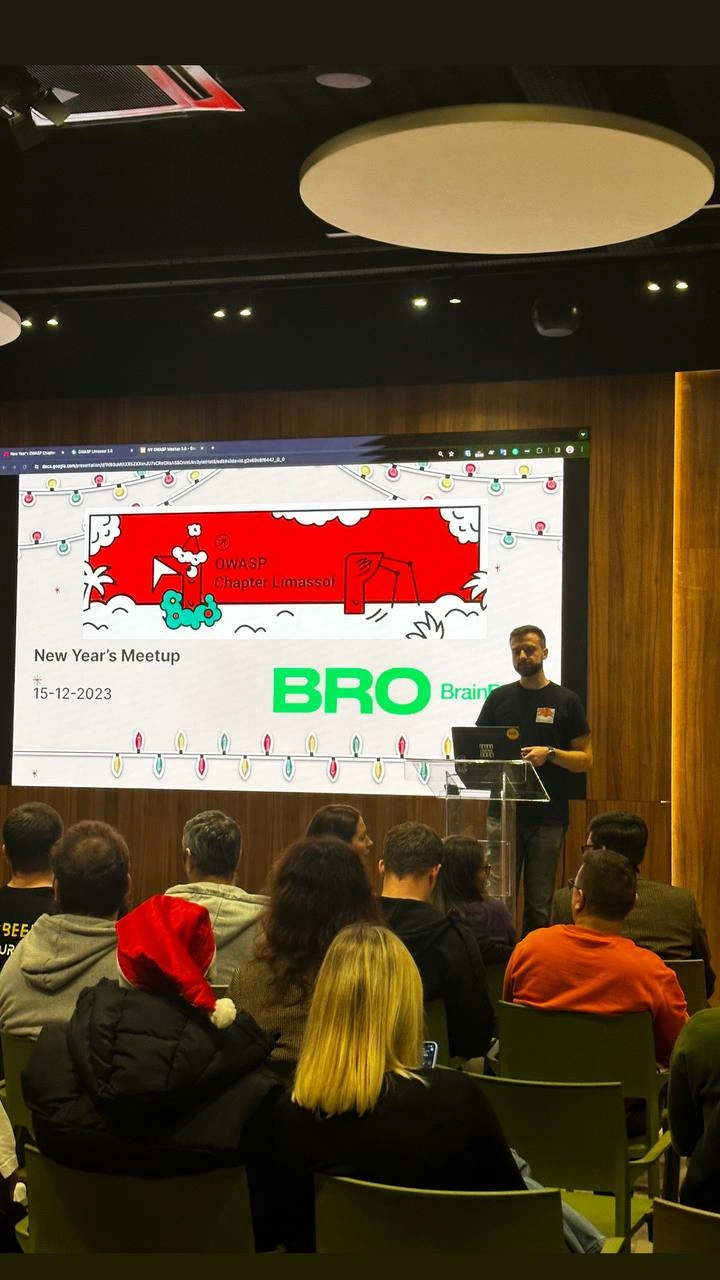
This image is from a real developer community event where programmers and security enthusiasts gathered to talk about keeping websites safe. It’s an OWASP meetup – OWASP stands for Open Web Application Security Project, an organization that helps everyone learn about web security. The slide on the big screen literally says “OWASP Chapter Limassol – New Year’s Meetup 15-12-2023.” In plain terms, the local OWASP group in that city (Limassol) held a special end-of-year meeting on December 15, 2023. They even made it festive: notice the string of cartoon holiday lights around the slide and someone in the audience wearing a Santa hat! 🎅 The organizers wanted a fun holiday vibe while discussing serious security topics. It’s common to mix security awareness with a bit of celebration to keep things engaging. This meetup is basically like a small tech conference session: a knowledgeable speaker presents a topic, and the audience can learn and ask questions in a friendly setting.

In the photo, a speaker is standing at a clear podium giving a presentation. The bright green BRO Brain text on the slide is likely the name of a sponsor or a project being discussed. (Often, local tech meetups have sponsors – maybe a company named “Brain” – who help support the event.) Everyone is seated and listening attentively. These attendees might be developers, students, or IT professionals who came to learn about the latest in application security. The atmosphere is friendly and enthusiastic; you can tell people are interested in the talk (and the Santa hat shows they’re having a bit of fun, too!).

Now, the meme caption says: “Is any of you there with admin today? 🤔😂” Let’s break down that joke. In computer terms, an admin (short for administrator) is a user account that has full control of a system. Think of the admin as the “boss” of a computer or network – an admin can install software, change settings, access any file, and generally do anything. Because admins have so much power, we usually protect those accounts with extra care (using strong passwords, and only using admin mode when necessary). The question “Is any of you there with admin?” is basically asking, “Hey, does anyone here have administrator access right now?”

Why would that be funny at a security meetup? Well, the whole point of an OWASP meeting is to teach developers how to secure their applications – which includes not using admin accounts recklessly! It’s a tongue-in-cheek comment. Imagine the presenter is about to show a cool hack or run a security testing tool, and suddenly they realize they need an admin password on the computer to continue. It’s ironic because everyone in the room has been saying “don’t use admin privileges unless you must,” yet here they might actually need those privileges to proceed. It’s the kind of little joke people in the room would appreciate, because they all understand the trade-off: sometimes you can’t get the job done without that special access, even though you tell everyone to be very careful with it.

To give more context, one of the tools that might be demonstrated is OWASP ZAP (which stands for Zed Attack Proxy). OWASP ZAP is a free program that helps find weaknesses in web applications – basically, it acts like a friendly “attacker” to test your website so you can fix issues before real attackers come along. If the presenter was showing how to use ZAP to test a website’s security, they might need to do things like see encrypted web traffic or install a testing certificate on the computer. Often, actions like installing software or certificates require – you guessed it – admin rights! If someone’s laptop is locked down by their company (which is common at workplaces), they’d have to ask, “Um, is there an admin around who can help me do this?” So the meme’s question captures that scenario in a humorous way. It’s simultaneously a practical request and a playful nod to the fact that admin privileges are a big deal in security.

Overall, for someone new to this, the meme shows how developer communities like OWASP combine learning with a sense of fun and camaraderie. People come together in person (in a classroom or small auditorium) to talk about topics like “how to stop hackers from breaking into your website” or “common mistakes that make apps unsafe.” They listen to a speaker, watch demos, and ask questions. The holiday theme – the decorative lights on the slide, the Santa hat in the crowd – makes it feel like a friendly end-of-year gathering rather than a formal lecture. And even though the subject is serious (keeping software safe), the group isn’t above making a nerdy joke about needing an admin password. It helps everyone relax and remember that they’re all there to learn and have a good time as a community.

Level 3: Root of Festivity

If you’ve ever attended a local OWASP chapter meetup, you know the scene: a bunch of security-minded developers and testers gathered in a room, a presenter at the podium, and slides about web vulnerabilities on the big screen. In this photo, the slide proudly shows “OWASP Chapter Limassol – New Year’s Meetup 15-12-2023” decorated with holiday string lights, and even a giant green BRO Brain logo (likely a sponsor’s branding). The audience is huddled in rows, with one attendee rocking a bright red Santa hat. It’s a delightful collision of security awareness and festive cheer – something seasoned devs find both endearing and ironic.

The meme’s caption jokingly asks, “Is any of you there with admin today? 🤔😂” which immediately gets a chuckle from experienced engineers. Why? Because “admin” in this context means an account or user with god-level access on a system – the keys to the kingdom. In a room full of security enthusiasts, asking if someone is “with admin” is deliciously ironic. These are people who spend their days warning developers not to browse as Administrator or leave admin accounts unguarded. Yet here we are, at a security meetup, and someone quips about needing an admin. It’s the kind of inside joke that makes everyone smirk and nod knowingly.

Seasoned devs have all been there: you’re about to demo a cool hacking tool or deploy a fix, and boom – you realize you don’t have the rights to do something critical on the machine. 😅 Maybe the speaker wanted to show how to intercept HTTPS traffic using OWASP ZAP (an open-source web security scanner) and needed to install a proxy certificate – only to be hit with a pop-up saying “Administrator privileges required.” In a security gathering, that scenario is both absurd and totally plausible. The crowd will half-tease, half-sympathize because they’ve all had to flag down an IT admin at the worst possible time. It’s a shared rite of passage in tech: the demo gods demand an admin password tribute exactly when you least expect it.

There’s a deeper satisfaction in that joke too: it hints at the principle of least privilege – a fundamental security concept that says users should operate with the minimum rights necessary. Everyone in that OWASP meetup preaches “Don’t run as Admin unless you have to.” And right on cue, someone actually needs to run as admin to get the job done. The irony isn’t lost on the veterans. It’s like discussing fire safety and then someone asking, “Anyone got a lighter?” It playfully highlights the gap between theory and real-world practice. In theory, we lock down everything; in practice, we’re sometimes scrambling because we locked it down too well and now can’t get our own work done without an override.

Furthermore, “admin” triggers memories of countless security horror stories. Experienced folks recall that many breaches start with an admin account – either a default credential like admin:admin left unchanged (yes, that still happens embarrassingly often) or some poor soul using an admin login for day-to-day work and getting phished. The OWASP community has been raising awareness about these pitfalls for years. In fact, Broken Access Control (like normal users sneaking into admin-only pages) and mismanaged admin credentials are high on the OWASP Top 10 list of web application risks. So an offhand question about “who’s with admin” winks at that collective memory. It says, “We know admin rights are powerful and risky, but we’ve all needed them – even here, even now.”

By blending a New Year’s party vibe with serious application security talk, this meetup shows how far dev culture has come. Decades ago, security was often an afterthought – something left for the ops team or an after-work crisis. Now, devs volunteer their free time to attend talks on XSS and SQL injection, all while wearing Santa hats and sharing cookies. That is developer community spirit at its finest. The presence of a sponsor logo on the slide (BRO Brain) is also telling – veteran attendees know that community events lean on local companies for support, whether it’s funding, freebies or just a venue. The name “BRO” might even get a grin from old-school network engineers who remember Bro (now called Zeek) as a famous network monitoring tool. Whether that’s intentional or a happy coincidence, it fits perfectly in a room of security geeks.

In short, this meme captures a moment that seasoned developers adore: a bunch of passionate tech folks coming together to make the web safer, having a laugh about admin permissions, and proving that even the most security-conscious people can share a joke about the very rules they enforce. It’s that mix of knowledge, experience, and camaraderie – all wrapped in holiday lights – that makes this scene both humorous and heartwarming for anyone who’s been around the IT block.

Level 4: From Root to Ring 0

At the deepest technical level, this meme touches on the fundamental concept of privilege in computing. In an operating system, not all code or users are equal – some have higher authority. Historically, early multi-user systems (think 1960s mainframes and later UNIX in the ’70s) introduced the idea of a superuser. On Unix/Linux this all-powerful account is called root, and on Windows it’s the Administrator account. These accounts can do anything on the system. Why do they exist? Because the system needs a trust anchor – someone who can install software, manage other users, and configure the system at the lowest level. It’s analogous to having a master key for a building: the key exists so that maintenance or emergencies can be handled, but if that key falls into the wrong hands, every room can be opened.

Under the hood, modern CPUs and operating systems enforce this with privilege levels. For example, x86 processors have protection rings (Ring 0, Ring 1, etc.), where Ring 0 is typically the kernel (the core of the OS) running with full hardware access. When you log in as an admin on your computer, you can request the OS to do things that regular users cannot – essentially, your commands can transition from a less-privileged ring (say Ring 3 for user applications) into Ring 0 via system calls. This is how an admin action (like installing a driver or opening a protected file) gets done: the OS checks “Are you an admin?” and if yes, executes the sensitive operation in kernel mode. If not, you get a “permission denied” error. This hardware-enforced hierarchy is critical: it prevents an ordinary program (or malware) from, say, turning off security features or reading another program’s memory – unless it somehow escalates privileges to admin level.

The notion of limiting access led to the well-known Principle of Least Privilege in computer security. Formally introduced by Saltzer and Schroeder in 1975, it means each user or program should operate with the minimum privileges necessary, and only elevate to a higher privilege (like admin) when absolutely required. This principle has guided the design of both software and corporate policies. For instance, it’s why your everyday login on a modern system isn’t supposed to be an admin account, and why tools like sudo in Linux or User Account Control (UAC) prompts in Windows exist – they act as gatekeepers. They make sure that even if you are an administrator, you consciously approve any high-risk action.

In the context of the OWASP meetup photo, that principle is part of the collective mindset. OWASP’s mission is to make security best practices (like least privilege) common knowledge among developers. Web applications often mimic these operating system ideas: they have roles (admin, user, guest) and must ensure, for example, that a regular user can’t simply pretend to be an admin by visiting an admin URL or altering a cookie. The OWASP Top 10 list of web vulnerabilities frequently highlights issues with broken access control – essentially cases where the application failed to enforce who is admin versus who isn’t. So the joke about “who’s with admin” has an extra nerdy layer: it subtly nods to the importance of proper access control. It’s as if someone at a bank’s security seminar joked, “Did anyone bring the universal vault key?” – it immediately evokes why that key is so critical and why you guard it with your life.

Security professionals and seasoned devs also think about the worst-case scenarios here. In advanced discussions, one might bring up credential rotation, two-factor authentication for admin accounts, or even more granular security models. For example, some operating systems and databases implement role-based access control (RBAC), where even admin powers can be scoped or split among roles (to avoid having one super-admin who can do everything). In cutting-edge systems, there are ideas like capability-based security, where instead of one omnipotent identity, you have unforgeable tokens (capabilities) that grant specific rights – no single token grants all rights. These approaches are designed to mitigate the inherent risk that comes with that “master key.” But regardless of the mechanism, the core idea remains: limit broad access, and whenever someone does have it, be very mindful.

This meme encapsulates that in a lighthearted way. It’s funny on the surface – someone at a security talk joking about needing the very thing we’re told to avoid using casually – but it’s also rooted (pun intended) in decades of computer science principles. From the hardware level (Ring 0 privileged instructions) to the software policies (least privilege, RBAC), the concept of an admin user is central to how we design secure systems. And ironically, it often takes a real-life moment (like a projector requiring an admin login) to remind us that these theoretical ideas have everyday implications. Even in a holiday-decorated auditorium, with laughter in the air, the laws of computer security are always in play.

Description

A photograph taken from the audience's perspective at a tech event. On a stage, a male speaker stands behind a podium with a laptop, addressing the crowd. Behind him, a large screen displays a presentation slide with a festive, holiday theme, including illustrations of Christmas lights. The slide reads 'New Year's Meetup', '15-12-2023', and 'OWASP Chapter Limassol', with a logo for 'BRO Brain' also visible. The audience is seated and facing the stage; one person in the foreground is wearing a red Santa hat, adding to the holiday atmosphere. This image captures a moment from a real-world developer community event, specifically a local chapter meeting for OWASP (Open Web Application Security Project). For a technical audience, this signifies the importance of continuous learning and community engagement, even during the holiday season, focusing on critical topics like web application security
Comments

39
Anonymous ★ Top Pick The OWASP holiday meetup: the only party where you discuss preventing cross-site scripting while simultaneously hoping the venue's guest Wi-Fi isn't vulnerable to a man-in-the-middle attack
  1. Anonymous ★ Top Pick

    The OWASP holiday meetup: the only party where you discuss preventing cross-site scripting while simultaneously hoping the venue's guest Wi-Fi isn't vulnerable to a man-in-the-middle attack

  2. Anonymous

    OWASP holiday meetup rule: the moment someone in a Santa hat asks “who’s got admin?” you rotate every key in prod - last year we found out Log4Shell doesn’t count as seasonal décor

  3. Anonymous

    The only security vulnerability at an OWASP meetup is the speaker's confidence when the demo gods decide to strike mid-presentation - that's why we always deploy to production first and call it 'live testing'

  4. Anonymous

    Nothing says 'we take security seriously' quite like an OWASP meetup where someone wore a Santa hat - because the only thing getting compromised tonight is the eggnog at the after-party. Though given it's mid-December and they're calling it a 'New Year's Meetup,' I suspect their sprint planning is about as accurate as their threat modeling timelines

  5. Anonymous

    The real MVP of any dev meetup: the coffee machine that hasn't 500'd yet

  6. Anonymous

    OWASP New Year’s meetup: where XSS got rebranded as “prompt injection” and the decade-old input sanitization ticket finally made the AI roadmap

  7. Anonymous

    OWASP meetup in December: least-privilege applies to the backlog; sponsor logos get admin while CSP/SSRF fixes get 'risk accepted until after freeze'

  8. dev_meme 2y

    I mean, who knows, would be cool to meet if someone is also there ;)

  9. dev_meme 2y

    wtf, i worked there dude, maybe I've seen you 🥴

    1. dev_meme 2y

      BRO, you are channel 💀

      1. dev_meme 2y

        not a problem

        1. dev_meme 2y

          huh

          1. dev_meme 2y

            nyaaaaa

            1. @RiedleroD 2y

              either way, nya!

  10. @callofvoid0 2y

    ain't he ukrain's president ?

  11. @ledzz1994 2y

    lol admin are you from limassol kalispera file mu

    1. dev_meme 2y

      Relocated to the island just 2 weeks ago :)

      1. @ledzz1994 2y

        Welcome then😊

        1. dev_meme 2y

          Thanks! And good evening to you too 😉

  12. @c137zod 2y

    Χαιρετε!

    1. @sylfn 2y

      tr Hello (gr>en) please use English in this chat

  13. @SamsonovAnton 2y

    Writes code on paper to avoid side effects. 😆

  14. Deleted Account 2y

    so C is the real chad and hero here

  15. @CcxCZ 2y

    You silly monoglots.

  16. @CcxCZ 2y

    Using own language in own operating system on own CPU architecture:

  17. @purplesyringa 2y

    I'm all four of those depending on who I'm talking to

  18. @purplesyringa 2y

    yeah that's about right

  19. @ZgGPuo8dZef58K6hxxGVj3Z2 2y

    oh it works again? XD

  20. @purplesyringa 2y

    @yuki_the_girl delete this

    1. @sylfn 2y

      done

  21. @sylfn 2y

    why

    1. @vrex141 2y

      Who knew you shouldn’t press on it🤷‍♂️

      1. @sylfn 2y

        would you press the "download" button?

        1. @vrex141 2y

          Every one, send it

          1. @sylfn 2y

            i have none

  22. @lord_nani 2y

    I see button I press button😟

  23. @lord_nani 2y

    Oh shit, rebellion

  24. @sylfn 2y

    turns out that blue text bot is deleted

    1. @sylfn 2y

      how long was i sleeping

Use J and K for navigation