Skip to content
DevMeme
5230 of 7435
The reality of power distribution in a high-end PC
Hardware Post #5737, on Dec 13, 2023 in TG

The reality of power distribution in a high-end PC

Why is this Hardware meme funny?

Level 1: Big Gulp, Tiny Drip

Imagine you have two friends and a big jug of water to share. One friend is very big and very thirsty – as soon as the water starts pouring, this big friend grabs the jug and starts chugging almost all of it straight from the spout! Your other friend is very small and only a little thirsty – they hold out a cup, but only a few tiny drops fall in. The big friend gets a huge gulp of water, and the little friend gets just a couple of drops. It looks silly and unfair, right? The big friend is practically swimming in water, while the poor little friend is left with barely a sip.

This meme is using that kind of silly scene to make us laugh. In the world of computers, the very big, thirsty friend is like the powerful graphics part of the computer (the GPU, which makes all the game graphics), and the tiny friend is like the little colorful lights inside the computer (RGB LEDs that just make it look pretty). The joke is that the graphics part is using almost all the “juice” (electricity), and the pretty lights are only using a teeny tiny bit. It’s funny because the picture makes it look so extreme: one guy is overstuffed with power and the other is starving for it.

Think of it another way: if a computer were a family at dinner, the graphics card is like the big kid who grabs almost all the pizza for himself, and the RGB lights are like the little kid who only gets a small slice. We find it funny because it’s drawn as a cartoon – a huge pipe dumping stuff into one guy’s mouth while the other gets droplets – showing in a simple, exaggerated way who’s getting almost all the resources. The big guy isn’t actually bad; he just needs a lot more to do his job (just like a big kid might need more food). And the little guy doesn’t need much at all, but it’s drawn like he’s desperately asking for more, which is the joke.

So even if you don’t know about computer parts, the idea is easy to get: one part is a giant hungry thing that takes almost everything, and another part is a tiny thing that only takes a little. We laugh because the cartoon makes this super obvious and exaggerated, kind of like a funny comic scene where one character gets way more than the other.

Level 2: GPU Guzzles, RGB Sips

Let’s break down the joke for newer PC builders or those not familiar with these terms. Your computer’s Power Supply Unit (PSU) provides electricity to all the parts of the PC. It delivers power on different voltage rails – essentially lines at fixed voltages like 12 volts, 5 volts, and 3.3 volts. The 12V rail is the heavy lifter: it powers big components like the GPU (Graphics Processing Unit) and the CPU (central processor), as well as motors (cooling fans, hard drives) and other high-draw parts. Think of each rail as a pipe carrying a certain pressure of electricity. The 12V pipe is the big one meant for the hungry components.

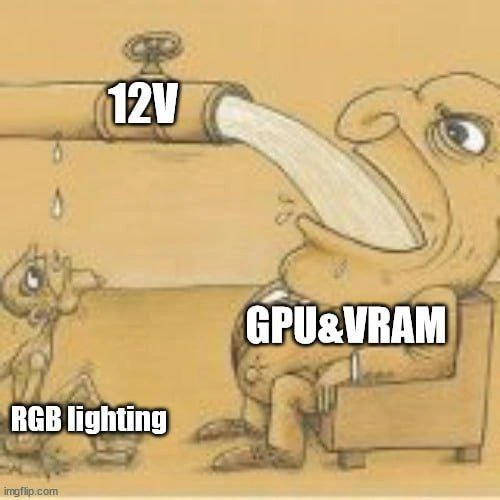
In the image, the large pipe labeled “12V” represents that main 12-volt power feed from the PSU. Now, the GPU is the part of the computer that handles graphics and visuals. If you play games or do 3D rendering, the GPU is doing most of the work to draw images on your screen. It’s essentially a very powerful specialized processor on a graphics card, and it needs a lot of electrical power when it’s doing intense work (like gaming at high settings). VRAM stands for Video RAM, which is memory on the graphics card used to store image data (textures, frame buffers, etc.) for quick access by the GPU. Both the GPU chip and its VRAM chips sit on the graphics card, and together they draw significant power from that 12V supply via the PSU.

In the meme, the big chubby character labeled “GPU & VRAM” is sitting in a chair gulping down the water gushing out of the “12V” pipe. This is a funny way of showing that the GPU (plus its memory) is consuming almost all the power flowing through the 12V line. How true is this? Very true for many systems! For example, a powerful gaming graphics card might use around 250W or more by itself. That’s 250 watts coming from the PSU’s 12V rail dedicated just to the graphics card. The PSU might be, say, 600W in total, and just the GPU is eating up a huge chunk of that when you’re gaming.

Now look at the tiny skinny character kneeling on the floor with an empty bowl, catching just a few droplets from that same pipe. This little guy is labeled “RGB lighting.” RGB lighting refers to those fancy Red, Green, Blue LED lights you see in a lot of gaming PCs – you know, the ones that make the keyboard glow or the inside of the computer case cycle through colors. They’re purely decorative and don’t really affect how fast your computer runs; they just make it look cool. Importantly, they use only a small amount of power. In real numbers, a strip of a few LEDs or a couple of glowing fans might use on the order of a few watts (maybe 5W or 10W total for a lot of lighting). That’s like the difference between one big gulp versus a tiny sip in terms of power.

So, the meme exaggerates the situation to make it clear: the GPU is like a big eater taking almost all the electrical “food” from the 12V pipe, while the RGB lights are the tiny eater getting just the leftovers. This is humorous because of how exaggerated the picture is, but it’s rooted in an everyday PC building fact – graphics cards need a ton of power, and LED lights need very little. If you build a PC and budget out the power, you’ll worry about your GPU and CPU first (did I get a strong enough PSU for my 300W graphics card and 100W CPU?). You probably won’t even think about the LED strips in terms of power, because their impact is so small. In fact, you could run dozens of LEDs and still not come close to one graphics card’s appetite.

To put it simply: imagine the PSU’s 12V rail as a big faucet of juice. The GPU is a big device that uses that juice to give you high frame rates and smooth graphics – it’s doing a lot of work, so it drinks a lot. The RGB lights just glow for fun; they don’t need much juice at all, just a trickle. The meme makes us laugh by showing the GPU as this overfed, greedy character and the RGB as a frail, begging character, which is a goofy way of saying “one of these uses almost all the power, and the other uses almost none.” Anyone who’s into building computers can relate to that scenario, which is why it’s funny and spot-on hardware humor.

Level 3: Power Budget Priorities

For anyone who’s built a gaming PC, this meme hits home instantly. It humorously captures a common pc_building reality: the GPU is a power-guzzling monster, and everything else is just along for the ride. When you spec out a new rig, you quickly learn that your beefy graphics card might demand 250–350W under load, while all your RGB fans, strips, and other extras together maybe sip <10W. Seasoned builders nod knowingly at the meme’s scene: the well-fed “GPU & VRAM” character hogging the gushing 12V pipeline, versus the emaciated “RGB lighting” figure catching drips. It’s funny because it’s true – a high-end GPU (plus its VRAM chips) often consumes 70–80% of the total power in a loaded system, leaving only a small fraction for the bling.

This disparity reflects clear hardware tradeoffs. We channel the bulk of our PSU’s capacity into the GPU because that’s where the heavy lifting happens for performance – rendering graphics, crunching numbers, driving up frame rates. Meanwhile, those rainbow RGB LEDs that make your rig glow like a unicorn? They’re mostly cosmetic, drawing trivial power. The meme plays on this by depicting the RGB as a starved peasant in rags; it’s an exaggerated metaphor for how little electrical “nutrition” the lighting actually needs. There’s an inside joke here within GamingCulture: people often quip that adding more RGB makes your PC run faster (spoiler: it doesn’t!). We invest in fancy lighting for style, not speed. In reality, you could deck out your case with an overkill number of LEDs (strips on every fan, RAM stick, and cable) and it would still be just a tiny power draw compared to a single high-end GPU. Even an extreme RGB setup is just a drop in the reservoir compared to a graphics card under full load.

Experienced folks also recognize the practical side: ensuring your PSU can feed that power-hungry GPU. The meme’s 12V pipe is essentially the PSU’s promise to deliver amps on amps to your graphics card. We’ve learned (sometimes the hard way) that an underpowered PSU can lead to system instability when the GPU cranks up to max load. On the flip side, nobody ever fried a PSU because they had “too many LED strips” – the scale is completely different. The GPU power draw is what dictates a 650W or 850W power supply, not the lights. Seeing the big guy literally drinking from a firehose of “12V” is a comical riff on how it feels to accommodate a top-tier GPU (with perhaps a nod to those hefty 8-pin connectors or the new 12-pin cable feeding it). Meanwhile, the puny RGB figure with an eye-dropper worth of power is a jab at how absurd our obsession with RGB can be relative to its actual impact.

The humor here also touches on the absurdity of PerformanceIssues we face: if your game is lagging or your system is overheating, it’s because of that watt-guzzling GPU (or maybe the CPU) – definitely not because of your case lighting. In fact, high-end GPUs run so hot from all that power use that gamers joke they’ve got a second space heater in the room. The RGB lights, by contrast, are so low-power they barely warm up at all (they just make your PC look like a disco). This contrast makes the meme relatable and funny. It’s highlighting the unspoken priority list in any rig: power for performance first, eye-candy second. Seasoned PC enthusiasts laugh because we’ve all allocated our budgets that way. We might agonize over which GPU to get for maximum FPS, then casually throw in some RGB strips knowing they barely affect anything (except the cool-factor). The meme essentially says, “We know who the real power hog is,” and does so with a perfect comedic exaggeration. The GPU gets the all-you-can-eat buffet of watts, and the RGB survives on crumbs – a tongue-in-cheek snapshot of every gaming PC’s power distribution.

Level 4: 12V Feeding Frenzy

In the realm of PC power engineering, the 12-volt rail is like a high-pressure main pipeline delivering energy to hungry components. This meme brilliantly visualizes that concept: electricity flow is depicted as a giant water pipe labeled “12V” gushing power. The GPU & VRAM guzzling from this pipe represents how modern graphics cards devour the lion’s share of a PC’s power capacity. There’s real engineering behind this humor. A typical PSU (Power Supply Unit) provides several fixed-voltage outputs (rails) and dedicates most of its wattage to the 12V rail. Why 12 volts? Because delivering large power at higher voltage requires less current. In fact, using the formula $P = V \times I$, a 300W GPU load on 12V means $I = 300/12 = 25\text{A}$ of current. If we tried that on a 5V line, we’d need a whopping 60A – impractical without very thick wires and serious heat. So the ATX standard focuses on 12V for power-hungry parts, minimizing current for a given power draw.

Modern high-performance GPUs often have Thermal Design Powers in the hundreds of watts, which is why they come with multiple PCIe power connectors (each 8-pin can supply up to ~150W of 12V power, plus 75W from the motherboard slot). The latest graphics cards even use the new 12VHPWR connector, allowing >450W from a single cable – illustrating just how power-hungry GPUs have become. All that 12V input feeds into the card’s onboard Voltage Regulator Modules (VRMs). These VRMs step down 12V to the lower voltages the GPU chip and VRAM actually use (for example, ~1.0V for the GPU core, ~1.35V for GDDR6X memory). In the process, the GPU’s VRMs draw intense current from the 12V pipe – it’s a feeding frenzy of electrons to satisfy a massively parallel processor. The large figure labeled “GPU&VRAM” embodies this design: a power-hungry beast pulling tens of amps from the PSU’s 12V rail to push maximum performance (and generating a lot of heat as a by-product!).

Meanwhile, the scrawny figure with the bowl catching a few drops – RGB lighting – illustrates the opposite end of the power spectrum. RGB LEDs typically run off the 5V rail (or sometimes 12V for certain LED strips, but either way their current draw is tiny). A single RGB LED might consume on the order of milliamps. Even a whole strip of addressable LEDs might use only a few watts (for instance, 5W at 5V is just 1A). Compared to a 300W GPU drawing 25A on 12V, the LED strips are a rounding error in the power budget – truly a drop in the bucket. The meme exaggerates with a comically starved character, but it’s grounded in reality: the GPU subsystem can easily hog 50x–100x more power than all the case lighting combined. In other words, if the GPU is an Olympic weightlifter for power consumption, the RGB is a tiny night-light.

This extreme imbalance is by design. PCs are built with power budget priorities: the PSU’s capacity is largely allocated for the GPU (and CPU), because that’s where the performance gains come from. In fact, today’s power supply designs reflect this with single hefty 12V rails and standards like ATX12VO (which delivers only 12V from the PSU, shifting minor voltages to motherboard converters) – a recognition that almost everything substantial (GPU, CPU, drives, fans) ultimately runs on or via 12V. The Hardware architecture has evolved to feed the power-hungry GPU directly and efficiently, much like that fat pipe aiming straight into the GPU’s mouth. The humorous slant of the meme comes from exposing this engineering reality in cartoon form. It’s poking fun at how absurd the disparity can seem: one component gulping down an electrical feast, while the flashy RGB gets mere scraps. Yet, any PC enthusiast knows this is accurate – we accept the GPU as the gluttonous king of the 12V rail, because that’s the cost of high Performance. The joke lands so well because it takes a technical truth (power distribution in a PC) and makes it visually obvious and absurd, encapsulating the essence of HardwareTradeoffs in a single funny image.

Description

A cartoon meme illustrating the disparity in power consumption within a modern computer. The image depicts a large, grotesque character labeled 'GPU & VRAM' sitting in a chair and greedily guzzling a massive stream of liquid from a large pipe labeled '12V'. Below, a small, emaciated, and desperate-looking character labeled 'RGB lighting' is on the ground, trying to catch single drops falling from the pipe. This meme is a technical joke for PC builders and hardware enthusiasts, humorously representing how modern high-performance Graphics Processing Units (GPUs) and their Video RAM (VRAM) consume the vast majority of the power delivered by the 12-volt rail of a power supply unit (PSU), while aesthetic features like RGB lighting use a comparatively insignificant amount


Comments

26
Anonymous ★ Top Pick My GPU's power connector has more pins than my first CPU had transistors. The RGB lights are just there for a 0.1% performance boost and to signal when the power bill is due
  1. Anonymous ★ Top Pick

    My GPU's power connector has more pins than my first CPU had transistors. The RGB lights are just there for a 0.1% performance boost and to signal when the power bill is due

  2. Anonymous

    Proof my PC is really a Kubernetes node: the GPU runs a privileged TensorFlow job guzzling 300 W, while the RGB sidecar sits in Best-Effort QoS praying for a single milliamp

  3. Anonymous

    After 20 years in the industry, I've watched GPUs evolve from sipping 75W through the PCIe slot to requiring dedicated nuclear reactors, yet somehow the RGB ecosystem still manages to make our power supplies cry - because nothing says 'enterprise-grade architecture' like allocating 10% of your PSU capacity to making your RAM sticks pulse in rainbow colors while your GPU melts through the floor

  4. Anonymous

    This perfectly captures modern PC building priorities: we've reached a point where motherboards have dedicated RGB headers with more sophisticated controllers than some embedded systems, while engineers are desperately trying to fit 600W GPUs into ATX specs designed in the 90s. The real kicker? That RGB controller probably has better documentation than your GPU's memory subsystem, and costs more to implement than the actual performance delta it provides. It's the hardware equivalent of spending sprint velocity on CSS animations while the backend is on fire - except here, the backend is literally thermal throttling

  5. Anonymous

    My PSU is a multi-tenant system: GPU+VRAM are the noisy neighbor on the 12V rail, and RGB runs as best effort QoS

  6. Anonymous

    GPU diets: chug 12V like open bar, hoard VRAM like it's Y2K, flex RGB to hide the power bill horror

  7. Anonymous

    12V QoS: GPU+VRAM are Guaranteed, RGB is BestEffort - then when the PSU brownouts, the only P1 ticket is “LEDs stopped breathing.”

  8. @Algoinde 2y

    don't actually power rgb from the 12V rail unless your led strip has resistors and is designed for it, PC PSUs regulate voltage, not current

    1. @Araalith 2y

      AMS1117 ftw.

  9. @Algoinde 2y

    it's easy for a regular led strip to overcurrent and catch fire due to yoinking too many amps or just strain the psu

    1. Felix 2y

      „Overcurrent“ is not a thing. Look up ohm‘s law.

      1. Deleted Account 2y

        Komedy

      2. @Bitals 2y

        Dude, Ohm's law says there's a limit to how much current a circuit can pull. It doesn't say that said circuit will be fine with that current. It doesn't say that is the amount of current needed for said circuit to work. There are a lot (most actually) of circuits it microelectronics that die instantly if you don't limit their current. That's why 12V led strips have resistors, and why connecting one not designed for PC12V application will make it die and/or catch fire.

        1. Felix 2y

          Resistors is the key word; it’s usually constant along with the design voltage. This leaves no wiggle room for current

          1. @Bitals 2y

            Not only the design voltage, but also the design application. A lot of led strips are made to work with their own PSU that has a current limit below the led strip, so the strip itself does not have any protection in place. Powering it with a PC PSU is a recipe for a bad time.

          2. Deleted Account 2y

            How does resistors limit current? 🤔

            1. @callofvoid0 2y

              resistors are just wires with high internal resistence

              1. Deleted Account 2y

                Yeah...the name suggests so. But as per my knowledge resistors only lowers the current in ratio of voltage and resistance. Very high voltage will still result into very high current.

                1. @callofvoid0 2y

                  yes

  10. Deleted Account 2y

    Why don't people use simpler terms to convey the exact same thing ?

  11. @Algoinde 2y

    Ye. the reason for it is you'd have to include a resistor on every segment due to it being snippable to arbitrary length, and that'd be expensive for no reason if you can just put that in the led driver circuit

    1. Felix 2y

      Snippable is a good point; makes the resistance variable and the brightness being bound to voltage and desired to be constant, the current has to be adjusted. Thx

  12. @Algoinde 2y

    so you know, the reverse meme would actually be funnier

  13. Deleted Account 2y

    Why? 😂

  14. Deleted Account 2y

    Why are you explaining it. Those who get it..get it.

  15. Deleted Account 2y

    What happened saaar Why are you laughing saaaar ???

Use J and K for navigation