Skip to content
DevMeme
3000 of 7435
The Siren Call of Scope Creep During a Sprint
Agile Post #3313, on Jun 22, 2021 in TG

The Siren Call of Scope Creep During a Sprint

Why is this Agile meme funny?

Level 1: Moving the Finish Line

Imagine you’re running a race and you’re almost at the finish line. You’ve been sprinting hard, and victory is in sight. But then, just as you’re about to reach the end, someone in charge picks up the finish line and moves it farther away. So you keep running to the “new” finish line, and guess what? They move it again, even further. No matter how fast you run, you never get to cross that tape because it keeps shifting out of reach. Pretty frustrating, right? It’s also a bit ridiculous — almost like a prank. That’s what it feels like to a developer when their boss keeps adding new tasks while they’re already busy trying to finish their current work. In the picture, the bosses are represented as sirens (like magical singing characters from old stories) pulling the sailors off their boat’s course. The core idea is the same: the team just wants to finish what they started (reach the finish line), and management’s constant “Oh, just do this one more thing!” is like moving that finish line again and again. It’s funny in a facepalm kind of way, because of course it’s silly to expect anyone to finish on time when the goalposts keep moving. The meme makes us laugh because we recognize how absurd that situation is — and if you’ve ever been interrupted with extra chores or tasks when you’re almost done, you know exactly how those developers (or runners) feel.

Level 2: Sprint vs Reality

Let’s break this down in simpler terms. In Agile software development (like Scrum), a sprint is a short, fixed period of time — usually 1 or 2 weeks — during which a dev team works to complete a set list of tasks. The team plans these tasks at the sprint’s start (Sprint Planning) and then tries to finish them all by the end. The phrase “crush the sprint” is casual dev-speak for absolutely nailing it: finishing all the work you promised and meeting your sprint goal with gusto. It implies the team is rowing in unison, making great progress.

Now, scope creep is when extra work or new requirements keep sneaking in after you’ve already set your plan. Imagine you agreed to build three features this sprint, but then someone keeps saying, “Actually, can we also add this one more thing?” The “scope” of work creeps larger and larger because of these additional requests. Scope creep is notorious in project management because it can make it impossible to finish what you originally set out to do on time. If you’re new to this: think of planning to bake a cake, and halfway through, someone says “Also, can you cook a five-course meal?” – suddenly your original cake might not get finished properly because your scope of work exploded.

In a healthy Scrum process, once a sprint starts, the team isn’t supposed to take on new tasks until the next sprint. This rule exists so the team can focus and actually deliver what they promised. But “management” — which could mean your boss, a Product Manager (PM), a client, or any stakeholder who requests work — might still press for changes or extras right now. They often have reasons: maybe a key client just requested a feature or a higher-up noticed an opportunity to impress investors. From their perspective, being agile means responding to change quickly. But to the dev team in the middle of a tightly packed sprint, it feels like being asked to change course in the middle of a race. If management keeps asking for additional work during an already packed sprint, the team has to drop or delay something else, or end up working overtime, to accommodate the new requests. That’s why developers sigh when they hear, “I know we’re mid-sprint, but can we also do ___?” It usually means their carefully laid plan is about to be blown up.

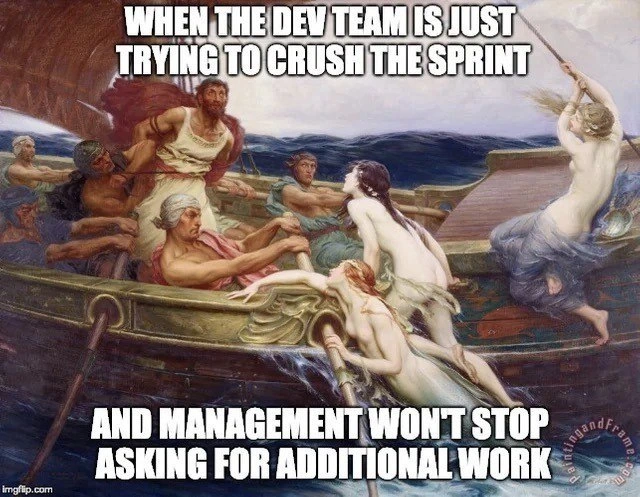
The meme uses a famous mythological scene to illustrate this situation. In Greek mythology, sirens are creatures whose magical singing is so enticing that sailors can’t resist — they steer towards the sirens’ island, often wrecking their ships on the rocky coast. In the image, the sailors (with blurred faces, standing in for “any dev team”) are rowing hard, just like developers working hard to meet the sprint goal. The sirens reaching into the boat represent those tempting new requests from management or clients. The sailors look distressed as the sirens grab at them, which is exactly how a dev team feels when sudden extra tasks try to “grab” their attention. The top text says “WHEN THE DEV TEAM IS JUST TRYING TO CRUSH THE SPRINT” – meaning the team just wants to focus and successfully finish what they planned. The bottom text continues “AND MANAGEMENT WON’T STOP ASKING FOR ADDITIONAL WORK.” That’s the punchline: no matter how hard the team is working, management keeps distracting them with, “Oh hey, can you also do this?”

For someone new to this concept, picture that you and your teammates have a to-do list for the week. You’re halfway through the list and feeling good, when your boss comes by and adds five new items to the list out of nowhere. You know you only have a couple of days left (the sprint is ticking down!), so you either have to rush like crazy or accept that some original tasks won’t get done. It’s frustrating. Developers often vent about this as one of the big Agile pain points. So this meme is basically an inside joke: it says even in an “agile” setting where we try to plan in short bursts, management can mess it up by changing priorities non-stop. The reason it’s funny is because of the exaggerated analogy – comparing managers to mythical sirens. It highlights the feeling that these extra tasks are almost magically luring the team towards disaster. If you’ve been on a software team even for a little while, you’ll likely witness this phenomenon: maybe during a sprint, a high-priority bug or a “quick” client request gets thrown onto your plate. Suddenly, what was a smooth sprint can become a scramble. This meme perfectly captures that experience in a single, dramatic image.

Level 3: Sirens of Scope Creep

In this classical-myth meme tableau, the dev team is like Odysseus’s crew rowing through a turbulent sprint, and management’s endless requests are the sirens singing seductive promises of “just one more feature.” The painting shows pale sirens clinging to a boat of desperate sailors — a perfect metaphor for scope creep pulling engineers off course. Experienced developers recognize this scene all too well: you’re midway through an Agile sprint, already rowing with all your might to hit the sprint goal, when management (product managers, project leads, or other stakeholders) lean over the side with “Quick, add this task!”. The text “JUST TRYING TO CRUSH THE SPRINT” reflects the team’s focus on meeting their commitment, while “MANAGEMENT WON’T STOP ASKING FOR ADDITIONAL WORK” nails the constant distraction. It’s a painful comedy: the team’s trying to stay on target, but management keeps luring them with new demands like sirens beckoning sailors into the rocks.

Scrum guidelines decree that once a sprint starts, its scope is locked — a short Sprint (typically 1-2 weeks) is supposed to be a safe harbor where devs can focus on a defined set of user stories or tasks. But out in the real world, Agile ideals often smash against the rocks of corporate habits. Management sometimes misinterprets “agile” as “we can change our mind every day” instead of honoring the sprint plan. The result is the dreaded scope creep: new features and fixes sneaking in after the sprint has begun. It’s the siren song of Scope Creep — tempting, seemingly innocent (“It’s just a small change, it’ll only take a few hours!”), but experienced devs know it leads to danger. We’ve all heard that chorus:

Manager: “Hey, could you just squeeze in this one tiny feature before Friday? It shouldn’t be a big deal.”
Developer Team: (glances at fully booked sprint board, imagines working overtime) “...Sure, we’ll try.”

The humor here hides real aggravation. Veteran engineers chuckle at this meme because it’s cathartic: it puts an epic, almost heroic spin on a frustrating workplace dynamic. Instead of simply saying “Ugh, mid-sprint scope change again,” it dramatizes it: management becomes enchanting sirens whose siren song (“more work, now!”) is nearly irresistible, and the devs are harried sailors trying not to wreck the project ship. The background shows churning seas and straining oars — just like a team already pushed to their limit with tasks. The sirens physically grab the sailors, mirroring how surprise requests grab developers’ attention and time. It’s funny because it’s true: that feeling of being dragged away from your planned work is all too familiar in software teams. Every senior dev has war stories of a sprint going off the rails because a higher-up couldn’t wait until next week for their pet feature. This pattern is a classic AgilePainPoints scenario that fuels endless DeveloperHumor: we laugh (perhaps bitterly) at the absurdity of being asked to be “agile” in a way that actually undermines the whole point of a sprint.

What really sells the meme is how it captures the tension between Agile theory and corporate reality. Agile mythology (fittingly, we even call them “scrum masters” as if they were captains) says commit to a plan for a sprint and deliver predictably. But management’s siren call of new priorities tests that discipline. The sailors in the image look alarmed and exhausted — just like devs feel when the sprint backlog suddenly doubles in size. There’s an element of dark truth: if the team keeps yielding to scope creep, the sprint (and possibly the project) could crash and sink, much like ships in the old tales. And yet, from management’s viewpoint, those siren calls are irresistible: market opportunities! client asks! urgent bugs! The meme exaggerates the scenario to mythological proportions to highlight how destructive it feels when leadership’s demands override the process. It’s a nod and a wink among seasoned tech folks: “Yup, been on that boat, heard those songs, hit those rocks.” No wonder the devs in the meme look like they’re resisting for dear life — we’ve all learned that giving in to mid-sprint temptations can leave a team drowning in unfinished work and technical debt. The meme is hilarious in a cynical way because it rings so true: the battle between staying on course and pleasing the endlessly requesting management is an epic saga in every agile shop.

Description

This meme uses the classical painting 'Ulysses and the Sirens' by Herbert James Draper to illustrate a common software development struggle. The painting shows Ulysses's crew frantically rowing their ship through rough seas while being accosted by sirens, mythical creatures who lure sailors to their doom. The top text reads, 'WHEN THE DEV TEAM IS JUST TRYING TO CRUSH THE SPRINT'. The bottom text adds, 'AND MANAGEMENT WON'T STOP ASKING FOR ADDITIONAL WORK'. The analogy is pointed: the development team is the focused, determined crew trying to reach their destination (the end of the sprint), while management and their constant stream of new requests are the distracting, dangerous sirens threatening to derail the entire voyage. For experienced developers, this is a vivid and relatable depiction of scope creep within an Agile framework, where protecting the sprint's committed work from outside interference is a constant battle

Comments

7
Anonymous ★ Top Pick Our team's sprints now include a 'siren protocol': the tech lead is tied to a chair, and developers are issued noise-canceling headphones until the release is deployed
  1. Anonymous ★ Top Pick

    Our team's sprints now include a 'siren protocol': the tech lead is tied to a chair, and developers are issued noise-canceling headphones until the release is deployed

  2. Anonymous

    Our sprint board is basically Odysseus’ deck - devs lashed to WIP limits while product sings yet another “just-a-quick” feature into Jira

  3. Anonymous

    The best part about "Agile" is watching management treat the sprint backlog like a suggestion box while simultaneously asking why velocity is unpredictable - it's like wondering why your GPS keeps recalculating after you ignore every turn it suggests

  4. Anonymous

    The dev team's sprint velocity chart looks like a seismograph during an earthquake - not because of technical debt, but because management keeps throwing 'quick wins' overboard mid-sprint. By day three, the sprint backlog has more unplanned items than a production incident log, and the retrospective will inevitably conclude with 'we need better sprint discipline' while everyone knows the real issue is that saying 'no' to stakeholders requires architectural authority no one on the team actually has

  5. Anonymous

    Every time management drops a “quick add” mid‑sprint, Little’s Law breaks, the M/M/1 goes unstable, and our velocity turns into a siren song - tie me to the sprint goal and lock Jira create-permissions

  6. Anonymous

    Odysseus had ropes and wax; we have sprint commitments and Jira locks - but PMs always find the 'business priority' skeleton key

  7. Anonymous

    Mid-sprint requests are the siren song of software: they all swear they’re O(1), until you realize n = number of stakeholders

Use J and K for navigation