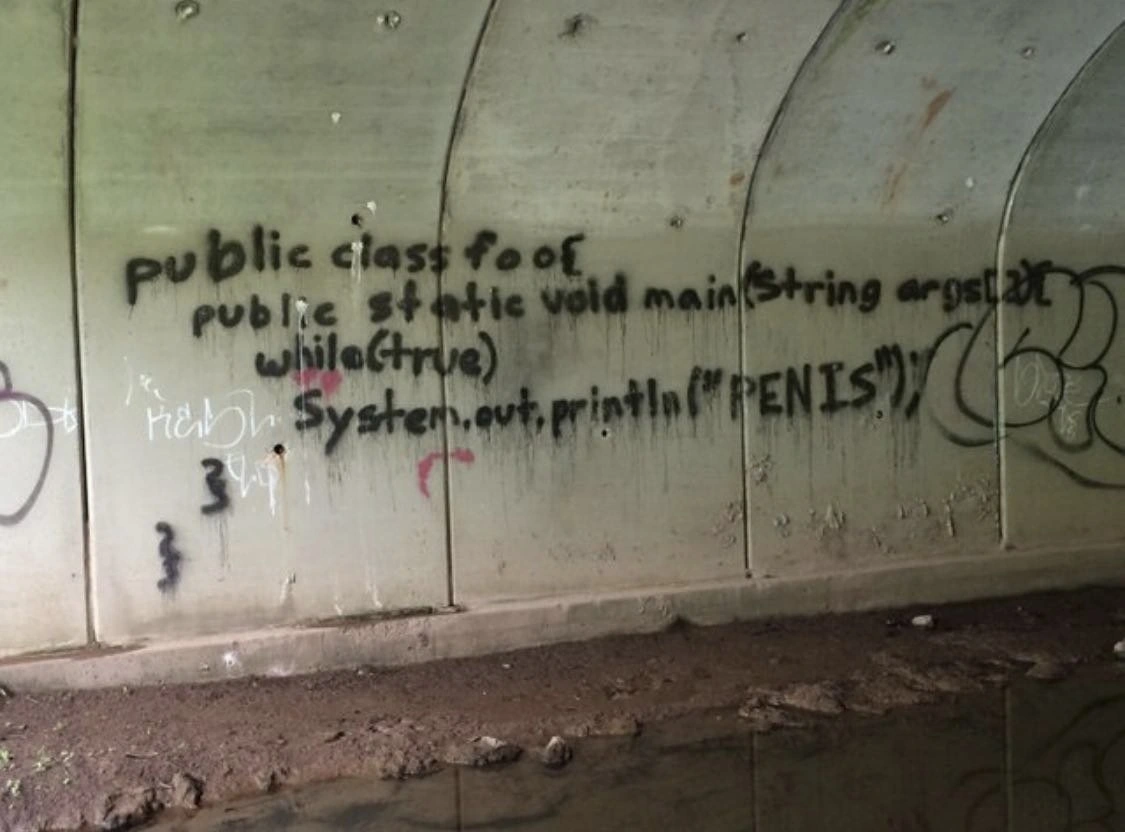
Urban code: Java's infinite loop graffiti
Why is this Languages meme funny?
Level 1: Stuck on Repeat
Imagine walking through a tunnel and hearing someone shout a silly, naughty word over and over and over again, endlessly. At first, you might giggle because it’s so ridiculous, and then you’d probably think, “Are they ever going to stop?” This meme is funny for the same reason. It’s showing a little joke in coder form: a set of instructions that would make a computer say a crude word non-stop, like a prank that never ends. It’s basically like a child who discovered a bad word and keeps yelling it because they think it’s hilarious – except instead of a child, it’s a piece of code doing the yelling! The code is painted on a wall for everyone to see, which makes it even more absurd. You’re not really supposed to write on walls, and you’re not supposed to make a computer go crazy repeating naughty words either. But here, both those “rules” are broken in one go. The result is a goofy scene that makes people laugh: the idea of something just stuck on repeat, saying the same rude thing forever. Even if you don’t know anything about coding, you can appreciate how silly it is to have a message that never stops. It’s that endless, cheeky repetition that’s the joke – like a song that gets stuck on one naughty lyric and just won’t quit.
Level 2: Infinite Loop 101
Let’s unpack what’s going on in that spray-painted code, step by step, as if we’re explaining it to someone who’s just started learning to program. The code is written in Java, a popular programming language. In Java, every runnable snippet of code typically lives inside a class. Here, the graffiti starts with public class foo. That’s Java’s way of saying “I’m declaring a class (a container for the program) named foo.” The { that follows would normally open up the body of the class. Now, “foo” is a bit of a humorous choice for a name. Programmers often use foo and bar as placeholder names in examples (kind of like using “John Doe” as a placeholder name for a person). It’s not a meaningful name; it’s used when the actual name doesn’t matter or in joke contexts. Also, Java convention says class names should start with a capital letter (e.g., class Foo, not class foo), so right off the bat this tells us the author isn’t concerned with proper style – it’s meant to be silly.
Inside that class, we see public static void main(String args[]). This is the signature of the main method – the entry point of a Java application. When you run a Java program, the runtime looks for this exact method to know where to start executing. Let’s break it down:
publicmeans the method is accessible from anywhere (which it needs to be for the runtime to call it).staticmeans this method belongs to the class itself rather than an instance of the class – Java needsmainto be static so it can run it without having to create an object first.voidmeans this method doesn’t return any value.mainis the name of the method that the Java runtime recognizes as the starting point.(String args[])is the parameter list: it says this method takes an array ofStringobjects calledargs. These are any command-line arguments you might pass to the program. Often you’ll see it written asString[] args(which is the same thing just a different syntax for arrays). In our graffiti, the method is written with no curly brace immediately after – probably just a newline – but in actual code, it should have an{to start the method’s body.
Now, inside the main method body, we encounter while(true). This is a while loop. The syntax while(condition) means “repeat the following block of code as long as the condition is true.” Here, the condition given is the literal boolean value true. That means the condition is always true, because true is, well, true by definition and it’s not being changed to false anywhere. In simpler terms, while(true) sets up a loop that will never end on its own. This is what we call an infinite loop – since the loop doesn’t have a stopping condition that will ever be met, it will keep executing the loop’s body forever (or until the program is manually stopped). In Java (and many C-like languages), if you put a statement right after the while(condition) without braces, that single statement is considered the body of the loop. In our graffiti, the next statement (and apparently the only statement inside this loop) is System.out.println("PENIS");. Because there’s no { } right after the while, Java interprets it as: keep executing System.out.println("PENIS"); over and over endlessly.
Let’s explain that print statement: System.out.println is a Java command that prints a line of text to the standard output (usually the console or terminal). It’s basically telling the system, “Hey, output this text and then move to a new line.” The text to output is enclosed in quotes "PENIS" – so that’s the exact string that will be printed each time. Every time System.out.println("PENIS") runs, you’ll see the word PENIS appear in the console (followed by a newline character, because println prints and then ends the line). Since this line is inside a while(true) loop, the sequence goes like this: print "PENIS", then loop back, condition is still true, print "PENIS" again, loop, print, loop, print… and so on, forever (or until you force-quit the program). The program doesn’t pause or change anything in the loop, so it will just hammer that print statement continuously. If you were to run this on your computer, the terminal would start scrolling with the word “PENIS” repeated ad infinitum, line after line. You’d have to stop the program (for example, by closing it or hitting Ctrl+C in a terminal) to break out of the loop, because the loop itself has no built-in termination.
Now, a couple of things about this code: In a proper Java program, we’d expect to see closing braces } to match the opening braces. There should be one to close the while’s body (if a { had been there) and definitely one to close the main method, and another to close the class. The graffiti might have omitted some of these, either because the artist didn’t care to complete it (maybe the joke lands even if the syntax isn’t perfect) or because of space/effort. In any case, the intention is clear even if the punctuation isn’t perfect. If we were to write this code correctly in a file, it would look something like:
public class Foo {
public static void main(String[] args) {
while (true) {
System.out.println("PENIS");
}
}
}
This is the well-formatted version (with Foo capitalized, braces in place, and String[] args syntax). But the essence is the same as the graffiti: an infinite loop that prints "PENIS" non-stop.
So why is this funny to developers and what’s the takeaway? For one, it’s showcasing an obvious bug (an infinite loop) in a very exaggerated way. When you’re learning programming, one of the early pitfalls is accidentally writing a loop that never ends – for example, forgetting to update the loop variable or using the wrong condition. When that happens, your program just hangs or churns until you intervene. It’s a mistake most of us make at least once. This code snippet is intentionally nothing but that mistake: it’s explicitly a loop with no end. It’s like a teaching example of what an infinite loop looks like, dialed up to eleven by making it print something outrageous.
Another aspect is code quality and professionalism. Printing a rude word like "PENIS" in a loop is definitely not something you’d do in any serious program. It’s an extreme example of unprofessional code. In the real world, even a single print of something inappropriate can be an issue if it ends up in logs or user-facing text. That’s why we usually keep our log messages clean and descriptive. This example violates that in the silliest way possible, which is part of the humor – it’s so wrong that it’s clearly a joke. It’s also worth noting, why Java? Possibly because Java’s syntax (with public static void main and braces) is very recognizable as “code” even to many non-Java programmers. It looks nerdy and “legit” to have a class and main method, more so than, say, a one-liner in Python. It kind of amplifies the nerd factor that this prank is written in a verbose language like Java – like using a formal tool for a very informal purpose.
For someone new to coding, this meme actually highlights a few lessons in a roundabout way:
- Be careful with loops: Always make sure a loop has a condition that will eventually be false, or a clear exit (like a
breakstatement), unless you intend it to run forever (and if so, usually you’ll also include some sleep or wait inside to avoid hogging resources). An unintentional infinite loop is a common programming bug. - Code should be clean and appropriate: Using meaningful names (not
foofor everything) and not including inappropriate jokes in code that others will see or that might run in serious contexts. Save the jokes for personal projects or harmless contexts – and even then, maybe not something offensive. - Understand what
System.out.printlndoes: it’s great for basic output and debugging, but if you put it inside a fast loop, know that it can overwhelm your output pretty quickly! In fact, printing to the console is relatively slow; an infinite loop printing like this will also demonstrate how quickly your program can generate output that you can’t even read.
Finally, the fact that this code is graffitied on a wall is part of what makes it a quirky piece of tech humor. It’s literally graffiti code. Typically we keep code in text editors, IDEs, and repositories, not on concrete tunnel walls. Seeing it there is jarring and funny – it’s like seeing a math formula or a snippet of Wikipedia painted on a building. It’s out of its normal context, which catches us off guard. The choice to write a buggy, bad piece of code as street art is an ironic statement in itself. It’s as if the artist is saying, “Here’s some code so bad, it belongs out here in the gutter (or tunnel), not in my codebase.” And for learners, it’s a memorable example: you won’t soon forget why infinite loops are bad when you’ve seen one literally plastered in a tunnel!
In summary, this code is a simple Java program that would print a silly word endlessly – demonstrating an infinite loop bug and poor coding practice in one stroke. It’s meant to be ridiculous, and that ridiculousness actually teaches what to avoid (and gives everyone a good laugh).
Level 3: Perpetual Print Prank
From a seasoned developer’s perspective, this scene is both hilarious and horrifying. We’re looking at Java code graffiti that, if executed, would unleash an infinite loop printing an arguably crude message endlessly. It’s a perfect storm of bad practice and inside joke. Let’s break down why an experienced coder might chuckle and cringe simultaneously:
Infinite loop hell: The snippet uses
while(true)with no break – the classic infinite loop. Any senior engineer has war stories of a roguewhile(true)(or its logical equivalent) causing havoc: maxing out CPU cores, flooding log files, or hanging an entire application. Here it’s played for laughs. The code would keep callingSystem.out.println("PENIS")over and over, as fast as the computer can, never pausing or stopping. In a real system, that would be a disaster: imagine a log file filling up with that word thousands of times a second! It’s the kind of bug that turns your console into a scroll of gibberish until the program is forcibly killed. Seasoned devs often put safety checks or at least aThread.sleep()or conditional break in loops to prevent exactly this scenario. So seeingwhile(true)spray-painted with no escape is like a textbook example of what not to do – broadcast in a literal tunnel. No wonder we do code reviews! This is the kind of mistake a peer review or a linter would scream about before code ever runs.Crude output (unprofessional code): Then there’s the output itself – printing the word "PENIS" endlessly. In professional software development, this is beyond frowned upon; it’s utterly unprofessional. Not only is it juvenile humor, but peppering production logs or console output with profanity or explicit words can lead to HR headaches and user complaints. Many workplaces have unwritten rules (or even automated checks) against leaving words like this in code, precisely because eventually someone might see it outside of a joking context. The humor here is that a developer has bypassed all the usual restraints of professionalism and common sense, writing literally an obscene infinite loop. It’s the kind of thing you might find scrawled as a joke on a whiteboard after hours, but never in a codebase… and here it’s not even on a whiteboard, it’s vandalism on a wall! For seasoned engineers, it’s a reminder of why we have things like coding standards and code reviews: to catch not just logic errors, but also bone-headed moves like this. If this were a code submission, the review comments would range from “Infinite loop detected – this will never exit!” to “Please remove the offensive string – not appropriate for production (or anywhere).” In real life, if a junior dev actually printed something like this even once, they’d get a stern talking-to.
Code quality & style violations: This graffiti code snippet sets off all kinds of code quality alarms. The class is named
foo– and in all lowercase to boot. In Java, class names are conventionally PascalCase, and we strive to name classes something meaningful.foois a classic metasyntactic placeholder name (often paired withbar), basically a sign that the author isn’t concerned with meaning. Usingfoohere is a wink to dev culture (“foo” is often used in examples), but it’s also signaling “this code is not serious.” A senior dev seespublic class fooand already knows nothing mission-critical is going on here. Additionally, braces and formatting are a mess (the graffiti shows missing or misplaced braces). In proper Java, you’d have braces{}around thewhile(true)loop and to close the class and method. The fact that they’re missing or out of place is itself a joke about sloppy coding. It’s as if the graffiti-artist-coder said, “Who cares about syntax? I’m writing on a wall!” Seasoned programmers have strong opinions about braces and indentation – some might jokingly gasp, “Allman style or K&R, just pick one – but don’t spray-paint code with half the braces gone!” This snippet on the wall violates style guidelines in the most blatant way, which contributes to the humor: it’s code written where it shouldn’t be, ignoring all the rules. Think of it as the graffiti equivalent of spaghetti code – messy, dripping, and hard to parse at first glance, much like how real spaghetti code tangles logic. A senior dev can decipher it (we’ve seen worse in legacy systems), but we’re also instinctively reaching for a can of refactor (or in this literal case, maybe a can of paint to cover it up!).“Deployed” with zero oversight: Perhaps the funniest meta-joke is that this code made it out “into production” (the public eye) without any review or testing – because it’s graffiti! In a company, code this problematic would never pass a code review or QA process. But here we are, in a damp underground tunnel, effectively looking at code that escaped all the code quality gates. It’s a physical reminder of why those gates exist. No unit tests, no QA, no code review, and you end up with a program that does something absurd and potentially harmful (well, harmless on a wall, but harmful if it ran). The tunnel wall is acting as this coder’s GitHub, and clearly no pull request approvals were required. The result? A bug (infinite loop), a content problem (offensive word), and poor style (missing braces) all rolled into one artifact. A senior engineer can’t help but think, “If our continuous integration systems could see this, they’d fail the build instantly.” It’s basically a code pipeline with zero safeguards – just spray and pray.
Developer humor and culture: Beyond the technical absurdity, seasoned devs recognize this as part of developer culture – the tendency to find humor in code, even if it’s dark or immature. The choice of word, while crude, is deliberately over-the-top for comedic shock value. It’s not that developers are obsessed with that word; it’s that taking such a formal thing (a Java program) and using it to output a lowbrow joke on loop is inherently funny in an ironic way. It’s a mashup of high-tech and juvenile prank. Many of us in tech have seen or even written throwaway joke programs that do silly things (like a script that prints “HELLO” 1000 times, or that flashes text on the screen). It’s usually done in private or as a learning exercise, not as wall art! This meme just cranks that trope to eleven by making it graffiti. There’s also a grain of truth in the humor: if you’ve ever left a debug
System.out.printlnin your code by accident, you know it can feel like it’s shouting at you relentlessly when you run the program. And if you’ve ever dealt with a novice programmer’s project, you might indeed find weird things like infinite loops or cheeky print statements that had no place in final code. So experienced devs are laughing with a hint of nostalgia (“Oh man, I remember when I was a newbie and found printing stuff to the console endlessly funny...”) and also with relief (“At least this ridiculous bug is on a wall and not paging me at 2 AM!”). It’s a shared understanding that writing good code is hard, and this graffiti is basically a caricature of bad code. We laugh because it’s exaggerated and out-of-place, and maybe a tiny part of us laughs because “there but for the grace of code reviews go I.” Every senior dev has seen some form of code ugliness; this one is just proudly ugly in public.
In summary, the Languages category is tickled by the use of Java in such a mischievous way, the Bugs aspect is the blatant infinite loop (a classic bug pattern) on display, and the CodeQuality angle screams “this is why we have standards and review processes!” It’s a senior engineer’s humorous reminder that without discipline, our code could easily turn into graffiti – messy, endless, and yelling nonsense into the void.
Level 4: Halting Problem IRL
On a theoretical level, this little graffiti snippet touches on a cornerstone of computer science: the idea of a program that never terminates. The code while(true) explicitly creates an infinite loop, a loop that will run forever (or until the heat death of the universe, whichever comes first). In computability theory, Alan Turing famously described the Halting Problem – the challenge of determining whether an arbitrary program will eventually stop or run indefinitely. Here, spray-painted on concrete, we have a trivial example of a non-halting program. Of course, any developer or static analyzer can immediately tell this particular loop will never break (it's literally while(true) with no exit), but its very simplicity highlights the essence of an undecidable scenario: a piece of code that, once started, goes on ad infinitum. It’s like a Turing machine designed to do one thing endlessly – print a particular symbol over and over. In fact, if you imagine running this on an ideal machine with unbounded resources, it would produce an infinite output stream of the word in question. This brings up another theoretical quirk: in terms of computational complexity, the runtime here isn’t just exponential or factorial – it’s literally unbounded (technically, it diverges rather than showing a complexity class). In a more practical theoretical sense, some programming languages and formal verification systems try to ensure termination of programs or flag possible non-termination. Java, being a general-purpose Turing-complete language, happily lets you write a program that doesn’t halt – it’s up to the developer to avoid or manage that. This graffiti code is a tongue-in-cheek proof by example that you can paint the Halting Problem on a wall: we can plainly see this program has no halting condition. If someone asked “Will this program ever finish running?”, the answer is a resounding no – not without external intervention. It’s a playful reminder that some bugs (or esoteric features) manifest when our code approaches those theoretical edges where infinite loops and undecidability lurk. And while real computers can’t truly run forever (they’ll run out of memory, or the process will be killed), the joke here is imagining an endless, unstoppable computation – a concept that tickles the minds of both pranksters and theoreticians alike.
Description
A photo shows a concrete wall in what appears to be an underpass or tunnel, covered in graffiti. The most prominent graffiti is a snippet of Java code spray-painted in black. The code reads: 'public class foo { public static void main(String args[]) while(true) System.out.println("PENIS"); } }'. The paint is dripping slightly, giving it a raw, urban look. This image blends nerd culture with street art, finding humor in the unexpected placement of a simple, yet juvenile, Java program in a public space. The code itself describes an infinite loop that endlessly prints a vulgar word, representing a basic, almost trivial, piece of code. For experienced developers, it's a mildly amusing sight gag, more notable for its context than its technical depth, reminiscent of early programming experiments or inside jokes

Comments
19Comment deleted
This is what happens when a developer's ticket to 'add more logging' gets interpreted by a junior who just learned about `while(true)`
DevOps promised to pipe our noisy stdout to /dev/null; turns out they misconfigured it to /dev/tunnel-wall
Finally found the production logs from that legacy system we inherited - at least this one has proper exception handling and clear business requirements
When your code review gets so brutal that developers start spray-painting their implementations on public infrastructure - at least this one compiles, though the infinite while(ctrl+c) loop suggests the author understands neither signal handling nor graceful shutdown patterns. The real tragedy is that someone chose Java for street art when Python would've been so much more readable to passersby
Cheaper than ELK: while(true) System.out.println to a bridge - unstructured logs, infinite verbosity, and automatic log rotation every rainy season
Replacing ELK with while(true) System.out.println(...) to a concrete-backed append-only store - unlimited retention, zero backpressure, and infinite SLO burn
Better uptime than my last K8s cluster - no pod evictions, just eternal concrete commitment
Amazing Comment deleted
naming a class starting with lowercase letter. How vulgar Comment deleted
Java Comment deleted
Dickpic that we deserve Comment deleted
This guy need to get a life Comment deleted
fucking toxic java devs, all my homies hate javadevs xD Comment deleted
Who's toxic if you hate other programmers? Comment deleted
And where is the result of foo.main()? Comment deleted
wtf Comment deleted
I would have obfuscated it Comment deleted
Xd xd Java Comment deleted
+ Comment deleted