Debugging Last Week's Code
Why is this Debugging Troubleshooting meme funny?
Level 1: The Mess You Made
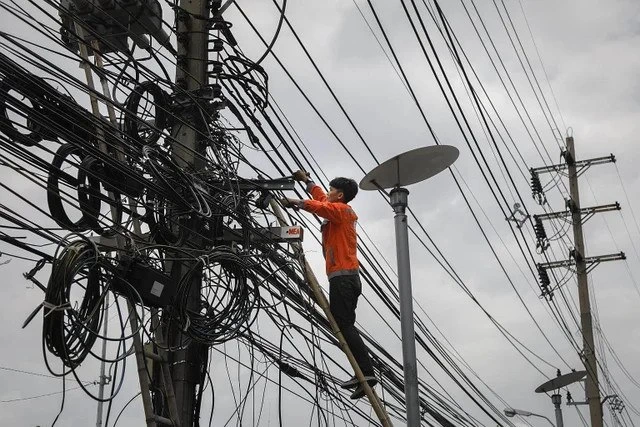
This is funny because the person is trying to fix a huge tangle, and the caption says that is what it feels like to understand your own code from only a week ago. It is like putting away all your toys in one giant knot, then coming back later and wondering who made such a mess. The answer is uncomfortable: you did.
Level 2: Trace the Cable
Debugging means finding out why software behaves differently from what you expected. Sometimes that is a simple typo. Other times it means tracing a path through many functions, configuration files, services, database rows, and external systems.
The photo's utility pole is a visual metaphor for codebase complexity. Each cable is like a dependency or a piece of logic. One cable might be a validation rule, another might be a background job, another might be a cache, and another might be a UI state update. When those connections are not clearly organized, a bug fix becomes a search problem.
Technical debt is the extra future work created when code is written quickly or unclearly. It is not always bad; teams often take shortcuts to ship important things. The pain arrives later, when someone has to maintain that code and cannot tell which shortcut is safe to touch.
Refactoring is the act of improving the structure of code without changing what it does. In this meme, refactoring would be like labeling the cables, grouping related lines, removing dead wires, and making sure the next person on the ladder does not need detective training just to find the right connection.
For newer developers, the lesson is not "never write messy code." Everyone does under pressure. The practical lesson is to leave clues: good names, small functions, focused commits, tests, and comments where the code's reason is not obvious. Future-you is a teammate, and apparently future-you needs a map.
Level 3: Past-You's Wiring Diagram
The photo shows a worker balanced on a ladder beside a utility pole, surrounded by a dense knot of black cables, loops, junctions, and overhead lines disappearing in several directions. There is no text inside the image itself, so the caption carries the punchline:
Debugging code I wrote one week ago.
The joke lands because "one week ago" is supposed to be recent enough that the author still remembers what they were doing. In practice, the mental model evaporates almost immediately. Past-you had the whole call graph in short-term memory; present-you has a ticket, a failing edge case, and a function name like handleThing2.
This is the Debugging_Troubleshooting version of cable management horror. The tangled wires stand in for spaghetti code, hidden dependencies, unclear ownership, side effects, and the kind of "temporary" patch that somehow becomes load-bearing. A clean system has visible routing: inputs, outputs, responsibilities, tests, and boundaries. The pole in the image looks like the opposite: everything connects to everything, and pulling on one line may turn off someone's internet, billing job, or login flow.
Experienced developers recognize the specific humiliation here: the code is not legacy from 2009, not inherited from a vanished contractor, not generated by some ancient framework. It is yours. From last week. That removes the comforting excuse that the mess was caused by unknowable historical forces. The villain is simply yesterday's deadline, an underspecified requirement, and the universal belief that "I'll clean this up after it works." Of course you will. Right after the next incident review and the sprint planning meeting about reducing incidents.
The image also gets at why debugging is harder than reading. When you write code, you travel downhill with intent. When you debug it later, you climb back up the slope by inference: logs, stack traces, variable names, database state, feature flags, and half-remembered assumptions. If the original code lacks clear structure, the debugger becomes the worker on the ladder, trying to identify which cable matters while all the cables look guilty.
Description
The image is a real-world photo of a worker standing on a ladder among dense, tangled overhead utility cables attached to a pole, with more power and communication lines stretching across a gray sky. There is no overlaid text in the image, and the associated caption reads, "Debugging code I wrote one week ago." The visual metaphor equates revisiting recent code with tracing a chaotic physical wiring mess, capturing how quickly local context, naming choices, and hidden coupling can turn fresh code into archaeology.
Comments
2Comment deleted
Past-you shipped a graph problem and forgot to leave the adjacency list.
https://en.m.wikipedia.org/wiki/Old_Stockholm_telephone_tower Comment deleted