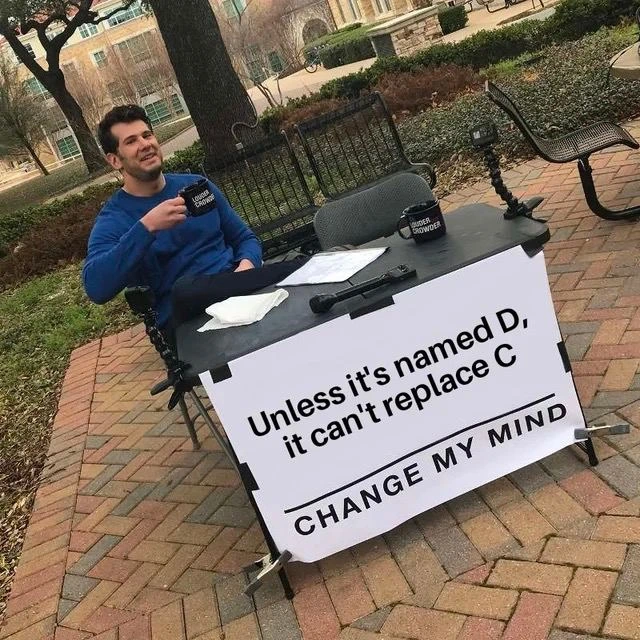
Change-my-mind meme claims only language D could ever dethrone C
Why is this Languages meme funny?
Level 1: Alphabet Showdown
Imagine the alphabet is having a little contest. The letter C has been champion for a long, long time – it’s super famous and everybody uses it. Now, a bunch of new letters show up, each saying “I can be the new champion!” There’s a G, an R, even a Z trying to show off. But the person running the contest holds up a sign and jokes: “Nope, nothing can beat C unless the challenger’s name is D!” In other words, he’s saying only the next letter in the alphabet (D comes after C) is allowed to win against C.
Of course, that’s a pretty silly rule! 😄 Normally, you’d expect the best letter (or in real life, the best tool) to win because it’s actually better, not just because of its name. It’s as if in a kids’ game, someone said, “Only a player whose name starts with the next letter can take the spot.” For example, if C is like a big boss of the playground, this rule would mean only a kid named Danny (D for short) could ever become the next boss, and no one else can, even if they are really strong or smart. That’s obviously not how things usually work, which is why it’s funny.
So the heart of the joke is: C is a long-time champion, and people keep predicting someone new will beat it. The meme maker jokingly acts like it’s all predetermined by the alphabet – “If its name isn’t D, it doesn’t count!” It’s a goofy way to show how stubborn that champion C is. Even if you don’t know about programming, you can sense the playful exaggeration: it’d be like saying only the next letter can replace the current one, which isn’t a serious rule at all. It makes us laugh because it’s a mix of being outrageous and kind of clever with the alphabet. In the end, it’s just having fun with the idea that sometimes we get attached to our favorites (like a favorite letter or a favorite tool) and come up with silly reasons to defend them.
Level 2: After C Comes D
This meme uses the well-known “Change My Mind” format, where someone sits at a table with a sign stating an opinion and challenges others to prove them wrong. In the image, the sign says: “Unless it’s named D, it can’t replace C.” This is a play on words about programming languages, specifically the C language and the idea of a successor language D. To understand the joke, let’s break down the pieces:
C is a very famous programming language created in the early 1970s. It’s considered a classic systems programming language, meaning it’s often used to build low-level software like operating systems (for example, much of Windows and Linux are written in C) and other performance-critical applications. C is prized for being small, fast, and close to the hardware – but it’s also known for being a bit dangerous because the programmer has to manage memory manually (which can lead to tricky bugs). Over the decades, C established itself as a dominant language in their domain, so much that many consider it the language to beat for systems programming tasks.
D in this context refers to a programming language literally named “D”. Not as many people have heard of D, because it’s more niche. D was introduced in the early 2000s as an attempt to improve on C and C++ (C++ being an extension of C with more features). The naming is tongue-in-cheek: if you have a language named C, the next letter in the alphabet is D. In fact, the creators of D did intend it as a successor (there was even a slogan that D is like “C, but better”). While D did introduce some modern features (like safer memory options and easier syntax), it never became anywhere near as popular as C.
The sign’s claim “Unless it’s named D, it can’t replace C” is a language pun. It suggests that no programming language will replace C unless that language’s name is literally the next letter, D. This is funny because, in reality, whether a new programming language becomes popular has nothing to do with its name and everything to do with its features, community, performance, etc. But here they intentionally ignore all those technical reasons and focus only on the naming sequence (C then D) as if it’s a rule of nature. It’s a bit like saying, “The only one who can beat the king is the prince with the next name in line,” where D is portrayed as the only legitimate prince to C’s king.
This meme taps into the replacement_language_debate that often happens in technology. Developers like to debate which new language might dethrone an older one. For example, you might have heard discussions like “Will Rust replace C?” or “Will Go replace C++?” or comparisons like Rust vs C or Go vs C. These debates can get heated, almost like fan clubs arguing – that’s why they’re jokingly called language wars. Older developers have seen many “hot new” languages come along claiming to solve all the problems of C. Some of these new languages include C++ (which is basically an expansion of C), Java (which became huge for business software in the late 90s), C# (early 2000s, influenced by Java/C++), Go (2009, from Google, aiming for simplicity and quick development), Rust (around 2010, focusing on memory safety and no crashes), and Zig (mid-2010s, aiming to be a modern take on C with less hassle). Each of these was, at some point, proclaimed as a possible “C killer” or at least the next big thing for systems or low-level programming.
The sign specifically singles out languages not named “D”. This is a nod to the fact that none of the popular C replacements have names following the alphabetic sequence of C. Rust, Go, Zig – these names don’t have any obvious relation to C’s name. The meme maker is joking that because they aren’t named D, they’re automatically disqualified from replacing C. It’s a deliberately silly criterion, which makes the statement funny. The underlying jest is that C is so entrenched that people almost mythically refer to a “true successor” by the next letter, as if it’s like a prophecy: only the chosen one named D shall succeed C. And indeed, there was a language named D, but life proved it’s not that simple; D didn’t overtake C either!
The tech humor here also relies on knowing a bit of TechHistory. For instance, the reason the text says “unless it’s named D” is because of the naming convention: there really was a language B, then C. People might expect logically a language “D” to follow. It’s like if someone sees a product version 2, then version 3, they’d expect a version 4 next. In programming, though, language naming isn’t always alphabetical. (One fun fact: C’s direct successor in popularity was arguably C++ instead of a language called D. The name C++ uses the
++operator from C, which means “increment”, so it literally means “C incremented by one”, essentially C 2.0. So even though it wasn’t named D, it implied it was the next step after C. The meme is cheekily ignoring C++ and everything else, sticking to the strict letter rule.)In simpler terms, the meme is saying: “I believe nothing can beat C. Prove me wrong.” The twist is adding “unless it’s named D,” which is a playful way to say “maybe the only thing that could have was a language following C alphabetically, and since that didn’t happen, C stays on top.” It’s a very tongue-in-cheek stance. The person behind the table (in the meme) is smiling with a coffee mug, looking smug – that adds to the comedic effect, as if he’s knowingly provoking all the fans of other languages. If you’re familiar with the format, you can almost hear the imagined arguments from passers-by: “What about Rust? It’s safer!” “What about Go? It’s simpler!” And the guy just responds, “Not D? Doesn’t count, sorry.” It’s an absurd debate tactic, which is why it’s funny to developers.
In summary, to a junior developer or someone new to coding, this meme is a lighthearted jab at how programmers argue about languages. LanguageComparison fights are common (like comparing syntax, performance, usage of different programming languages). Here the comparison is reduced to a joke about names. It helps to know that C is a very important language historically, and that a language called D does exist (though it’s not very famous). People who have been around in programming get the inside joke that “D replacing C” references a long history and a bit of a running gag. The irony is clear: naming something D isn’t truly what would make it better than C – but the meme pretends that’s the only reason, which is what makes it DeveloperHumor.
Level 3: C’s Heir Apparent
Picture the classic change_my_mind_meme: a confident guy sits behind a table with a big sign that declares:
“Unless it’s named D, it can’t replace C”
CHANGE MY MIND
This bold statement riffs on decades of LanguageWars in tech. The sign humorously posits that the only true successor to the C programming language would have to be literally called D – otherwise, forget about it. Seasoned developers smirk at this because they’ve seen countless “C killers” come and go. C is a legendary low-level language (born in 1972) that still powers operating systems, embedded devices, and high-performance libraries. Every few years a new contender rises, waving improvements and hoping to dethrone C as the king of systems programming languages. Yet C’s reign continues unbroken, so this meme suggests an almost magical naming rule behind C’s dominance.
Historically, the naming joke has a kernel of truth in how languages evolved. C itself succeeded a language named B (yes, there was a B, created by Ken Thompson). When B’s successor came along, Dennis Ritchie mischievously called it “C” – simply the next letter in the alphabet. Since then, the language evolution around C has played out more like a family tree than a simple alphabet series. In the 1980s, C++ emerged: rather than call it “D”, Bjarne Stroustrup named it with the ++ operator (meaning “increment C by one”) – a geeky pun suggesting it’s C, improved. Around the same time, Objective-C prefixed C’s name, bolting on object-oriented features. Both C++ and Objective-C became influential, but neither replaced C; instead, they lived alongside it. Indeed, much of the world’s software was built with C well into the 90s and 2000s, so a vast legacy codebase cemented C’s position. New languages had to prove themselves not just technically, but against decades of inertia and trust in C.
Enter the actual D programming language in 2001 – yes, there really is a language named D! It was designed by Walter Bright (and augmented by Andrei Alexandrescu) as a modern successor to C++ with cleaner syntax, memory safety options, and built-in convenience. For a moment, some thought D might be the heir to C/C++ because, on paper, it kept the efficiency but fixed many of C++’s pain points. But despite its noble goals (and an alphabetically correct name), D remained a niche player. By the 2010s, the industry’s attention shifted to other challengers: Go (Golang) from Google, Rust from Mozilla, and later Zig, among others. None of these languages is named after a letter that follows C, and yet each has been hyped as the C replacement in certain circles. Rust, for instance, offers strict memory safety to prevent the buffer overflows and pointer madness that plague C – a big deal for systems programming. Go promises simplicity and built-in concurrency for network services (though it’s garbage-collected, making it less suited for bare-metal programming). Zig goes for a C-like feel but with modern tooling and safety mechanisms. Tech conferences, blog rants, and Reddit threads have buzzed with claims that “Rust will rewrite the world” or “Go is the new C for cloud era”. These debates — affectionately called language wars — are often passionate. Yet, here we are: the Linux kernel is still mostly C, Python’s interpreter is written in C, and decades-old C code runs NASA probes.
That’s why this meme hits home with senior devs: it satirizes the replacement_language_debate by boiling it down to an absurdly simple criterion — the language’s name. It’s poking fun at our tendency to declare each new tool as the champion, when in reality legacy vs modern languages battles are won slowly (if ever) and on technical merits, not nomenclature. The statement “Unless it’s named D, it can’t replace C” mocks the idea of a predestined successor. It implies that all those fancy new languages (with fancy new names) are automatically disqualified because they didn’t continue the alphabet series. It’s a playful jab: Rust, Go, Zig, Java, C#, etc. – sorry, you’re not the chosen one because your name doesn’t start with D!
Of course, the seasoned folks also recall that even a language actually named D didn’t topple C. This adds a layer of tongue-in-cheek irony: maybe not even “the literal D” could do it! So the meme wryly suggests that C’s throne is safe and sound, with an implied challenge – if you think otherwise, change my mind. It’s the perfect bait for a flame war in a meme: a claim that’s simultaneously trivial (alphabetical silliness) and provocative (dismissal of all C alternatives). The humor comes from that contrast. It echoes the kind of stubborn, half-serious proclamations you might hear from an old-timer who’s seen trends come and go: “Heh, Rust or Go replacing C? Not unless it’s called D, kiddo.” The TechHumor here is self-aware: both the futility of replacing such a entrenched language and the absurd criteria proposed elicit a knowing laugh. In short, it’s a witty snapshot of programming language history and hype cycles, condensed into one sign on a folding table.
Description
Outdoor "Change My Mind" meme scene: a person in a blue sweatshirt sits at a small folding table on a brick-paved path, holding a black coffee mug. A large white banner, duct-taped to the front of the table, reads in bold text: "Unless it's named D, it can't replace C" followed by a smaller "CHANGE MY MIND" tagline. Loose papers, a pen, and another mug rest on the tabletop; park benches, trees, and campus buildings appear in the background. Technically, the sign riffs on decades of programming-language succession debates - asserting that the only true successor to the venerable C language would have to be literally called "D", poking fun at attempts by Rust, Go, Zig, and others to claim that crown. The meme leverages language-war humor familiar to seasoned developers who remember C’s dominance and the naming conventions that spawned C++, Objective-C, and the relatively niche D language
Comments
6Comment deleted
C++ was just the post-increment; the next eval returns D - every other “C killer” is undefined behavior
After 20 years in this industry, I've seen Rust evangelists promise zero-cost abstractions, Go advocates swear by simplicity, and Zig developers claim they've finally solved metaprogramming - but they all still compile to the same segfaults we've been debugging since 1972
This is the kind of technically correct argument that wins code reviews but loses friends. Sure, renaming 'C' to 'E' would break every reference in the codebase, but that's what find-and-replace is for... unless you also have variables named 'CACHE', 'CONST', or 'CLASS'. Then you're in for a fun afternoon of regex debugging and explaining to your team lead why the build is broken. The real change-my-mind moment: convincing anyone that single-letter variable names were a good idea in the first place
C's been 'one segfault from retirement' since '72; D shows up with GC and suddenly it's 'feature creep'
Everyone wants to replace C until they meet the ABIs, vendor headers, and build scripts - at scale, the only D that replaces C is duct_tape across the FFI boundary
Every 'C replacement' roadmap starts: bootstrap the compiler in C, bind to libc via FFI, ship, promise to remove it in v2 - the alphabet is still the only migration plan that ships on time