Skip to content
DevMeme
4435 of 7435
Mission-critical grounding achieved with a sandwich bag and a dash of optimism
TechDebt Post #4861, on Sep 13, 2022 in TG

Mission-critical grounding achieved with a sandwich bag and a dash of optimism

Why is this TechDebt meme funny?

Level 1: Pretend Safety

Imagine you have a very important safety job to do, like tying down a big bouncy castle so it doesn’t blow away. The right way would be to tie its ropes to something solid like a heavy pole in the ground. But instead, someone ties those ropes to a plastic bag filled with dirt and even sticks a “✅ Totally Secure!” badge on the bag. Would you trust that? Of course not! The bag of dirt could just lift off or tear open – it’s not truly attached to the solid Earth. This picture is funny for the same reason: someone needed to make a machine safe by connecting it to the ground (the Earth), but they just pretended to do it. They hooked a safety wire to a little bag of soil and called it done. It’s like putting a “Certified Safe” sticker on a toy parachute – it might make us laugh, but we all know it isn’t actually safe.

Level 2: Not Actually Grounded

Let’s break down what’s going on here. In electrical systems, grounding (or earthing) means connecting equipment to the Earth’s mass (yes, the actual planet) using a metal conductor. This provides a reference voltage of ~0V and a safe path for fault currents. If something goes wrong – say a live wire touches a metal case – the electricity should rush down the ground wire into the Earth rather than zapping any humans touching the device. Proper grounding usually involves a thick copper wire bolted to a grounding bus bar or a rod driven into the soil beneath a building. It’s a serious safety measure, not optional bling.

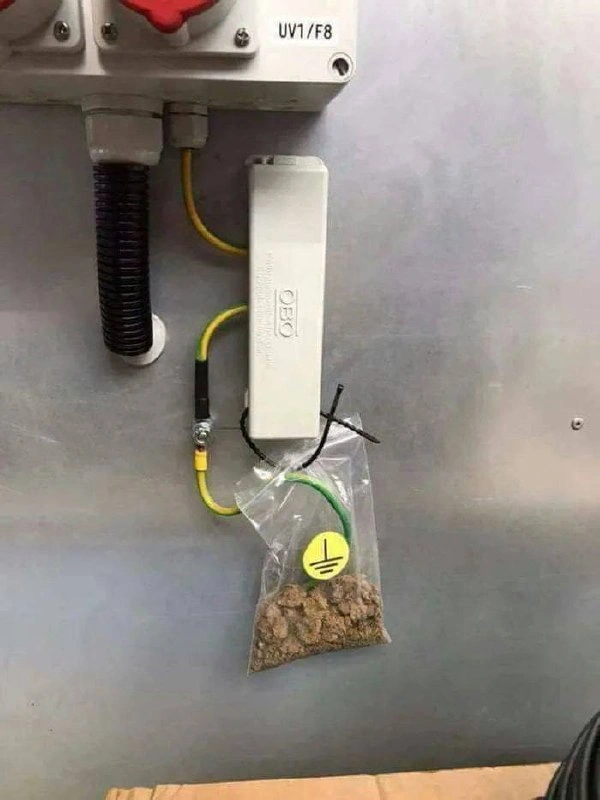
Now, what do we see in this image? Two yellow-green wires (that color code typically denotes ground/earth wires) come from a junction box labeled “UV1/F8.” Instead of being screwed into a proper grounding point on the metal panel or an earthing bar, the wire ends in a small white OBO connector and then... disappears into a clear plastic sandwich bag half-filled with plain old brown soil. The bag is hanging by a black zip tie. Slapped onto the bag is a bright yellow sticker with the official ground symbol (the one with the vertical line and three horizontal bars). In theory, that symbol marks a legitimate Earth connection – but here it’s basically a comic label on a bag of dirt.

Why is this funny to tech folks? Well, it’s a textbook Workaround. Someone needed a ground connection but either didn’t have one or was too rushed to do it right. So they made a fake one. The bag of dirt is a tongue-in-cheek literal interpretation of “earth” ground – as if grabbing some actual earth (soil) and putting it near the wire counts as grounding. In reality, that bag isn’t connected to the vast Earth; it’s just hanging there. Dry soil in a plastic bag is not conductive enough to disperse electrical charge effectively (and it’s not connected to the actual ground anyway except perhaps via a few mounting screws, if at all). This is like a junior developer “fixing” a bug by mocking a return value instead of implementing the real logic: it might stop the error message, but it doesn’t truly solve the problem.

Technical debt is a term worth knowing here. It refers to the future cost incurred when you choose a quick, easy solution now instead of the better, proper solution. This grounding hack is pure technical debt in physical form. It’s the kind of QuickFix a frantic engineer might implement at 5 PM Friday when the boss says the new panel must be live by end of day. They did something that closes the task (“ground wire attached ✅”), but they know (or will eventually learn) it’s not a sustainable fix. Over time, technical debt like this piles up, whether in code or in wiring, and you eventually pay the price – often at the worst possible moment.

For a junior engineer or anyone new to DevOps/SRE or hardware: imagine you’re deploying a web app and discover a bug in production. Instead of fixing the code properly, you write a quick script to restart the server every hour so the memory leak never crashes it – hacky, but it keeps things running. That’s a software analogue to this hack. Here, the proper fix would be to attach the ground wire to a real grounding point. The hack was to use a makeshift earthing method: tie the wire to a bag of dirt so it “looks” grounded. It’s a security trade-off and a safety risk – if a fault occurs, that fake ground likely won’t carry dangerous current away effectively. In plain terms, it’s pretending to solve the problem. And as anyone who’s been through a few on-call rotations can tell you, pretending won’t keep the data center lights on (or the circuit safe) when things hit the fan.

Level 3: Minimum Viable Ground

In a just world, grounding an electrical system means giving stray current a safe path straight into the literal Earth. In this brushed-metal nightmare, someone decided that a zip-tied bag of dirt is close enough to Earth for government work. Consider the layers of TechnicalDebt on display: a critical safety feature implemented with a QuickFix so crude it’s practically a hardware humor performance piece. This is compliance theater at its finest – the ground symbol sticker slapped on the bag is the equivalent of merging a PR that only changes the README to say “Totally secure!”. It’s a makeshift earthing solution that technically closes a safety ticket while silently accruing catastrophic risk.

Let’s be clear: this isn’t an innocent DIY – it’s a prod patch with zip tie that screams “we had no budget or time, but hey, it passes the sniff test, right?”. The DevOps/SRE part of my soul is cringing: This is the physical-world analog of wrapping a failing server in a restart loop and calling it “stable.” In software, we’ve all seen the “temporary” patch that becomes a permanent fixture (the // TODO: fix this later that ships to production). Here that ethos is translated literally into a bag of soil hanging off an electrical panel. It’s both hilarious and horrifying – a Workaround so sketchy that even OSHA would do a double-take.

From a senior engineer’s perspective, the humor comes from painful familiarity. We recognize the pattern: under pressure, someone implements a dirt-cheap solution (here, literally dirt cheap) that technically fulfills requirements without actually solving the underlying problem. Need a ground connection? Sure, toss some earth in a bag, attach the wire, and optimism will do the rest. What could possibly go wrong? 😅 This is SecurityTradeoffs 101 in physical form – trading away real safety for the illusion of "done." Seasoned folks chuckle because we’ve been there: watching management high-five over a "solution" that we know is one neon sticker away from a meltdown. It’s funny until you remember you might be the poor soul on call at 3 AM when this ground ground™ fails spectacularly. Then it’s not so funny – just familiar.

Description

Photo of an electrical junction box labeled “UV1/F8” feeding two yellow-green earth wires. Instead of being bolted to a proper earth bar, the wire terminates inside a small white OBO connector, exits, and is zip-tied to a clear plastic bag half-filled with loose brown soil. A bright yellow ground symbol sticker is slapped on the bag as if to certify the arrangement. The entire assembly hangs against a brushed metal panel, proudly advertising a ‘ground’ that is only metaphorical. For seasoned engineers, the image is the physical equivalent of shipping to prod with TODO comments still in place - an expedient hack that technically closes a ticket while silently accruing catastrophic technical debt

Comments

12
Anonymous ★ Top Pick Sure, it’s not UL-listed, but it perfectly models our compliance posture: loosely coupled, eventually consistent, and grounded only in spirit
  1. Anonymous ★ Top Pick

    Sure, it’s not UL-listed, but it perfectly models our compliance posture: loosely coupled, eventually consistent, and grounded only in spirit

  2. Anonymous

    After 20 years of explaining impedance matching and ground loops, I finally understand why junior engineers keep asking if they should use organic or regular soil for their grounding implementations - apparently someone's been taking the IEEE standards a bit too literally in the field manual

  3. Anonymous

    When the junior engineer reads 'connect to earth ground' in the electrical specifications and implements it with maximum literal compliance. This is what happens when you follow the documentation too precisely without understanding the underlying abstraction - a perfect metaphor for cargo cult programming, but in hardware form. At least they got the ground symbol right and used proper yellow/green color coding

  4. Anonymous

    Hardware TDD: they mocked Earth with a Ziploc so isGrounded() passes - classic security theater where the interface compiles and the electrons disagree

  5. Anonymous

    The electrical equivalent of mocking a dependency in production: the requirement says must be grounded, so they shipped bagOfEarth() and the audit went green

  6. Anonymous

    Hardware's technical debt: granular accumulation that's hell to refactor without downtime

  7. @sashakity 3y

    are they putting ground in cereal?

    1. @qwnick 3y

      They grounding electricity XD

  8. @sashakity 3y

    oh wait that's a bag of dirt

  9. @sashakity 3y

    I thought it was cereal

  10. @yuriikovalets 3y

    Dependency inversion with ground interface?

  11. @victorsheih 3y

    💻

Use J and K for navigation