Windows zealots on Stack Overflow dismiss POSIX, ignite portability flame war
Why is this OperatingSystems meme funny?
Level 1: Playground Console Wars
Imagine you and your friends want to play a game together, but each friend has a different game system. One friend – let’s call him Willy Windows – has an Xbox, and he’s very proud of it. Another friend – let’s call her Penny Portable – suggests, “Hey, let’s pick a game we can all play, like a board game or a simple tag game, so that everyone, no matter what stuff they have, can join in.” But Willy Windows crosses his arms and says, “That’s stupid. My Xbox has the best game ever, and anything else is garbage. Why would we play any game that’s not on Xbox? Your PlayStations and Nintendo consoles are junk compared to my system.” The other kids look puzzled. Sure, the game on Willy’s Xbox might be cool, but if they choose that, only Willy gets to host and play on his system – the kids with other consoles or no consoles at all are left out. Penny Portable tries to reason: “We want everyone to have fun together. If we only use your Xbox game, our friends with Switches or PlayStations have to just sit and watch. How is that fair or fun?”
Willy basically replies, “So you want us to not use the best game just so everyone can play? You want us to play a lamer game on those lame consoles? Is that what you’re saying?” He’s getting a bit red in the face, really worked up about his console being the superior one. It sounds pretty silly, right? He’s insulting the others’ stuff just because he loves his own so much. The friends ultimately just shake their heads and say, “Look, the whole point is for all of us to play. It doesn’t matter if one system has fancier graphics; if half the group can’t play, then it’s not a good choice for a group game.” In the end, maybe they pick a game that’s available on all consoles, or they just go play soccer outside where it doesn’t matter what console you have at home.
This is basically what the meme is about, but in the world of programmers and computers. One person is acting like Willy Windows, insisting on a Windows-only solution and trash-talking the other systems (Linux, Mac) as if they’re worthless. Another person is like Penny Portable, saying “Hey, I want a solution that works for everyone, not just one system.” The funny part is how over-the-top the argument gets – it’s as if Willy Windows is screaming “my way or no way!” even when it clearly misses the whole point of playing together. In real life, we can see how unreasonable that is on the playground, and it’s just as unreasonable (and kind of laughable) in the programming world. The meme is making us chuckle at how developers sometimes behave like stubborn kids arguing over whose toys are better, instead of just finding a way so everyone can play along.
Level 2: POSIX vs Windows 101
Let’s break down what’s happening in this meme in simpler terms, especially for those newer to programming or not deeply familiar with operating system specifics. The core issue is portability: writing software that can run on different operating systems (for example, on Windows, on Linux, and on macOS) without needing separate codebases. Cross-platform or portable code is highly valued when you want your program to reach a wide audience, because not everyone uses the same OS. The meme’s conversation is essentially an argument about this: one person wants a solution that works on all major OSes, and another person is arguing for a Windows-only solution because they believe Windows’s way is better.
First, what is POSIX? POSIX stands for Portable Operating System Interface. It’s a set of standards defining common operating system features (like how to manage files, processes, and other system calls) that is followed by many OSes, especially Unix-like ones. Linux, macOS, and other Unix-derived systems implement POSIX interfaces (or come close to it). That means a program that uses only POSIX-specified functions can often be compiled and run on any of those systems with minimal changes. It’s like having a common language or rulebook that different OSes agree on, so developers don’t have to completely rewrite their code for each one. For instance, POSIX defines that to open a file you use a function called open(). Both Linux and macOS provide an open() call that behaves as POSIX specifies.
Windows, on the other hand, historically did not adhere to POSIX as its primary interface. Windows has its own “native tongue” for system operations – often referred to as the Win32 API (and newer incarnations like Win64, etc.). Instead of open(), a Windows programmer might call CreateFile() to open a file. So if you write code calling CreateFile() directly, that code will only compile/run on Windows. Likewise, if you use a POSIX-specific feature like fork() (to create a new process by duplicating the current one) in Linux, that code won’t run on Windows, because Windows doesn’t support fork() in the same way. In short, POSIX vs Windows is a shorthand for “portable, Unix-like code vs platform-specific Windows code.”
Now, in the meme, someone on Stack Overflow (a popular site where developers ask and answer programming questions) is asking for help. It sounds like they’re trying to do something involving remote procedure calls in a project that needs to run on multiple OSes. Remote Procedure Call (RPC) is just a fancy term for invoking a function or operation on another program (often on another computer or another process) as if you were calling a local function. Think of it like having a helper in another room: you send a message saying “do this task for me,” and they do it and send back the result. Many operating systems provide mechanisms to make RPC easier.
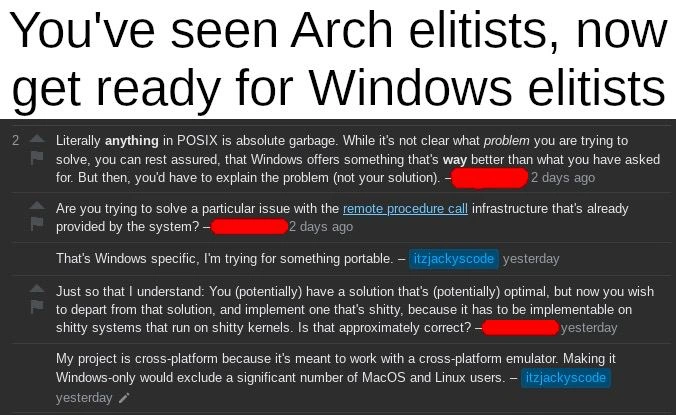
From the comments we see: one person suggests that anything POSIX (i.e., any solution that’s generic enough to work on Linux/macOS) is “garbage” and that Windows offers something better. They’re likely referring to Windows’ built-in RPC facilities. Indeed, Windows has had robust inter-process and network communication libraries (like its own RPC implementation, COM/DCOM, or Named Pipes). The commenter is basically saying, “Why are you even looking for a general solution? Windows already does this really well with its own tools – just use those.” This person wants the question-asker to explain the problem more, probably expecting to say “just use the Windows feature X to solve it.” This hints at a common Stack Overflow situation: sometimes people ask for a specific way to do something (their “solution”), but seasoned folks will ask them to clarify the actual underlying problem to see if there’s a better approach. That’s often good advice, but in this case the seasoned answer-er is coming in with a huge bias.
Then another comment asks if the questioner is trying to solve an issue that the existing “remote procedure call infrastructure” on Windows handles. In plain terms: “Hey, Windows already has system-provided tools for RPC; are you sure you can’t just use those?” This again is nudging the idea that the person should stick to Windows’ way. The questioner (itzjackyscode) responds: “That's Windows specific, I'm trying for something portable.” Here, they clarify that their project isn’t Windows-only; it needs to run elsewhere too (macOS, Linux). So using Windows-specific RPC would defeat the purpose — it won’t work on other systems.
Now comes the fiery retort from the Windows enthusiast. They basically rephrase what the asker said in a very exaggerated (and rude) way: “So you want to leave an optimal Windows solution and implement one that’s shitty… on shitty kernels. Is that about right?” There’s a lot to unpack in that single line:
- They concede the Windows-specific solution might be “optimal” on Windows, but they label any cross-platform solution as “shitty.” Why? Because to them, anything that isn’t using Windows’ native capability is inherently inferior (perhaps slower, more work to implement, less elegant in their eyes).
- They then insult other operating systems by calling them “shitty kernels.” A kernel is the core part of an OS that manages the hardware and system resources. By saying “shitty kernels,” they’re insulting the core of Linux, macOS, etc. It’s pure name-calling — there’s no technical argument presented about why those kernels would be worse; it’s just tribal smack talk.
- The phrasing is confrontational and meant to put the questioner on the defensive, as if wanting portability is an absurd desire.
Finally, the original questioner responds very reasonably: “My project is cross-platform because it’s meant to work with a cross-platform emulator. Making it Windows-only would exclude a significant number of macOS and Linux users.” In simpler terms, they’re saying, “Look, I have to support multiple OSes. If I make this only work on Windows, I lose a bunch of users. That’s not acceptable for my project’s goals.” This is the pragmatic truth: if you’re distributing a tool or app to a broad audience, you often cannot assume everyone is on Windows. A significant number of people use macOS and Linux, especially in certain fields (for example, many developers and tech enthusiasts use macOS or Linux; many servers run Linux). So the questioner is reasserting the importance of cross-platform portability. They’re basically the adult in the room, ending the argument by restating the project’s requirement.
What makes this meme funny to developers are a few things:
- The tone mismatch: Stack Overflow is usually pretty professional and factual. Seeing a comment that includes phrasing like “shitty kernels” stands out as absurd. It’s like if someone started yelling in the middle of a quiet library.
- The role reversal: Often, you might anticipate a Linux user bragging about Linux on such forums (it’s common to see Windows criticized on developer forums for various reasons). But here it’s a Windows user being the zealot. That subverts expectations in a humorous way. The meme’s top text about “Arch elitists vs Windows elitists” plays on that reversal explicitly.
- The tribalism: The Windows commenter acts like an overzealous fan, as if Windows vs Linux is a sports rivalry or a matter of pride, rather than just two different tech choices. This exaggerated loyalty is recognizable and a bit ridiculous, which is why it’s humorous. It’s poking fun at the idea that some developers treat their preferred OS like a religion (hence terms like OS religion wars).
- The straightforward reasonable response from the questioner at the end highlights how off-base the rant is. The contrast between “shitty kernels” and “significant number of MacOS and Linux users” is almost comedic timing — one is slinging mud, the other is calmly stating a fact. It’s like a slapstick scene where one character is flailing angrily and the other just stands there, eyebrow raised, with a dose of reality.
For newcomers to development, a takeaway here is: always choose the right tool for the job. If your goal is cross-platform software, you generally should use portable technologies or be prepared to write different code for each platform. If you lock yourself into one OS’s “optimal” feature, you do so knowing it won’t work elsewhere. There’s no absolute “better” way without context. Windows has some great features, Linux/Unix has others. A good developer is flexible and aware of these differences. What this meme mocks is the inflexibility and combative stance some people take. It’s a humorous reminder that in developer communities (just like anywhere online), you’ll encounter strong opinions, and sometimes discussions can go off the rails into petty arguments about whose tech is superior.
On a lighter note, let’s see a tiny pseudo-code example to illustrate the idea of a portable solution vs a Windows-specific solution for something like communication (which could be analogous to RPC). It might look like this in code:
#ifdef _WIN32
// Windows-specific approach: e.g., use a Windows-only RPC or named pipe API
useWindowsRPC("someEndpoint");
#else
// POSIX (Linux/macOS) approach: e.g., use a socket which works on all OS
int sock = socket(AF_INET, SOCK_STREAM, 0);
// ... set up network connection (works on Linux/macOS/Windows alike if using common libraries)
#endif
In this snippet, #ifdef _WIN32 is a common way in C/C++ to say “if we’re compiling on Windows, do the following”. So inside that block, you might call something that only exists on Windows (like a Windows RPC function or a named pipe function). The #else part is for other systems (Linux, macOS, etc.), where you’d use a different method, such as standard BSD sockets (which are POSIX compliant and available on Unix-like systems, and even on Windows if you use the right compatibility layer). This conditional compilation is one strategy to keep code portable: you include both versions, and the appropriate one is selected depending on the target OS. It shows concretely why a “portable” solution might be more work – you may end up writing and maintaining two code paths to handle differences. That’s extra complexity the Windows commenter in the meme is basically sneering at. To them, it’s simpler to just do it the Windows way and ignore other OS. But as the project maintainer pointed out, that isn’t an option if you care about all your users.
In summary, this meme (and the conversation in it) is about a conflict between wanting a solution that works everywhere versus using a solution that only works on one system but is perhaps easier or more powerful on that one system. It’s presented humorously as a fight, showing how people can get oddly passionate about their operating system of choice. For a junior developer or someone new: don’t be discouraged by this kind of argumentative behavior you might see online. Instead, notice the underlying lesson – know your requirements. If you need cross-platform, stick to cross-platform approaches (or multi-implementations as needed). And beware of anyone who says “X is absolute garbage, use Y”; in tech, such extreme views are almost always wrong or at least highly biased. Every tool has pros and cons. The best developers keep an open mind (and ideally, a civil tone!). The meme just exaggerates the opposite for comedic effect. 😄
Level 3: Stack Overflow Smackdown
This meme captures a too-real scenario from developer Q&A culture: a simple programming question derailed by an OS religious war. The Stack Overflow thread (depicted in a dark theme screenshot) shows a user asking about a cross-platform solution, only to be confronted by a combative Windows elitist. The initial bold heading sets the tongue-in-cheek tone: “You’ve seen Arch elitists, now get ready for Windows elitists.” This references a well-known trope in dev communities – enthusiasts of the Linux distribution Arch Linux often (jokingly) have a reputation for elitism, always quick to tout Arch as superior. Here the meme cheekily warns that Windows power-users can be just as zealously territorial. In the thread, the Windows partisan dismisses "literally anything in POSIX" as "absolute garbage", igniting what is essentially a portability flame war on the forum. It’s a classic example of tech tribalism: loyalty to one platform (Windows, in this case) is so strong that anything else is deemed worthless. We’re basically witnessing an OperatingSystems cage match: Linux vs Windows round infinity, now serving on Stack Overflow. 👊
For seasoned developers, this kind of heated exchange is both familiar and eye-roll inducing. It’s the Stack Overflow version of a bar fight over sports teams – but instead of Red Sox vs Yankees, it’s Windows vs Linux. The Windows advocate’s tone is dripping with condescension: they demand the asker explain the “problem (not your solution),” implying the asker is doing it wrong from the get-go. That phrasing hints at the X–Y problem (a common Stack Overflow theme where someone asks about their attempted solution ‘Y’ instead of the real problem ‘X’). Normally, asking for clarification is helpful, but here it’s just a setup — the answerer quickly pivots to a “my platform is superior” rant. They essentially say: “Whatever you’re trying to do, Windows already does it better than what you asked for.” It’s presumptive and snarky. Then another commenter inquires if the asker is trying to solve something that Windows’s own remote procedure call infrastructure handles. The asker (itzjackyscode) replies, “That’s Windows specific, I’m trying for something portable.” This is the crux of the matter: the asker needs a cross-platform solution (perhaps writing an emulator or tool that runs on Windows, macOS, and Linux alike). In response, the Windows enthusiast doubles down, paraphrasing the asker’s goal in the most caricatured way:
“So you want to depart from an optimal Windows solution and implement one that’s shitty… on shitty kernels. Is that approximately correct?”
Ouch. 🙃 This line is so over-the-top hostile that it’s equal parts appalling and darkly funny to anyone who’s spent time in dev forums. It’s basically a strawman: painting the perfectly valid desire for portability as a ridiculous choice to use an inferior approach on inferior systems. The hyperbolic phrasing (two instances of “shitty” in one sentence) satirically epitomizes the worst of online tech arguments. You can almost hear the collective groan of the community: “Here we go again with the OS wars…” The humor here comes from how absurd the Windows zealot sounds – it’s a mirror image of the extreme Linux fanboy rants we’ve all seen, just inverted. In a way, the meme is poking fun at both sides of such arguments. The headline explicitly ties it to Arch elitists vs Windows elitists: no group has a monopoly on obnoxious behavior; given a topic to be fanatical about, any faction (be it Arch Linux users or hardcore Windows users) can produce this kind of blowhard.
What’s being satirized is a real pattern in DevCommunities: instead of collaborative problem solving, discussions devolve into platform evangelism. The Windows partisan isn’t really trying to help solve the problem; they’re more interested in proving Windows is the one true solution. This is a well-known dynamic in forums and comment sections — the dreaded “{My Technology} vs {Your Technology}” flamewar. It’s the same energy as tabs vs spaces, vim vs emacs, or JavaScript vs everyone debates. Here it’s posix_vs_windows, a long-running feud. These spats resonate with developers because many have experienced them first-hand. Perhaps you’ve witnessed a coworker insist that all servers should run Windows because “Linux is just a hobby OS,” or conversely, someone on a team who calls Windows “Winblows” and refuses to acknowledge it could ever be suited for serious work. The meme zooms in on that combative tone and entitlement, exaggerating it to comedic effect.
On Stack Overflow specifically, such open flame wars are relatively rare (moderators often intervene), but they do occur, especially on hot-button questions like portability, security practices, or language design. The timestamps “2 days ago / yesterday” and the partially obscured usernames give it an air of authenticity — it feels like a real thread where one user’s genuine question got hijacked by an OS zealot. The frustration of the original poster (itzjackyscode) is something many junior devs and independent project maintainers can relate to: they just want a straight answer on how to do something across platforms, and instead they’re getting a lecture implying they’re foolish for even attempting cross-platform support. It highlights an undercurrent in some developer circles: a belief that the “one right way” (usually the commenter’s preferred stack) should trump the actual project requirements. In this case, the requirement is clear — the project must run on Windows, Mac, and Linux. But the Windows enthusiast is essentially saying, “Why bother with those other OS at all? Windows is superior, focus only on that.” This mindset, taken to an extreme, is what we call windows_elitism in the context_tags: treating Windows as the only platform that matters. It’s a bizarro mirror of the more commonly seen Linux elitism in open-source circles (where someone might scoff at anything Microsoft). The meme gets its punch by flipping the script — we expect a fight on Stack Overflow to maybe have someone say Windows is inferior, but here we have a Windows warrior trashing POSIX systems with an almost meme-able ferocity.
Experienced developers are likely nodding (or smirking) at how the exchange escalates. We’ve all seen how a technical discussion can get derailed by pride and tribal loyalty. The term “OS religion wars” is apt: like religious or sports arguments, logic sometimes flies out the window and it becomes about defending one’s chosen idol. The irony is that both Windows and POSIX-based OS have their strengths; a well-rounded engineer usually recognizes that tool choice depends on context. The absurdity in the meme shines a light on the fact that this Stack Overflow respondent either doesn’t know or doesn’t care about context – they just want a soapbox. In reality, if you’re building, say, a cross-platform emulator (as the final comment suggests), portability is the prime directive. A senior developer facing that scenario would likely suggest using a portable library or writing conditional code to support each OS as needed, rather than picking a fight. But flame warriors aren’t known for their pragmatism.
One subtle nugget here is that this conversation, while comically toxic, touches on a real challenge: cross_platform_portability versus using native capabilities. It’s a tension many projects face. An anecdote many seniors might recall: teams that built Windows-only solutions which later had to run on Linux (or vice versa) often endure a world of pain refactoring everything, because they didn’t plan for portability. The Stack Overflow asker is actually forward-thinking, trying to avoid that trap from the start. The Windows zealot, however, views this forward-thinking as a mistake — in their mind, why not just cater to Windows and get the best performance/features now? This is basically short-term vs long-term thinking. It’s humorous because the commenter is so short-sighted that they’d rather be king of a small hill (the Windows ecosystem) than acknowledge a bigger picture. The final reply from itzjackyscode is almost a mic drop of rationality: “Making it Windows-only would exclude a significant number of macOS and Linux users.” In plain terms: “Dude, not everyone lives in Windows-land, and I actually care about those people.” It’s an understated, professional way to end the argument – and within the meme’s narrative, it leaves the Windows elitist looking rather narrow-minded and silly.
In summary, at the senior engineer level, this meme is a wink and a nudge about tech tribalism in developer communities. It exaggerates a Stack Overflow spat to remind us how foolish these Linux vs Windows holy wars appear, especially when the combatants ignore real-world requirements (like user base diversity and code portability). It also implicitly encourages us to focus on the problem, not blind platform advocacy. After all, the best engineers choose the right tool for the job – they don’t try to make the job fit their favorite tool. As humorous as the meme is, it’s also a tiny cautionary tale: don’t be that comment #4 person in real life, or you’ll be the one being laughed at in the next meme.
Level 4: Syscall Schism
At the deepest technical level, this meme highlights a fundamental Operating System API divide: the POSIX vs Windows interface gap. POSIX (Portable Operating System Interface) is a family of standards that define a common set of system calls and C library functions for Unix-like systems (e.g. Linux, macOS, BSD). In contrast, Windows has its own proprietary API (historically Win32/NT APIs, COM, .NET) that doesn’t adhere to POSIX norms. This divergence means that code written to the POSIX standard is source-portable across Linux and macOS, but often won’t compile or run on Windows without adaptation (and vice versa). Fundamentally, each OS kernel provides different syscalls (e.g., fork() on POSIX vs CreateProcess() on Windows) and different inter-process communication mechanisms. This syscall schism is at the heart of the conflict: the meme’s “Windows elitist” considers the Windows-specific approach superior, while the original questioner favors a generic POSIX-friendly approach for portability.
Digging deeper, the remote procedure call (RPC) debate in the comments is rooted in OS design decisions. Windows NT-based systems come with an integrated RPC infrastructure (often based on the DCE/RPC protocol) baked into the OS. This allows Windows applications or services to perform remote procedure calls through the system’s high-performance facilities (for instance, COM/DCOM, or named pipes with RPC, which tie into the kernel’s scheduling and security model). On POSIX systems, there isn’t a single blessed “system RPC” service at the same kernel level – developers typically use network sockets, IPC mechanisms like pipes or message queues, or higher-level libraries (like gRPC or CORBA) for similar functionality. The Windows advocate in the meme implicitly references this: “the remote procedure call infrastructure that’s already provided by the system” refers to the built-in Windows RPC mechanism. From a systems-theoretic angle, calling those native RPC primitives on Windows can indeed be more efficient on that OS, as they leverage kernel-optimized pathways (like high-speed local RPC, shared memory transports, kernel-level thread scheduling for RPC calls, etc.). In academic terms, Windows provides a vertical integration for RPC – a single-vendor optimized solution – whereas POSIX offers a horizontal integration approach – a standard interface that can be implemented in various ways on different kernels, trading absolute optimization on one OS for broad compatibility across many.
This leads to a classic portability vs optimization trade-off. The Windows-specific solution might utilize advanced OS features (like efficient asynchronous IO, I/O completion ports, or kernel-level object handles) to achieve high performance and reliability on Windows. However, those features are proprietary – a cross-platform portability approach can’t assume their existence. Instead, a portable solution must rely on common denominators (e.g., standard TCP/IP sockets for communication, which every OS supports, or higher-level frameworks that abstract differences). These portable abstractions might not exploit 100% of Windows’s capabilities, possibly making them slightly less performant or requiring extra development effort. From a theoretical perspective, this is related to the concept of leaky abstractions: building a universal solution means sometimes you don’t get to use each platform’s most specialized tools. The meme’s Windows zealot frames this as “optimal vs shitty” – claiming anything not using Windows internals is inherently inferior. Of course, from an engineering standpoint, that’s a myopic view; optimality is multidimensional. If the goal is to serve users on varied systems, then being POSIX-compliant and portable is itself an optimization (maximizing reach and maintainability), even if it sacrifices some platform-specific perks. It’s a manifestation of the CAP theorem of portability vs performance (not a real theorem, but a tongue-in-cheek nod): you often can’t maximize platform-specific performance and cross-platform compatibility simultaneously – you have to balance them based on project requirements.
Historically, this POSIX-vs-Windows split has deep roots. UNIX systems in the 1980s converged on POSIX to allow the same C programs to run on any compliant Unix (from Solaris to Linux to macOS’s UNIX underpinnings). Windows, starting with Windows NT, went another direction, focusing on the Win32 API and its own paradigms (e.g., registry, dynamic libraries .dll differences, structured exception handling, etc.). There was even a POSIX subsystem in early Windows NT for government compliance, but it was very limited and eventually deprecated as few used it. The result: two parallel universes of system calls and libraries. This meme sits squarely at the collision of those universes. The “shitty kernels” comment demonstrates the flame-warrior’s ignorance of the engineering trade-offs: modern OS kernels like Linux, XNU (macOS), and NT (Windows) each excel in different areas (Linux’s I/O scheduler and modular design, macOS’s Mach microkernel heritage with a Unix layer, Windows’s fine-grained access control and driver model), but none is objectively “garbage.” Calling Linux’s highly-tuned kernel or macOS’s UNIX-certified kernel “shitty” is pure tribal rhetoric, not technical fact. Nonetheless, it’s precisely these low-level differences (monolithic vs hybrid kernel architectures, different scheduling and IPC strategies, file system semantics, etc.) that make true “write-once-run-anywhere” portability a non-trivial challenge. In essence, this kernel-level divergence forces developers to choose: either embrace one OS’s full power or design for a common subset of features. The meme dramatizes that choice – treating it not as a nuanced engineering decision but as fodder for an OS holy war.
Description
The meme has a large headline in bold black letters on a white background reading, "You've seen Arch elitists, now get ready for Windows elitists." Below, a dark-theme Stack Overflow comment thread is shown. Comment 1 says: "Literally anything in POSIX is absolute garbage… Windows offers something that’s way better… you’d have to explain the problem (not your solution)." Comment 2 asks: "Are you trying to solve a particular issue with the remote procedure call infrastructure that’s already provided by the system?" Comment 3 (blue username itzjackyscode) replies: "That's Windows specific, I'm trying for something portable." Comment 4 retorts: "So you want to depart from an optimal Windows solution and implement one that’s shitty… on shitty kernels. Is that approximately correct?" The final reply states: "My project is cross-platform… Making it Windows-only would exclude a significant number of MacOS and Linux users." Red rectangles obscure two usernames, and grey timestamp labels like “2 days ago” and “yesterday” appear beside each line. The image pokes fun at OS religious wars, portability debates, and the sometimes combative tone seen in developer Q&A communities

Comments
6Comment deleted
Sure, portability is great - unless it means letting your pristine Win32 brain dump compile on one of those "shitty kernels" the rest of the planet inexplicably runs
"Watching someone defend Windows' POSIX compliance is like watching a senior architect explain why their monolith is actually microservices because it has multiple threads."
Ah yes, the eternal cycle: Arch users tell everyone they use Arch, Windows developers insist their platform-specific APIs are 'objectively superior,' and meanwhile the rest of us are just trying to ship cross-platform code that doesn't require explaining to stakeholders why we're excluding 40% of potential users because someone had strong opinions about POSIX. Nothing says 'senior engineering judgment' quite like sacrificing market reach for the sake of winning an internet argument about syscall elegance
Win32-only RPC as 'optimal' is the senior-architect speedrun to ship vendor lock-in and rebrand portability as an NFR - right up until PMs ask where the macOS users went
POSIX optimal until a Windows elitist calls it 'suboptimal' - suddenly cross-platform means 'works on my Azure VM'
Every time someone declares 'POSIX is garbage,' the platform team adds three new #ifdefs, a Win32 shim, and a reminder that vendor lock-in is just technical debt with better marketing