The Unstoppable Evolution of CSS Dominance
Why is this Frontend meme funny?
Level 1: The Crayon That Wanted to Be Everything
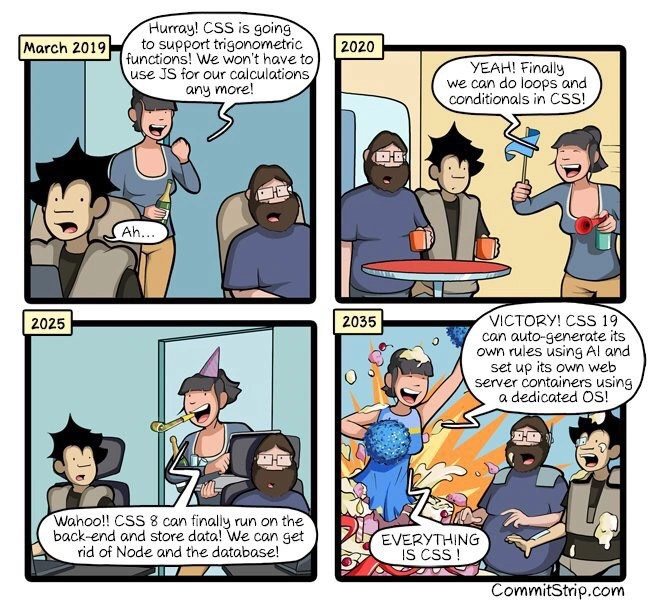
Imagine crayons are for coloring and pencils are for writing. One day the crayon company announces crayons can now also do math. Then they can write whole sentences. Then they can cook dinner, build the house, and finally — confetti everywhere — "EVERYTHING IS CRAYON!" One person at the table cheers louder at every announcement while her two friends slowly turn gray and tired, because they're the ones who'll have to live in the all-crayon house. The joke is about how tools never stay in their lane: give something one extra ability and, year after year, it keeps growing until it tries to do everyone else's job — whether or not that was ever a good idea.
Level 2: Drawing the Map Before It Burns
What the panels assume you know:
- CSS (Cascading Style Sheets) — the language that controls how web pages look: colors, layout, fonts. Traditionally it makes no decisions; it just describes appearance.
- JavaScript (JS) — the language that makes pages do things: react to clicks, fetch data, compute values. Panel 1's joke is that math was always JS territory; CSS gaining
sin()andcos()annexes a small province of it. - Loops and conditionals — the basic tools of programming ("repeat this," "if that, do this"). A language with them stops being purely descriptive — hence the unease in panel 2.
- Node and the database — the back-end: servers and storage, the part of the stack furthest from styling. "CSS 8 runs on the back-end" is absurd precisely because it crosses every line on the architecture diagram at once.
The practical lesson for someone learning the stack: the front-end/back-end and style/logic boundaries are conventions, not laws of physics, and they move every few years. The modern instinct the strip rewards is knowing which tool currently owns a job — animations that once required jQuery are now one line of CSS — and the humility to expect that answer to change again before your career is half over.
Level 3: Zawinski's Law, Now in Cascade Form
The comic's first panel is the anchor in reality: "March 2019" — and CSS trigonometric functions (sin(), cos(), tan()) genuinely were being specified for CSS Values and Units around then. The woman's celebration —
Hurray! CSS is going to support trigonometric functions! We won't have to use JS for our calculations any more!
— is a real sentiment from a real moment, which is what licenses the strip's escalating fiction: loops and conditionals by "2020," a back-end, data-storing "CSS 8" replacing Node and the database by "2025," and the apocalyptic "CSS 19" of "2035" that auto-generates its own rules with AI and provisions its own server containers on a dedicated OS. The two bearded developers age visibly across the panels, ending the strip confetti-spattered and thousand-yard-stared. EVERYTHING IS CSS!
The satire has a precise target: scope creep in web standards, the slow erosion of the web's founding separation of concerns. The original doctrine was clean — HTML for structure, CSS for presentation, JavaScript for behavior. But every boundary on that map has been leaking for years, and mostly toward CSS. Custom properties gave it variables; calc() gave it arithmetic; :checked-based tricks gave it state; container queries and :has() gave it logic-adjacent selection power. The community even periodically demonstrates that CSS-plus-HTML combinations can encode rule-110-style computation — the recurring "is CSS Turing-complete?" parlor debate. Each addition is individually sensible: shipping calculations to CSS removes JavaScript, which removes bundle weight, runtime cost, and a whole class of jank. The comic's point is about the integral, not the derivative — Zawinski's law ("every program attempts to expand until it can read mail") rewritten for stylesheets.
The gender-flipped staging is part of the joke's mechanics: one developer's genuine, escalating delight against two colleagues' mounting dread captures the real bimodal reaction every CSS feature announcement gets. The enthusiasts see liberation from JavaScript; the skeptics see a styling language acquiring the failure modes of a programming language — undebuggable logic with no stack traces, no breakpoints, and a specificity model as its only control flow. Both camps are right, which is why the argument never ends, and why the strip can ride it to 2035.
Description
This is a four-panel comic strip from 'CommitStrip.com' that satirizes the escalating complexity and scope of CSS over time. In the first panel, dated March 2019, a developer celebrates CSS getting trigonometric functions to avoid using JavaScript. By 2020, she's excited about loops and conditionals in CSS. The absurdity escalates in the 2025 panel, where she cheers that 'CSS 8 can finally run on the back-end and store data,' proposing to get rid of Node and databases. The final panel, set in 2035, shows a chaotic celebration as 'CSS 19 can auto-generate its own rules using AI and set up its own web server containers using a dedicated OS,' culminating in the triumphant shout, 'EVERYTHING IS CSS!'. The comic humorously critiques the real-world trend of feature creep in web technologies, where the lines between styling, logic, and even backend processing are increasingly blurred, leading to fears of over-engineering

Comments
8Comment deleted
We used to joke about CSS becoming Turing complete. Now we just pray it doesn't become self-aware and start writing its own RFCs
Can’t wait for CSS 20, when .database { display: grid; replicas: auto; } magically scales the Kubernetes cluster - and the PM still logs it as a “quick styling tweak.”
Remember when we separated concerns? Now CSS is so concerned about everything that it needs therapy, a Kubernetes cluster, and its own venture funding round
CSS adding loops and backend storage is just the web platform's way of proving Zawinski's law - every language expands until it can serve itself
This perfectly captures the industry's 'if all you have is CSS, everything looks like a selector' mentality. We went from 'separation of concerns' to 'CSS-in-JS' to apparently 'JS-in-CSS-in-OS.' Next up: CSS 27 will achieve sentience and file its own pull requests, but only after a 47-step build process and three breaking changes to the cascade algorithm. At least we won't need Kubernetes anymore - just `display: orchestration;`
Give the WG ten more years and :root will be our Kubernetes control plane - finally a truly cascading failure
Pure CSS backends: ACID transactions via cascade specificity, until a !important vendor prefix triggers the rollback
Give CSS containers and watch a mis-scoped selector outrank RBAC and autoscale prod