Coding on Drugs: The Definitive Guide for Programmers
Why is this MentalHealth meme funny?
Level 1: The Silly Fake Textbook
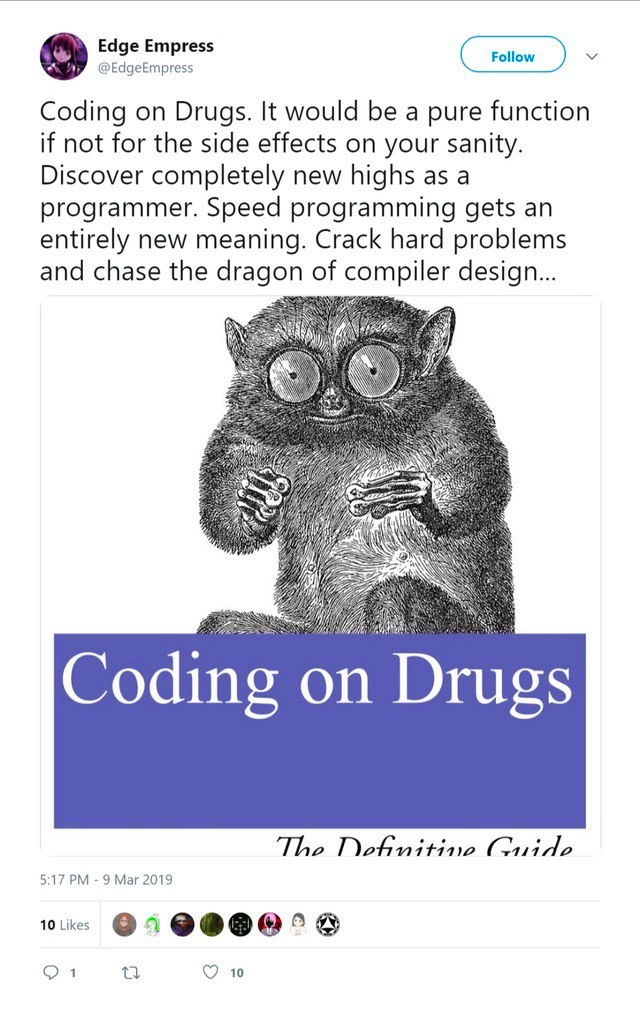
Someone made a pretend school textbook called "Coding on Drugs," complete with the serious old-fashioned animal drawing that real programming books use — except the animal is a tiny monkey-like creature with gigantic, totally wired eyes. The fun is the same as drawing a fake serious encyclopedia cover called "Eating Candy: The Definitive Guide" with a hamster mid-sugar-rush on it. Every sentence in the description hides two meanings — words that mean one thing to programmers and something naughtier to everyone else — and the joke is that being glued to a computer all night, eyes huge, brain buzzing, really does look a lot like the picture.
Level 2: Decoding the Cover
Terms worth unpacking for anyone early in the craft:
- Pure function — like a vending machine: same coin, same snack, every time, and it doesn't repaint the wall behind it. Code built from pure functions is easy to test and reason about.
- Side effect — anything a function does beyond returning a value: saving a file, printing, updating shared state. Necessary (a program with zero side effects is a space heater), but the source of most "works on my machine" mysteries.
- Compiler — the program that translates your source code into something executable. Building one involves parsing, type checking, and optimization — famously deep material, hence its textbook's dragon mascot.
- O'Reilly covers — the animal-engraving tech books you'll inevitably own. The animal has no official relationship to the topic, which is exactly why parodies can pick any beast for any vice.
The joke format itself is a rite of passage: you know you've absorbed enough culture when a fake book cover makes you laugh before you consciously parse why. This one tests four vocabularies at once — FP, compilers, publishing aesthetics, and slang — and the 10 likes on the tweet suggest a niche that found its audience.
Level 3: Referential Transparency, Chemically Assisted
The tweet's opening line is the densest joke in the image, and it only detonates if you know functional programming:
It would be a pure function if not for the side effects on your sanity.
A pure function is one whose output depends only on its inputs and which mutates nothing outside itself — no I/O, no global state, no surprises. Side effects are everything else: writing to disk, firing network calls, changing a variable someone else reads. The pun works because "side effects" is also pharmacology's term for unintended consequences, and the sentence quietly asserts that programming itself is the substance: the act would be clean and predictable, except it observably mutates the practitioner. Haskell programmers, who quarantine side effects inside the IO monad, will note that sanity here is global mutable state with no such discipline.
The rest of the tweet is a pun fusillade with real targets. "Speed programming" lands on the stimulant-fueled hackathon/crunch culture the industry romanticizes and then pays for in burnout. "Crack hard problems" is self-explanatory. But "chase the dragon of compiler design" is the connoisseur's joke: Compilers: Principles, Techniques, and Tools by Aho, Sethi, and Ullman — the canonical university compiler text — is universally known as the Dragon Book, its cover depicting a knight facing a dragon labeled with the complexity of compiler construction. "Chasing the dragon" is simultaneously the drug idiom and an accurate description of every graduate student who thought writing a compiler would be a one-semester affair.
The visual layer is its own genre: the O'Reilly parody cover. Real O'Reilly books pair austere 19th-century woodcut animals with deadpan titles, an aesthetic so rigid it became a template for satire (an entire generation of fake covers exists: Copying and Pasting from Stack Overflow, Writing Code that Nobody Else Can Read). The choice of animal here is the punchline within the punchline — a tarsier, the saucer-eyed primate, rendered in faithful engraving style. The actual O'Reilly tarsier graces their classic Unix books; redeployed under the title "Coding on Drugs," those enormous dilated eyes read as a 4 AM stimulant stare. The subtitle The Definitive Guide completes the forgery — that's O'Reilly's real series branding, lending bureaucratic authority to the bit. Underneath the laughs sits the genre's usual dark sediment: the industry's open secret of caffeine-to-worse coping chemistry, deadline mania, and the gallows acknowledgment that the job's mental toll is a known, shipped feature.
Description
This meme is a screenshot of a tweet that satirically presents 'Coding on Drugs' as a technical topic, complete with a parody of an O'Reilly book cover. The cover features a black and white sketch of a tarsier, an animal known for its enormous eyes, making it look perpetually startled or caffeinated. A solid blue banner across the image contains the title 'Coding on Drugs' in a classic serif font, with 'The Definitive Guide' written underneath. The tweet from 'Edge Empress' above the image uses technical jargon to extend the metaphor, stating, 'It would be a pure function if not for the side effects on your sanity... chase the dragon of compiler design...' The humor stems from the juxtaposition of illicit drug use with complex, high-focus software engineering concepts, mocking the extremes of 'flow state' and developer burnout culture. It's a dark commentary on the lengths developers might feel they need to go to for peak performance

Comments
8Comment deleted
The only time 'pure function' has side effects is after three days of no sleep, a gallon of coffee, and discovering the bug was a typo in a config file
“Coding on Drugs” - because enabling -O3 on your brain looks great until the optimizer reorders your side effects and you’re trying to debug undefined reality at 3 AM
The only difference between debugging production at 3 AM and chasing the dragon is that one of them eventually gives you closure
Of course it's not a pure function - the highs are referentially transparent but the comedown mutates global state
The real joke here is that 'pure functions' promise no side effects, but the programmer's sanity is clearly a mutable global state that's been corrupted by too many all-nighters chasing that elusive compiler optimization. At least the lemur's wide-eyed stare accurately represents the moment you realize your 'quick fix' just introduced a race condition in production at 3 AM
Pure functions in FP paradise: no side effects. Prod reality: monadic IO dragons breathing impure fire on your sanity
Coding on Drugs - where your functions look pure because you forgot the global state, and every side effect is just a deferred call to the SRE monad named "pager"
The only acceptable “speed programming” is your SSA pass eliminating unintended side effects - otherwise chasing the Dragon Book at 3am is just undefined behavior