The Programmer's Circadian Rhythm Paradox
Why is this MentalHealth meme funny?
Level 1: Stay Up or Get Up?
Imagine you're reading your favorite comic book late at night. You're really into the story and you don't feel very sleepy yet. Your parent says it's bedtime, but you think, "I'm not that tired, I can read a little longer." So you stay up later than you should because the story is exciting. Now imagine a different situation: you go to bed, fall asleep, and then try to wake up super early — before the sun, say 6 AM — just to continue reading that book. Waking up that early feels really hard! You’d probably hit the snooze button or pull the covers over your head because you're still so sleepy. In the end, continuing to read late into the night was easier than waking up from cozy sleep at dawn to do the same thing. That’s exactly what this meme is joking about: it's easier to stay awake doing something fun or important (like coding or reading) when you're already awake and in the middle of it, than it is to wake yourself up from deep sleep to start doing it. The funny part is that we all recognize this feeling. Just like a kid who'd rather keep playing with their toys at night than go to bed and wake up early to play, a programmer would rather keep coding through the night than try to get up at the crack of dawn to write code. The meme makes us smile because we know how true that feeling is!
Level 2: Night Owls vs Early Birds
In simpler terms, this meme is talking about night owls (people who stay up very late) versus early birds (people who wake up early in the morning). Many developers jokingly identify as "night owls." If you've just started coding, you might notice a trend: lots of programmers love to code late at night. Why? At night, everything is quiet — no emails, no meetings, no distractions. It's common for a developer to get deep into a problem or a feature and suddenly realize it's 3 or 4 AM. At that point, the meme’s statement “It's easier to stay awake till 6 AM than to wake up at 6 AM” starts to make sense. Staying up till 6 AM means pulling an all-nighter, which is when you don’t sleep at all for the whole night. Many of us have done this during a big project or even back in school when cramming for an exam. On the other hand, waking up at 6 AM means going to sleep at a normal time and then forcing yourself out of bed very early. The joke says that not sleeping at all can feel easier than sleeping for just a little bit and then trying to wake up. Anyone who has hit the snooze button on a 6:00 AM alarm can relate — it feels almost impossible to get up, especially if you went to bed late. So, the meme is a humorous way to say, "I’d rather just continue coding through the night than try to be an early riser."
Let's break down some terms and ideas from this meme:
- Late-night coding: This simply means writing code late at night. For example, imagine you're working on a fun personal project or an assignment and you start in the evening; then you keep going because you're making progress, and suddenly you see the sunrise. That's late-night coding. Developers often find a good flow late at night when there's peace and quiet.
- Sleep deprivation: This is what happens when you don't get enough sleep. If you stay awake until 6 AM and skip a night's rest, you'll be extremely tired the next day. Your body and mind are deprived (lacking) of sleep. Symptoms include heavy eyelids, slow thinking, irritability, and maybe needing a huge mug of coffee first thing in the morning.
- Circadian rhythm: This is a fancy term for your body's internal clock – it’s what makes you feel sleepy at night and awake during the day. When the meme talks about staying up till 6 AM, it means you're going against your natural circadian rhythm (which normally would have you asleep at that hour). Doing an all-nighter basically flips your sleep schedule upside down, which is why it feels so hard to become a morning person if you're used to coding all night.
- Deadline crunch: Often, developers stay up late because they have a deadline – maybe a project is due in the morning or there's a server issue that has to be fixed ASAP. "Crunch time" is a period of intense work right before a due date. In those times, a team might decide to keep working through the night rather than risk stopping. For a junior developer, this might sound exciting at first (like, “Wow, we're heroically finishing this feature overnight!”), but it’s actually something companies try to avoid because it can lead to burnout and mistakes.
To put it simply, the meme is highlighting a relatable developer experience: many programmers have found themselves still awake at dawn, not because anyone forced them to stay up, but because either inspiration struck late or they thought they’d get more done by not sleeping. The humorous twist is that if you asked that same programmer to wake up fresh at 6 AM to start coding, they'd probably groan and hit snooze. It's a funny exaggeration of how our brains work: continuing something you're already doing (coding through the night) feels easier than stopping and starting again in the early morning. Almost every developer can relate to this, either from hackathons (coding competitions that often last overnight), last-minute bug fixes, or the classic "one more hour won't hurt" mentality that turns into watching the clock strike 6:00 AM.
For example, imagine you have a school project due at 9 AM. You could either:
- Stay up late to finish it (maybe you’re already awake at midnight and you say "I'll just push through a few more hours").
- Go to sleep and wake up super early to finish it (which means you have to actually get yourself out of a warm bed at maybe 5 AM to work).
Most people find the second option much tougher. If you're already awake and in the middle of work, your brain is active. But if you go to sleep, when that alarm rings in what feels like the middle of the night, your brain is groggy and begging for more sleep. That’s why the meme jokes that staying awake till 6 is easier than waking up at 6.
This kind of humor is very common in developer culture. It's a way for programmers to laugh at the less healthy habits we sometimes fall into. It also subtly reminds new developers that while pulling the occasional all-nighter might happen, it's not something you want to do all the time. After all, the code you write at 5 AM might not be your best work once you look at it with fresh eyes! The underlying advice is: try to manage your time so you don't have to do this often, because being exhausted isn't fun. But if you do end up coding till dawn one day, know that you're not alone — it's almost a badge of honor in the coding world, and everyone will understand exactly why you have that giant cup of coffee the next morning.
Level 3: The 6 AM Paradox
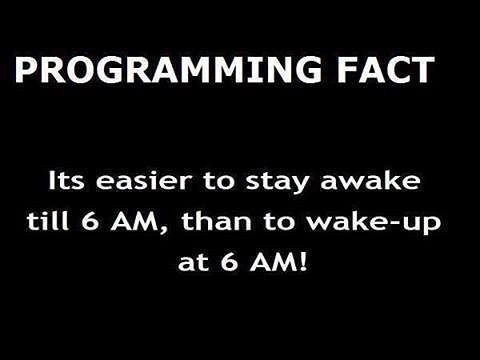
The meme boldly presents a Programming Fact: “Its easier to stay awake till 6 AM, than to wake-up at 6 AM!” This tongue-in-cheek declaration resonates with developers because it's disturbingly relatable. We've all experienced that surreal productivity boost in the dead of night. The office Slack is quiet, no meetings are being scheduled at 3 AM, and the code flows with fewer interruptions. It's a scenario born from adrenaline and looming deadlines: if you’re already deep in a coding session at 4 or 5 AM, pushing through to see the sunrise can feel more achievable than forcing a groggy 6 AM wake-up call after a short nap. In essence, the meme pokes fun at our circadian rhythm hacks – developers manipulating their sleep schedule to squeeze out a few more hours of LateNightCoding. (Notice the missing apostrophe in "Its easier" – perhaps the meme creator was too sleep-deprived to care about grammar at 5 AM, which itself adds a layer of authenticity to this Programming Fact.)
On a deeper level, this humor reflects the reality of developer lifestyle and the late-night coding culture. Many in the industry have internalized that staying up all night is just part of the job, especially when crunching on a project or chasing an elusive bug. There's an old saying, "Don’t go to bed when you’re on a roll," and in software development, inspiration often strikes when the world is dark and silent. Senior engineers chuckle (and cringe) at this meme because it satirizes a common anti-pattern: trading healthy sleep for a perceived spike in developer productivity. Under the pressure of looming deadlines, teams will often hunker down and code until dawn to ship a feature or meet a release cutoff. It's almost a rite of passage in some startups and game development studios – the infamous all-nighter fueled by pizza, soda, and endless coffee refills. The absurd wisdom here is that continuing an already active brain session is oddly easier than rebooting your brain with an alarm clock after a brief sleep. It’s a wry acknowledgment that our brains would rather stay in the programming groove than endure the shock of an early morning alarm.
The meme also highlights a bit of gallows humor around sleep deprivation and developer exhaustion. Veteran developers grin at this because they have war stories of 36-hour coding streaks that felt genius at night but looked like spaghetti code the next afternoon. There's an implicit dark joke: “Sure, it’s easy to keep coding till 6 AM – easy, right up until you face the consequences.” Those consequences include staring at code the next day with bloodshot eyes, discovering the quirky bugs or nonsensical logic written at 5:47 AM. (Ever try to decipher a 5 AM commit message? It's like reading hieroglyphs from a dream.) The shared experience being satirized is that semi-delusional productivity high when you're beyond normal limits. In reality, nothing good happens to code quality after about 2 AM – we just think we're rockstars at that hour. But because so many developers have been there, this meme elicits a knowing laugh. It's funny because it’s true: we’ve all made that cost-benefit analysis at midnight, convincing ourselves “I'll be more productive if I just power through” only to suffer the next morning.
Behind the humor, there’s a critique of tech culture’s sometimes unhealthy relationship with work hours. The industry patterns being poked at include crunch time (cramming work in last-minute marathons) and the unspoken hero complex where pulling an all-nighter is seen as dedication. Why do developers keep doing this if it’s so brutal? Partly because of systemic issues: late-night coding sessions are often born from poor planning or unrealistic deadlines imposed by management. When a feature spec changes close to release or a production bug appears at midnight, engineers feel the pressure to fix it before morning. And since software tends to be a global endeavor, someone is always awake somewhere – it almost normalizes these odd hours. There's also a practical side: nights are free from stakeholder emails and daily stand-ups, so coders guard that quiet time as their own. It's a trade-off many accept: sacrificing sleep for a stretch of uninterrupted "flow state" coding. Over time, these habits can degrade mental health – developers joke about it because humor is a coping mechanism for the very real burnout and anxiety that chronic sleep loss can trigger. The meme’s wisdom is intentionally facetious, reflecting a collective self-irony: we know this behavior is unsustainable, but at 3 AM with a deadline looming, it genuinely feels like the easier path. This shared cognitive dissonance (knowing we shouldn’t, yet doing it anyway) is exactly why the joke lands so well among seasoned programmers.
To play with the idea in code form, a simplified pseudo-code version of this 6 AM paradox might look like:
# Decision making at 4 AM: keep coding or sleep for a bit?
if already_awake and current_time < 6:
# Still in the zone, so just keep coding till morning
action = "Stay up until 6 AM"
else:
# Too sleepy to start fresh at 6 AM, likely won't get up on time
action = "Hit snooze and sleep in"
Description
This is a simple, text-based image on a black background. At the top, the words 'PROGRAMMING FACT' are displayed in a bold, white, sans-serif font. Below, in a smaller version of the same font, it states, 'Its easier to stay awake till 6 AM, than to wake-up at 6 AM!'. The humor is rooted in a widely shared experience among software developers. The state of deep focus required for coding, often called 'flow state,' can make hours disappear, leading to unintentional all-nighters. Staying awake feels like a continuation of that productive state, driven by the momentum of solving a problem. In contrast, waking up early is a hard context switch, forcing a restart of the mental engine. This meme is a simple but effective commentary on the nocturnal tendencies and intense focus that characterize the developer lifestyle, often at the expense of a conventional sleep schedule
Comments
8Comment deleted
The compiler doesn't care if it's 4 AM, but my brain's garbage collector gets really aggressive around sunrise. Waking up at 6 AM feels like a cold boot with no cache
Pulling an all-nighter is just leaving the process running with debug logs; starting fresh at 06:00 is a cold restart with empty caches and the caffeine sidecar stuck in ImagePullBackOff
The same logic that makes us think "just one more commit before bed" at 2 AM is why we schedule production deployments for 3 AM but mysteriously can't make the 9 AM standup
Developers don't have sleep schedules, they have uptime - and like all uptime, the reboot is the painful part
This meme perfectly captures the asymmetric energy function of developer productivity: the activation energy required to context-switch from sleep to code at 6 AM approaches infinity, while the energy barrier to maintain an existing coding session until 6 AM is remarkably low - especially when you're three Stack Overflow tabs deep into solving that 'one last bug' that appeared at 11 PM. It's not procrastination; it's just that our mental state machines have a much higher transition cost from SLEEP to CODING than from CODING to STILL_CODING, regardless of what the system clock reports
The real technical debt? Sleep debt piled up resolving 4AM merge conflicts
My circadian cron only supports keep‑alive; waking at 06:00 is a cold start with a 30‑minute GC pause
Easier to stay awake till 6 AM than to wake at 6: one is a warmed JVM, the other is a cold start with a full GC - right as PagerDuty rings