Navigating the Chaos of Modern CS Education
Why is this Juniors meme funny?
Level 1: Too Many Teachers, Too Many Lessons
Imagine you’re a kid learning to ride a bike, and a bunch of adults are all shouting different tips at you at the same time. One yells, “If you don’t learn BMX tricks, don’t even bother riding!” Another insists, “Training wheels are stupid, throw them away, or you’re not a real rider!” Someone else chimes in, “Oh, bikes are old news – you should learn to ride a unicycle instead, it’s the future!” Then a worried voice warns, “Actually, don’t get too into biking, all the bike shops are closing because nobody’s buying bikes...!” Another person asks, “Have you started a biking blog yet to show off your skills?” and yet another teases, “Haha, soon everyone will just teleport, and your biking will be useless!” Poor you — you just wanted to learn how to pedal, and now you’re completely confused and stressed. That’s exactly what’s happening in this meme: a computer science student is trying to learn coding, but so many people and headlines are throwing contradictory advice at them that it’s overwhelming. It’s funny in a way (because it’s so over-the-top), but it also feels a little like “wow, no wonder the student looks ready to scream!” All the kid wanted was to ride the bike (or in the real case, learn to code), but with everyone saying different things, it’s hard to know where to start or what to ignore. The meme makes us laugh because we remember being that confused learner, and sometimes the best thing to do is just cover your ears, focus on the basics, and keep on pedaling.
Level 2: Information Overload for New Devs
For a newcomer to coding, each floating statement in the meme represents a real pressure or trend they’ve likely heard about. Let’s break down what all these buzzwords and advice mean in plain terms:
“you don’t know DSA? gtfo” – “DSA” stands for Data Structures and Algorithms. This phrase is gatekeeping, basically saying “If you haven’t mastered algorithms, get out!” Many competitive programming sites and big-tech interview prep materials drill this into students. It reflects the pressure on CS students to excel at algorithmic problem-solving (like coding puzzles on whiteboards or LeetCode) as if it’s the only thing that matters. A junior often hears that without strong DSA skills, you can’t land a good job – which is intimidating when you’re still learning the basics. In reality, while understanding algorithms is important (especially for jobs at places like Google), it’s not the only skill that makes a good developer. Hearing “gtfo” (“get the heck out”) just exaggerates the harsh tone of some online communities, making newbies feel unwelcome if they’re not already experts.
“windows is shit learn linux” – This is the classic Windows vs. Linux tribalism in tech. Some experienced devs insist that Linux (an open-source operating system) or macOS is the only “real” environment for coding, and that Windows is a poor choice for serious programmers. A CS student on Windows might be told their OS is “garbage” and they must switch to Linux to be a true developer. This can cause confusion: Do I really need to dual-boot Ubuntu just to write Python code? The truth: you can program on any OS, and each has pros/cons. Many developers use Windows just fine (especially with WSL nowadays), while others prefer Linux for its developer-friendly tools. The meme highlights how strong opinions (“Windows is shit”) get thrown at learners who are just trying to code on whatever laptop they have. It’s overwhelming because it implies “You chose the wrong setup from day one.”
“indian influencer recommending the best language to learn in 2023” – This refers to the tons of YouTube videos and articles (often by tech influencers from large developer communities like India) that claim “X is the best programming language to learn this year!” For example, one video might say “Learn Python in 2023 for high-paying jobs,” another blog screams “No, Go is the future,” next week it’s “Actually, Rust is the hottest language now.” A student trying to pick a language to start with ends up dizzy from this revolving-door of advice. It’s contradictory because the “best language” changes depending on who you listen to. New developers often ask, “Which language should I learn first?” and instead of a straightforward answer, they get a flood of opinions influenced by hype. The meme specifically mentioning an “Indian influencer” pokes at how ubiquitous these recommendation videos are (India has a huge English-speaking CS student population and many content creators targeting them). The core issue: chasing the “hot language” every year can be a wild goose chase – fundamentals matter more, but that nuance is lost in the noise.
“faang is the only way to success” – FAANG is an acronym for Facebook (now Meta), Apple, Amazon, Netflix, Google – the tech giants. This statement is the myth that “the only respectable or successful software engineering career is at a big-name company like FAANG.” Many students feel pressure that if they don’t land a job at Google or Amazon, they’ve somehow “failed” as developers. It’s an intense career-path stereotype reinforced by forums where people equate FAANG salaries and prestige with success. A junior might think they must grind relentlessly for a FAANG interview – meanwhile, reading headlines about those same companies doing layoffs (the contradiction the meme points out). In reality, there are many paths to success in tech – smaller companies, startups, research, entrepreneurship – but the hype around FAANG roles can skew perceptions. So this floating advice adds to a student’s anxiety, making it sound like “Anything less than Google is failure,” which is both untrue and discouraging.
“learn this new js framework” – Web development moves fast, and there’s a running joke about a “new JavaScript framework” every other month. Frameworks like React, Angular, Vue, Svelte, Next.js, you name it, each have passionate advocates. This phrase represents the constant pressure on developers to keep up with the latest front-end framework trend. Imagine a student who just learned some basic JavaScript – then they go online and see, “Oh no, now I have to learn THIS framework to be relevant.” It’s overwhelming because there’s always a new library or framework being hyped as the next big thing. Newcomers worry that if they pick the “wrong” one, their skills will be obsolete. The meme throws this in to show how one voice says “focus on fundamentals (DSA)”, while another simultaneously says “nah, frameworks are what gets you hired, and by the way it’s a brand new one this year.” Keeping up with JavaScript fatigue (the feeling of too many frameworks) is a known source of developer anxiety for learners.
“do open source” – Many mentors and articles advise juniors to contribute to open-source projects. Open source means the code is publicly available, and contributions are usually voluntary. The advice “do open source” implies that contributing to big projects on GitHub will greatly improve your skills and make your resume stand out. It’s good advice in theory: working on open source can teach collaboration, git workflows, and let you learn from real-world code. However, for a student just learning, diving into a large codebase can be intimidating. They might think, “I barely understand my coursework, how can I contribute to Linux or some huge project?” It can feel like if you aren’t pushing code to popular repositories, you’re falling behind. The meme highlights how this is just one more thing on a long list of “to-dos” for an aspiring dev. It’s well-intentioned advice that, taken with all the rest, adds pressure: you not only have to study and build your own projects, but apparently you also need to volunteer coding labor in your spare time to be considered worthy.
“mass firing everywhere” – This isn’t exactly advice, but a contextual stressor. In 2022-23, news of mass layoffs in tech was everywhere: big companies were cutting thousands of jobs, startups were downsizing, and there was constant chatter about a looming recession. For students about to graduate or junior devs seeking jobs, reading “mass firing everywhere” is panic-inducing. It suggests “nobody is safe, jobs are disappearing,” feeding the fear that even if you do everything right, external forces might wreck your plans. In the meme, this phrase amplifies the anxiety: while one voice is telling you to aim for FAANG, another is basically saying “Good luck with that, everyone’s getting laid off anyway.” It’s a contradictory mix of hype and dread – study hard to get into top companies, but also be aware those companies are in turmoil. No wonder students feel stressed: the goalposts for success seem to be moving during a storm.
“you know how to code? lol learn to network first.” – This line is about career networking (not computer networks). It’s the idea that who you know can be more important than what you know. Someone might snarkily tell a diligent CS student, “Haha, you can code? Big deal – if you don’t have connections, you won’t get a job. Go network!” For a shy or studious programmer, hearing that social networking (attending events, LinkedIn schmoozing, making friends in the industry) is more crucial than coding skill can be both confusing and demoralizing. It implies that meritocracy is a myth and you need some insider hookup to succeed. This advice often comes from jaded professionals or career coaches and can be half-true (networking does help, but it’s not like coding ability doesn’t matter at all). The meme tosses this in to show even career strategy advice conflicts: one camp says “grind leetcode and GitHub” while another laughs “silly student, go make friends and connections, that’s the real key.” The poor student is left thinking they have to also become a master of networking events on top of everything else – yet another domain to worry about beyond coding.
“all this is good but where are your blogs?” – In recent years, aspiring devs are often encouraged to write technical blogs or articles. “Where are your blogs?” is like an authority figure demanding to see your published writings. The idea is that having a blog where you explain coding concepts or document your projects demonstrates communication skills and passion, which can impress recruiters. It’s solid advice for building a portfolio, but for someone already overwhelmed with classes, programming assignments, and perhaps a part-time job, the thought of also maintaining a regular blog can induce guilt. Many students hear, “You should be blogging about what you learn,” and feel bad that they’re not. The meme pokes at this expectation: Everything you’re doing is fine, BUT unless you’re also churning out blog posts, you’re still not doing enough. It highlights the modern pressure to be a content creator on top of being a learner. For a junior dev who might not even feel confident in their knowledge yet, writing blogs can feel like an enormous additional hurdle – as if just learning isn’t enough, you also have to teach others via blogging right away.
“recession is here lol” – Similar to the mass firing line, this phrase is a sardonic nod to the constant news about a coming recession during 2022-2023. Tech Twitter and news sites were full of debates about whether we’re in a recession, headed for one, or how long it’ll last. The “lol” adds a dark humor as if the commentator is shrugging cynically. For students, talk of a recession means hiring might slow down just when they’re entering the job market. It’s another background stressor making them question, “Even if I do everything right, will there be a job for me?” In the meme, this voice adds to the chorus of negativity and uncertainty. It pairs with “mass firing everywhere” to underscore the general doomscrolling vibe new grads faced: not only are people losing jobs now, but the whole economy might tank – haha, good luck kiddos! It’s bleak humor that any junior watching the news can unfortunately relate to.
“blockchain is the future” – This represents the tech hype of blockchain (and by extension, cryptocurrencies and web3). A couple of years ago, you couldn’t escape people proclaiming blockchain would revolutionize everything from finance to supply chains to social networks. Students were told to learn about smart contracts and blockchain programming (Solidity, Ethereum, etc.) or else risk missing the next big wave. Some might have pivoted to blockchain courses or personal projects thinking it guaranteed future relevance. The meme includes this to show how one moment, a loud voice insists “XYZ technology is the future – you MUST jump on it!” For a while, “learn blockchain” was extremely trendy advice. Fast forward and suddenly interest shifted elsewhere (many blockchain startups struggled, crypto saw downturns). So a student who invested time in “the future” tech might now hear new voices saying that future has changed (to AI, for instance). It’s confusing and frustrating – was that advice just a fad? The phrase captures how each year there’s a “this is the future” claim (before blockchain it was things like IoT, Big Data, etc.), often hyped beyond what a beginner really needs to worry about.
“ai is going to eat your job lol” – As if blockchain hype wasn’t enough, the latest fear in 2023 is Artificial Intelligence (AI) taking over jobs. With advances in AI like GPT-4 and coding assistants, headlines started asking “Will AI replace programmers?” This meme phrase bluntly says what many newbies dread: “AI will devour your programming job, haha.” The “lol” here is that same dark humor – like someone finds it amusing to scare programmers about their career longevity. For a CS student, this is terrifying: you’re investing years to become a developer, and suddenly people claim a machine might do your future job better and faster. It’s a classic job displacement fear, something every generation of technologists faces (remember folks saying automation would replace all jobs, or outsourcing will kill local tech jobs – now AI is the new boogeyman). The meme piles this on to show just how demoralizing the noise can be: on top of learning dozens of skills, you’re told it might all be pointless because AI will render human coders obsolete. (In reality, AI is a tool that can boost productivity, and historically new technology creates new roles – but that nuance isn’t what goes viral. Instead, scary one-liners do.) For a junior, hearing this constantly can seriously spike their anxiety and uncertainty about staying in CS.
“microservice is shit comeback to monolith” – This highlights a current industry debate: the shift from praising microservices to re-evaluating monolithic architectures. A few years ago, “microservices” – designing an application as a suite of small, independent services – was the darling approach for scalable systems. The mantra was “Monoliths (one big codebase/app) are outdated; every serious company is moving to microservices.” Students and developers were encouraged to learn distributed systems, Kubernetes, Docker, etc., to handle microservices. But by 2022-23, people began joking that microservices had been over-hyped and brought complexity; some well-known tech leads even blogged “maybe monoliths weren’t so bad.” So now the trendy contrarian take is exactly what the meme says: “microservice is shit, come back to monolith.” For a student, this is utterly perplexing: Which one is it? One textbook or professor says to design systems the modern microservices way, but Twitter or tech blogs mock that as a mistake and say to do the opposite. It exemplifies how fast the pendulum swings in tech opinions. Today’s “best practice” might be tomorrow’s laughable mistake – something only experience teaches. Newcomers haven’t seen the cycle before, so encountering such a reversal can make them question everything they just learned. The meme includes this to represent the broader confusion over architecture trends, a kind of insider baseball that even juniors feel pressured to understand before they’ve built their first big app.
“algoexpert ad randomly popping in” – If you’ve watched coding videos on YouTube or browsed tech forums, you’ll likely have seen advertisements for platforms like AlgoExpert, HackerRank, or other coding interview prep services. This line in the meme is a humorous nod to how often these ads appear, almost stalking aspiring devs online. Imagine a student already stressing about learning data structures (remember “you don’t know DSA? gtfo”), and then every other video or site shows an ad: “Struggling with coding interviews? Try AlgoExpert!” It’s like a constant reminder of the looming interview challenge. The “randomly popping in” part is funny because it’s true – these ads pop up mid-video or as banners, sometimes jarringly unrelated to what you were originally trying to learn. It adds to the pressure to be interview-ready at all times. Also, it’s a bit meta: even while consuming content about tech, you get marketed more things to learn or do (prep for interviews better!), contributing to the feeling that you’re never doing enough. The meme uses this as another facet of a student’s overwhelmed mind: even their attempt to learn calmly can be interrupted by commercialization telling them to learn even more.
“checkout mojo” – This phrase is referencing Mojo, a new programming language that emerged around 2023 with a lot of buzz. Mojo is touted as a language for AI developers that combines Python’s ease with C++ performance. When the meme says “checkout Mojo,” it’s mocking the constant barrage of “Have you heard about [shiny new tech]?” that bombards developers. For a student in 2023, it wasn’t enough that they might have learned Python or C++ – suddenly there’s this brand new language everyone on Hacker News was talking about. It’s FOMO (fear of missing out) incarnate: “Oh great, now I have to check out Mojo too?!” The meme brings this up to show how learning priorities can get thrown off by hype. One moment you think you know what to focus on, then some new language or framework appears and people claim it’s a game-changer. It’s exhausting for a junior who is still solidifying the basics of one language to hear that a different language might leapfrog what they’re learning. “Checkout Mojo” is basically another distracting voice in that student’s head, saying “drop everything and learn this new thing because it’s trending.” It symbolizes the never-ending stream of new tech that makes students feel like they can’t catch up.
“where are your green squares?” – This refers to the GitHub contributions graph on a developer’s profile, which is a grid of green squares indicating how active you’ve been in coding (each square is a day you made a contribution, with darker green meaning more contributions that day). Some tech recruiters and peers casually look at this as a measure of consistency or passion: lots of green squares means you code frequently. “Where are your green squares?” is the voice of someone essentially judging a student’s dedication by seeing an empty or sparse GitHub graph. It’s become a bit of a meme itself in developer circles – people hacking the system by committing something every day just to keep their streak of green squares. For a newcomer, this is a weird form of pressure: not only do you need to code, you apparently need to broadcast your activity publicly and make sure it’s daily! It can create anxiety like, “If my GitHub isn’t full of projects and daily commits, will companies think I’m not serious?” The meme exaggerates this expectation to point out how it contributes to impostor syndrome. Many juniors start obsessing over making trivial commits just to avoid an “empty” profile, which is really putting the cart before the horse. The truth is quality matters more than green square counts, but in the noise of social media, the visual of a fully green GitHub calendar has become one more competitive yardstick.
“software is not real lol” – This one is a bit of a cynical zinger. It echoes a sentiment sometimes heard from outside the software field (or from jaded individuals within it) that software engineering isn’t “real” work or that the products we make are intangible compared to, say, building a bridge. It could also be interpreted as existential tech cynicism – the idea that all this code and tech career stuff is kind of made-up or insignificant (“not real”). For a student proud to be in CS, being told “software is not real” is confusing and undermining. It’s like someone dismissing the entire field as a joke, which can rain on their enthusiasm. In context, the meme probably includes this to amplify that feeling of being deflated by negativity. After juggling all the other advice (learn this, learn that, worry about jobs, etc.), seeing “software is not real lol” is the final absurd straw – like a trollish voice saying “None of what you’re doing matters anyway, haha.” It’s dark humor representing the extreme end of contrarian takes a newbie might encounter online. Seasoned devs recognize this kind of phrase as edgy nihilism (we’ve seen variations like “computers are just fancy toys” or “coding isn’t a real trade”), often said to provoke. The student in the meme, already overwhelmed, has even this thrown at them, symbolizing peak disillusionment stress: if you start doubting the value of the entire profession, that’s a real crisis of confidence for someone just starting out.
In sum, all these elements depict a CS student’s nightmare info-feed: every direction they turn, there’s a new demand, a new trend, or a new fear. It hits on common early-career experiences: being told to learn a dozen things at once, feeling pressure to mold yourself into the “perfect candidate” with projects, contributions, blogs, and also hearing doom-and-gloom about the industry you’re trying to join. The humor of the meme comes from how absurdly dense and contradictory this cloud of advice is — a junior developer in 2023 could easily feel like they’re drowning in information overload. Every experienced developer remembers some version of this feeling: when you’re just trying to write simple programs, but online commentary makes you feel like you must also master everything, follow every trend, and somehow predict the future of tech. The meme is basically giving a sympathetic wink to all the overwhelmed beginners out there: “Yes, all that noise is real (and ridiculous)… hang in there, it gets better!”
Level 3: Advice Overflow
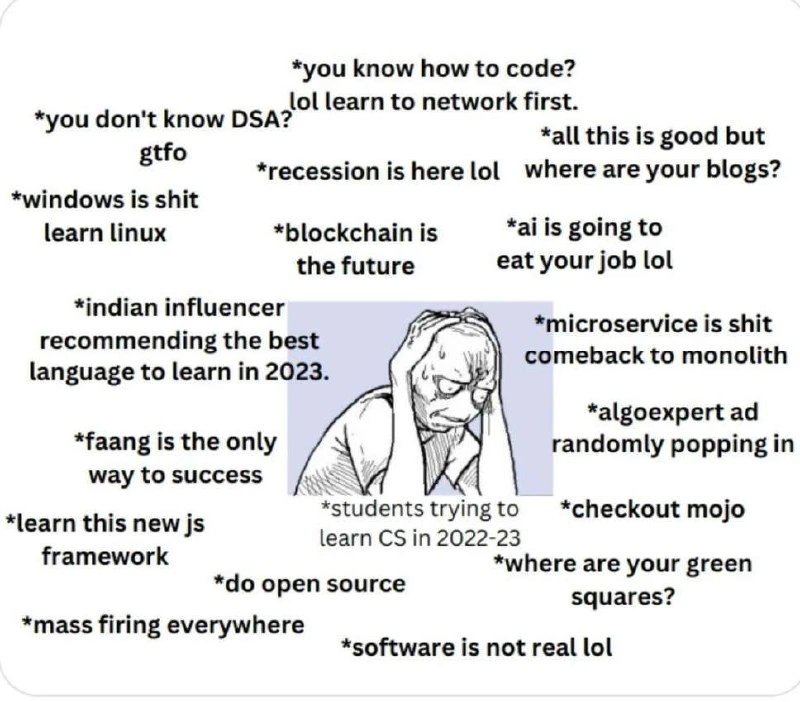
At first glance, this meme is a chaotic word cloud of tech hot-takes swirling around a frazzled CS student. Seasoned engineers will smirk at how spot-on it captures the signal-to-noise overload in today’s developer community. The humor cuts deep because each “*” phrase is a real piece of contradictory advice or hype that newbies in 2022-2023 have been bombarded with. It’s essentially a parody of the Tech Hype Cycle on fast-forward: one minute “blockchain is the future,” the next “AI will eat your job,” then “learn this new JS framework,” quickly followed by “microservices are shit, go back to monolith.” The meme exaggerates only slightly – the industry’s rapid-fire shifts in trends and doomsaying genuinely make newcomers feel whiplash. We have tribal OS wars (“Windows is shit, learn Linux”) colliding with interview gatekeeping (“you don’t know DSA? gtfo”). We see career path dogma (“FAANG is the only way to success”) clash with economic panic (“mass firing everywhere… recession is here lol”). The caricature of an “Indian influencer recommending the best language to learn in 2023” hits close to home for anyone doom-scrolling LinkedIn or YouTube – advice from self-proclaimed experts often feels like it’s trending weekly, each time claiming the one true path for a tech career. The absurdity lies in how these messages taken together would paralyze anyone: “Build side projects! No, grind LeetCode! Contribute to open source! Actually, where’s your tech blog? Also, your GitHub looks empty… better get those green squares!” The meme’s dark punchline is that junior devs internalize this cacophony, leading to classic imposter syndrome (#imposterSyndrome) – feeling like they can never catch up or “do enough.” Seasoned developers laugh (perhaps a bit bitterly) because we’ve all learned the secret: the tech world always has mixed signals, and chasing every piece of advice is a one-way ticket to burnout. The humor here is both relatable and cathartic – it’s funny because it’s painfully true that the industry’s “advice” often oscillates between hype and horror, leaving newcomers stuck in analysis paralysis. In other words, this meme is a tongue-in-cheek survival guide for navigating the modern info overload in a tech career.
Description
This meme captures the overwhelming and contradictory reality for computer science students in 2022-23. The central image features a stressed, overwhelmed Wojak-style character, clutching their head in despair, with the caption '*students trying to learn CS in 2022-23*'. This character is surrounded by a chaotic cloud of disparate, unsolicited advice and industry commentary. The text includes gatekeeping remarks ('you don't know DSA? gtfo'), conflicting architectural advice ('microservice is shit comeback to monolith'), pressure to constantly grind ('where are your green squares?'), hype cycles ('blockchain is the future', 'ai is going to eat your job lol'), and grim economic news ('recession is here lol', 'mass firing everywhere'). The meme effectively visualizes the anxiety, imposter syndrome, and analysis paralysis that newcomers face when bombarded with a firehose of often toxic, rapidly changing, and mutually exclusive expectations from the tech community
Comments
13Comment deleted
The real final exam for a CS degree is building a mental `рі` to filter out 99% of the 'expert' advice you get from Twitter
Modern CS education feels less like learning algorithms and more like implementing a debounce on the industry’s advice feed
The real distributed system here is the conflicting advice - eventually consistent, but never actually converging on consensus. At least our microservices have better coordination than tech influencers
This perfectly captures the Dunning-Kruger valley of despair that every CS student experiences when they realize the tech industry's advice forms a directed cyclic graph with no topological sort - where every path to success contradicts the previous one, and the only constant is that your current tech stack is already legacy code
All that career advice is a Kafka topic with unbounded producers; the senior move is setting your consumer group to ‘ship value’ and letting the rest expire
The 2023 CS curriculum I actually teach: Fundamentals 101, then “Kafka for human brains” - filter, dedupe, and rate‑limit all the industry hot takes
After 20 years, the real tech debt is every 'essential skill' influencers pushed since Web 2.0 - now all legacy
I had the same feeling recently Comment deleted
Just open an IDE and start coding DSA. Comment deleted
*i'm using arch btw Comment deleted
Microservices rly shit Comment deleted
elaborate Comment deleted
gpt will take your jobs Comment deleted