Skip to content
DevMeme
5011 of 7435
When the shiny Next.js façade is literally strapped onto a PHP core
Frameworks Post #5482, on Sep 21, 2023 in TG

When the shiny Next.js façade is literally strapped onto a PHP core

Why is this Frameworks meme funny?

Level 1: Candy-Coated Broccoli

Imagine a little kid who hates eating vegetables. The parents have a secret trick: they take some broccoli (yuck, green veggies) and cover it in chocolate or mix it into a sweet smoothie. Now it looks and tastes like a yummy treat to the kid, so the kid happily gobbles it up, not realizing they’re actually eating the same old broccoli that’s been there all along.

This meme is laughing about a similar kind of trick, but with computer stuff. The React developers are like the kid who only wants the latest yummy candy (the cool new tech). The PHP system is like the broccoli – an old but nutritious vegetable (an older technology providing substance). So what do we do? We wrap that broccoli in something sweet: here, Next.js is the chocolate coating. It’s the shiny presentation that covers the old PHP so that the developers (the “kids”) will accept it. The baby in the picture is being fed by a parent who’s hiding behind a tablet screen showing something the baby likes. In the same way, a company might hide an old system behind a fancy new interface. The baby gets the milk and thinks “Yum, my favorite stuff!”, just like the developers get the data and think they’re using a cool new system – while in reality, they’re still getting fed by the older system underneath.

It’s funny because it’s true: sometimes you dress up something old to make it acceptable to those who only like new things. Just like a clever parent sneaking veggies into a picky child’s meal, engineers sometimes sneak an old-school backend behind a modern frontend. The end result: everyone is fed and happy, even if they didn’t realize exactly what they were eating!

Level 2: Modern Front, Legacy Back

Alright, let’s unpack this meme in simpler terms. We have two main technologies here: PHP and Next.js (with React). These correspond to the backend and the frontend in a web application. The backend (PHP in this case) is like the engine of a website – it runs on the server, handles the database, and generates or provides data. PHP is a programming language that was super popular for building websites especially in the 2000s (Facebook started in PHP, WordPress is PHP, etc.). It typically runs on a web server (often Apache or Nginx) and spits out HTML or data in response to requests. It’s been around long enough that many big, older systems are written in PHP. When something is referred to as “legacy” in tech, it means it’s an older system that’s still in use – proven and trusty, but maybe not the shiny new thing.

On the other side, the frontend is the part of a website that the user directly interacts with – the buttons, text, and visuals in your browser. React is a popular JavaScript library for building those user interfaces, especially for dynamic single-page applications. Next.js builds on React by adding features to generate pages on the server and handle routing, among other things. Think of Next.js as a framework that makes a React-based website load faster and be more SEO-friendly by doing some work on the server before sending pages to the user. Importantly, Next.js usually runs on a Node.js server (JavaScript on the server side) instead of a traditional server like Apache/PHP.

So what happens when a Next.js app is “strapped onto” a PHP core? It means the visible part of the website (the part built with React/Next.js) is sitting on top of an older PHP system that actually holds the data or functionality. Picture a car where the body is a new model (sleek and modern design), but under the hood the engine is older. The outside (what users/developers see) is Next.js – modern JavaScript code – but it’s not running solo. It has to talk to the PHP engine to get things done. How do they talk? Usually through APIs: the Next.js frontend might request data by calling URLs or endpoints that the PHP backend provides. For example, the React code might do something like:

// Inside a Next.js page or API route
const res = await fetch('https://oldsite.com/data.php?id=42');
const data = await res.json();

Here, data.php on the server would be a PHP script returning, say, a JSON object with the info needed. Next.js takes that data and uses React to render a nice page for the user. Essentially, PHP is working in the background as a hidden data source, while Next.js is the presentation layer making everything look and feel modern.

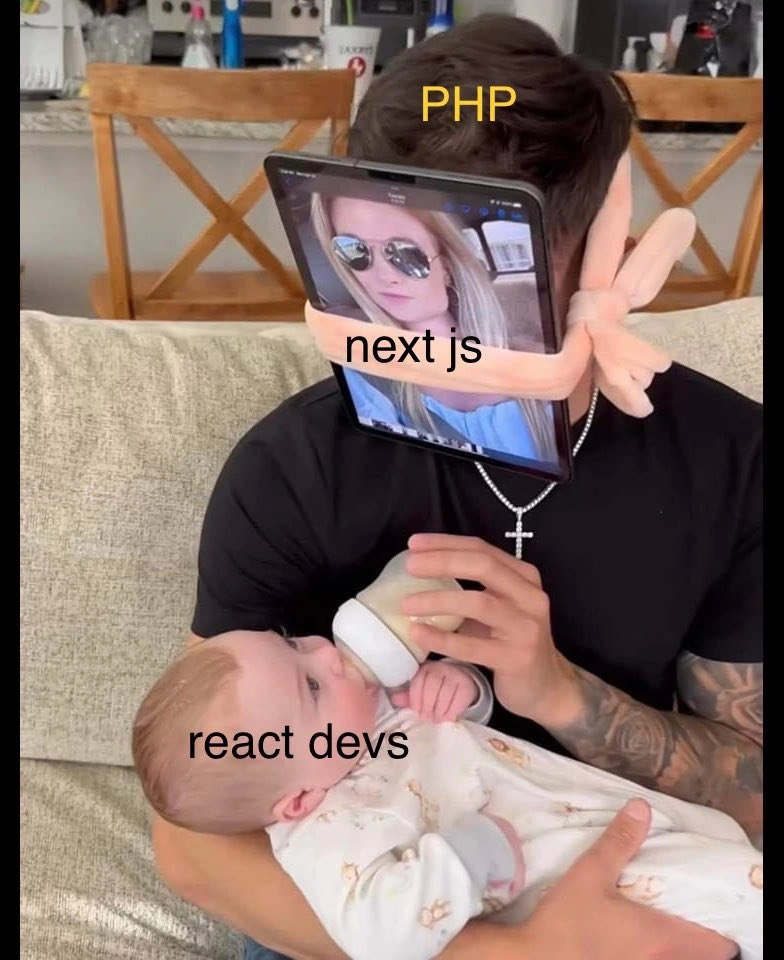
Now, the meme image is a funny literal portrayal of this relationship. The man on the couch represents the PHP backend, and he’s feeding a baby. The baby, labeled “react devs,” symbolizes developers who primarily work with React (and by extension Next.js) on the frontend. They are like the consumers of the data that the backend provides. The catch is, the man’s face is completely covered by a tablet strapped to his head, and on that tablet it says “next js”. In other words, the PHP backend guy is wearing a Next.js mask. He’s pretending to be Next.js while he feeds the baby.

Why would he do that? The joke here is that React developers (the “baby”) are being taken care of by a PHP system, but to keep them calm and happy, the PHP system is disguised as Next.js (since React devs love when things are in JavaScript/Next.js). It’s poking fun at how some modern developers might not like working with older tech like PHP, so the company just hides it behind a layer of something trendy. The React devs get their “milk” (the data, the APIs) from PHP, but since it’s presented through a Next.js interface, they feel like everything is modern.

In simpler terms, this is a common setup in WebDevelopment today: you have a legacy backend (old but reliable system, here PHP) and you add a modern frontend (new technology, here React/Next.js) on top. The two are tied together. The frontend is what you see, but it’s supported by the backend behind the scenes. Frameworks like Next.js often are used exactly this way – as a new front door to an old house. The old house (PHP backend) still does the cooking, cleaning, and heavy work (business logic, database), but the new front door (Next.js app) is what visitors see first, with a fresh coat of paint and sleek design. The meme just exaggerates it by saying the old house literally strapped the new door to itself with a goofy band, and is spoon-feeding the guests!

For a junior dev or someone new to this: don’t worry if you haven’t encountered PHP or Next.js directly. The key point is understanding frontend vs backend roles and how companies often mix technologies. Frontend devs (like React devs) focus on user interfaces and may prefer tools like JavaScript, React, etc. Backend devs maintain the server logic, databases, and might use older languages like PHP, Java, or others. This meme highlights a situation where the backend is older and the frontend is newer, and rather than rewrite everything in one consistent stack, the team layered the new tech on the old. It’s both a clever solution and a bit of a kludge (an awkward but working fix). The React devs get to work with modern tools, the business keeps its reliable PHP core, and everyone is… happy? Well, at least the baby isn’t crying in the picture! But the setup is undeniably a bit comical – thus the meme.

Level 3: Lipstick on a LAMP

This meme nails a scenario seasoned devs know all too well: putting a glamorous new React/Next.js front on top of a battle-worn PHP backend. It’s basically the tech equivalent of putting lipstick on a pig – or as we might say here, lipstick on a LAMP. The company’s stack is still the classic LAMP (Linux, Apache, MySQL, PHP) under the hood, but they’ve slapped on a sleek Next.js interface to woo the modern web crowd. The humor (and pain) comes from that dichotomy. Everyone’s raving about SSR, hydration, and fancy Next.js Pages, while in the server room there’s an old PHP beast quietly churning out JSON and HTML.

Why is this funny to a developer? Because it’s FrameworkFatigue meets legacy reality. We’ve seen hype cycles where the frontend flavor-of-the-year (Angular, React, Next, you name it) gets grafted onto an existing backend rather than the company undertaking the herculean task of a full rewrite. It’s a pragmatic if slightly absurd solution. The meme’s photo literally shows a man labeled “PHP” wearing a Next.js mask – an iPad tied to his face with what looks like a flesh-colored plush strap. It resembles an Alien facehugger clinging to his head (truly parasitic integration 😜). This is PHP begrudgingly hosting a Next.js facade. And who’s being fed with the baby bottle? The React devs, portrayed as an infant cradled in PHP’s arms. That’s a tongue-in-cheek jab at how front-end developers consume data and services provided by the backend. The React devs get their warm milk (API data, ready to be rendered in the UI) without seeing the “parent” source – they don’t care if it’s coming from a gnarly old PHP script, as long as the feed (likely a REST API or GraphQL endpoint) tastes like JSON.

The “shiny Next.js façade” exists to placate the modern front-end crowd. In many teams, the frontenders are more comfortable working in JavaScript/TypeScript with React. Telling them “Our data comes from a PHP CMS” might cause some pacifiers to drop. To avoid tantrums (or a mass exodus to cooler startups), the engineering leads stick a Next.js layer on top. That way, the React devs can pretend they’re working with a hip ModernTechStack – Node on the server, React on the client, all the buzzwords – while the core business logic remains in stable, boring PHP. It’s a bit of organizational theater: “Don’t worry, we’re using cutting-edge tech!” on the front, while the back quietly says “Psst… I’m still here doing the real work.”

Real-world war stories echo this meme. Perhaps the team had a gigantic PHP codebase (imagine an old-school e-commerce or a legacy CRM). It’s ugly, but it’s reliable and full of crucial features developed over a decade. A total rewrite into Node or Go would take years and might bankrupt the project. So instead, they stuck a Node + Next.js frontend on it within a few months. Now all new UI work happens in React, and PHP just exposes data through new endpoints. The result can actually work pretty well… until 3 AM when that flesh-colored “glue code” starts failing. I’ve seen scenarios where the Next.js layer crashes and suddenly the React devs see cryptic PHP errors leaking out – the equivalent of the mask falling off. The illusion shatters: “Oh no, the wizard behind the curtain is just old PHP after all!”

The meme pokes fun at both sides: the backend folks (PHP guy) silently doing heavy lifting, and the frontend folks (React dev baby) blissfully unaware of where their milk comes from. It’s a gentle roast. The text labels make it clear: PHP feeding React developers with a Next.js mask on. There’s also a subtext about BackendVsFrontend culture. Backend devs sometimes joke that frontend devs are coddled or working on “toy” tech, while frontend devs tout that they’re using the latest and greatest tools. Here the PHP person literally has to wear a silly tablet mask to keep the frontenders happy – an exaggerated metaphor for how legacy systems appease new developers by interfacing through trendy frameworks.

Let’s break down the absurdity with a quick reality check table:

The Hype: Modern Stack 🤩 The Reality: Legacy Inside 😅
“We built our app with React and Next.js!” The UI talks to an old PHP backend through APIs.
Fully decoupled WebDevelopment architecture Framework layering on a monolith – basically headless PHP.
New tech solves all problems! 🚀 Extra layer, added complexity – tech debt deferred.

In essence, the “Next.js mask on PHP” is a form of technical compromise. It’s easier to hire React devs if you promise them modern tools, and it’s safer to keep the reliable PHP core running the show. But the meme highlights the comic disparity: that modern JavaScript front isn’t bravely independent at all – it’s literally strapped onto the old PHP, being its face. And the React devs are like blissful babies thinking the world is all Next.js, unaware that behind that tablet screen is a tired PHP engine making funny faces to keep them smiling.

Level 4: Façade Pattern IRL

In software architecture, the Façade pattern provides a simple high-level interface to a complex subsystem. Here we have Next.js acting as a modern façade in front of a legacy PHP core. It’s a textbook case of hiding an old monolith behind a new framework interface. The Next.js layer is essentially a Backend-for-Frontend (BFF): a dedicated Node.js service that takes requests from the React UI, fetches or transforms data from the PHP system, and then serves it up in a format the front-end expects. This design lets the team claim a cutting-edge stack while all the critical business logic still runs on that tried-and-true PHP backend.

From a systems perspective, this arrangement creates an interesting mix of paradigms. Node/Next.js operates on an event-loop, handling asynchronous requests for server-side rendering of React pages. Meanwhile PHP, part of the classic LAMP stack (Linux, Apache, MySQL, PHP), follows a synchronous request/response model where each page load runs a PHP script from start to finish. When these two worlds meet, you often see the Next.js server making HTTP API calls to PHP endpoints (maybe REST or GraphQL wrappers) to retrieve data on the fly. The Next layer might even cache the results to mask PHP’s slower response time, trying to keep that snappy modern feel. We essentially have two servers (Node and Apache/PHP) working in tandem just to deliver one page: Next.js pulls data from PHP, then renders the React components server-side, and finally sends HTML to the client. It’s a distributed monolith in disguise – all the old logic is centralized in PHP, but now there’s an extra moving part strapped on front.

This pattern can be a pragmatic legacy modernization strategy. It follows the spirit of the “Strangler Fig” pattern: gradually wrap the old system with new layers, replacing pieces over time. Initially, the new Node/React front-end completely depends on the old PHP for data (much like a young fig tree wrapping around the host tree). Over time, certain PHP endpoints might get replaced with Node services or microservices, slowly “strangling” the PHP core out of the system. In theory, you eventually retire the legacy backend. In practice, teams often stop at the facade stage – the Next.js front works, the users are happy, the React devs are productive, so the PHP core gets to live on indefinitely behind its shiny mask. The trade-off is complexity: instead of one system to maintain, there are now two tightly-coupled systems. Any mismatch in data contracts or a slowdown in the PHP API will bubble up to the shiny front-end, breaking the illusion. As an academic principle, it demonstrates separation of concerns (UI vs. data layer) – but also highlights real-world constraints. Total rewrites are risky and expensive; a façade lets you innovate at the edges without tampering with the core… until eventually that plush strap holding the tablet (Next.js) onto the face (PHP) starts to chafe or snap under load.

Description

Photo meme: A man in a black t-shirt sits on a beige couch, bottle-feeding a baby. His real face is obscured by a tablet that’s been awkwardly tied to his head with a plush, flesh-colored strap. On the tablet screen is a blurred video-call face. Bright yellow text above the man reads “PHP.” Black text on the tablet reads “next js,” and black text on the infant’s torso reads “react devs.” The visual gag: PHP (the unseen backend) wears a Next.js ‘mask,’ nurturing React developers like helpless infants - highlighting how legacy stacks often hide behind fashionable frameworks to placate the modern front-end crowd

Comments

13
Anonymous ★ Top Pick Nothing says ‘progress’ like strapping a statically rendered SPA onto a decade-old monolith and calling it a micro-frontend strategy
  1. Anonymous ★ Top Pick

    Nothing says ‘progress’ like strapping a statically rendered SPA onto a decade-old monolith and calling it a micro-frontend strategy

  2. Anonymous

    After 15 years of defending PHP's honor in architecture reviews, you finally convince the team to migrate to Next.js, only to discover you've traded '$_POST' confusion for an endless debate about whether to use app router or pages router, while your Kubernetes cluster silently weeps at the 500MB Docker images

  3. Anonymous

    This perfectly captures the irony of React developers evangelizing 'modern' web development while Next.js abstracts away half of what they claim to understand, all built on the shoulders of PHP - the language they mock but which still powers more of the internet than they'd care to admit. It's the circle of life: today's cutting-edge framework is tomorrow's 'legacy system' that some new framework will be built to replace, while the baby React devs remain blissfully unaware that their entire ecosystem exists because someone solved server-side rendering decades ago in PHP

  4. Anonymous

    Modern stack: PHP in a Next.js balaclava bottle‑feeding React devs SSR and routing - 2005 features, 2025 cloud bill

  5. Anonymous

    We escaped PHP templates, then Next.js strapped SSR back on, fed React devs hydration, and added a Vercel bill - innovation by renaming the same architecture

  6. Anonymous

    PHP dad: stable but verbose. Next.js mom: SSR superpowers. React baby: endlessly re-rendering for attention - classic hydration drama

  7. @danylo1554 2y

    SSR, hmm, tasty

  8. @kandiesky 2y

    I admire how many shitty ideas react devs have just so they can do things without learning javascript/a backend properly

    1. valentyn 2y

      crr project on react + django. is it bad?

      1. @kandiesky 2y

        It's slow. Unless you're reaching a bottleneck it's ok, tho. And even then there are some ways to scale without rewriting it in Go/Rust or another performant language. React is really slow if you're using too many elements (giant table, ultra large list, sorting, etc) but if you're not using it for that it's ok.

        1. valentyn 2y

          memorization, virtualization, lazy. limiting request data, sorting filtering leaving for server side?. i may have a lot of users(more than 1k). any resources for optimizations?

  9. @NaNmber 2y

    For those who also wonder

  10. @ZgGPuo8dZef58K6hxxGVj3Z2 2y

    💀💀😂😂Aperture

Use J and K for navigation