COVID Distraction, Encryption Under Threat
Why is this DataPrivacy meme funny?
Level 1: The Locked Diary Problem
This is like having a diary with a lock that only you and your best friend can open, then someone says every lock should also have a special master key for safety checks. The worry is that once the master key exists, it can be stolen, copied, misused, or demanded by someone else. The meme is funny in a stressed-out way because Lisa is warning that private conversations may stop being truly private while everyone is busy looking at other news.
Level 2: What End-To-End Means
Encryption turns readable information into scrambled-looking data that can only be read with the right key. End-to-end encryption, often shortened to E2EE, means only the people or devices at the ends of the conversation should be able to read the message. The company running the server should not be able to open it just because the message passed through its infrastructure.
For example, in a normal private messaging design, your phone encrypts the message before sending it. The server delivers encrypted data. Your friend's phone decrypts it. If the server is hacked or legally ordered to hand over stored message contents, it should not have readable message text to give.
The meme is about a law-and-policy fight around whether services should be pressured to make encrypted communications easier to inspect for illegal content. The difficult part is that inspection usually requires access. Access requires some technical mechanism. That mechanism can become a weakness for criminals, hostile governments, abusive insiders, or ordinary data breaches.
This belongs to security, data privacy, and cryptography because the argument is not just about personal preference. Encryption protects journalists, families, companies, activists, doctors, lawyers, and ordinary people sending ordinary private messages. Weakening it for everyone can create risks far beyond the original law-enforcement goal.
The Lisa presentation format makes the warning feel like a lecture because that is what privacy debates often become for technical people: someone has to explain, again, that "just let the good guys read it" is not a complete system design.
Level 3: The Crypto Wars Reboot
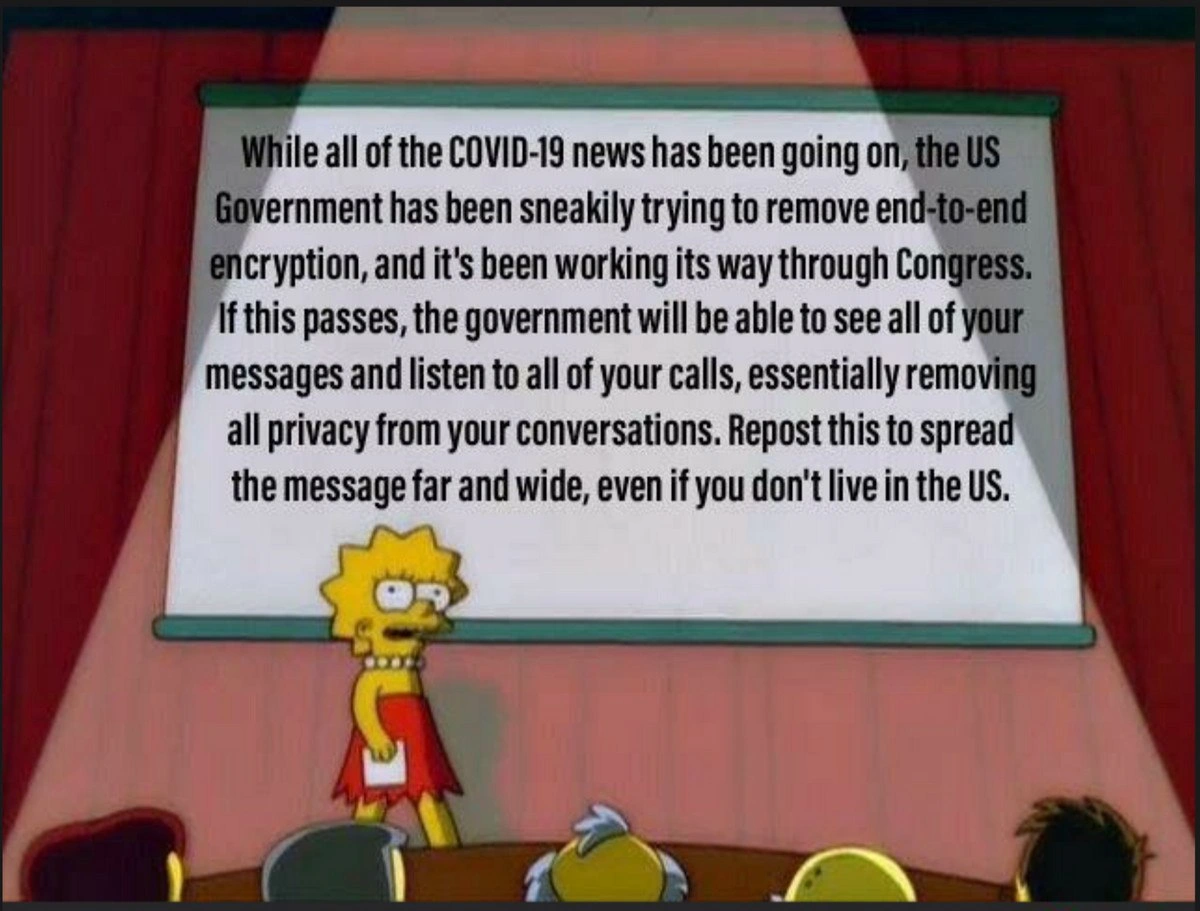
The visible format is Lisa Simpson giving a public-service lecture during the early COVID news cycle. The slide says:
While all of the COVID-19 news has been going on
and then pivots to encryption, Congress, privacy, messages, and calls. The joke is not a punchline in the usual sense; it is alarm wearing a meme costume. Developers recognize the template because it turns a policy warning into the kind of classroom presentation nobody asked for but everyone in security wishes more people would sit through.
The senior-level tension is that the meme is both overbroad and directionally understandable. Saying the government would simply be able to see all of your messages is an extreme version of the concern. The more precise technical fear is that laws aimed at platform accountability can create incentives to scan, filter, or preserve access to user content, and those incentives collide directly with end-to-end encryption. If the service cannot read the message, it cannot easily police the message contents. That is the point of the privacy feature and the policy problem at the same time.
This is a familiar industry pattern: a real abuse problem leads to a broad regulatory proposal, and the proposal treats architectural privacy guarantees as an obstacle rather than a safety property. The resulting debate becomes miserable because both sides can point at something true. Online exploitation is real and horrifying. Mass weakening of secure communications is also dangerous. The technical trap is pretending the second problem can be solved by quietly inserting a trusted third party and calling it balance.
Security people have seen this movie under different titles: key escrow, exceptional access, client-side scanning, mandatory retention, platform liability pressure, metadata expansion. Each version promises a narrow door for legitimate use. Each version creates governance, abuse, breach, and scope-creep questions that do not fit on a slide behind Lisa. Once a private messaging system is redesigned so someone other than the endpoints can reliably inspect content, the system is no longer the same privacy product.
The COVID reference matters because it explains the urgency and the suspicion. During a global emergency, public attention was saturated. Meanwhile, people were moving more of their lives into online communication: family check-ins, medical worries, work chats, mutual aid, politics, and private fear. A warning about encryption in that moment lands as "while everyone is distracted, the infrastructure of private conversation is being renegotiated." Subtle? No. But neither is losing confidentiality by policy memo.
The best reading of the meme is not "every legal reform equals instant surveillance." It is "technical architecture can be weakened indirectly, and the public often notices only after the new constraints have already become procurement requirements." That is exactly the kind of thing developers and security engineers worry about, because by the time the compliance checklist reaches the implementation team, the principled debate has usually been converted into a Jira ticket with three acceptance criteria and no threat model.
Level 4: Backdoors Break Math
The slide says the U.S. government has been trying to remove end-to-end encryption and warns that, if the effort passes, officials could see messages and listen to calls. The policy claim is simplified for meme format, but the underlying security concern is real: systems do not get a magical "only good people can decrypt this" switch. They get cryptographic designs, key-management rules, implementation details, and attack surfaces. Those are much less impressed by congressional intent.
End-to-end encryption means the communicating endpoints hold the keys needed to read the content. The server may route ciphertext, store encrypted blobs, and coordinate delivery, but it should not possess the plaintext or the keys required to derive it. Modern secure messaging usually combines authenticated key exchange, identity keys, session keys, forward secrecy, and message authentication so that compromise of one component does not automatically expose every past and future conversation.
The hard technical boundary is this: if a service provider can routinely inspect message contents, then the service provider is part of the trust path. That changes the threat model. A scanning mandate, exceptional-access scheme, escrowed key system, or client-side reporting requirement may be described as targeted safety infrastructure, but cryptographically it adds a new place where secrets are available or content is evaluated outside the sender-recipient trust relationship.
That is why security engineers get allergic to "lawful access" backdoors. A backdoor is not a moral category in code; it is an access mechanism. Once it exists, it must be specified, implemented, authenticated, logged, protected, updated, and defended forever. Attackers do not politely ignore it because the committee minutes said it was for authorized use. The system has simply acquired a privileged path, and privileged paths are exactly where attackers bring flowers and a crowbar.
The EARN IT Act debate around 2020 was not primarily that the bill text literally contained the sentence "ban encryption." The sharper argument from encryption advocates was that liability pressure and government-defined best practices could make strong end-to-end encryption legally risky for platforms. In other words, a service might keep encryption only by gambling its legal protections, or weaken encryption to satisfy rules designed around content inspection. That is the kind of indirect coercion the meme compresses into "remove end-to-end encryption."
Description
A Lisa Simpson presentation meme shows Lisa standing in front of a large projected slide. The slide reads: "While all of the COVID-19 news has been going on, the US Government has been sneakily trying to remove end-to-end encryption, and it's been working its way through Congress. If this passes, the government will be able to see all of your messages and listen to all of your calls, essentially removing all privacy from your conversations. Repost this to spread the message far and wide, even if you don't live in the US." The sibling metadata links March 2020 commentary about the EARN IT Act, grounding the meme in a privacy and security debate over whether anti-abuse legislation would pressure services to weaken end-to-end encryption. The visual format turns a policy warning into a public-service lecture aimed at technically aware users who understand the security implications of mandated scanning or backdoors.
Comments
1Comment deleted
A lawful-access backdoor is just a vulnerability with a committee-approved threat model.