C# Bends Logic with its Three-State Boolean
Why is this Languages meme funny?
Level 1: Yes, No, Maybe
Imagine you ask your friend a simple yes-or-no question: “Do you want a cookie?” Normally, your friend must answer either yes or no. But what if your friend shrugs and says, “Hmm, I’m not sure yet” – basically a maybe. Now you’ve got a third answer where you expected only two! In this meme, one character is like the strict friend who insists, “You can’t answer maybe! It has to be yes or no!” He’s super upset and screaming that it breaks the whole idea of a yes-or-no question. The other character is chill and represents the programming language C# as a cool dude. He’s basically replying, “Haha, watch me. I can answer maybe by using a special trick (null).” The funny part is how overly dramatic the first guy is about “breaking the rules,” while the second guy just casually does it anyway. It’s like a kid yelling “You’re not allowed to do that!” and another kid calmly saying “I just did.” The meme makes us laugh because it shows a rigid rule being bent in a clever way, and the person who loves that rule absolutely losing his mind over it. The takeaway in simple terms: usually things are black or white (yes or no), but sometimes it’s useful to have a grey area (maybe) – and C# the “cool kid” is totally okay with that, much to the other kid’s dismay.
Level 2: True, False, Null
Let’s break down what’s happening in simpler terms. A boolean (often shortened as bool in many languages like C#) is a basic data type that can hold one of two values: true or false. Think of it like a simple yes/no flag. For example, you might have bool isStudent = true; meaning “yes, this person is a student” or isStudent = false; meaning “no, they’re not a student.” Booleans are fundamental in programming for things like if conditions (e.g., if (isStudent) { /* give student discount */ }).
Now, ordinarily, you can’t assign null to a boolean. Null basically means “no value” or “nothing here.” By default, something like bool isStudent = null; is not allowed because isStudent is expecting a true/false and null isn’t one of those. Null is used in many languages to signify that a variable doesn’t have a value at the moment (commonly for objects or other data types), but for simple types like booleans or numbers, many languages don’t allow null directly.
C# is a bit special here. It has a feature called nullable value types. When you see a type with a question mark, like bool?, read it as “bool or nothing.” It’s C# syntax sugar for Nullable<bool>. This means the variable can be true, false, or null. So in the meme’s code snippet bool? b = null;, the b variable is a boolean that currently has no value (null). This is totally legal in C# because of that ?. The ? basically says to the compiler and runtime, “I know booleans usually only hold true/false, but I want this one to be allowed to be null as well.”
Why would one want a “maybe” value for a bool? Imagine an example: suppose you have a questionnaire with the question “Do you own a car?” and it’s optional for the user to answer. You might want to represent their answer with a bool: true (yes), false (no)… but what if they skipped the question? You’d need to represent “no answer”. That’s where a nullable bool (bool?) is handy: it can distinctly represent “yes”, “no”, or “no answer/unknown”.
In a scenario without bool?, developers might handle this by setting some convention like true = yes, false = no, and maybe use a separate flag or a special value to indicate no answer (some might use false to double as no answer, which can be confusing, or use a separate variable like answered = false). But C#’s approach makes it straightforward: one variable that naturally holds a third state. It’s an example of a language feature aimed at clarity.
Now about the meme characters: The left side is upset because in his mind, boolean means two-state (binary) only. (Binary is literally base-2, like 1 or 0 – the word bit comes from “binary digit”.) Seeing bool? b = null; might blow a beginner’s mind or a purist’s mind: “How on earth can a bool be null? That’s not true or false!” He’s basically clinging to the textbook definition. The meme exaggerates this with him yelling in all caps and crying blue tears, which is an internet meme way to show someone being overly dramatic or dogmatic about a rule. This character style (the Wojak) is commonly used to represent an upset nerdy guy who is frustrated that someone is breaking a “rule” he holds dear.
The right side is the Chad character with the C# logo face. Chad in meme culture represents the cool, confident guy who does something unconventional and isn’t bothered by others’ complaints. Here Chad is “C# personified,” proudly using bool?. When he says “haha bool? go null,” he’s essentially saying “lol, I can do this, and I don’t care if it breaks your little rule.” The .NET logo is beside him to emphasize this is a Microsoft/.NET thing.
If you’re a newer developer: yes, in C# you can append ? to many value types, not just bool. For example, int? age = null; means you can have an “int or null”. It’s very useful for similar reasons (maybe an age is unknown). Under the covers, C# still treats these in a structured way – you can check b.HasValue to see if the bool actually has a true/false or if it’s null, or use b.Value to get the actual true/false when you know it’s set. The compiler also helps by preventing you from using a bool? in a boolean expression without handling the possibility that it might be null. For instance, you can’t directly do if (b) {...} if b is a bool? unless you somehow ensure it’s not null. You’d instead do something like if (b == true) {...} or check b.HasValue first. This is part of static typing and type safety in the language – it’s designed so you don’t accidentally treat “unknown” as false or true incorrectly.
So, summarizing the joke in technical terms: C# has a neat feature where you can make a tri-state boolean – a bool with an extra “null” state. The meme humor arises because that idea sounds absurd at first (“three-state boolean” sounds like a contradiction, right?). One side of the meme is voicing that exact absurdity in a comically exaggerated way. The other side, representing C# (and by extension Microsoft’s design decision), just confidently showcases it, as if to say “We know it’s non-traditional, but it’s cool and it works.” For a junior developer, this is a tongue-in-cheek way of learning that programming languages sometimes bend theoretical rules. It also highlights C#’s language quirk: the ? nullable types. And hey, now you know – bool? in C# lets you have true, false, or null in one variable. Pretty cool, right?
Level 3: Purism vs Pragmatism
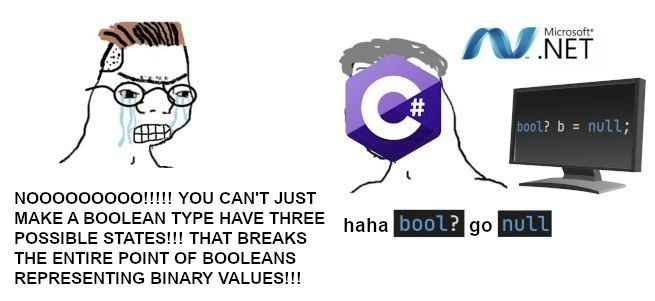
On the left side of the meme, we have the crying Wojak character (the nerdy, bespectacled cartoon often used to represent an upset or purist developer) screaming in all caps:
Purist Wojak: “NOOOOOOOOOO!!!!! YOU CAN’T JUST MAKE A BOOLEAN TYPE HAVE THREE POSSIBLE STATES!!! THAT BREAKS THE ENTIRE POINT OF BOOLEANS REPRESENTING BINARY VALUES!!!”
He’s the binary purist here, essentially saying a boolean must be just 0/1, true/false – anything else is sacrilege against computer science fundamentals. This reaction reflects a common knee-jerk response from someone very tied to the strict definition of a boolean (perhaps imagining the two states like a light switch that can only be on or off). In programming culture, we sometimes encounter folks who insist on theoretical purity (“a bool means two and only two values!”) or who are aghast at language features that bend the rules.
On the right side, we see the confident Chad character with a big C# logo for a head, standing alongside the Microsoft .NET logo. He calmly replies in lowercase, very chill:
Chad C#: “haha
bool?gonull.”
Chad is the embodiment of the C# language (and the .NET platform) being proud of its feature. The phrase “haha bool? go null” is a play on the Chad meme vernacular – minimalistic and smug. It’s like he’s saying, “Oh, you have a problem with three-state booleans? Too bad, we did it anyway 😎.” The code on the monitor next to him, bool? b = null;, is basically flexing this feature: in C#, you can literally assign null to a boolean if you declare it as a bool? (nullable bool).
This is poking fun at real debates in programming. C# introduced nullable value types back in the mid-2000s to address practical needs. In everyday development (especially with databases or configurations), you often encounter scenarios where a boolean value might be unknown, not applicable, or not yet set. For example, “Has the user completed their profile? True/False… or maybe we don’t know because they just signed up and haven’t answered.” Traditionally, if a language only has plain bool, you’d have to resort to clunky solutions: maybe use a special sentinel value or an extra separate flag like isSet. C#’s solution was to bake in a shorthand T? for any value type T, meaning “this is a T that can also be null.” It’s a language feature aimed at better type safety: the compiler knows b might be null and will usually force you to check for that before treating it as a normal bool. In the meme, Chad’s rejoinder “bool? go null” is basically saying “Why limit ourselves to two states? We’ve got a built-in way to have a third one (null) when needed.”
For seasoned developers, this meme is hilarious because it exaggerates a common tug-of-war between theoretical purity and practical design. The Wojak’s despair (“you can’t do that!!!”) echoes things we’ve heard in language wars or code reviews. Indeed, by a strict definition, a Boolean is binary. But C# (and many other modern languages or systems) chose pragmatism. This doesn’t “break” booleans so much as extend them in a controlled manner. The purist might worry: “Doesn’t a tri-state boolean make logic more complicated?” – and it’s true, you now have to handle the case where the bool is null. But the benefit is clarity when a value is not available. Seasoned C# devs know that bool? isn’t a bug or hack; it’s an intended type system design choice. In fact, the C# team (Microsoft) put a lot of thought into it. The alternative was the pattern of using separate variables or magic values, which often led to bugs. By incorporating nullability into the type, DotNet made the “unknown” state explicit.
From an experienced perspective, the meme also references a bit of history and culture:
- Back when C# introduced this, some programmers from other languages (like Java or C++) were surprised or skeptical. Java at the time only had primitive
boolean(no null allowed) or the Boolean object wrapper (which could be null but was less elegant). C++ has no built-in nullable primitive bool either. So C#’s approach was relatively novel in mainstream languages. It triggered debates about whether this was good design or not. - The Microsoft .NET philosophy has often been about developer productivity and language innovation (they added generics, LINQ, async/await, etc.). Nullable value types solved real problems (e.g., working with databases where a boolean field can be NULL in SQL). An experienced dev reading the meme might chuckle, remembering heated discussions on forums about “null is evil” vs “null is necessary”. The Chad figure here solidly falls on the side of “it’s necessary and we handled it, deal with it.”
- There’s also the humorous dynamic of the wojak_chad_meme format: the left is drawn with tears, shaking in anger (labeling him like an old-school or rigid thinker), and the right is the unfazed cool dude. It mirrors conversations we’ve all seen: one dev yells “You’re violating the sanctity of boolean algebra!” and the other goes “Lol, ship it, it works.” The “haha bool? go null” line even sounds like a meme catchphrase (akin to the “haha X go brrrr” meme style), emphasizing how unbothered C# is about this purist concern.
In essence, the senior-level joke here is about language quirks and the divide between theory and practice. It’s funny because booleans are like the simplest data type we learn, so the idea of giving bool a “bonus state” feels cheeky. C# unapologetically ignores the pedantry – and many devs actually love that, because it makes their life easier. The “binary purist” loses his mind, which is an over-the-top representation of that one team member or commenter who will insist “null bools are wrong!”. Meanwhile, the rest of us (Chad .NET included) smirk because, well, it’s already a normalized feature and we’ve probably used it to solve real problems. The meme perfectly captures that “pragmatic engineering vs. theoretical correctness” conflict, with a big wink to static typing enthusiasts. It’s a classic case of Developer Humor where the punchline is a language feature that overturns an expectation: Booleans aren’t strictly binary when real-world needs say otherwise. And the .NET Chad is totally okay with that.
Level 4: The Third Truth Value
In classical logic and CS fundamentals, a Boolean is binary: either True or False, with nothing in-between. This is known as the law of the excluded middle – a principle stating there’s no third truth value. Computer science built a lot on this idea: a bit is 0 or 1, a circuit is on or off, a condition is true or false. However, not all systems stick strictly to two. There’s a concept of three-valued logic in academia (pioneered by logicians like Łukasiewicz and Kleene) that introduces a third state often interpreted as Unknown or Undefined. In a truth table for a three-valued logic, you might see outcomes like “True AND Unknown = Unknown” – the uncertainty propagates. Real-world computing examples of this include SQL’s boolean logic, where a comparison with a NULL yields “unknown” (neither true nor false).
C#’s bool? is effectively embracing this ternary logic idea. Formally, bool? means the type is “bool or null”, which you can think of as the union {"True", "False", "Null"}. In type theory terms, it’s akin to an Option type (Option<bool>) or a Maybe monad – you have a boolean that might not actually be there. This is done in a type-safe way: under the hood the .NET runtime represents Nullable<bool> as a structure containing a regular bool plus a flag indicating if a value is present. So it’s not that a single bit magically holds three values; rather, the system packs an extra bit to signal “no value”. The language’s type system is extended to understand this pattern, ensuring you handle the null case explicitly rather than accidentally treating null as just false.
It’s interesting how this breaks the simplistic definition of a boolean yet aligns with a well-defined logical system. In formal semantics, adding a null is like adding a special “bottom” value to the domain of discourse. You could imagine a proof system where every boolean expression might also yield an “undefined” result if some part is undefined – that’s exactly what nullable booleans allow. Even digital hardware has a hint of this: there’s a notion of a tri-state in circuits (high, low, and high-impedance/disconnected) which isn’t exactly a third truth value, but it shows that beyond the ideal binary, engineers manage a third condition to indicate “no signal.” In software, the motivations are usually practical: representing incomplete data or optional values. Decades ago, Tony Hoare dubbed the unchecked null reference “the billion-dollar mistake” because of countless bugs, but here C# is using null deliberately and safely through its type system. What looks at first like heresy to binary purists (a boolean with three states?!) is actually backed by sound logic and a desire for safer, clearer code. The meme humorously highlights this collision of pure theory with pragmatic language design.
Description
This meme uses the 'NOOOO... haha X go brrr' format to contrast theoretical purity with pragmatic language design. On the left, a crying and angry Wojak character, representing a computer science purist, yells: 'NOOOOOOOOO!!!! YOU CAN'T JUST MAKE A BOOLEAN TYPE HAVE THREE POSSIBLE STATES!!! THAT BREAKS THE ENTIRE POINT OF BOOLEANS REPRESENTING BINARY VALUES!!!'. On the right, a calm, chad-like character with the C# logo for a head stands next to the Microsoft .NET logo and a monitor displaying the code 'bool? b = null;'. His simple, dismissive reply is 'haha bool? go null'. The joke centers on C#'s introduction of nullable value types, specifically 'bool?'. While a standard boolean can only be 'true' or 'false', a nullable boolean can also be 'null', creating a third state. This feature is immensely practical for representing unknown or uninitialized values, especially when mapping to database fields, but it amusingly violates the strict binary definition of a boolean from a purely theoretical standpoint
Comments
7Comment deleted
In theory, a boolean is true or false. In practice, it's true, false, null, and sometimes 'false' as a string from a legacy API that you have to defensively code against
Nullable<bool> is Schrödinger’s feature flag - simultaneously on, off, and “PM hasn’t decided” until someone eagerly calls .Value and the wavefunction collapses into an InvalidOperationException
After 20 years of arguing that null is a billion-dollar mistake, we've decided the real solution is to make it a first-class citizen in our type system and let junior devs discover why FileNotFound should've been a valid boolean all along
Ah yes, the existential crisis every C# developer faces when they realize `bool?` isn't just a boolean with commitment issues - it's Schrödinger's boolean. True, false, and 'I haven't decided yet.' Nothing says 'enterprise-grade type safety' quite like needing to check if your truth value exists before checking if it's true. At least in SQL we've been living with three-valued logic since the 70s, but sure, let's act surprised when .NET does it. Next you'll tell me that `0`, `null`, `undefined`, `NaN`, and empty string aren't all the same thing in JavaScript
bool? is how SQL snuck three-valued logic into C# - now every code review says 'please use if (flag == true)' and your test matrix quietly triples
bool? in C#: the only flag where false means off, true means on, and null means “we’ll coalesce later” - proof that once you touch a database, boolean logic becomes optional
C#'s bool?: true, false, or 'the ORM decided for you today'