Skip to content
DevMeme
1188 of 7435
Compiler's Opinion on Meticulous Documentation
Documentation Post #1327, on Apr 18, 2020 in TG

Compiler's Opinion on Meticulous Documentation

Why is this Documentation meme funny?

Level 1: Robot Doesn't Read Letters

Imagine you write a long letter full of instructions and funny notes for your toy robot, explaining how to clean your room. You give it to the robot, but the robot just whirrs and does its own thing without even looking at your words. It can’t read your letter at all. All those helpful notes you wrote turned out to be only for people, not for the robot. This meme is just like that: the programmer writes lots of comments (like a detailed letter) to explain the code, but the computer ignores them completely. It’s funny because the programmer tried so hard to help, and the computer doesn’t notice at all.

Level 2: For Human Eyes Only

Let’s break this down in simple terms. A compiler is a program that takes the code you write in a programming language (like C++ or Java) and translates it into something the computer can actually run (machine code or bytecode). Now, within our code, we often write comments or documentation notes. These are special pieces of text that are meant only for other humans reading the code. For example, in many languages you can start a comment with // or #. Anything on that line after those symbols is completely ignored by the compiler. You could write // This part adds two numbers above a line of code, and the compiler will act like that comment isn’t even there. Comments are there to explain, clarify, or remind humans about what the code is doing; they do not tell the computer to do anything.

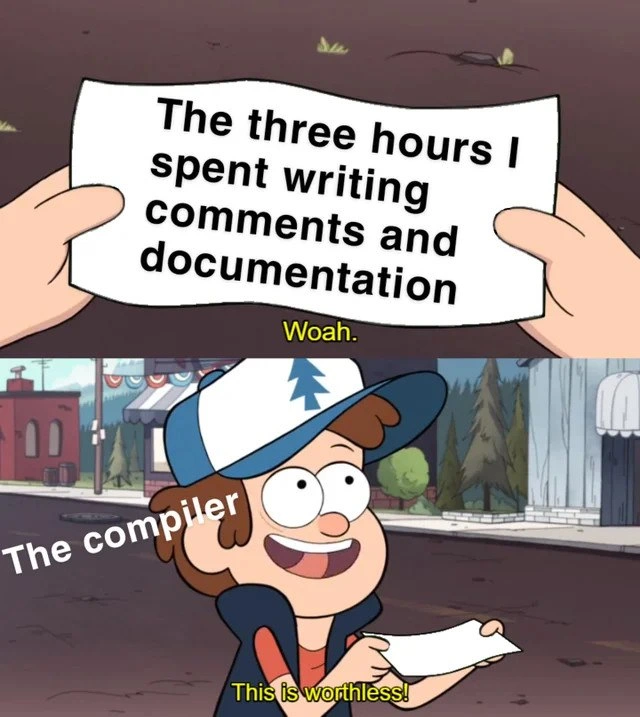
In the meme’s two-panel cartoon, the top panel shows a pair of hands holding a piece of paper that says “The three hours I spent writing comments and documentation.” The person holding it is amazed – captioned with “Woah.” – because that represents a lot of effort put into writing helpful notes in the code. The bottom panel shows a cartoon boy, labeled “the compiler,” literally tossing that paper away. He’s smiling and saying “This is worthless!” in the subtitle. This visual gag perfectly illustrates what happens during compilation: no matter how long you spent writing those lovely comments and docstrings, the compiler throws them out without a second thought. It’s not being mean; it’s just following the rules – the compiler only processes actual code, not the human explanations around it.

To a new developer, this highlights a funny truth: you can write a whole essay inside your source code as comments, and it won’t change how your program runs at all. For instance, check out this tiny Python example:

# This line is a comment explaining the next line
print("Hello, world!")  # This comment won’t affect the output

If you run this code, you’ll simply get:

Hello, world!

The two comment lines (one full-line comment and one at the end of the print line) don’t alter the behavior or output. The Python interpreter (and similarly, compilers for other languages) completely skips over them. The only way anyone ever sees those comments is by reading the code file itself.

The humor of the meme is in the mismatch of importance: you (the developer) might treat those comments and docs as crucial guides – spending hours to get them right – but the compiler doesn’t utilize them at all. It’s a one-way conversation. The computer program compiles and runs exactly the same with or without your three hours’ worth of documentation. Only human beings – maybe your teammates or your future self when revisiting the code – will benefit from that effort. In short, comments are for human eyes only, and the compiler acts like they’re not even there. The meme is poking fun at that reality by showing the compiler character literally discarding the documentation paper as “worthless” in terms of running the code.

Level 3: The Indifferent Compiler

This meme makes experienced developers smirk because it captures a classic disconnect: the compiler doesn’t give a single byte about your beautiful documentation, while humans (like your teammates or future self) desperately do. In the top panel, we see the proud display of “the three hours I spent writing comments and documentation” – a developer’s hard-won effort to improve code quality and clarity. The bottom panel labels the smiling boy as “the compiler” casually discarding that paper and declaring “This is worthless!”. It’s a humorous exaggeration of reality: no matter how extensive or eloquent your code comments are, they won’t make your program run any faster, slower, or differently. The compiler’s job is to translate code into executable form, and by design it ignores comments completely, treating them as if they don’t exist. From a machine’s perspective, comments are literally worthless – they carry no operational meaning.

Every seasoned coder has felt this pinch. You might pour your heart into writing a detailed docstring or clarifying comment, and the app still compiles to the exact same binary as it did before. There’s no special credit from the computer for well-documented code. This leads to a kind of dark comedy in programming culture: we value good documentation for humans, yet the tools that execute our code show zero acknowledgment of that effort. It’s like spending time cleaning a restaurant’s kitchen meticulously; the food tastes the same, but the chefs who come in next shift will appreciate it – not the stove or the ingredients. In our world, the stove is the compiler, and it doesn’t care if the recipe was written in elegant prose or not at all.

The meme format nails this feeling using the Gravity Falls reference: one moment of awe (“Woah.” at the amount of documentation) followed by utter dismissal (“This is worthless!”). It’s the compiler_ignores_comments gag in a nutshell. This trope resonates with developers who have seen perfectly working codebases that are completely comment-free (the computer chugs along happily) versus codebases where someone painstakingly documented every function (the computer still chugs along exactly the same). The humor cuts a bit deep: commenting can feel like a thankless task. You don’t get immediate, tangible rewards because your program’s output doesn’t improve or change – hence the sly tag DocumentationWoes. And yet, we all know those comments can be a lifeline when debugging or ramping up on that project later. The compiler’s indifference doesn’t mean the documentation is truly worthless; it just means the payoff is delayed and human-centric. In fact, the very absurdity of a compiler tossing away knowledge highlights why writing docs is an act of altruism: you’re doing it purely for human benefit, not because any toolchain mandates it.

There’s an unwritten shared experience here too: trying to convince stakeholders or fellow devs to allocate time for documentation. “Why spend extra hours if it doesn’t affect the product’s behavior?” is a common refrain. The meme’s answer, dripping with sarcasm, is the visual “the compiler doesn’t care” – implying that if we only code for what the compiler cares about, we’d never comment anything. It exposes the tension between just-get-it-working mentality and make-it-understandable best practices. Also, any programmer who’s ever forgotten a */ in a comment and had the compiler freak out with errors can appreciate the irony: the one time the compiler does notice your comment is when you screw up the syntax! Aside from such cases, you could fill your source with a novel’s worth of commentary and the compiler would still optimistically compile “Hello World” as if no soulful exposition accompanied it. That absurd one-sided relationship – where you communicate passionately and the compiler just silently filters it out – is exactly what makes this meme both funny and a tiny bit painful.

Level 4: AST Apathy

At the heart of compiler design, comments are treated as ghosts in the machine – present in the source text, but evaporating before any serious work gets done. When you feed your well-documented code to a compiler, the first stage it hits is often lexical analysis (the lexer). Here, the code is chopped into tokens (identifiers, keywords, operators, etc.), but any token that looks like a comment (for example, starting with // or enclosed in /* ... */) is immediately recognized as “non-code” and effectively thrown out. This is why in the meme, the sheet of carefully written documentation is literally tossed aside. The compiler’s abstract syntax tree (AST) – a structured map of your program’s logic – has no nodes for comments. Comments are deliberately omitted from the AST because they carry no semantic weight in how the program runs. They’re like friendly no-ops: bits of text that do nothing, influence nothing, and vanish from the compiled output.

This isn’t a bug or a rude personality quirk of compilers; it’s by design. In formal language specifications (like for C++ or Java), the grammar often explicitly defines comment syntax and then says, “and then ignore it.” The compilation process is optimized to focus only on what actually produces machine instructions. By the time the compiler is optimizing your code or generating machine code, it’s as if those // comments never existed at all. If you were to examine the compiled binary or bytecode, you’d find zero traces of your documentation – not a single character of your comments makes it into the executable. The compiler doesn’t just figuratively not care; it literally cannot care about comments because it doesn’t even keep them around long enough.

Interestingly, some advanced tooling will separate documentation from code via special conventions, but even those don’t change the compiler’s apathy. For instance, Javadoc-style comments in Java (/** ... */) or Python’s triple-quoted docstrings are intended for documentation generators or runtime help, not for the compiler to enforce any logic. They might be stored in a separate structure for introspection or documentation purposes, but as far as the program’s execution goes, they could be entirely absent. In other words, to the part of the system that runs your code, all that painstaking documentation is just whitespace. The meme nails this concept with humor: three hours of comments are as good as invisible to the rigorous, algorithmic eyes of the compiler’s parser.

Description

A two-panel meme from the animated show 'Gravity Falls'. In the top panel, a pair of hands holds up a piece of paper with the text: 'The three hours I spent writing comments and documentation'. A small caption below it reads 'Woah.'. In the bottom panel, the character Dipper Pines, labeled 'The compiler', looks at the paper with a cheerful expression and exclaims, 'This is worthless!'. The meme humorously illustrates the fundamental truth that compilers and interpreters ignore comments and documentation, as their sole purpose is to process executable code. While crucial for human understanding, collaboration, and maintainability, all the effort put into writing them is stripped away and has no bearing on the final compiled program, making it 'worthless' from the machine's perspective

Comments

7
Anonymous ★ Top Pick Documentation is like a ghost whispering secrets to the next developer. The compiler, however, is a devout skeptic
  1. Anonymous ★ Top Pick

    Documentation is like a ghost whispering secrets to the next developer. The compiler, however, is a devout skeptic

  2. Anonymous

    I spent half a sprint crafting pristine Javadoc; the compiler inlined the method, the optimizer dead-stripped the class, and now the only thing reading my eloquent prose is git blame

  3. Anonymous

    The compiler treating your documentation like it's worthless is actually the kindest code review you'll get all week - at least it doesn't leave passive-aggressive comments about your architectural decisions from 2019

  4. Anonymous

    This perfectly captures the existential crisis of documentation: you spend hours crafting beautiful comments explaining your elegant algorithm, complete with complexity analysis and edge case handling, only to watch the compiler strip it all away in milliseconds during preprocessing. The compiler doesn't care about your carefully worded explanations of why you chose O(n log n) over O(n²) - it just wants semicolons and braces in the right places. Yet we persist, because six months from now, *you* will be the one desperately searching for those comments, cursing your past self for not documenting that 'clever' bit manipulation hack. The compiler may find it worthless, but Future You will find it priceless

  5. Anonymous

    The compiler doesn’t read your docs; the postmortem does

  6. Anonymous

    Compilers read your code like a speed-reader skimming comments: straight to the syntax, zero empathy for your prose

  7. Anonymous

    The optimizer does dead-comment elimination; pity the 3am human runtime lacks that pass

Use J and K for navigation