Architectural Health Standards: SOAP and REST for Pandemics
Why is this API meme funny?
Level 1: Wash Your Hands and Rest
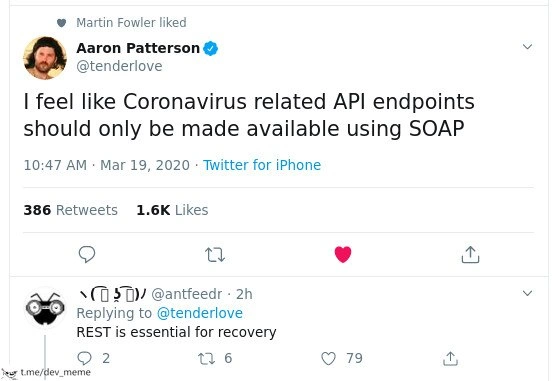
This joke is funny on a very simple level because it uses two words that have double meanings in different worlds. In normal life, soap is what you use to wash your hands and stay clean, and rest is what you need when you’re sick to get better. At the same time, in the programming world, SOAP and REST are names of two ways that computers talk to each other over the internet. The tweet is basically playing with those words: it’s as if someone said, “For anything about the coronavirus, make sure to use SOAP,” and someone else replied, “REST is essential to recover.” To a regular person, that just sounds like health advice (use soap and rest up!), but to a programmer it also humorously means “use the SOAP method for the API, and remember the REST method is important too.” It’s like a little inside joke where a serious health tip is perfectly phrased using tech jargon. Even if you don’t know the tech side, you can chuckle because it literally echoes the safety mantra of the pandemic – wash your hands and get rest – but if you do know the tech terms, it’s a clever crossover that makes you grin and think, “Ha! I see what they did there.”
Level 2: Not That Kind of SOAP
Let’s break down the buzzwords for those newer to the API world. An API endpoint is just a URL or address where one application can request data or services from another. In the 2000s, enterprises often built APIs using SOAP (Simple Object Access Protocol). Despite its friendly name, SOAP is a rather bulky way for applications to communicate. It always wraps messages in XML (a structured text format) and follows strict rules defined in a WSDL contract (basically a formal blueprint describing what the service can do). You can imagine SOAP like sending a very official, formatted letter – with a specific envelope and paperwork – every time you ask a server for something. It’s powerful and standardized, but a bit overkill for many tasks.
On the other hand, REST (Representational State Transfer) is a later approach that turned out to be simpler and more in tune with how the Web itself works. REST isn’t a specific protocol but an architectural style for designing networked applications. In practice, “using REST” means building your API to use standard HTTP methods (GET, POST, etc.) and URLs to represent data resources. Instead of XML, responses are often in JSON (a lighter weight data format) or plain data. If SOAP is the formal letter, a RESTful API call is like a quick conversation or a text message – more concise and using common language. For example, with a REST API you might get COVID-19 stats by simply calling a URL like https://api.example.com/covid/stats?country=USA and get back a tiny JSON snippet. With a SOAP API, you’d send a big XML envelope to an endpoint, and get an XML envelope back.
Now, the joke in the tweet makes use of the fact that “soap” and “rest” mean other things in everyday English. When there’s a virus going around, what does every health guideline say? “Use soap (wash your hands) and get plenty of rest!” So Aaron Patterson’s tweet tongue-in-cheek suggests: if you make an API about the coronavirus, only do it with SOAP (the tech). It’s a goofy literal twist – as if the computer system could be kept virus-free by using SOAP, just like people use soap to kill germs. The reply comes back with “REST is essential for recovery,” which reads like health advice (you need rest to recover) but in context also means “don’t forget RESTful APIs are crucial.” This back-and-forth is poking fun at a long-standing discussion in programming: SOAP vs REST – which is better for web services? For a newcomer, think of it like the tech equivalent of debating Coke vs Pepsi. Both have their fans, but these days REST is the more popular choice for APIs, considered more modern and easier to work with. That’s why it’s especially funny – hardly anyone was seriously proposing new SOAP APIs in 2020, so the tweet is clearly a joking reference.
This meme snapshot came from Twitter, a hotspot for developer humor and wordplay. In tech communities (on Twitter, Stack Overflow, Reddit, etc.), you’ll often see folks make light of serious topics with puns or jokes only insiders fully get. Here, the community was in the thick of pandemic anxiety, and weaving coronavirus puns into tech talk became a way to cope and share a laugh. The participation of well-known figures (the screenshot even notes Martin Fowler liked this) shows how the joke resonated from junior devs to veteran architects alike. It’s educational in its own way: if you didn’t know about SOAP or REST, a joke like this nudges you to ask, “Wait, what do they mean by SOAP? And why is that funny?” – leading you to learn about these API approaches. And if you do know the context, it’s a gem of a pun that combines software engineering knowledge with everyday common sense advice. In short, not only do you get a chuckle, you also subtly revisit the basics of API design best practices (keep things clean and RESTful!) while feeling part of a witty dev community moment.
Level 3: Cleanliness Is Next to RESTfulness
This meme mashes up a classic API design debate with pandemic humor in a way senior developers find brilliantly layered. In a tweet from March 2020 (the early COVID-19 outbreak), developer Aaron Patterson quips that “Coronavirus related API endpoints should only be made available using SOAP.” This immediately hits two registers for experienced devs: SOAP is an old-school web service protocol (more on that in a moment), and of course plain soap is what everyone was obsessively using to wash hands and kill the virus. The tweet cleverly suggests quarantining any COVID-19 API behind SOAP – as if the protocol itself were a sanitizer. The reply, “REST is essential for recovery,” doubles down on the wordplay: REST in tech refers to Representational State Transfer (a lighter, modern style for APIs), but in everyday terms rest is what sick people need to recuperate. It’s a one-two pun punch that had seasoned engineers smirking and nodding in appreciation.
On the technical side, this joke pokes fun at the long-running SOAP vs REST saga in web services. SOAP (Simple Object Access Protocol) is anything but simple in practice – it’s a heavyweight XML-based protocol that was a staple of enterprise systems in the early 2000s. SOAP uses an explicit envelope structure for messages, a rigid contract via WSDL (Web Services Description Language), and a stack of WS-* standards for things like security and transactions. In essence, a SOAP call wraps your data in a thick, soapy XML bubble every time you invoke an API. For example, a SOAP request to get virus data might look like:
<!-- SOAP: heavy-duty request format -->
<soapenv:Envelope xmlns:soapenv="http://schemas.xmlsoap.org/soap/envelope/">
<soapenv:Body>
<GetCovidStats>
<Country>USA</Country>
</GetCovidStats>
</soapenv:Body>
</soapenv:Envelope>
By contrast, REST is an architectural style defined by Roy Fielding’s dissertation around 2000, embracing the simplicity of HTTP. A RESTful request for the same info would be much leaner, often just a URL and query parameter, for example:
GET /covid/stats?country=USA HTTP/1.1
Host: api.example.com
Seasoned developers immediately recognize the humor in Patterson’s tweet because suggesting new COVID-19 APIs use SOAP is playfully absurd. By 2020, nearly everyone favors REST (or JSON-based HTTP APIs) for web services due to its simplicity and lower overhead. Recommending SOAP — with all its verbose XML and enterprise ceremony — for a fast-moving pandemic dataset is like saying “let’s handle this urgent problem with the most bureaucratic tool possible.” It’s tongue-in-cheek advice that riffs on the word soap as a lifesaver during a pandemic, while also poking at SOAP’s notoriety for over-engineering. The reply about REST being “essential for recovery” not only echoes medical wisdom (get plenty of rest) but slyly implies that RESTful design is the cure for cumbersome APIs. Together, they turn a bitter tech debate into a friendly joke: the SOAP vs REST rivalry momentarily set aside for a bit of pandemic pun.
What really sells the joke in developer communities is the context and who’s involved. The Twitter exchange format is familiar territory for dev humor – a place where insiders share quips that outsiders might miss. The fact that renowned software architect Martin Fowler liked the tweet (as noted in the screenshot banner) is the cherry on top. Fowler is famous for writing about enterprise patterns and was an early observer of the SOAP-to-REST shift; his appreciation signals that the joke nailed a truth of the industry. Indeed, the humor works on multiple levels: it’s a play on words, an allusion to real-world health advice, and a nod to the history of web service design. In one line, it manages to reference how we sanitize APIs (quite literally, with SOAP) and how we ensure resilience and healing (with REST). For veteran developers, it’s a delightful reminder that sometimes our esoteric tech debates can intersect perfectly with real life – yielding a joke so apt that you can’t help but laugh and maybe groan a little. After all, who knew enterprise integration patterns could mix with epidemiology so well?
Description
A screenshot of a Twitter conversation between prominent software developers. The main tweet is by Aaron Patterson (@tenderlove) and is liked by Martin Fowler. It reads: 'I feel like Coronavirus related API endpoints should only be made available using SOAP'. This is a pun, playing on the word 'SOAP' (the API protocol) and its literal meaning of soap for handwashing, a key public health measure during the COVID-19 pandemic. Below it, a user named '@antfeedr' replies, 'REST is essential for recovery'. This continues the joke, punning on 'REST' (the API architectural style) and the need for physical rest to recover from illness. The humor is layered, appealing to senior developers who understand the technical history and debate between the older, more verbose SOAP protocol and the more modern, lightweight REST style
Comments
7Comment deleted
A SOAP API for a pandemic seems appropriate. The WSDL would be so complex and the XML so verbose, it would enforce social distancing by preventing any two systems from getting close enough to communicate efficiently
We resolved the “SOAP for hygiene vs REST for recovery” debate the enterprise way - by putting a REST adapter behind a SOAP façade in front of a GraphQL gateway. Now every call is squeaky clean, well-rested, and contagiously high-latency
The only time in my career where implementing SOAP actually improved system health metrics
Ah yes, the classic architectural debate: should we use REST for recovery or SOAP for sanitization? In March 2020, we learned that while SOAP might be better for handwashing, REST is still the preferred protocol for most APIs - though both require proper error handling when dealing with 503 Service Unavailable responses from overwhelmed healthcare systems. At least with SOAP you get built-in WS-Security, which is more than we can say for the initial contact tracing APIs
SOAP for COVID endpoints: the only time I’ve tolerated XML bloat in the name of hygiene. Recovery’s REST - idempotent PUT on /health, because retries shouldn’t make you “more recovered.”
SOAP-only pandemic endpoints are peak enterprise: nothing like a WSDL to flatten the curve of developer productivity - REST is the only low-latency path to recovery
SOAP prevents endpoint infections; REST just aids recovery - true architectural immunity